Our statement on the 2023-24 Pennsylvania State Budget |
|
Late in the evening on July 5, the Pennsylvania House of Representatives passed the first state budget since Commonwealth Court declared our public school funding system unconstitutional. It included a 7.8% increase in Basic Education Funding for public schools (keeping pace with inflation), $100 million for the most underfunded districts through the Level Up supplement, a significantly smaller increase than last years’ boost for special education, and no dedicated funds for school facilities.
The passed budget, when signed and enacted, will not include a program that has dominated budget negotiations: a proposed $100 million school voucher program, supported by the State Senate Republican leadership and Governor Shapiro, that would divert taxpayer funds to private schools. Governor Shapiro has promised that he will veto the provision for the voucher program after it became clear that the Democratic House of Representatives would not pass it.
We thank the House of Representatives for recognizing the many ways that school vouchers undermine quality public education. The court’s ruling is clear: the General Assembly has a constitutional mandate to support and maintain a contemporary, effective public education system that is available to every child in Pennsylvania, regardless of their community's local wealth. Sending public funds for education to private schools will not bring us a dollar closer to meeting this charge.
|
|
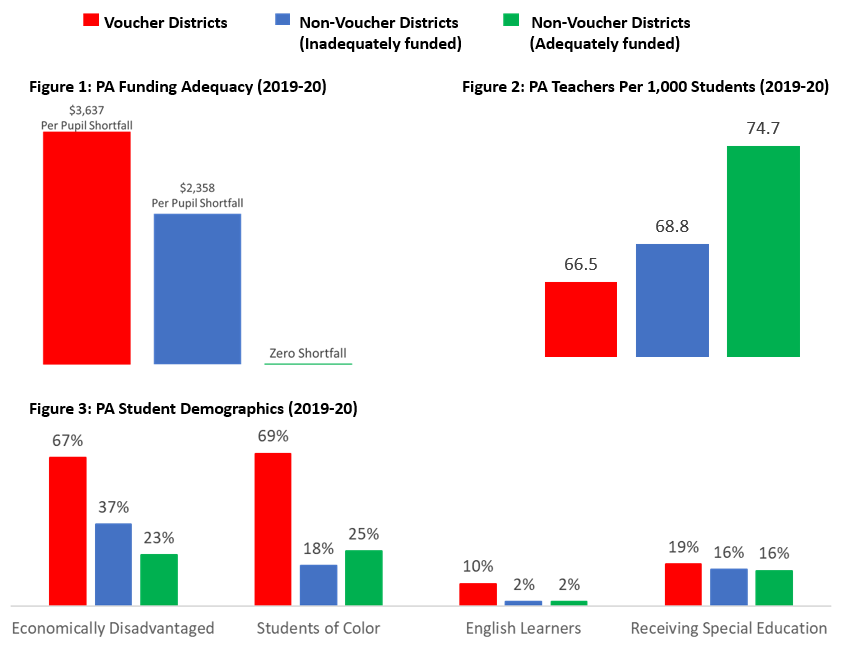
Left: data compiled by Research for Action on the unmet student needs in districts impacted by the proposed voucher program.
Private schools can and do legally shut out students who struggle academically or behaviorally, students whose religious background does not mesh with the schools’ mission, students who “don’t fit in,” and many more. “A religious school can say, sorry, we don’t take gay kids at this school,” our senior attorney Dan Urevick-Ackelsberg told a reporter for Spotlight PA. “Pennsylvania should in no way use public funds to allow discrimination against children.”
We will remain committed to ensuring that school vouchers, which research shows have a negative academic impact on the students that private schools do choose to accept, do not become a reality in Pennsylvania.
Now, the task before us is clear. Over the next six months, as both the Governor and House leadership have promised, the Commonwealth must devise a comprehensive, constitutionally compliant school funding plan to ensure, once and for all, that all children have access to the contemporary, effective system of public education that the constitution mandates, that our children need, and that the decision of the Commonwealth Court requires.
The Basic Education Funding Commission, the bipartisan panel charged with beginning this task, holds its first hearings in York on July 18. Stay tuned for more information as hearings continue throughout the summer.
|
|
School Funding Update: Court denies legislative leaders' motion for post-trial relief
Legislative respondents now have two weeks to file a possible appeal
|
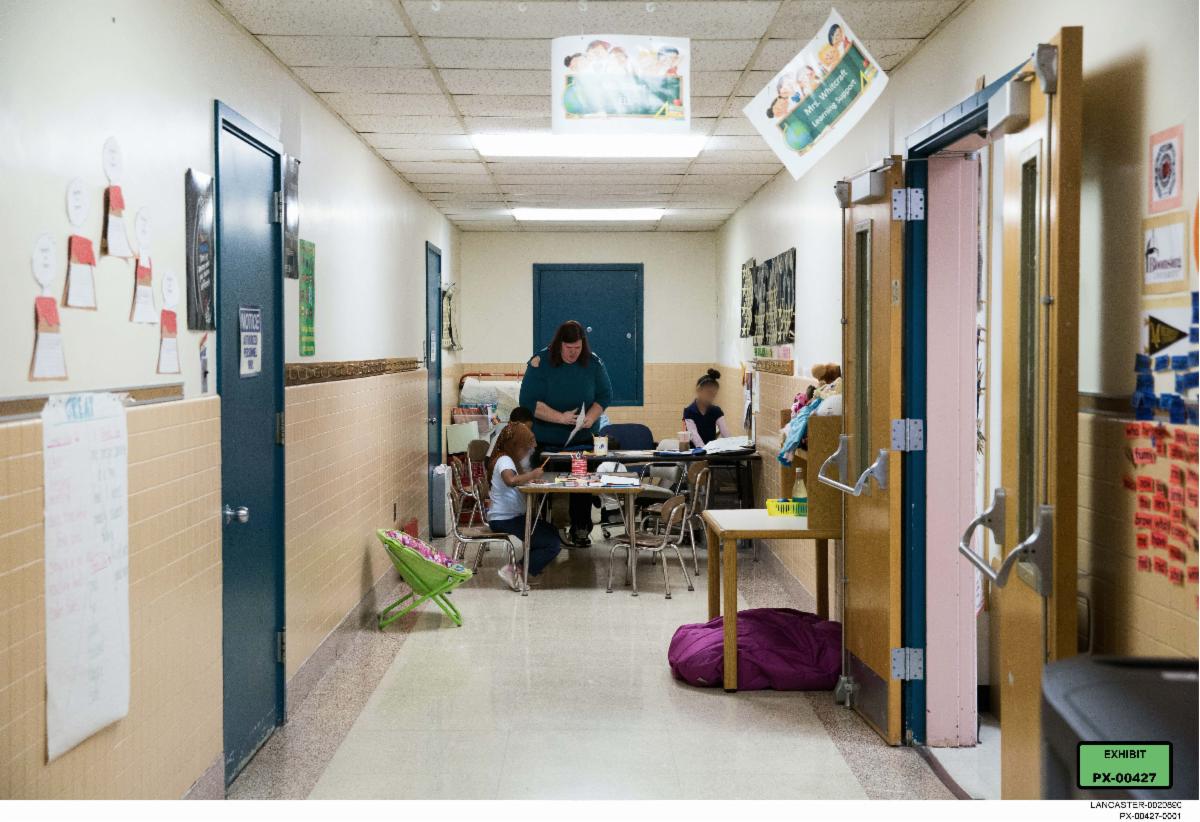
Students learn in a converted hallway classroom in a School District of Lancaster elementary school.
This motion was a required step before any potential appeal to the Pennsylvania Supreme Court. By law, any appeal must now be filed by July 21. The Philadelphia Inquirer covered the ruling. Senate President Ward and Minority Leader Cutler have not yet announced whether or not they intend to appeal.
“This Court now tasks Respondents with the challenge of delivering a system of public education that the Pennsylvania Constitution requires – one that provides for every student to receive a meaningful opportunity to succeed academically, socially, and civically, which requires that all students have access to a comprehensive, effective, and contemporary system of public education,” the opinion reads (emphasis added).
School Funding Press Coverage:
-
The work starts now: It’s time to make Pennsylvania’s education promise a reality | Opinion – PA Speaker of the House Joanna McClinton and our client Superintendent Eric Becoats of William Penn SD, PennLive, 6/4/23
-
Schooled – A three episode podcast series taking an in-depth look at the school funding trial and the communities behind it – WHYY, 6/27/23
-
A look at the trial — and ruling — that could change Pa.’s school funding system forever (Schooled Season 6 episode 2) – WHYY, 6/20/23
-
Otto-Eldred superintendent honored for advocacy, trial testimony – Olean Times Herald, 6/20/23
-
Funding the 500: Closets for classrooms, mold, staffing crisis hurts K-12 students – Pennsylvania Capital-Star, 6/19/23
-
Funding the 500 - A in-depth series on school funding in Pennsylvania and the trial to change it – Pennsylvania Capital-Star, 6/19/23
-
Advocates Look for Budget Increases to Address School Infrastructure in Pa. – Erie News Now, 6/16/23
-
Pa. budget 2023: How a landmark school funding lawsuit is shaping negotiations – Spotlight PA, 6/14/23
|
|
Count Every Vote: We stand up for fair provisional ballots in Delaware County |
On May 25, 2023, we sued the Delaware County Board of Elections for disfranchising three long-time senior voters in Delaware County whose provisional ballots were not counted during the May 16, 2023 primary election.
Provisional ballots are a crucial safety net in our electoral system to ensure that every eligible citizen’s vote should be counted. If pollworkers cannot confirm a voter’s eligibility at the polling place on Election Day—for example, if the voter’s name is not present in the poll book—the voter can fill out and submit a provisional ballot, which can be counted if election officials later determine that the voter is, in fact, eligible. Act 77, Pennsylvania’s 2019 law establishing that any voter may choose to vote by mail, clearly stipulates that a voter whose mail-in ballot was rejected can submit a provisional ballot, which “shall be counted” if county election officials confirm that the voter’s mail-in ballot was not counted.
Joined by co-counsel from the ACLU-PA, we argued that an unpublished and nonprecedential Commonwealth Court opinion cited by the Delaware County Board of Elections did not properly interpret the Election code and should not be applied. On June 12, the Delaware County Board of Elections filed an answer to our petition for review. They confirm that a majority of the Board agrees that, in all fairness, our clients’ provisional ballots should have been counted. However, the Board again referred to the 2020 Commonwealth Court decision, though a majority of the Board agree that the decision was not correctly reasoned and should be reconsidered. Spotlight PA covered the case.
|
|
Get your tickets today!
Our annual event will be held September 20, at the Fairmount Water Works
|
|
Mark your calendars! Join us to celebrate and support our work at the Fairmount Water Works on September 20 for our annual celebration! Tickets and sponsorships are now available - reserve your spot today! Tickets at the early bird price are $175 and $100 for nonprofit friends and colleagues--make sure to take advantage of this advance deal!
This year, we honor those who stand with us to take on gun violence by clearing the roadblocks for local action. We will recognize the people who made our case against firearm preemption possible: our clients, Philadelphia and Pittsburgh residents who have lost loved ones to gun violence; our pro bono counsel Hogan Lovells; and Nancy Bregstein Gordon, founder of CeaseFirePA.
|
|
Our client Stanley Crawford (right) |
|
|
|
Two Philadelphia workers sue to overturn state law banning those with most criminal convictions from working as security guards |
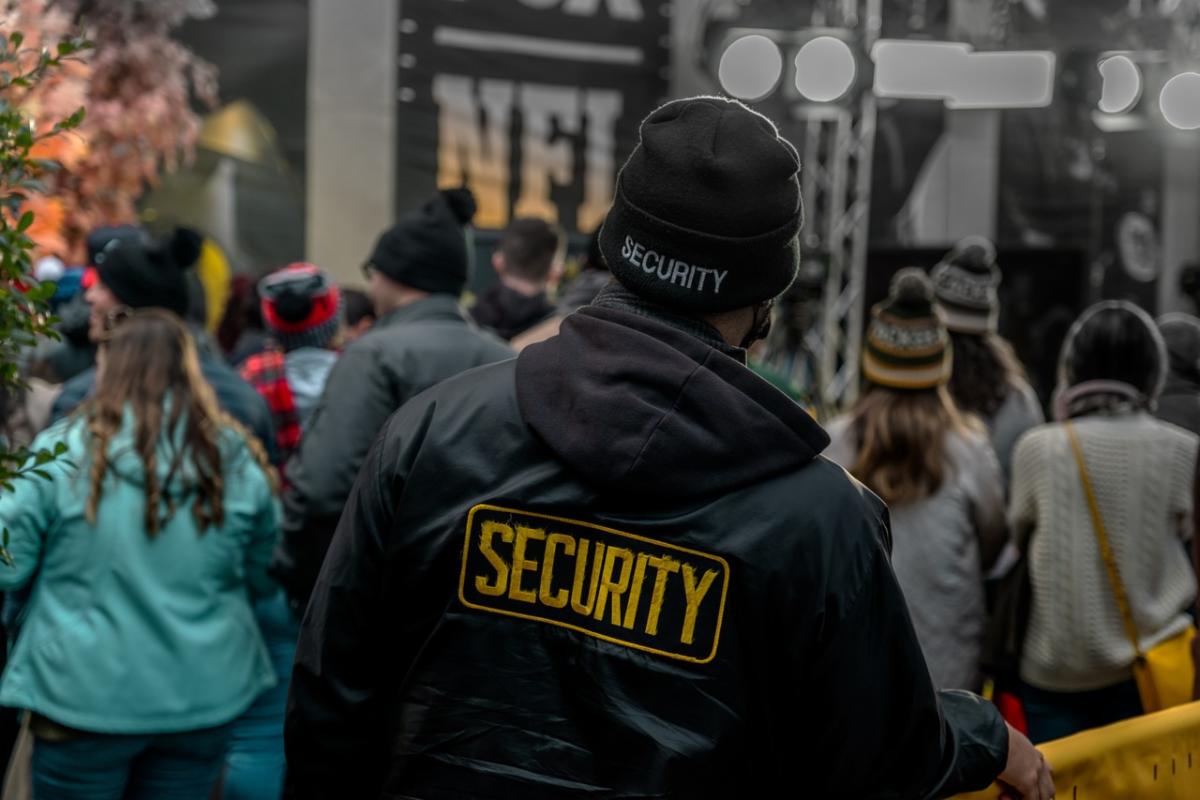
In Pennsylvania, a 70-year-old law, the Private Detective Act, is exacerbating barriers to employment for people with criminal histories by blocking anyone who has ever been convicted of any felony and a long list of misdemeanors from working in security for life, with no exceptions. On June 27th, our clients, two Philadelphia workers who lost their jobs as unarmed security guards due to convictions from more than 15 years ago, sued the Commonwealth of Pennsylvania and Philadelphia District Attorney Larry Krasner, seeking an injunction to block enforcement of the law. We argue that the categorical ban imposed by the law violates our clients’ right to pursue an occupation under the Pennsylvania State Constitution.
We were joined by co-counsel from Community Legal Services. “An antiquated and irrational law is shutting qualified workers out of a growing field of employment for the rest of their lives based on unrelated criminal records,” said Law Center senior attorney Ben Geffen. “We should not impose a life sentence of bias and discrimination in the job market on workers who are seeking to rebuild their lives and contribute to their communities.” The case was covered by the Philadelphia Inquirer.
Criminal history can serve as a steep barrier to employment, and research makes clear that this bias is unwarranted. The risk of recidivism for individuals with criminal history over seven years old falls below the risk of arrest for the people without criminal records. Employment exclusions fall hardest on Black and Latino workers, who face the greatest impacts of over policing, mass incarceration, and employment discrimination.
|
|
We celebrate Philadelphia’s efforts to preserve 88 vulnerable garden parcels by acquiring U.S. Bank liens |
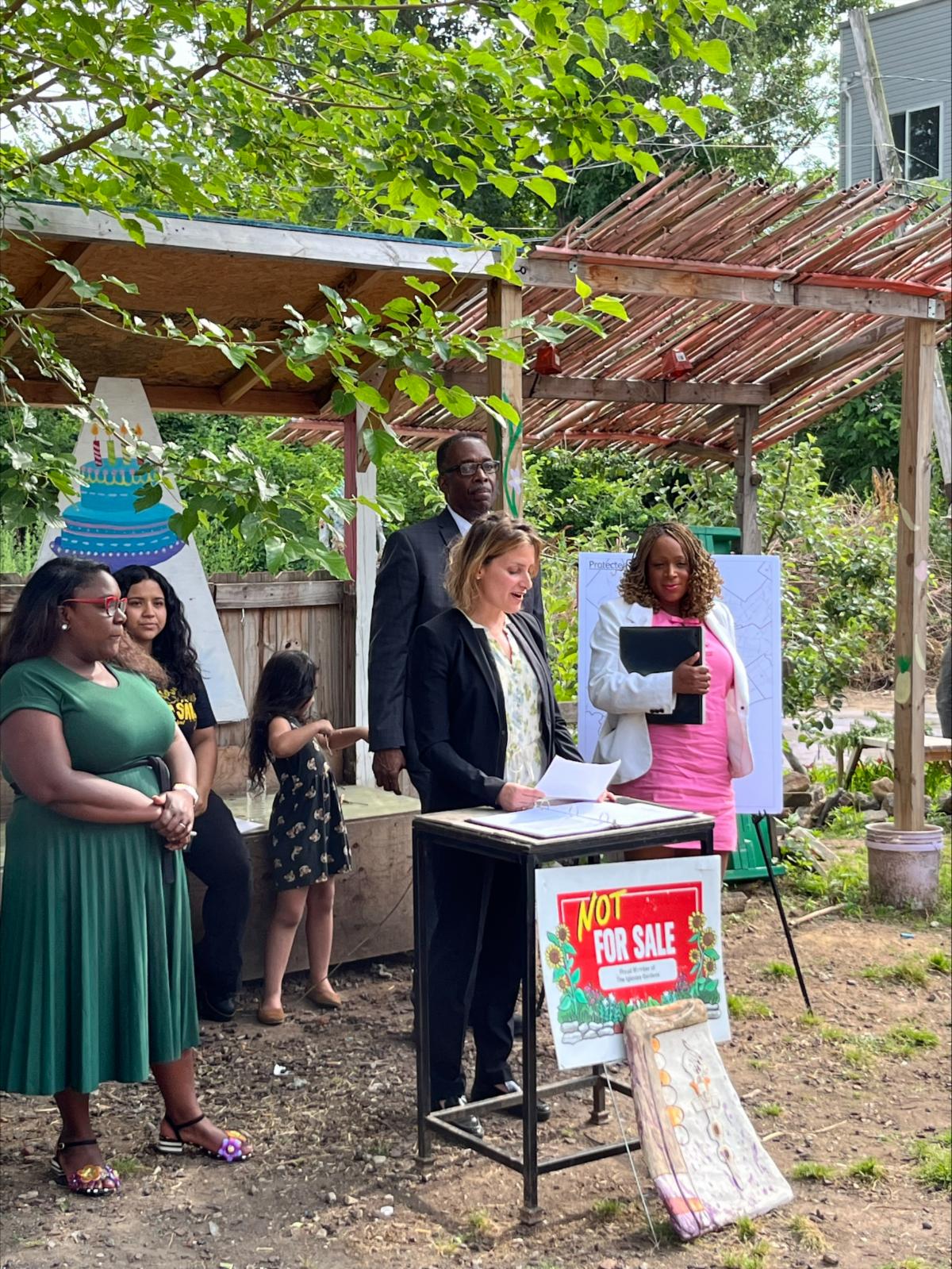
Law Center staff attorney Sari Bernstein speaking at the June 20 press conference in Iglesias Garden
On June 20, 2023, we joined a broad coalition of community gardeners and Philadelphia elected officials to announce that the City of Philadelphia will soon acquire U.S. Bank liens on dozens of community gardens, assuring that these lots are protected from being sold at sheriff’s sale. These privately-held liens have saddled gardens with burdensome third-party debt since the City sold delinquent tax liens in 1997. This major victory for the preservation of green space in the city was covered by WHYY and the Philadelphia Inquirer.
The Law Center has advocated for years for City action to address the threat these liens pose to vital community spaces. We look forward to working with the Land Bank, the Administration and City Council to finish the job by transferring title for these parcels to the longtime garden stewards who have stepped up to care for the land. “Community gardeners revitalize and reclaim abandoned vacant parcels,” Law Center staff attorney Sari Bernstein said, “providing beacons for residents to come together to grow fresh food, seek shade and peace, and for neighbors to gather and play.”
|
|
The Law Center elects new board leadership at our 2023 annual meeting |
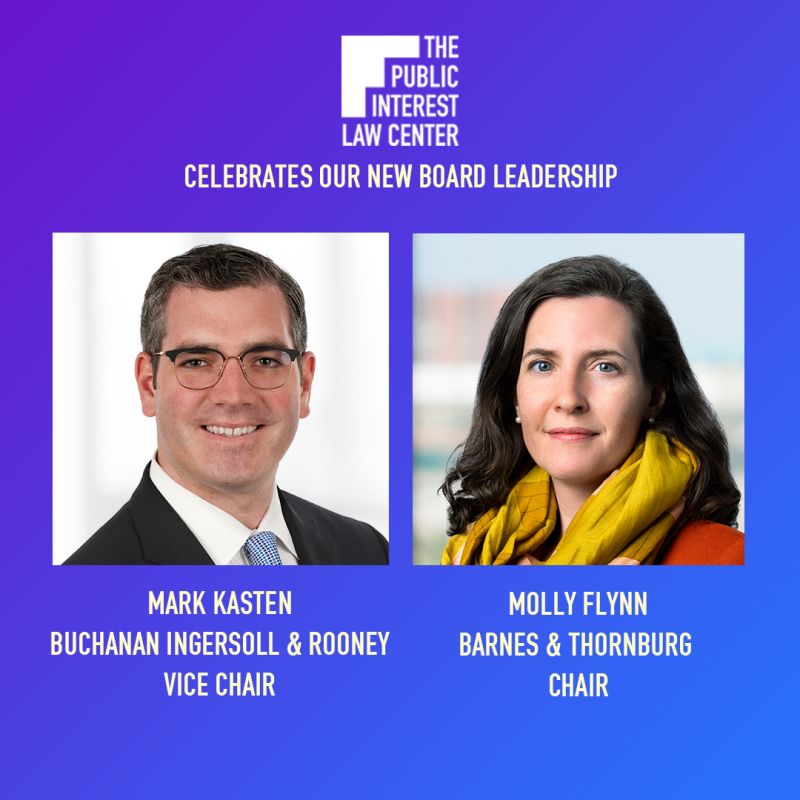
At our May 18, 2023, annual meeting, the Law Center's board of directors elected new leadership. Molly Flynn, a partner with Barnes & Thornburg, was elected Chair. Mark Kasten, counsel with Buchanan Ingersoll & Rooney, was elected Vice Chair. They will each serve two-year terms in their new roles.
“Molly and Mark are brilliant lawyers who are dedicated to building a better future for Philadelphia and Pennsylvania,” said executive director Brenda Marrero. “Throughout their service on the board, they have supported our mission with a deep passion for justice and they have helped all of us at the Law Center provide the best possible advocacy for our clients and the communities we serve. I’m excited to work with them as they lead us through the next chapter in our history.” Learn more and help congratulate them on Instagram!
|
|
Law Center executive director Brenda Marrero named to City & State PA's Law Power 100 |
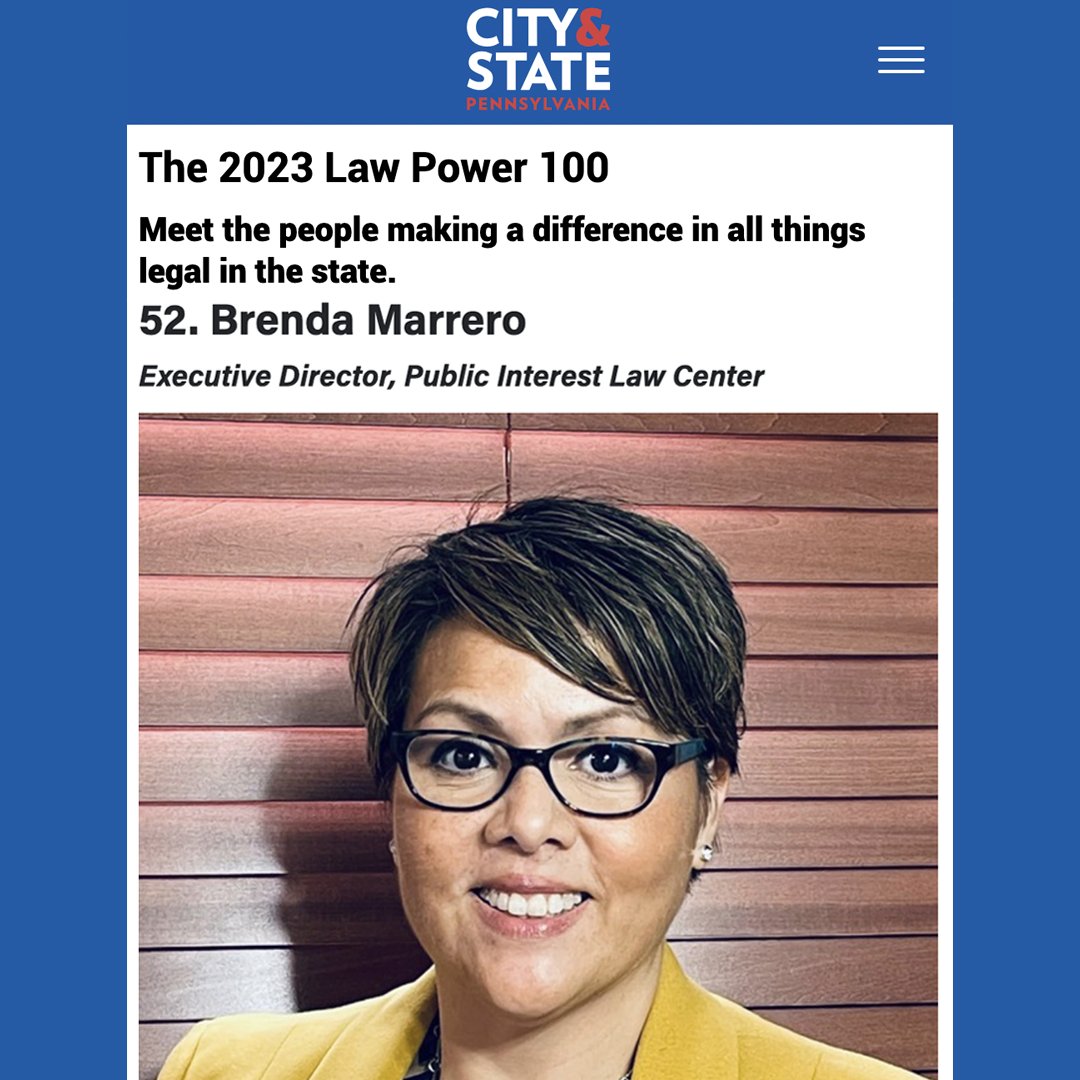
"Since taking over leadership of the Public Interest Law Center in 2021, Brenda Marrero has led efforts to combat poverty and discrimination in areas including health care, housing, voting rights and public education," City & State wrote. Help congratulate Brenda on Facebook!
|
|
|
|
|
|
|