|
Palm Beach County State Legislative Update
Week of February 17
| |
UPDATES FROM THE EXECUTIVE BRANCH | |
|
Nuñez Resigns as Lieutenant Governor
Florida Lieutenant Governor Jeanette Nuñez has officially resigned to become interim president of Florida International University (FIU), her alma mater. Nuñez previously served in the Florida Legislature and will now lead the Miami-based university while they search for a permanent president. Alan Levine, vice chairman of the Board of Governors, advised Nunez to pursue the presidency on a permanent basis, a suggestion echoed by state Education Commissioner Manny Diaz Jr., also a former Miami-Dade County lawmaker.
DeSantis has yet to announce her replacement as lieutenant governor, and there is no legal deadline for doing so. Her appointment reflects a growing trend of political figures assuming leadership roles in Florida's public universities, strengthening ties between higher education and state government.
| |
|
Former DeSantis Chief of Staff James Uthmeier Sworn in as Florida AG
James Uthmeier, formerly Governor Ron DeSantis's chief of staff, was sworn in as Florida's 39th Attorney General on February 17, 2025, during a ceremony at the Old Capitol in Tallahassee. At 37, Uthmeier is among the youngest to hold this position. He succeeds Ashley Moody, who was appointed to the U.S. Senate following Marco Rubio's resignation to become Secretary of State under President Donald Trump.
A Destin native, Uthmeier earned degrees from the University of Florida and a law degree from Georgetown University. Before joining DeSantis's administration, he served as a senior adviser at the U.S. Department of Commerce and practiced law at Jones Day. Within the DeSantis administration, Uthmeier held roles as General Counsel and Chief of Staff, playing a pivotal part in advancing DeSantis’ policies including ending DEI initiatives and attempting to block ballot initiatives regarding abortion access and recreational marijuana.
Uthmeier has already expressed intentions to pursue a full term as Attorney General in 2026.
| |
|
Larry Keefe to Head State Immigration Board
Larry Keefe, a former U.S. Attorney for the Northern District of Florida, has been appointed as the executive director of Florida's newly established State Board of Immigration Enforcement. This appointment, approved by Governor Ron DeSantis and the Cabinet during a special meeting in Niceville, follows recent legislation aimed at intensifying the state's stance on illegal immigration. Keefe previously served as the state's public safety czar and was instrumental in coordinating the 2022 relocation of migrants from Texas to Martha's Vineyard. In his new role, Keefe will oversee the board's efforts to enhance cooperation among federal, state, and local agencies in enforcing immigration laws. Governor DeSantis emphasized the state's commitment to active involvement in immigration enforcement, indicating potential future relocations of unauthorized immigrants.
| |
|
Florida Continues to Expand Immigration Enforcement Efforts
Governor Ron DeSantis has directed Florida law enforcement agencies to enter into agreements with U.S. Immigration and Customs Enforcement (ICE) to expand their role in immigration enforcement. These agreements, authorized under section 287(g) of the Immigration and Nationality Act, will provide state law enforcement and the Florida State Guard with additional authority to assist in federal immigration operations.
Under the agreements, personnel from the Florida Department of Law Enforcement (FDLE), Florida Fish and Wildlife Conservation Commission (FWC), and the Florida State Guard will receive training and oversight from ICE. The Florida Highway Patrol and the Florida Department of Agricultural Law Enforcement have already signed similar agreements.
These agreements will allow state law enforcement officers to identify and process individuals in custody who may be subject to immigration removal. Officers will be authorized to detain individuals suspected of immigration violations and transfer them to ICE for further proceedings. Additionally, they will have the ability to enforce federal immigration-related felony arrests, serve warrants, and collect evidence for immigration processing. Officers will also be empowered to detain individuals attempting to enter the U.S. unlawfully through Florida’s ports or coastal waters.
The expanded collaboration between Florida law enforcement and ICE is intended to expedite processing and removal proceedings for individuals identified as deportable while in state custody. These agreements aim to enhance Florida’s role in immigration enforcement efforts and strengthen coordination between state and federal authorities.
| |
UPDATES FROM THE LEGISLATURE | |
|
President Releases Priority Legislation “Rural Renaissance” Package
The Rural Renaissance package (SB 110), sponsored by Senator Corey Simon, is a comprehensive initiative aimed at revitalizing Florida’s rural communities by enhancing infrastructure, economic development, education, and healthcare access. Senate President Ben Albritton has championed the legislation, emphasizing the need to modernize rural economic strategies and improve quality of life while preserving the traditional values of Florida’s small communities.
A key component of the bill is the creation of the Florida Arterial Road Modernization (FARM) Program, which will direct an additional $30 million toward improving farm-to-market roads, bringing the total investment in arterial roads to $50 million annually. This funding could be utilized to help reconstruct County Road 880, a critical farm to market connection in the Glades region of Palm Beach County. This funding is intended to support Florida’s agricultural sector by ensuring better transportation routes between farms and market distribution centers.
The legislation also establishes the Office of Rural Prosperity within the Department of Commerce to provide technical assistance to rural communities, helping local governments navigate state and federal funding opportunities. Additionally, the bill includes $45 million for the Rural Infrastructure Fund, $5 million for a Rural Revolving Loan Program, and a $1 million annual block grant for eight counties that have experienced population decline over the past decade.
To address healthcare disparities, the Rural Hospital Capital Improvement Program receives $25 million to fund mobile healthcare units and telemedicine kiosks. Another $25 million is allocated to help doctors and nurse practitioners establish primary care practices in rural areas. The Rural Educator Incentive Program will provide up to $15,000 in student loan repayment for teachers in fiscally constrained counties, and the bill also increases funding for regional education consortia to support rural school districts.
Overall, SB 110 represents a historic investment of $197.4 million in rural Florida, focusing on infrastructure, education, and healthcare while promoting sustainable economic development. With bipartisan support, the legislation aims to ensure that rural communities have access to the same opportunities as urban areas while maintaining their unique way of life.
| |
|
House Combined Workgroup on Vetoed Libraries, Cultural, and Historical Preservation Budget Issues
A Florida House Combined Workgroup, authorized by Speaker Daniel Perez, is recommending the restoration of six member-sponsored arts and cultural projects that were previously vetoed by Governor Ron DeSantis. The House Combined Workgroup on Vetoed Libraries, Cultural, and Historical Preservation Budget Issues, led by Rep. Susan Plasencia, focused on these specific projects rather than the broader $32 million in vetoed cultural and museum funding.
Among the recommended projects is $200,000 for a Florida Black music legacy exhibit at the Wells' Built Museum in Orange County, intended to honor the museum's founder, the late Sen. Geraldine Thompson, who recently passed away. Other proposals include $1 million for repairs to Key West's San Carlos Institute, $820,000 for storm damage repairs at Ruth Eckerd Hall, $650,000 to complete the Cape Canaveral Light Station, $500,000 to construct a bandshell at Tampa's Perry Harvey Park, and $50,000 for a mobile library in New Port Richey. These recommendations will be submitted to Speaker Perez as the Legislature considers potential overrides of the Governor's vetoes. The Florida Senate has not indicated that they are willing to override any vetoes at this time.
| |
|
Discussion and Legislation Relating to the Elimination of Property Taxes
Governor Ron DeSantis has recently expressed support for the idea of eliminating property taxes in Florida, suggesting that such a move would require a constitutional amendment approved by voters.
In response to this proposal, Senator Jonathan Martin has introduced a bill (SB 852) that calls for a comprehensive study to assess the potential impacts of abolishing property taxes. This study would evaluate effects on public services—including education, infrastructure, and emergency services—and explore alternative revenue sources, such as consumption-based taxes, to offset the loss of property tax income.
Property taxes are a primary funding source for local governments in Florida, supporting essential services like public schools, law enforcement, fire rescue, emergency response, and infrastructure maintenance. Eliminating this revenue stream could significantly impact these services, necessitating either the identification of alternative funding mechanisms or potential budget reductions. The proposed study aims to provide a detailed analysis of these implications, ensuring that any policy decisions are informed by comprehensive data and consider the fiscal health of local governments.
While the prospect of eliminating property taxes may appeal to property owners, experts caution that such a change could have far-reaching consequences for local governance and public services. The outcome of the proposed study will assist in determining the feasibility and advisability of pursuing this significant tax reform in Florida. There has been no substantive discussion about what mechanism, if any, would be put into place upon the repeal of property taxes to replace the revenue lost to provide essential services.
| |
|
SB 7002, Water Management Districts
The Senate Committee on Environment and Natural Resources released a proposed committee bill which was passed through committee on February 18, 2025. SB 7002 introduces significant changes to Florida’s water management district funding, budgeting, and operational practices while also providing direct appropriations for Everglades restoration projects.
The bill prohibits water management districts from using state funds as a local match for state grant programs unless specifically appropriated. It also allows districts to levy ad valorem taxes by referendum for water-related capital improvement projects and creates a new loan program for district projects in the Statewide Flooding and Sea Level Rise Resilience Plan, using gaming revenue funds to finance flood resilience projects with interest-free, 20-year loans.
Regarding budgets, the bill mandates that each district include a capital improvement section for the current and upcoming fiscal year in its five-year plan. The South Florida Water Management District (SFWMD) must also report separate budget details for Everglades restoration projects, and the Legislative Budget Commission is granted authority to reject portions of district budgets that involve state funds.
The bill prohibits water district board members, executives, and employees from accepting expenditures from lobbyists for lobbying purposes. It also establishes that a quorum is required for official board decisions and requires that contracts over $1 million for water projects prioritize low-cost bids with 10-year construction bonds or equivalent financial assurances.
SB 7002 requires SFWMD to report the total remaining costs for Everglades restoration and prevents state task forces from assuming future state funding beyond set amounts when planning restoration efforts. It allocates over $750 million in funding for key restoration projects in the 2025-2026 fiscal year, including improvements to the Indian River Lagoon, Lake Okeechobee, and Central Everglades Planning Projects, among others.
This legislation reflects a major commitment to water resource management and Everglades restoration while also implementing new financial oversight and accountability measures for Florida’s water management districts.
| |
|
SB 268, Public Records/Public Officers
SB 268 was passed by the Senate Committee on Governmental Oversight and Accountability on February 18, 2025. The bill creates a public records exemption for the personal information of state and local public officers, including county commissioners, as well as their spouses and children. The bill shields from public disclosure partial home addresses and phone numbers of current public officers, their spouses, and children. The measure aims to enhance privacy and security for public officials and their families.
| |
|
HB 301, Sovereign Immunity
HB 301 was passed through the House Civil Justice and Claims Subcommittee on February 19, 2025 and increases the caps on damages that can be recovered from a governmental entity in Florida. For claims accruing between October 1, 2025, and September 30, 2030, the per-person cap rises from $200,000 to $1,000,000, and the cap for multiple claims from the same incident increases from $300,000 to $3,000,000. The bill also provides for an automatic increase for claims accruing on or after October 1, 2030.
Additionally, the bill allows local governments to settle claims exceeding these caps without requiring legislative approval. It also prohibits insurance policies, starting October 1, 2025, from making payment of benefits or liability coverage contingent on the passage of a claim bill.
| |
|
SB 118, Regulation of Presidential Libraries
The Senate Committee on Community Affairs passed SB 118 on February 18, 2025. The bill preempts to the state all regulation of the establishment, maintenance, activities, and operations of any presidential library within its jurisdiction and defers regulation of such institutions to the Federal Government. Under the bill, a local government may not enact or enforce any ordinance, resolution, rule, or other measure governing a presidential library or impose any requirement or restriction upon such libraries, except as otherwise authorized by federal law.
| |
|
SB 7006, Open Government and Sunset Review/NG911 Systems
On February 18, 2025 the Senate Committee on Regulated Industries introduced and passed this proposed committee bill (SB 7006) to save from repeal the current public records exemptions for various plans, maps, and blueprints regarding 911, E911, and public safety radio communication system infrastructure. The bill also saves from repeal a public meeting exemption for any portion of a meeting that would reveal the above information, as well as a public record exemption for any recordings or transcripts of the meetings. The bill adds Next Generation 911 (NG911) systems to the above systems protected by the public record and public meeting exemptions as well. The exemptions are required to protect this infrastructure to ensure the security of emergency communication infrastructure, structures, and facilities.
| |
|
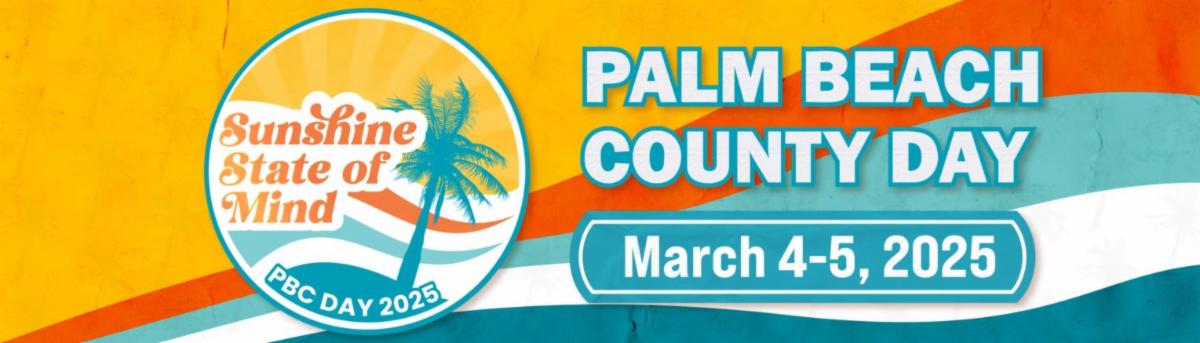
Palm Beach County Day 2025
Save the date for Palm Beach County Day 2025! Join us in Tallahassee on Tuesday, March 4 and Wednesday, March 5 to advocate for our community.
| | | | |