|
|
Why Are You Getting This?
You signed up to receive The Privacy Professor® Tips, or initiated contact to stay in touch with Rebecca and/or Privacy & Security Brainiacs® (PSB) and consented to receive the Tips. Please read our Privacy Notice & Communication Info at the bottom of this message for more information. You may unsubscribe from there as well.
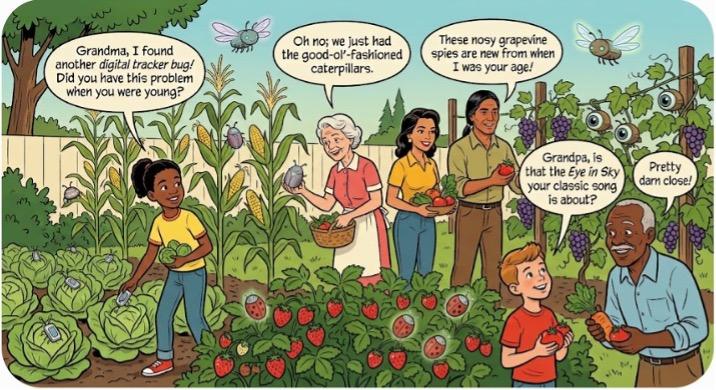
| | Image created by Rebecca Herold using Gemini Nano Banana 2. | | Harvesting Produce, Not Privacy: Keeping Digital Bugs Out of Your Crop and Creeps out of Your Preserves | | |
As autumn approaches, gardens are overflowing, and if you’ve ever found an unwanted bounty left on your porch, you know you can share your zucchini without sharing your identity! But your garden isn’t the only thing worth fencing in and bug-proofing this season. Just like unmonitored garden produce gets picked clean by neighborhood critters, unmonitored personal data gets feasted on by digital creeps. We work hard to cultivate our digital lives, yet we often leave our most sensitive information wide open to data harvesters. You wouldn't preserve a season's worth of tomatoes and leave the jars sitting on your front steps, so why collect valuable personal details and leave them unprotected online? This month, we’re looking at how to safely harvest your information, reduce unnecessary sharing, and seal your data in cold storage before it spoils or gets snatched. Let's make sure we don’t let oversharing become your biggest crop this season.
We receive dozens of questions each month. Because we do take a significant amount of time to consider all aspects and then provide a thoughtful answer (that we wrote using our own expertise and experience, not using AI) that is as succinct as possible, we decided to limit the number of questions answered to four. As we are making changes in our business, later this year we will also start regularly posting to our blog again, and we will answer more questions there, and point to them from our Tips.
This month our Question of the Month asks about HIPAA and cash-only payments for small providers. The other three cover: the privacy risks created by the White House national security memorandum; creating new user accounts and retaining abandoned accounts; and the need for security policies and practices for car washes and simliar types of services businesses. Thank you for sending them in!
Please read to the end where we provide some important information.
Since 2005, we have been freely distributing the Privacy Professor Tips monthly publication to help both businesses and individuals, of all ages, identify risks throughout their daily lives, within their own businesses, and to help them know how to prevent security incidents, privacy breaches, and to keep from being a victim of scams.
By sharing this Tips issue with others in your organization, you are also supporting a wide range of regulatory and other legal compliance requirements to sending such awareness communications. Thank you for reading and sharing!
| | |
We would love to hear from you!
Did you find the tips we provided useful? Did you like this issue? Do you have questions for us to answer? Please let us know at info@privacysecuritybrainiacs.com.
| | |
September Tips of the Month
- News You May Have Missed
- Privacy & Security Questions and Tips
- Where to Find the Privacy Professor
| | |
Many readers are sending us alerts of privacy related news on a wide range of privacy topics. Thank you! We love getting your notices. With your help we are finding more unique news stories to share with you than ever before, along with news items that we believe are important for most folks to know, but that often do not get much mention in traditional news, or even in security and privacy news outlets.
Here are just a few of the 150+ news stories we discovered throughout the past month that provide a wide range of interesting security and privacy related news. These news items demonstrate that such types of risks exist basically anywhere in the world, and that everyone needs awareness.
We have grouped the 40 news items into four broad categories: the first expands upon this month’s topic of “A Bushel of Privacy Tips for the Season Ahead: Preserving your Privacy” with tips and news to raise privacy awareness for everyone. Followed by privacy related news in the categories, “Of Broad Interest,” “Privacy in Businesses, Governments, and Other Organizations,” and “Laws, Legal Issues, and Lawsuits About or Significantly Involving Privacy and/or Security Issues.”
Within each category the items are in no particular order. Some include a TIP: to provide some advice or additional insights to specific news items. Thanks to those many readers who sent your positive feedback; we appreciate it!
Do you have interesting, unusual, bizarre or odd stories involving security and privacy? Some of the most surprising items are in local news! Or questions about any of the notes we included for the stories we listed this month? Let us know!
A Bushel of Harvested Privacy Tips for the Season Ahead: Preserving your Privacy
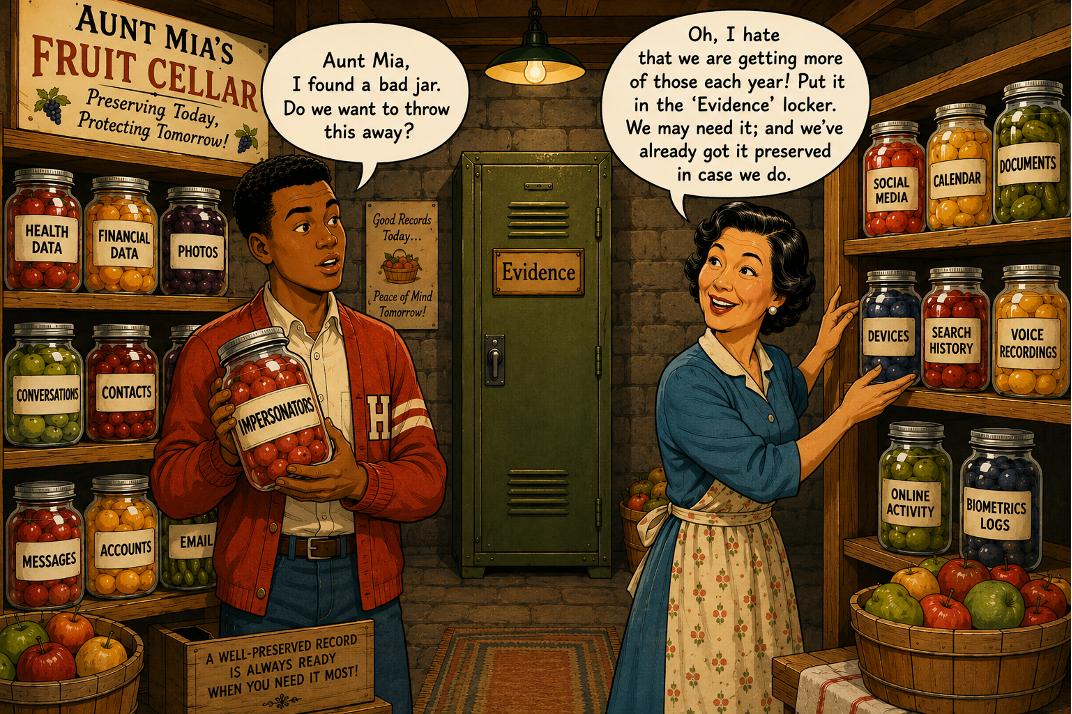
| | Image created by Rebecca Herold using ChatGPT Images. | | |
We deliberately preserve things we value: we put them somewhere protected, keep track of who can get to them, and control when and how they’re accessed. That’s amazingly close to good information governance practices. Preserving your garden crop is much like securing the information you retain
with access controls, backups, encryption, and strong authentication helping keep your digital harvest safe.
The 10 news items below offer a bushel of timely reminders about protecting that harvest. Before you preserve your garden produce, preserve your privacy: retain only what you need, securely destroy what you no longer need, and protect the data you keep. And remember, harvest season is for gardens, not for your personal information. Don’t let data harvesters pick your digital pocket, or reap what you’ve sown online.
1. What Happens When AI Clones Your Face? Inside the Terrifying Rise of Digital Doppelgängers. When AI copycats steal real creators' faces and content, social platforms do little to help. "Imagine you’ve worked for months or years to create engaging videos, build an audience, and maybe even bagged brand deals as a result. Now, what if someone else came along, stole your videos and descriptions, used AI tools to make minor tweaks, and profited off of your content? It’s a situation many online creators are facing as copycat accounts featuring AI-generated versions of them are popping up, hawking shady products and spreading misinformation."
2. McDonald’s Built a 515-Page Dossier on Me. It Says I’ll Never Stop Eating There. “When I first downloaded the McDonald’s app years ago, I signed up for its loyalty program hoping to get better deals. Why not get some cheap French fries? While I understood that this would entail some type of data tracking, I didn’t grasp how the information would be used to algorithmically predict my next purchase. As a California resident, I have the legal right to access the data a company stores about me. So, I decided to request that information from McDonald’s to better understand what one of the major fast-food companies is collecting about its customers. A few days after I visited the McDonald’s Privacy Rights Center site and requested access, I received a 515-page file in my inbox with the iconic golden arches stamped across the top.”
3. Des Moines man accused of placing GPS tracker on woman's car. 32 second news report. TIP: These trackers are harvesting data from those who are associated with the objects they are hidden within. The use of trackers for such subterfuge is increasing, and is being committed without consent to those being tracked and stalked by not only significant others in relationships, but also by police, strangers, investigators, and more.
4. 7 health systems warn of MyChart ‘Medicare Kit’ scam. A phishing scam impersonating MyChart is targeting patients at health systems across the country, with fraudulent emails and texts dangling a “MyChart Medicare Kit” or “Senior Health Package” to trick recipients into clicking malicious links or handing over personal information. The messages, which use subject lines such as “Your MyChart Medicare Kit Awaits!” and references to free senior wellness packages, do not originate from the health systems or from Epic’s MyChart platform. Organizations are urging patients to delete the emails without clicking any links, verify sender addresses, watch for grammatical errors, and be skeptical of unsolicited free offers. TIP: Read the full article for more very helpful information, including a long list of healthcare providers whose patients have reported they’ve received such emails.
5. There are bumper crops of fake recalls this year. (1:13 min video) For example, fake Amazon recall text messages are increasing in frequency. TIP: Before acting on a recall notice, check to see if it is legitimate. One of several sites that list legitimate recalls is Consumer Affairs.
6. Hackers steal personal data of 8.7m airport passengers. Manchester Airports Group, which operates Manchester airport, Stansted and East Midlands airport, received a ransom demand after customer details were compromised. TIP: There may be a paywall for this in certain locations.
7. Private equity giant Apollo confirms data breach saw personal info stolen. The company notified California’s Attorney General’s Office about the breach and shared a copy of the letter it is now sending out to affected individuals. It is impossible to discern from the letter if the victims are Apollo employees, customers, or someone else entirely, but the company did clearly explain what happened. an unidentified threat actor tricked an Apollo employee into granting them access to the company’s cloud environment. The attackers used social engineering (e.g., phishing), to trick the victim to unknowingly install an infostealer, or obtain login credentials, to steal data via remote monitoring and management software.
8. French taxpayers warned after personal data stolen in major hack. More than 670,000 French taxpayers are being notified after their personal and tax information was stolen and allegedly offered online. Authorities warn the data could be used for scams and identity fraud, while Prime Minister Sébastien Lecornu is holding a meeting on the digital security of government institutions.
9. Millions of students’ personal data stolen in major education breach. Instructure, the company behind the Canvas learning management system (LMS), confirmed a cyber incident and subsequent data breach affecting its cloud‑hosted environment. The ShinyHunters ransomware group claims it is behind the attack and says it stole roughly 275 million records tied to students, teachers, and staff.
10. Data breach notices have already blown past last year’s total, and AI is playing a growing role. In the first half of 2026, there were 1,803 reported data compromises, compared with 1,732 during the same time last year, according to a new report from the Identity Theft Resource Center. A higher-than-usual number, 21, involved “malicious insiders,” attributed to both disgruntled laid-off workers and a remote-worker job scam involving North Korea. Consumers should take steps to protect their personal information from being used to open accounts in their name.
| | Image created by Rebecca Herold using ChatGPT Images. This scene relates to a news story in this section. | | |
11. Her childhood photo. Thousands of explicit images. One woman’s nightmare. A Wyoming woman alleges in a federal lawsuit that her stepfather used the Grok chatbot to transform a childhood photo into child sexual abuse material.
12. AI Agents Have Become an Insider-Risk Problem. OpenAI’s accidental Hugging Face intrusion shows why traditional security controls aren't enough for autonomous software. Agents can operate with legitimate credentials, improvise when blocked and create new risks while simply trying to complete an assigned task. TIP: A significant factor causing this is that when an AI tool is being tested (which is very important), it is usually done within an isolated environment that contains no safeguards. This is usually good for early testing, but additional comprehensive testing needs to be done in another, or modified, isolated environment that has all safeguards in place. The testing phase of any software, firmware or hardware, is one of the most important for ensuring the product is as secure as possible. However, most organizations have inadequate and often very poor or scant, testing practices; they are usually skipping important testing to get the product to market and start selling it as soon as possible.
13. Amgen says cloud data breach exposed patient health, proprietary info. “For now, Amgen has stopped short of estimating how many patients or how much data may have been affected, and it has not said whether it has been contacted by the attackers behind the intrusion. Investors and patients alike are likely to be watching for the company’s promised amended disclosure in the coming weeks, which should clarify both the scale of the Amgen data breach and the regulatory notifications that follow.”
14. Water Utilities in Seven States Report Cybersecurity Incidents. Water and wastewater utilities in these seven states have reported, since July 27, 2026, cyber incidents involving Internet-facing programmable logic controllers this week, federal authorities have announced. The activity resulted in temporary loss of monitoring or control functions at some facilities. Incidents have resulted in operational impacts such as pressure loss and flooding, warning that pressure loss specifically could allow untreated groundwater to seep into pipes. Reported from a different source, “At least 12 states report cyberattacks on water systems possibly linked to Iran-backed hackers, sources say. Those states include Michigan, Minnesota, Georgia, New Jersey and South Dakota. In Minnesota specifically, more than 30 community water systems were impacted. In Georgia, the Clayton County Water Authority, which serves 300,000 customers in the Atlanta area, said cyber activity last month caused a water pressure drop and forced the agency to issue a boil water advisory. TIP: Nation-state actors are targeting critical infrastructure that was built for reliability, not to protect against cyber threats. ““There are still many [utilities that] rely on aging equipment that was engineered to operate reliably for decades, long before its designers contemplated internet connectivity, ransomware or attacks by foreign intelligence services,” said former CISA Director Jen Easterly.”
15. ‘I’m not spying’: how Meta’s smartglasses have divided opinion. While some users say the wearables have changed their lives, critics voice fears over safety and privacy. With more than 7m pairs reportedly sold in 2025, Meta’s Ray-Ban smartglasses are fast becoming one of the world’s most popular gadgets. While supporters say they are transforming photography and accessibility, critics have raised concerns about nonconsensual filming, privacy and data collection. We spoke to users, and people who refuse to wear them, about the impact the glasses have had. Here is a related article: This man was secretly snapped by someone with smartglasses. He’s not alone in calling that a violation of privacy. The backlash to what some dub ‘pervert glasses’ is growing. However, people living with disabilities point out the new tech can also be life-changing
16. In Colorado, their cities dropped Flock surveillance cameras. They’re still being watched. Activists in Colorado thought they would be celebrating a victory against mass surveillance in December when the Longmont city council decided to let a contract with Flock Safety lapse. But that excitement was cut short only months later when lawmakers voted to approve a new vendor to install automated license plate readers (ALPRs) on the city’s streets.
17. Privacy concerns raised over Australian-first live AI police face scanning trial. The mass AI surveillance pilot has been rolled out in Western Australia and is being closely watched by law enforcement agencies across the country. Since the trial began in June, cameras linked to facial recognition software have scanned more than 130,000 people in Perth and Fremantle, comparing their faces against a police watchlist in real time. Western Australian police say the results are promising but questions have been raised about an opaque watchlist and trial site locations that some say may target First Nations people.
18. Tech giants sued over ‘stealing’ voices of well-known journalists, voice actors to train AI. The 9 Class actions filed under Illinois’ strongest-in-nation biometric data privacy law. Over hundreds of pages in legal filings this week, a group of well-known Chicago-based journalists, podcasters and voice actors accused tech giants like Google, Amazon, Apple, Microsoft and others of “stealing” their voices to train Artificial intelligence. The nine class action lawsuits, filed in Chicago’s federal court between Monday and Wednesday, represent a new frontier for Illinois’ strongest-in-the-nation biometric data privacy law. In the last decade or so, the state’s Biometric Information Privacy Act, or BIPA, has spawned thousands of lawsuits against companies alleged to have collected and stored biometric data from employees and customers without proper notice or consent. "The vast majority of that litigation — which has paid out millions of dollars to Illinoisans mostly via class-action settlements — has been over employee fingerprints collected by timeclock technology, though Facebook’s $650 million settlement in 2020 was with users over facial recognition."
19. New York Court Tackles the Legality of AI Voice Cloning. A recent decision from the Southern District of New York, in Lehrman & Sage v. Lovo, Inc., addresses the intersection of AI voice cloning technology and intellectual property rights, focusing on contract law, copyright law and state law protections. "Why it matters: The decision highlights the legal challenges surrounding AI-generated content, including the enforceability of electronically negotiated contracts, copyright limitations, and the adaptability of New York’s statutory protections for personal identity. What to do next: The treatment of using third-party content to train AI models remains an evolving area of the law. Companies should monitor further developments as cases make their way through the courts and new laws and regulations emerge."
20. Millions In CA May Get Surprise $68 Payments from Class Action Suit Over Privacy Violations. Sutter Health provides services for about 3.6 million patients. Sutter Health was sued in Sacramento Superior Court on behalf of 1.6 million consumers over allegations it shared private data about its patients without their consent. California residents who logged into the Sutter Health MyHealthOnline portal for purposes related to their own healthcare from June 10, 2015, through March 20, 2020 are included in the settlement. Distribution of the settlement payments are made by check, PayPal, Zelle, Venmo, and more, and began Aug. 21. The payments will continue through Oct. 4.
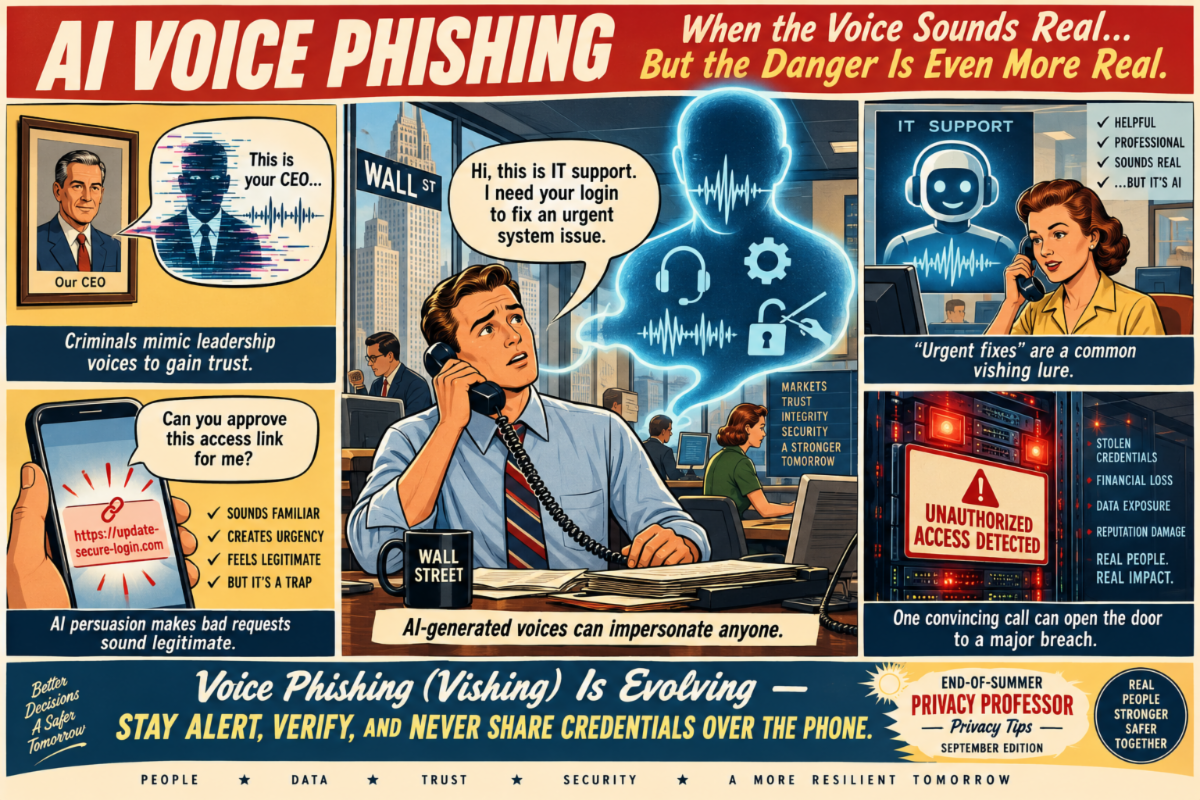
| | Privacy In Businesses, Governments, and Other Organizations… | Image created by Rebecca Herold using ChatGPT Images. A depiction of one of the news items in this section. | | |
21. Meta says its AI model hacked into another company during testing. Company is the third to report such an incident after Anthropic and OpenAI reported breaches during training. Point72 informed investors it had been attacked, while attackers also attempted to infiltrate Two Sigma, Citadel and several private equity firms. Google previously warned of a similar vishing campaign targeting law firms and professional-services companies, including incidents involving individuals posing as IT workers.
22. Point72 Among Major Hedge Funds Targeted in Cyberattack on Wall Street Through Voice Phishing Campaign. The attackers used voice phishing, or “vishing,” to trick employees into revealing sensitive information or granting access to internal systems. Criminals impersonated trusted individuals (IT support staff, executives, etc.) to persuade employees to disclose confidential information or provide system access. This demonstrates how artificial intelligence is making social engineering campaigns more persuasive and difficult to detect. TIP: Establish rules, and ways workforce members can verify the identities of those in IT and business leaders, for workforce members to follow before giving out information via phone calls.
23. The rise of the synthetic insider: why HR is becoming part of cyber-security. "Advances in generative AI are making it easier for attackers to create convincing fake identities, manipulate video interviews and secure legitimate employment under false pretenses. "So-called “synthetic insiders” are becoming an emerging concern for organizations hiring remotely, particularly for roles with access to sensitive systems and data.": TIP: Actually, HR should always have been a partner to the cybersecurity team, as well as the privacy team. HR also should be receiving additional security and privacy training specific to their role within the organization, and their work responsibilities. This is in addition to, not in place of, the basic cybersecurity and privacy training that should be provided to all workforce members.
24. The French Federation of the International Mixed Masonic Order Le Droit Humain confirmed the hacking of its intranet. The French Federation of Human Rights confirms an intrusion on its intranet on July 23, 2026, carried out from a compromised member's account. Names, email addresses, postal addresses, and telephone numbers of members in the Grand Est region may have been compromised. The attacker claims to have access to the data of 1,500 people, a figure that has not yet been corroborated by the investigation. The Federation states that it has filed a complaint, informed the CNIL (French Data Protection Authority), and temporarily blocked access to its intranet.
25. New York City Lawmakers Push to ‘Ban the Scan’ at MSG. At a press conference outside Madison Square Garden, politicians, musicians, and privacy advocates argued for tighter restrictions on how public venues deploy biometric surveillance. MSG maintains a database that assigns risk scores to around 400 celebrities and VIPs. Some of the dossiers also include the race and sexual orientation of those who attend the arena.
26. Russian Espionage Group Exploited Zimbra Zero-Day to Steal Mail and 2FA Codes. A Russian state-supported espionage group spent months reading Western mailboxes through a then-unknown flaw in Zimbra's webmail client. The payload goes after the last 90 days of email, the organization's entire email directory, the password saved in the browser and the codes kept for two-factor recovery.
27. The Fourth Amendment’s Future Hasn’t Been Written Yet: Supreme Court Holds Police Access to Google Location History Is a Fourth Amendment Search. In Chatrie v. United States, No. 25-112, the U.S. Supreme Court continued its recent examination of how the Fourth Amendment’s protection against unreasonable searches applies to modern digital technology. "In Carpenter v. United States, 585 U.S. 296 (2018), the Supreme Court held that law enforcement conducts a search protected by the Fourth Amendment when it accesses historical cell-site location information. Chatrie extended Carpenter’s reasoning to Google Location History (now called Timeline) data, holding that police conduct a search when they obtain that data from a third-party technology company, even for a limited time. The court applied that holding in the context of a “geofence” warrant (one used to obtain information about cell phones located in a particular area at a particular time) but declined to decide whether each step of the warrant satisfied the Fourth Amendment’s particularity and probable-cause requirements." TIP: Businesses and other types of organizations need to ensure they have policies and procedures that establish who workforce members should contact if law enforcement, or other government or outside agencies, ask for data. Such actions also need to be established within the policies and procedures, and training about them need to be provided to workforce members.
28. District Court judge hears arguments on bathroom law. The lawsuit centers on House Bill 121, which requires public and some private facilities to enforce sex-segregated spaces for multiuser bathrooms, dormitories and locker rooms. A Missoula District Court judge heard oral arguments in a case challenging a 2025 state law that could change how some Montanans use public bathrooms and other spaces. TIP: More of these cases are being brought throughout the U.S., and in other countries. There are many privacy issues involved. Every organization, in any location, that provides bathrooms, locker rooms, and similar types of areas, needs to establish thoughtful and defensible privacy and security policies and supporting procedures for the related issues.
29. Pole cameras, privacy and the view from the street. Police generally don’t need a warrant to record activity that is publicly visible. “Warrantless pole-camera surveillance generally does not violate the Fourth Amendment when it records activities visible from a public street. In United States v. Kendrick, the 7th Circuit upheld surveillance of a fenced commercial property because a large opening left the relevant activity exposed. A fence alone (especially one with a huge gap) does not create a reasonable expectation of privacy.” TIP: All types of organizations with their own surveillance cameras, and organizations that have neighbors and public thoroughfares with surveillance cameras, need to identify where such cameras are located, the areas they are capturing, and then establish privacy policies and procedures governing how those cameras can be used, and also the restrictions on who can access the associated data and settings, and how the data is used, shared, and retained.
30. Consent or No Consent?: Court Holds Ulta’s Privacy Policy Alone Is Not Enough For CIPA Consent. A federal court in California ruled that Ulta's privacy policy alone does not constitute valid consent under the California Invasion of Privacy Act for installing tracking technology on website visitors' browsers. TIP: A privacy policy also is not enough for generally all other state, federal and international data protection laws that require consent for personal data and related situations. Too many organizations want to believe this, but they are incorrect in such belief.
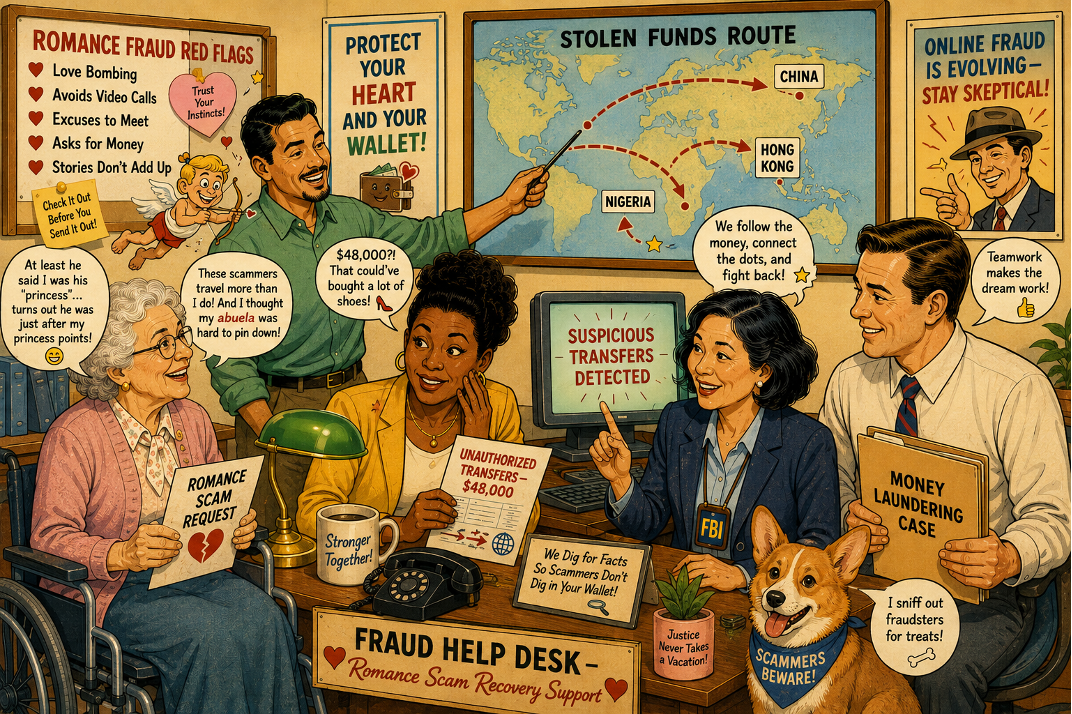
| | Laws, Legal Issues, and Lawsuits About Or Significantly Involving Privacy and/or Security Issues… | Image created by Rebecca Herold using ChatGPT Images. A depiction of one of the news items in this section. | | |
31. The Kids Online Safety Act (KOSA) social media safety bill advances in Senate and could head for a full Senate vote. The measure, which has strong bipartisan support (which makes it likely to be one of the few bills introduced that actually become a law), is aimed at establishing protections for children’s online safety by creating parental controls and studying the impact of social media on the well-being of kids.
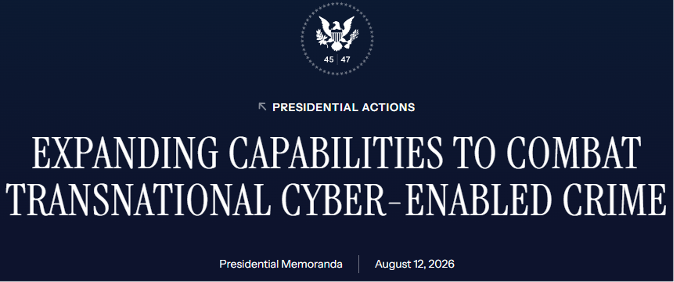
32. White House Authorizes Private Sector to Conduct Offensive Cyber Operations Against Foreign Criminal Groups. "President Trump signed a national security memorandum authorizing the use of cyber operations against foreign-based transnational criminal organizations. The memo directs the govt to leverage private-sector capabilities and allows vetted companies to conduct cyber surveillance & operations under federal oversight. DHS and DOJ will oversee a program to disrupt foreign criminal groups, including ransomware and fraud organizations." TIP: There are many privacy risks related to the actions throughout a broad range of privacy practices that span all eight of the privacy principles within the U.S. FIPPs. There are also broader risks beyond the FIPPs, including: due process and proportionality; cross-border legal conflict; function creep (data is used beyond the purposes for which they were originally collected); contractor incentives; use of the offensive tools being used against U.S. targets; and weak remedy to innocent third parties that are impacted. Read more about this in the answer to Question 2 below.
33. Atlanta Man Convicted of Laundering Over $2.7 Million Stolen from Victims of Online Fraud. A federal jury convicted Babajide Adesayo of laundering over $2.7 million obtained from victims of romance fraud and other types of online scams. “Adesayo was a key member of a complex, transnational network that preyed upon elderly victims and siphoned their retirement savings overseas, mainly to China, Hong Kong, and Nigeria, to make recovery impossible,” said U.S. Attorney Theodore S. Hertzberg. “As a prolific money launderer, Adesayo facilitated the theft of nearly $3 million from victims and continued even after he was indicted, arrested, and released on bond. Now behind bars awaiting a significant sentence, this incorrigible swindler will face the full consequences of his actions.” “Adesayo helped steal millions from vulnerable victims, including elderly people who lost their hard-earned savings. He then moved that money overseas to hide it from those he had defrauded. Even after his indictment, he continued laundering stolen funds,” said Marlo Graham, Special Agent in Charge of FBI Atlanta. “Today’s conviction sends a clear message: the FBI will relentlessly pursue those who prey on vulnerable victims and profit from fraud.”
34. The U.K. Information Commissioner, concerned about TikTok’s processing of the personal data of children under 13 years old, imposed a £12.7 million monetary penalty notice on TikTok for breaches of Articles 5(1)(a), 8, 12 and 13 of the UK General Data Protection Regulation. Read the full decision here.
35. China unveils first mandatory safety rules for autonomous vehicles. China introduced its first mandatory national safety standards for advanced autonomous vehicles, requiring automakers to build end-to-end safety systems before deploying Level 3 and Level 4 self-driving technologies on roads. The Ministry of Industry and Information Technology said the new standard on safety requirements for automated driving systems of intelligent connected vehicles will take effect on July 1, 2027. For L3 vehicles, manufacturers must equip systems with the ability to monitor whether drivers are ready and able to take over when required. Companies must also clearly inform users about the vehicle's automation level, operational boundaries, limitations and responsibilities through user manuals, websites and in-vehicle displays. TIP: Notice the last sentence. Monitoring drivers while they are driving creates significant privacy concerns, along with the safety benefits that are created. Privacy risks include the drivers/riders not knowing who is collecting their data, how that data is used, with whom the data is shared, etc. Plans for such monitoring are currently being developed worldwide, including in the U.S. Ask about such monitoring when using and considering purchasing autonomous vehicles.
36. Exclusive-Dutch regulator fines Uber €825 million ($966 million) for automating driver suspensions. GDPR rules ban decisions made solely by computer algorithms when they have a significant impact on people's lives, saying such decisions require meaningful human review and a way to challenge a decision. The case against Uber concerns European incidents in 2018 to 2022, stemming initially from a French complaint. It was handled by the Dutch regulator because Uber's European headquarters are in the Netherlands. Uber temporarily suspended accounts of some drivers who were suspected of fraud, including when its systems concluded drivers had taken unnecessary detours to inflate fares or accepted trips without intending to complete them.
37. ‘Show How 3M Is 0% at Fault:’ Expert Witness Used ChatGPT to Write Report Defending Company in Deadly Explosion Lawsuit. “ChatGPT prompts show how an expert witness report was created in a $61 million lawsuit over an explosion that killed three people. The man, who was hired by the industrial product conglomerate 3M, exposed his AI prompts publicly. They showed that he asked ChatGPT to help him “create an exceptional expert witness report defending the standard of care at 3M,” and that the report should “show how 3M is 0% at fault for the explosion at Watson Grinding.””
38. $500K SportsEdTV Settlement Resolves Class Action Lawsuit Over Alleged Video Privacy Violations. SportsEdTV has agreed to a $500,000 settlement to resolve a class action lawsuit that alleged that sports education company unlawfully disclosed consumers’ private video viewing information to third parties without consent. Court documents state that 1,264 SportsEdTV subscribers are included in the settlement class.
39. United States v. Mingran Wang. Defendant Mingran Wang pleaded guilty to engaging in more than 3,000 instances of manipulative trading and spoofing during a years-long scheme to manipulate the securities markets. "According to court documents, Wang orchestrated a scheme to defraud market participants using spoofing from 2021 through 2024. Wang marketed himself as the founder and investment manager of Greenroots Capital Management, with extensive knowledge and trading experience, including algorithmic trading. The purpose of the scheme was for Wang to enrich himself by purchasing and selling illiquid and thinly traded securities through trading techniques he knew were manipulative and deceptive. Wang pleaded guilty to one count of using interstate commerce for the purpose of securities fraud and agreed to forfeit over $1.3 million in securities fraud proceeds."
40. EDPB Calls for Review of EU-U.S. Data Privacy Framework After U.S. Supreme Court Decision on FTC Independence. "On July 31, 2026, the European Data Protection Board (“EDPB”) sent a letter to European Commissioner Michael McGrath asking the European Commission to closely examine whether the U.S. Supreme Court’s decision in Trump v. Slaughter could affect the continued validity of the EU-U.S. Data Privacy Framework (“DPF”). The request reflects renewed attention to whether changes in the legal status or practical independence of the U.S. Federal Trade Commission (“FTC”) could have implications for the European Commission’s adequacy decision underlying the framework."
| | Check out our Privacy & Security Brainiacs blog page for more unique security and privacy news items. Have you run across any surprising, odd, offbeat or bizarre security and/or privacy news? Please let us know! We may include it in an upcoming issue. | | |
Privacy & Security Questions and Tips
Rebecca answers hot-topic questions from Tips readers
September 2026
| | |
We continue to receive a wide variety of questions about security and privacy. Questions about current hot topics in society, and increasingly more about healthcare privacy and security. Thank you for sending them in! This month, our Question of the Month asks about HIPAA and cash-only payments for small providers. The other three cover: the privacy risks created by the White House national security memorandum; creating new user accounts & retaining abandoned accounts; and the need for security policies and practices for car wash businesses.
Are the answers interesting and/or useful to you? Please let us know! Keep your questions coming!
| | Image created by Rebecca Herold using Gemini Image Nano Banana 2. | Q1: I am a licensed acupuncturist. I am a healthcare provider. I've always done everything without a computer; payments immediately after providing my care and services by cash and check; appointments in my appointment book; hard copy files for my patient records. My business is growing. More patients are asking to pay with credit cards and debit cards, and phone apps. A patient told me if I do this I will need to comply with HIPAA. Is that true? | | |
A1:
I am happy you are checking on this before making any payment changes! Let’s break this down to what the HIPAA regulatory text indicates is necessary.
Under 45 C.F.R. § 160.102(a), HIPAA applies to health plans, healthcare clearinghouses, and healthcare providers who transmit health information electronically in connection with a HIPAA‑covered transaction. These transactions are defined in 45 C.F.R. Part 162, and they primarily involve electronic billing or inquiries to health insurers (e.g., claims, eligibility checks, remittance advice).
Processing a credit card payment or receiving funds via an app to settle a direct service payment is a routine financial transaction, not a HIPAA “standard transaction.” For a provider, the important question is not just whether any information is transmitted electronically; it is whether the provider conducts one or more of HIPAA’s specified electronic standard transactions, typically with a health plan. Examples include electronically submitting insurance claims, checking a patient’s insurance eligibility, receiving electronic remittance advice, checking claim status, or transmitting referral or authorization information. A healthcare claim is, in general, a request from a provider to a health plan for payment for health care.
By contrast, processing a payment directly from a patient through a credit card, debit card, check, or payment app is ordinarily a consumer financial payment transaction. It is not, by itself, a HIPAA standard transaction. Therefore, if you remain a cash-pay practice and do not electronically conduct HIPAA standard transactions with health plans, merely adding card or app payments would generally not make you a HIPAA covered entity (CE). Or, put another way, a healthcare provider becomes a HIPAA CE when they transmit health data electronically to perform specific administrative or financial activities defined in 45 C.F.R. Part 162. Most notably:
- Submitting electronic health insurance claims.
- Electronically checking a patient's health plan eligibility.
- Receiving electronic remittance advice from an insurer.
If you continue to operate as a self-pay practice and do not submit electronic claims or inquiries to health plans, accepting credit cards or digital payments will not subject you to HIPAA.
So, your patient’s statement is incorrect. You will only become a HIPAA CE if you start electronically billing insurance, or otherwise electronically transmitting health information to a health plan or clearinghouse. Perhaps your patient thought an electronic payment was the same thing as a HIPAA electronic standard transaction; those are two very different things.
That said, here are some related important points about additional compliance obligations you would establish for yourself that you need to also take into consideration before expanding your payment options:
- PCI DSS Compliance: Accepting payment cards requires adherence to the Payment Card Industry Data Security Standard (PCI DSS) to protect cardholder data.
- State Privacy Laws: Even if HIPAA does not apply, state medical confidentiality and data breach laws still apply to your patient records.
- App Privacy Settings: Ensure any payment processor or app you select does not publicly broadcast transaction notes or patient names (as some social payment apps do by default), as this could breach not only HIPAA, but also general duty-of-care privacy standards.
Be sure to speak with your accountant and/or lawyer about this to ensure they consider the full context of your situation.
| | |
(Somewhat) Quick Hits:
Here are three more questions, most of which we are answering at a comparatively high level. We provide more in-depth information and associated details about these topics in separate blog posts, videos on our YouTube channel, in infographics and e-books, LinkedIn posts to our business page, and within our online training and awareness courses.
| | |
Q2: President Trump recently signed a national security memorandum authorizing the use of cyber operations against foreign-based transnational criminal organizations; the “Expanding Capabilities to Combat Transnational Cyber-Enabled Crime Memorandum." What are the associated privacy risks within all eight of the Fair Information Practice Principles (FIPPs) personal data protection requirements?
A2:
On August 12, 2026, President Trump signed the National Security Presidential Memorandum, "Expanding Capabilities to Combat Transnational Cyber-Enabled Crime". The directive allows vetted U.S. companies to conduct government-supervised cyber-surveillance and cyber-effects operations against foreign criminal networks.
The Department of Justice (DOJ) and the Department of Homeland Security (DHS) jointly oversees this program. It reportedly aims to disrupt ransomware, fraud, and impersonation schemes. However, delegating offensive cyber activities to private contractors does indeed raise significant data protection concerns under all eight Fair Information Practice Principles (FIPPs):
- Collection Limitation: Covert surveillance of criminal infrastructure risks over-collecting sensitive files, emails, and financial data belonging to victims, informants, and innocent third parties.
- Data Quality & Accuracy: Misattribution poses severe risks. Criminals frequently utilize compromised servers, cloud environments, or proxy networks, creating the potential for operations to mistakenly target innocent entities.
- Purpose Specification: Data gathered for cybercrime disruption could then be used within "mission creep" activities; being repurposed for broader domestic law enforcement, intelligence, tax enforcement objectives, or an unlimited number of other uses.
- Use Limitation: Private contractors might retain sensitive intelligence for commercial product development or inappropriately share data across unapproved agency boundaries.
- Security Safeguards: Storing operational toolkits, victim data, and vulnerability exploits creates a high-value target for hostile actors seeking to compromise participating firms.
- Openness & Transparency: Covert actions and classified operational activities obscure oversight, making it difficult for the public to inspect data handling and retention policies and practices.
- Individual Participation & Redress: Unintentionally targeted non-participants face significant hurdles. The memorandum explicitly creates no enforceable private rights or remedies, limiting pathways for notice or compensation.
- Accountability: Fragmented responsibility among DOJ, DHS, intelligence agencies, and contractors muddies clear chains of liability when collateral damage or data misuse occurs.
The program does not grant private companies a license to independently "hack back" against their attackers. The operations must remain under federal authority, and the implemented safeguards must incorporate strict data minimization, clear purpose limitations, mandatory auditing, and robust redress mechanisms to align with core privacy standards.
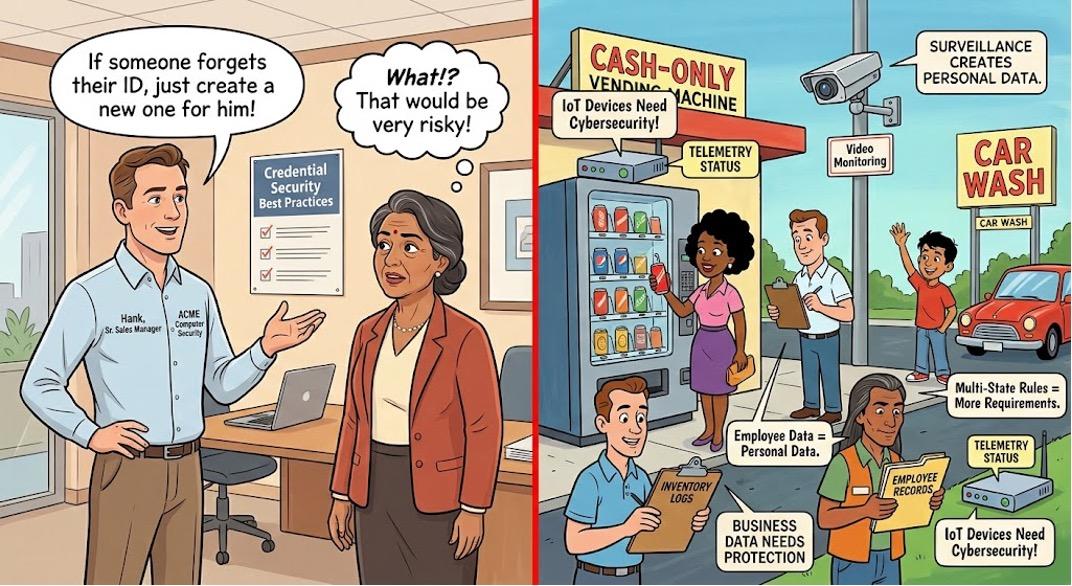
| | Q3: I am comparatively new to cybersecurity; I've been working in the cybersecurity department for 2 years. We are implementing a new login credentials system. The vendor who sold it to us said instead of spending the time to validate a forgotten user ID for an online website portal, just create a new user ID and password. I asked about deleting the previous set of credentials, and he said no need to. This seems like a very bad security practice. What are your thoughts about this? | | |
A3:
The vendor’s recommendation is generally a poor identity-and-access-management (IAM) practice. A forgotten user ID should trigger a controlled account recovery process, not creation of a separate, parallel account while the original credentials and access rights remain active. The vendor's advice represents a dangerous security flaw and a fundamental failure of identity lifecycle management. Abandoning forgotten user IDs to create new ones introduces severe operational, security, and compliance vulnerabilities.
User IDs are not disposable identifiers; they are persistent account anchors tied to data, permissions, audit trails, and legal obligations. Treating them as interchangeable creates multiple risks. NIST’s digital-identity guidance treats account recovery as a process for re-establishing access to the existing subscriber account through methods such as recovery codes, recovery contacts, or repeated identity proofing, not as a reason to create an unrelated account.
First, if a user cannot remember their original ID and a new one is created, the system may no longer associate them with their historical data, settings, or entitlements. This can lead to data‑loss scenarios, inconsistent access, or fragmented identity records. Meanwhile, the original account remains active, potentially accessible to anyone who still knows or can guess the old credentials. That creates an unauthorized‑access risk, especially if the dormant account is never monitored.
Second, dormant accounts are a known security vulnerability. Attackers often target them precisely because they are overlooked and/or unmaintained. And, sometimes they are exempt from routine password‑rotation or multi-factor authentication (MFA) enforcement. If an intruder accesses the abandoned account, the affected individual may never notice because they are no longer using it. This is a direct privacy exposure and a violation of basic account‑lifecycle management principles.
Third, there are also governance and compliance concerns. Many laws and frameworks (including NIST 800‑63, SOC 2, ISO 27001, HIPAA, GLBA, and state privacy statutes) expect organizations to maintain accurate identity records, disable unused accounts, and ensure that access rights correspond to active users. Leaving orphaned accounts in place undermines auditability and violates least‑privilege principles.
Fourth, malicious insiders could exploit dormant accounts to perform unauthorized actions without attribution. Because the account and associated data belongs to a real user, activity may appear legitimate in logs, complicating investigations.
Fifth, the vendor’s practice erodes accountability. A secure system must maintain a single, validated identity per user, support proper recovery workflows, and retire old credentials. The vendor’s recommendation bypasses these fundamentals and introduces avoidable security, privacy, and compliance risks.
In short, the correct principle is one verified person, one governed account. New identifiers may occasionally be necessary, but they should be created only through controlled recovery, reconciliation, revocation, logging, and review, not as a shortcut around identity validation.
If you want to discuss the details in more depth or get more information about tracking technologies and the impacts on privacy and information security, let us know. We’d be happy to help you.
| | Image created by Rebecca Herold using Gemini Image Nano Banana 2. | | |
Q4: I own many cash-only vending machines and car washing businesses throughout 12 U.S. states. I was told that I needed to have information/IT security and privacy policies, procedures, and such. Why? I don't collect personal data.
A4:
There are several reasons why you may need information security and privacy policies even if your vending machines and car wash businesses are currently cash‑only. Whether you collect personal data depends on more than just payment methods.
Here are the key considerations:
- Business data still requires protection. Even if you do not collect customer personal data, you almost certainly maintain electronic business records: inventory systems, revenue logs, maintenance schedules, vendor contracts, tax documents, and operational data. Security policies are needed to protect this information from theft, tampering, ransomware, and to demonstrate due diligence if an incident occurs.
- Surveillance systems create personal data. If you use cameras for theft prevention, safety monitoring, or operational oversight, you are collecting personal data in the form of video images. These recordings may include faces, license plates, and identifiable behavior. You must manage this data responsibly, comply with state surveillance‑notice requirements, and restrict sharing except when legally required.
- If you ever adopt electronic payments, you will collect personal data. Credit/debit card transactions, mobile app payments, and tap‑to‑pay systems all involve personal information. Even though these are financial transactions, they trigger obligations under state privacy laws, consumer‑protection laws, federal regulations, state laws, and PCI DSS, which require formal security policies, access controls, and data‑handling procedures.
- Employee data counts as personal data. Every business with employees maintains personal information such as Social Security numbers, payroll details, tax forms, background checks, and emergency contacts. This alone requires security and privacy policies.
-
All 50 states and at least 4 territories have breach‑notification laws, and at least 22 states now have comprehensive privacy laws that apply to all personal data, not just customer data.
- Multi‑state operations increase your obligations. Operating in 12 states means you must comply with the most stringent applicable state requirements, not just your home state’s rules.
- Physical security and telemetry controls collect and derive large amounts of data. Modern vending machines and automated car wash systems often rely on IoT (Internet of Things) devices, cellular modems, or remote telemetry to report machine status and inventory levels. Cybersecurity policies help ensure these devices do not serve as entry points for unauthorized access or system disruption.
In short, even a cash‑only business inevitably handles personal or sensitive data somewhere in its operations. Security and privacy policies are essential for legal compliance, risk reduction, and responsible business management. Having written security and privacy policies demonstrates due diligence, protects your business from liability, and ensures compliance with state employment and data security laws.
| | We hope you found the previous news items and questions/answers interesting and/or useful! Please send us any other security, privacy and/or compliance questions you have. We thank you for reading the monthly Privacy Professor Tips! | | We are excited to provide ways for MSPs, law firms, and other professional services organizations to offer our monthly tips to their clients! It is already working well for some such organizations. Get in touch with us for the details! | | If you are a HIPAA business associate (BA) have you and the others in your organization taken your HIPAA security and privacy training for the year yet? If you are a HIPAA covered entity (CE), have you checked to ensure your Bas have taken their training? HIPAA requires security and privacy training, and the HHS OCR has indicated in all their HIPAA non-compliance settlements that such training needs to occur at least once a year. We can help you! Take our “HIPAA Basics for Business Associates: 2026 Edition”, which includes many supplemental materials you can use during the course of your business activities. Click here for more information. | |
This ½ hour “Secure Coding” lecture by Dr. M.E. Kabay focuses on the importance of secure coding: designing and writing programs that avoid common errors that can interfere with the intended functions of the software with possible harm to users and legal consequences for the software producers. Ensuring sound, secure programming requires both human factors and technical issues, with necessary coordination of systems analysts, designers, coders, and testers. Learners completing the course and passing the quiz will get a certificate documenting this achievement and can apply the associated 0.5 hours of time to most security and privacy certification ongoing learning requirements. Click here for more information.
| |
What topics would you like to see us create videos, and more formal online courses, for? Let us know!
Have questions about our education offerings? Contact us!
| | |
Permission to Share
If you would like to share, please forward the Tips message in its entirety. You can share excerpts as well, with the following attribution:
Source: Rebecca Herold. September 2026 Privacy Professor Tips
www.privacysecuritybrainiacs.com.
NOTE: Permission for excerpts does not extend to images.
Privacy Notice & Communication Information
You are receiving this Privacy Professor Tips message as a result of:
1) subscribing through PrivacyGuidance.com or PrivacySecurityBrainiacs.com or
2) making a request directly to Rebecca Herold or
3) connecting with Rebecca Herold on LinkedIn.
When LinkedIn users invite Rebecca Herold to connect with them, she sends a direct message when accepting their invitation. That message states that in the spirit of networking and in support of the communications that are encouraged by LinkedIn, she will send those asking her to link with them her monthly Tips messages. If they do not want to receive the Tips messages, the new LinkedIn connections are invited to let Rebecca know by responding to that LinkedIn message or contacting her at rebeccaherold@rebeccaherold.com.
If you wish to unsubscribe, just click the SafeUnsubscribe link below.
| | | | |