Welcome to Connected Communities |
|
Connected Communities Projects Making Strides |
I am pleased to share updates about the U.S. Department of Energy (DOE) Connected Communities (CC) initiative, some of which are highlighted in the articles below. Our inaugural cohort of ten demonstration projects is making great progress: new projects are breaking ground, several projects are in the midst of implementing energy efficiency retrofits, and earlier this year two projects received approval for new utility tariffs. In addition, new research related to the projects’ varied control approaches is providing valuable findings to stakeholders via two industry conferences this year. We held a successful CC Eastern Summit January 18-19, hosted by the New York Power Authority project team, in their White Plains, NY office. We also just wrapped an equally successful Western Summit held May 14-15 in Salt Lake City, UT, hosted by the PacifiCorp project team. We are excited to see the emerging developments and results from these innovative projects and teams!
Please visit the Connected Communities website to keep up to date on these projects and to learn about other valuable resources and events that are supporting the nation's clean energy transition.
Cecilia Johnson-Hayman
Technology Manager
U.S. Department of Energy Building Technologies Office
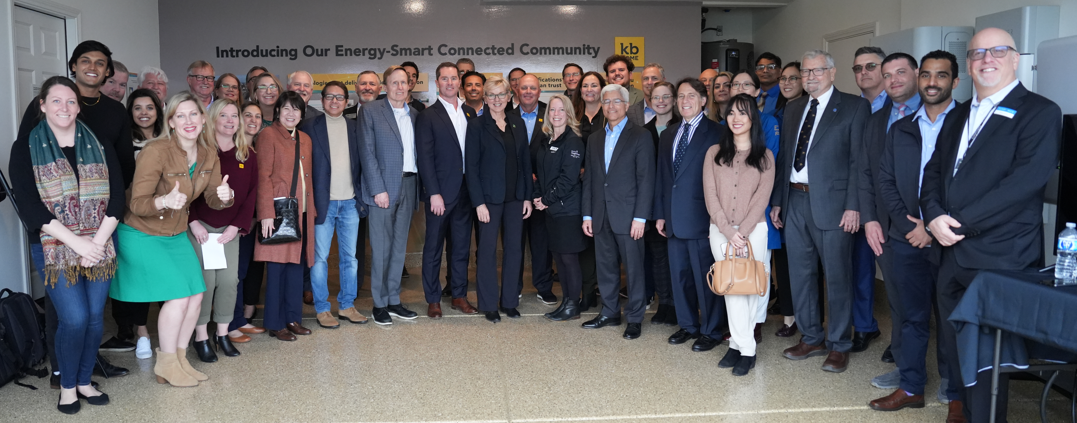
[Photo: DOE Secretary Granholm and other visitors attend an event at the Menifee, CA Connected Communities neighborhood.]
|
|
Highlights from the Eastern Connected Communities Summit |
In January of this year, DOE convened the Summit of the Eastern Connected Communities projects.
The event was hosted by the New York Power Authority (NYPA) in White Plains, NY, a partner on the Electric Power Research Institute (EPRI) CC project. The Summit brought together more than 60 attendees including DOE staff, CC project team members, and regional stakeholders, as well as team members from Berkeley Lab, the CC National Coordinator.
Day one included three panel sessions with staff from utilities, an ISO, a program implementer, and the project teams. The first panel, Bulk Power System and GEBs, identified various ways virtual power plants (VPPs) could participate in the bulk power market; it also explored challenges that the aggregator business model faces in becoming economically favorable. The second panel, Distribution Systems and GEBs, explored the role of demand flexibility for distribution planning and how to right-size the distribution system for building and transportation electrification, how to demonstrate reliability value, and what the CC projects are doing to help distribution planning. The third panel, Low and Moderate Income, Multi-Family Retrofits and GEBs, explored the challenges of project financing and implementing coordinated controls, the barriers to efficiency upgrades, and what technologies look promising in this setting.
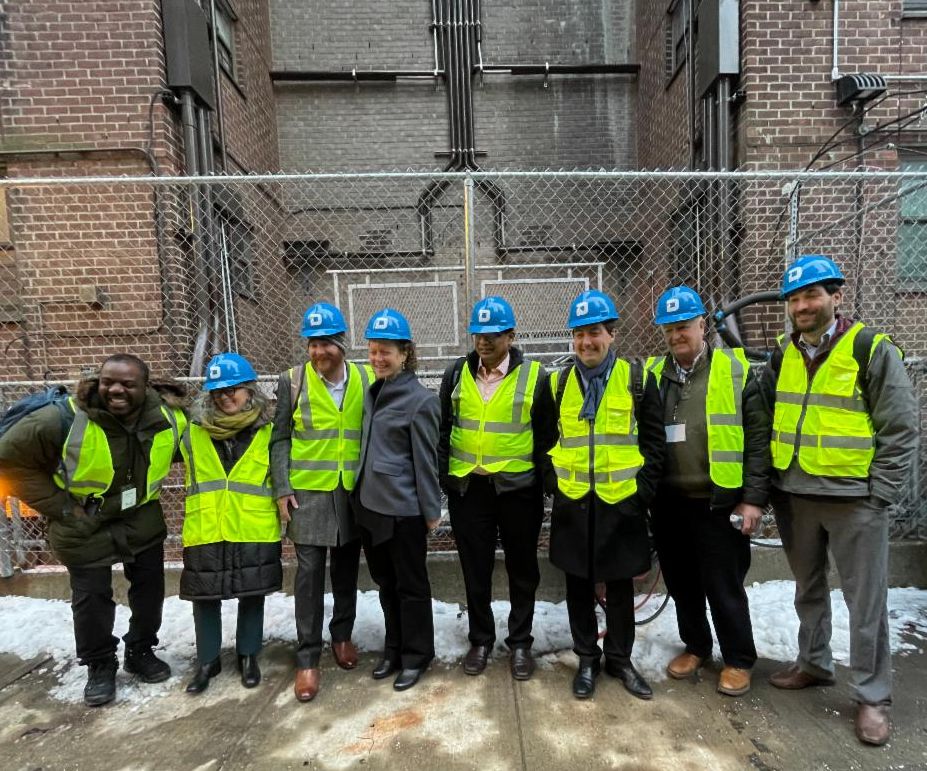
Also, on Day 1, participants attended a site tour of either the New York City Housing Authority (NYCHA) Public Housing CC site or the NYPA Integrated Smart Operations Center (iSOC) laboratory. The NYCHA site, (pictured above), represents a full electrification retrofit of a 20-story public housing complex with a replacement of the steam radiator system with variable refrigerant flow (VRF) heat pumps on each wing of the building. The district hot water (DHW) system was replaced with a cascade heat pump system to improve heating functionality. Alternatively, some attendees visited the NYPA iSOC and were able to see the impressive monitoring and learn about the predictive analytics forecasting used to prevent equipment failures and significant outages in the NYPA system.
On Day 2, the project teams participated in breakout sessions to discuss cost-effectiveness and scaling of demand flexibility solutions from the CC projects.
“The Connected Communities project has significantly impacted Edo's demand flexibility initiatives, mainly through collaboration with other utilities. Upon learning about the Spokane Connected Communities project, several utilities have expressed interest in replicating similar projects within their territories. This interest serves as a testament to the credibility and impact of Connected Communities. Edo is appreciative of the DOE and the other Connected Communities projects in bolstering demand flexibility efforts and accelerating progress in this field.”
- Emilie Bolduc, Chief Commercial Officer, Edo Energy
[Photo: NYCHA site tour showing VRF piping along the exterior of the building.]
|
|
Project Highlight: Secretary Granholm Visits Menifee, CA Connected Communities Project |
In February, DOE Secretary Jennifer Granholm visited two all-electric neighborhoods in Menifee, California that are part of DOE’s Connected Communities program. The community’s 219 homes are equipped with energy-efficient features, solar photovoltaic (PV), and energy storage and are connected through a community-level microgrid, which allows them to operate independently from the main grid during unstable grid conditions. The Menifee project is one of the ten DOE-funded pilot projects demonstrating how smart, resilient, energy-efficient buildings can help the nation reach its energy and climate goals.
The project also incorporates bidirectional charging for electric vehicles (EVs), one of the latest developments to support clean grid operations and support the microgrid. Bidirectional charging allows the vehicles to be charged for transportation but also allows them to provide power back to residents’ homes, either directly or to charge other onsite batteries. The EV battery can be used to support home loads during grid-connected operation to ensure offsetting import from the grid and thereby reducing costs to the homeowner. The EV battery can also support critical and non-critical loads when the community is islanded and the home is connected to the community microgrid.
The project partners have applied a “reduce before produce” approach to designing, constructing, and connecting the homes. First, in the “reduce” step, project partner KB Home built all-electric homes with high-efficiency building technologies to produce houses about 40% more energy efficient than typical California homes. In the second “produce” step, technologies from partner SunPower were installed, including solar PV and storage systems. The homes are connected in a microgrid and they function as distributed energy resources that can be controlled simultaneously, which provides both resiliency for the community and service to the grid.
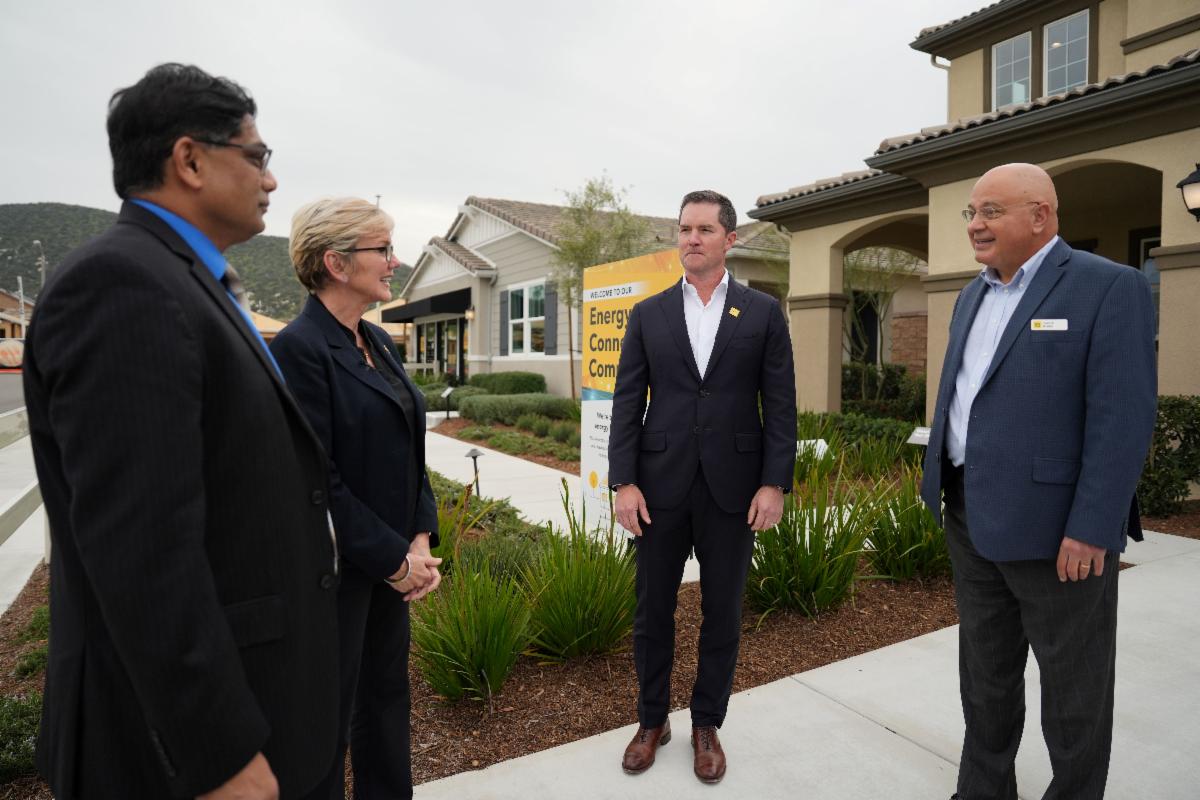
[Photo: L to R: Ram Narayanamurthy, DOE Buildings Technologies Office; DOE Secretary Jennifer Granholm; Robert McGibney, President & Chief Operating Officer, KB Home; Jacob Atalla, VP, Innovation & Sustainability, KB Home]
|
|
New OpenADR 3.0 Standard Released |
Open Automated Demand Response (OpenADR) is a standard that provides an automated communication infrastructure that allows electricity providers to communicate demand response (DR) signals directly to customers. For over twenty years, OpenADR 2.0 has been the leading protocol globally for automated DR signals.
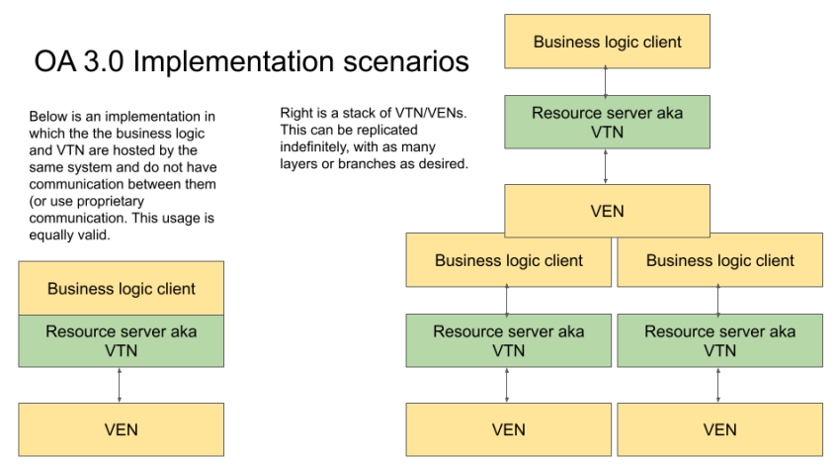
In November 2023 The OpenADR Alliance released a new version of the OpenADR standard, Version 3.0. It uses modern IT technology (such as REST principles and JSON) which makes it much simpler for IT professionals to implement than previous versions. OpenADR V.3.0 should have much wider applicability than the previous version, 2.0b, which was released over a decade ago.
OpenADR 2.0b provides communication between utilities, as well as between those utilities and their customers’ devices. OpenADR can serve any type of DR needs and programs, including event-based, price-based, and aggregator models. The new OpenADR 3.0 can serve the same sophisticated uses of 2.0b, but its simpler design enables it to be used in many application contexts that 2.0b was not suitable for, such as between devices within a single customer site, including any individual small loads. This makes OpenADR 3.0 well-suited for communicating highly dynamic prices such as those that California is currently working to make available to residential and commercial customers, those that have existed in Illinois for some years, and those that have been implemented in several European countries.
“The combination of OpenADR 3.0 and highly dynamic prices will enable widespread adoption of demand response, contributing significantly to reducing system and customer costs and integrating more renewable energy on the grid,” said Bruce Nordman, Research Scientist at Berkeley Lab and leader of communications research at the California Load Flexibility Research and Deployment Hub ( Cal-FLEXHUB). Bruce was co-editor of OpenADR 3.0 and conducts research on demand flexibility, capacity management, DC power distribution, and other topics.
Existing uses of the OpenADR 2.0b standard may continue as-is. The relationship between the two versions is similar to USB-A vs. USB-C; i.e. new products generally use USB-C, while USB-A products can continue to be used indefinitely.
The new standard was a collaborative effort among many organizations, including Berkeley Lab, which played a central role in its creation, as it did for the original versions of OpenADR. The content of the 3.0 standard is freely available for download from the OpenADR Alliance website. For further information, interested stakeholders can consult the OpenADR Alliance or contact Bruce Nordman of Berkeley Lab (bnordman@lbl.gov).
[Image source: OpenADR Alliance, 2024.]
|
|
Connected Communities: Frameworks for Utility Interaction and Coordinated Control |
|
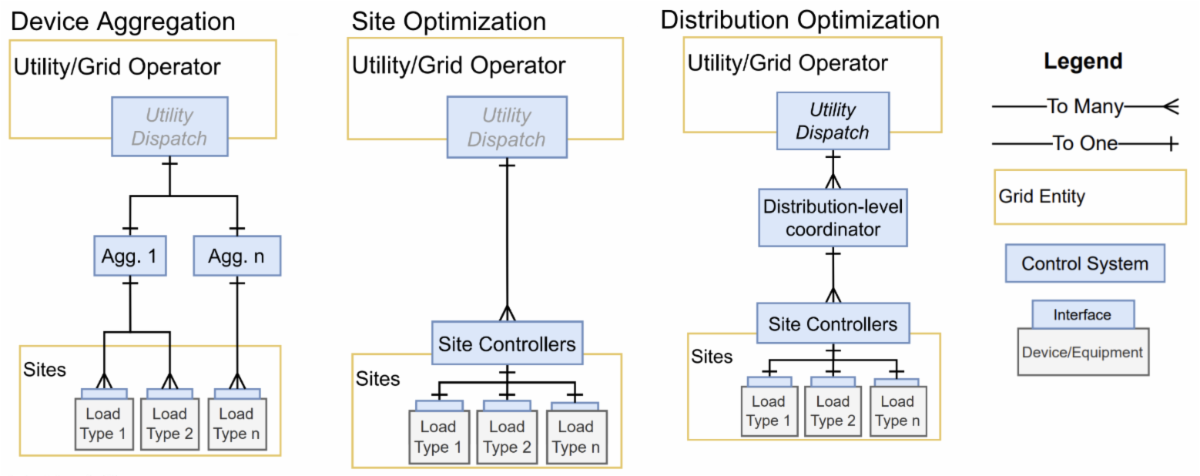
Berkeley Lab researchers have completed a study on the various controls approaches of the CC projects. Several types of coordinated control architectures have evolved in the CC program, influenced by the stakeholder use cases, existing market conditions, and the types of buildings and energy resources integrated. The authors have developed a framework of these architectures, including their use cases, benefits, and potential implementation challenges. The findings can support scalability of community-scale coordinated energy systems by clarifying tradeoffs in their design for utilities, control vendors, and developers. Results of the study have been accepted for presentation by lead author Lazlo Paul at two different conferences so far this year: The Peak Load Management Alliance (PLMA) national conference, which was held May 7-9, in Portland, OR, and the American Council for an Energy Efficient Economy (ACEEE) Summer Study conference, to be held August 4-9, in Pacific Grove, CA. |
|
To learn more about connected communities, GEBs, and grid services visit
|
|
|
|
|
|
|