|
|
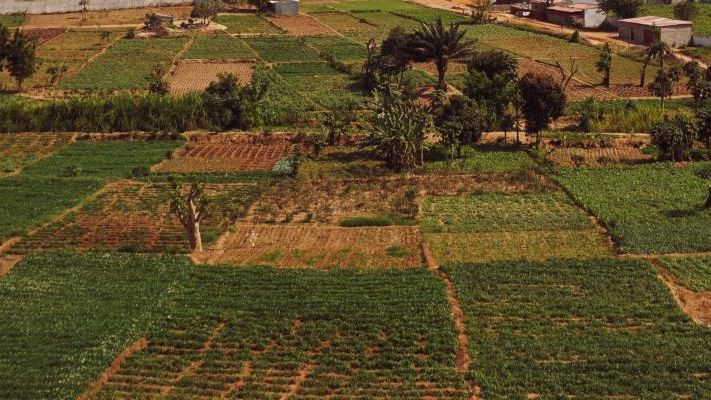
NASA Harvest Africa Program Lead, Dr. Catherine Nakalembe, recently led a team of researchers reviewing a number of open-access operational agricultural monitoring systems for several African countries. Comparing and contrasting the various systems, the data they use, and their resulting outputs, the study is an especially good resource for stakeholders lacking technical expertise but interested in utilizing EO data for agricultural monitoring.
|
|
|
|
Dr. Hannah Kerner [NASA Harvest Domestic Co-Lead and AI Lead] was recently featured by NASA Applied Sciences on her work integrating machine learning and EO data to combat global food insecurity. The profile also expands on her efforts encouraging female STEM education, civic engagement, and the underlying motivation that drives her to create positive change for both the world and her local community.
|
|
|
|
NASA Harvest Deputy Director and Manager, Dr. Alyssa Whitcraft, recently moderated a panel focusing on food security challenges across the globe and the necessary steps to combat them. The panel was part of a webinar publicizing the Deep Space Food Challenge (DSFC), an international competition where participants develop new methods for producing food during long-term space missions. In addition to the celestial ambitions, DSFC hopes that these innovative methods will create new terrestrial applications that can be used to help overcome food insecurity on Earth.
|
|
|
|
Dr. Hannah Kerner [Domestic Co-Lead and AI Lead], Christina Justice [S & SE Asia Lead; Food Security Early Warning Co-Lead], and Dr. Christopher Justice [Harvest Chief Scientist] were recently recognized by the University of Maryland’s Department of Geographical Sciences for their achievements over the past year.
|
|
|
|
Beginning with the respect for the human aspect of agriculture that she gained growing up on a vineyard and continuing through to the creation of NASA Harvest with Drs. Inbal Becker-Reshef and Christopher Justice, Dr. Alyssa Whitcraft tells the story of how the Harvest Consortium was founded and how the leadership team ensures that people stay at the center of the Consortium's focus.
|
|
Given the success of Volume I, the Research Topic “Democratizing Earth Observations-Based Science to Improve Agriculture, Food Security and Resilience, from Village to Globe: Volume II” will be accepting manuscripts for publication. Co-edited by NASA Harvest Program Director, Dr. Inbal Becker-Reshef, Dr. Kiersten Johnson [USAID], and Dr. Molly Brown [6th Grain Corporation], this Research Topic is seeking submissions that “demonstrate the extent to which the Geosciences are making revolutionary strides in applying EO data to the world’s most pressing problems while leveraging and building capacities of all stakeholders, from village to globe.” Submissions can include novel EO applications in food security and agriculture; analysis of current capacity shortfalls in fully utilizing EO data in those two areas; and the creation of new agricultural EO datasets. Given the focus on multi-level stakeholder capacity, all submissions should concentrate on local realities of the research, how stakeholders at multiple levels were engaged in the creation and execution of the project, remaining challenges to cross-stakeholder cooperation, and how cross-stakeholders can partner in future endeavors.
Abstracts are accepted through June 14, 2021. The deadline for manuscripts submission Oct 11, 2021.
|
|
Edited by Dr. Alyssa Whitcraft and Dr. Ritvik Sahajpal, the Special Issue "Cropland Carbon" in the journal Land will focus on cropland carbon and how it can be impacted by regenerative agriculture (RA) techniques. This Special Issue is seeking submissions focused on the modeling of carbon in RA systems; the use of EO to monitor how crop productivity is affected by RA management techniques; linking climate change, food security, and soil degradation in traditional vs RA systems; and creating baseline spatio-temporal datasets on RA management practices.
Manuscript submission deadline EXTENDED through November 1, 2021.
|
|
"Recent Advances for Crop Mapping and Monitoring Using Remote Sensing Data" is a Special Issue being published in Remote Sensing and edited by Dr. Mehdi Hosseini, Dr. Ritvik Sahajpal, and Dr. Hannah Kerner. This special issue is accepting submissions that demonstrate recent advances in EO applications in agriculture including "crop type mapping; crop yield prediction; cover crop mapping; crop residue monitoring; and crop water stress and disease monitoring." Papers utilizing advanced remote sensing techniques like multiresolution data fusion; SAR and optical data integration; and SAR polarimetry and interferometry are particularly welcome.
Manuscripts are accepted through Feb 28, 2022
|
|
The new Section "Discoveries in Remote Sensing" was created with the goal of promoting diversity in science. It seeks innovative work on "remote sensing applications, technology, discussions, and ethics" produced by research teams embodying the Section's goal of transdisciplinary research and diverse perspectives. In an effort to broaden the field of submitted papers, the co-editors are offering a “Get one, Give one” where they match every paid manuscript accepted in the section with a processing fee waiver for another article. The editorial board is comprised of: Dr. Catherine Lilian Nakalembe, Dr. Karen Joyce, Ms. Morgan A. Crowley, Dr. Kate C. Fickas, Dr. Cristina Gómez, Dr. Meghan Halabisky, Dr. Michelle Kalamandeen, and Dr. Gopika Suresh.
The submission deadline for the “Get one” paper is August 31, 2021 and the submission deadline for the “Give one” paper is December 31, 2021. To get involved with the “Get one, Give one” offer, email cris.wang@mdpi.com.
|
|
Dr. Hannah Kerner is curating new advancements in AI agricultural analysis in the journal AI in Food, Agriculture, and Water. Dr. Kerner, alongside co-editors Dr. Lyndon Estes and Dr. Ernest Mwebaze, is currently leading a special issue on the topic “Advances in AI Applications for Small-scale Agricultural Systems”. They are accepting submissions that “demonstrate how AI can be combined with new data collection technologies to improve the ability to monitor, measure, and/or manage small-scale farms.” They are particularly interested in methods that have only become possible in the previous 3-5 years either through the development of new techniques or the creation of new data.
The submission deadline for manuscripts is June 30, 2021. Those interested in submitting a manuscript can find more information here. Those who would face difficulty in publishing due to lack of financial support may request fee support here.
|
|
Live Q&A Session with the Down to Earth Podcast
|
|
Just over four months ago, Episode 1 of GRSS IDEA’s Down To Earth Podcast was released. Since then, nine inspirational women have shared their journey in geoscience and their trials along the way, including NASA Harvest's Dr. Alyssa Whitcraft. Join the Down to Earth team on June 7th at 10 am EDT to celebrate all of the hard work that has gone into the podcast. You will hear from the podcast guests and host, and even get a chance to win some prizes. Register today!
|
|
|
This webinar will train participants on the use of Google Earth Engine (GEE) in the accessing and analysis of EO data for land monitoring applications. Specifically, the training will cover change detection, time series analysis, land cover classification, accuracy assessment, as well as scripting in the GEE Code Editor. Participants will be provided scripts and will learn how to execute them to perform these analyses and produce maps and visualizations. Skills learned in this training apply to various geospatial applications including mapping land cover change and degradation and monitoring agricultural conversion and expansion. |
|
|
The International Society for Photogrammetry and Remote Sensing (ISPRS) will be hosting its 2021 Congress virtually in June 2021. The meeting convenes every four years and provides a platform for Society members, as well as other PRS researchers by invitation, to present recent advances in the field. Delayed from the initial 2020 meeting, the 2021 meeting has gone virtual. NASA Harvest’s Mehdi Hosseini will be presenting on Harvest’s efforts analyzing crop conditions post-Iowa derecho in August 2020. Meeting information will be provided in a future newsletter once official program is released by ISPRS. |
|
|
IGARSS 2021 Symposium will focus on crossing the borders that exist between countries and research institutes; different collection platforms; data sources; and disciplines. In an attempt to increase accessibility, IGARSS has created an online platform that will run concurrently with the in-person events in Brussels. More info can be found here.
|
|
|
|
|
|
|
|