|
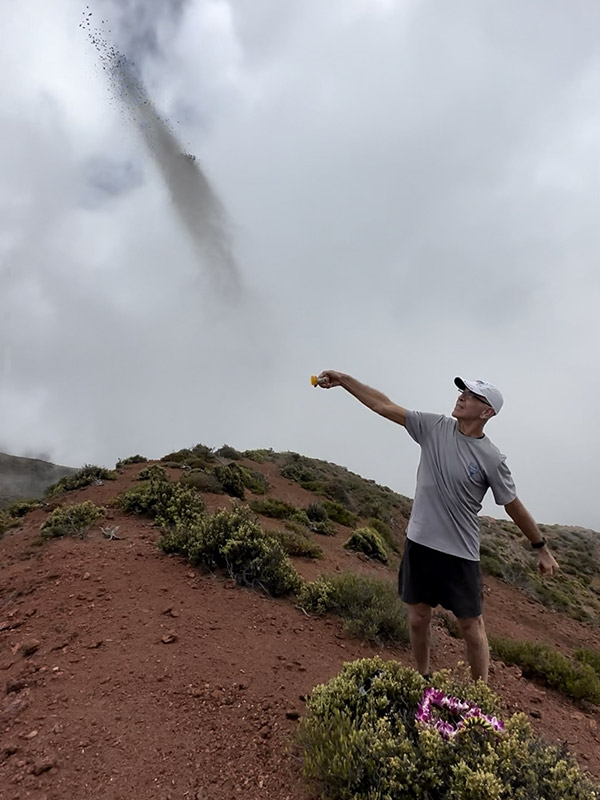
1. This past Monday evening, I hosted a post Lavaman ohana party at the King Kam pool bar, where friends gathered to honor the memory of Ken 'Cowman' Shirk, a much-loved member of the triathlon community. The next morning, a small group of us hiked up to the summit of the Hualālai volcano to fulfill Ken's wish to have his ashes spread at this special place. Right before the trek, I learned of the passing of Nancy Grossman, another friend, and added a lei to honor her at the summit as well.
2. In The Heavens, we have two more 'must see' celestial events to add to 2024: a comet on the western horizon and a nova explosion in the constellation corona Borealis.
3. We have two religious holidays coming up this week Vaisakh, a Sikh spring festival marking the solar new year and Ram, Navami, the Hindu celebration of Lord Rama's birth.
4. A National Geographic film crew has captured the first ever video of Emperor penguin chicks leaping off a 50-foot-high ice shelf into the Southern Ocean for their first swim.
5. In our Artist's Corner we have an update on new work from artist Del Geist that was recently installed at The State University of New York's Old Westbury campus.
6. In this week’s Pet's Corner we have some unusual animal pairings starting Cita Scott's Akita Grim and his best friend, a chicken named Phoenix.
| |
Now, to this week's Flock. | |
1. Honoring Friends? Ken 'Cowman' Shirk & Nancy Grossman
| |
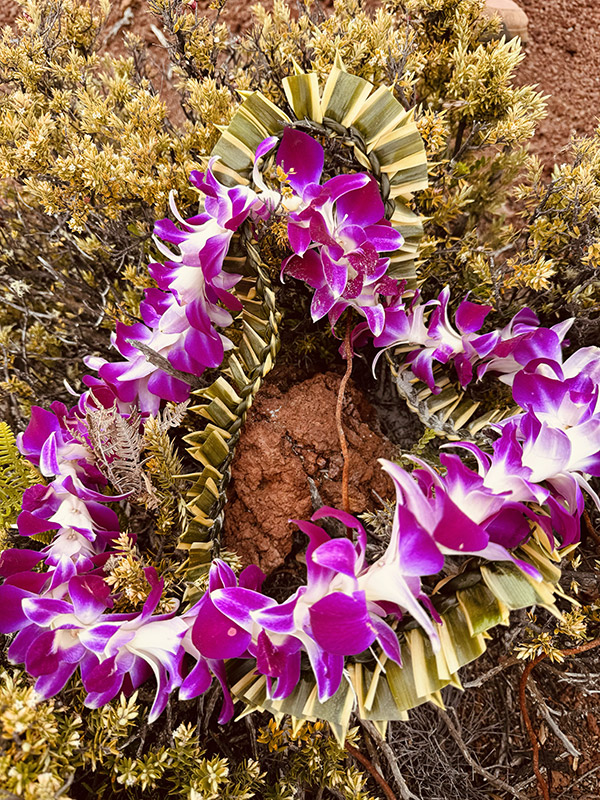
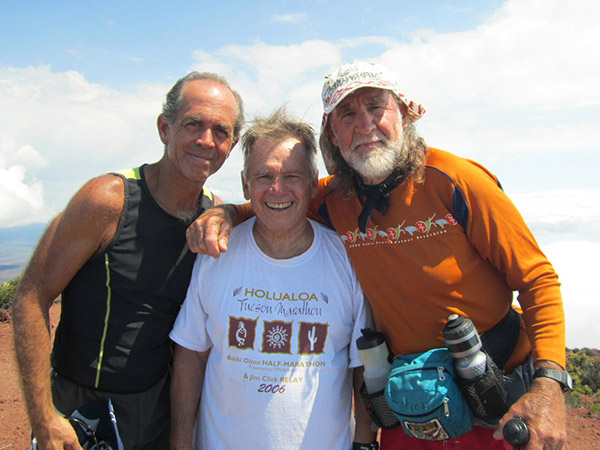
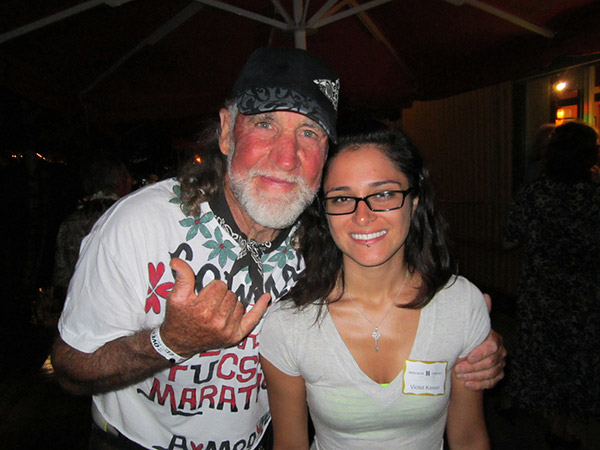
The triathlete community lost a special friend this past year with the passing of Ken "Cowman" Shirk last August. On Monday evening a select group gathered together at the King Kam pool bar for a post Lavaman ohana party and to celebrate Cowman's life. Ken's friend and the caretaker of the Cowman's legacy, Gary Sheilds, shared two suitcases of mementos and racing t-shirts from Cowman. The following morning at dawn, Cowman's close friend Gary Theriault, my daughter Violet, and I began the five hour trek up the Hualālai volcano to fulfill Cowman's wish to have his ashes spread on its summit. Shortly before we began our hike up Hualālai, I learned of the passing of another friend, Nancy Grossman. While we were at the summit we left offerings of a lei of purple orchids to honor Nancy alongside the forest reeds lei we left honoring Cowman. | |
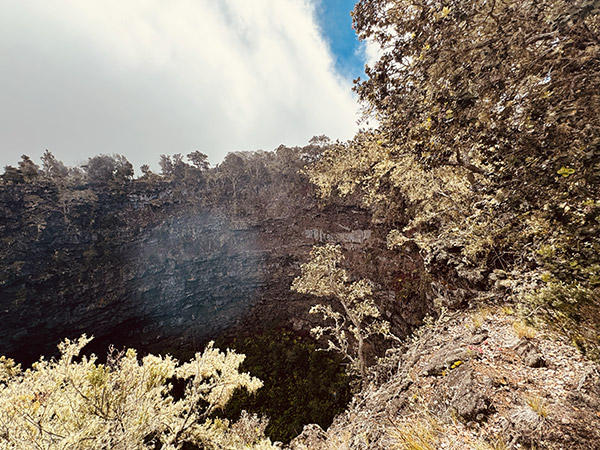
A pit crater on the way up the Hualālai volcano | |
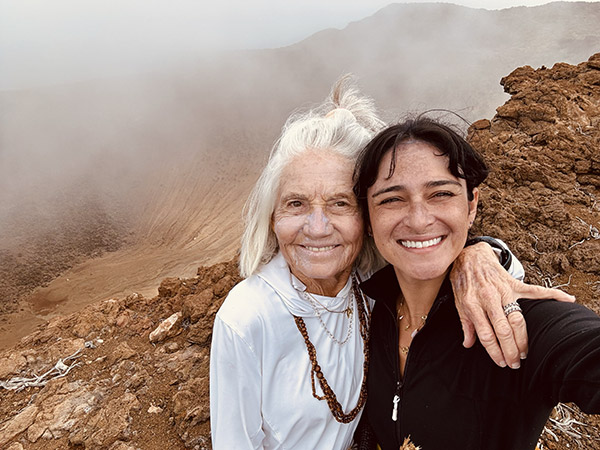
Beth and Violet at the summit of Hualālai | |
The shrine to Ken 'Cowman' Shirk and Nancy Grossman | |
|
Gary Theriault, Michael Kasser, & Ken 'Cowman' Shirk
on the summit of Hualālai in 2011
| |
The following posts are from shortly after Ken's passing and can be found in the August 4th, 2023 issue of The Flock. | |
Remembering a Legend:
Ken 'Cowman' Shirk, aka Cowman A MooHa
| |
|
Ken, known for wearing a helmet sporting fur and large bovine horns was an ultramarathon runner who in 1976 was the ninth person to complete the course of The Western States Trail Ride on foot. In 1977 the Western States Endurance Run was officially established on the same course. As of 2006 he also had raced officially and unofficially in every Ironman World Championship except the first one.
In a 2006 article in the Tahoe Daily Tribune wrote this about Ken:
No matter what the description, and no matter what the event, there are never any dull moments when Cowman shows up. And that’s every bit as true today as it was three decades ago when this endurance athlete – also known as Ken Shirk – and his famous set of buffalo horns literally streaked into the limelight at Lake Tahoe and, in time, worldwide.
They also listed many of his accomplishments up to that time.
He has finished the Boston Marathon more than 15 times and the Honolulu Marathon more than 25 times and has made it to the finish line more than 22 times at the Kilauea Volcano Marathon, billed as the world’s most difficult marathon.
Cowman tries to pass on a message when possible. For example, he ran the Boston Marathon earlier this year and carried a sign calling for “World Peace” over the 26.2-mile distance.
More recently, he continued to compete in nearly every race that fell in the islands of Hawaii, finishing the Aloha run just last year.
Cowman was one of a kind, a friend, a father, and an unmatched athlete.
Goodbye my friend.
| |
Recalled: Simpler Times at The Hawaii Ironman | |
|
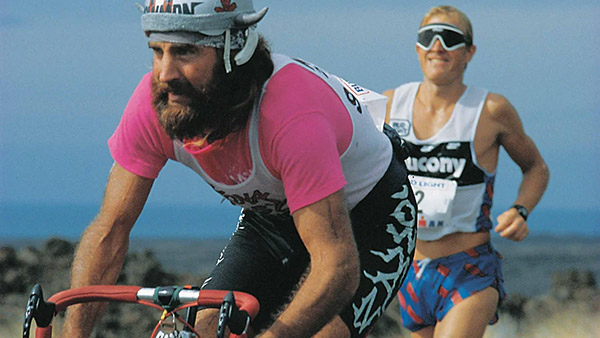
The year was 1985 and Scott Tinley (“S.T.”) was leading the eighth ever Ironman Triathlon. By the finish, Tinley’s gap over Chris Hinshaw would end up being about 26 minutes. I was in a convertible covering the event while chatting with S.T. as he cruised the marathon with his huge lead. Next to me was Lois Schwartz, the lead photographer for the magazine we both worked for, Running and Triathlon News. As Ken Shirk, aka Cowman, approached on his bike, Schwartz captured this classic image of Cowman heading toward the finish of the ride with Ironman champion Tinley running toward the turnaround.
We didn’t think much of it at the time, but the photo symbolizes what the Ironman had always been about. The Ironman’s creators had always envisioned fast guys and gals up front battling for the win while average, everyday folks joined them on the same roads simply to do something they thought was impossible.
| |
2. The HEAVENS: Comet 12P/Pons-Brooks & a Coming Nova
| |
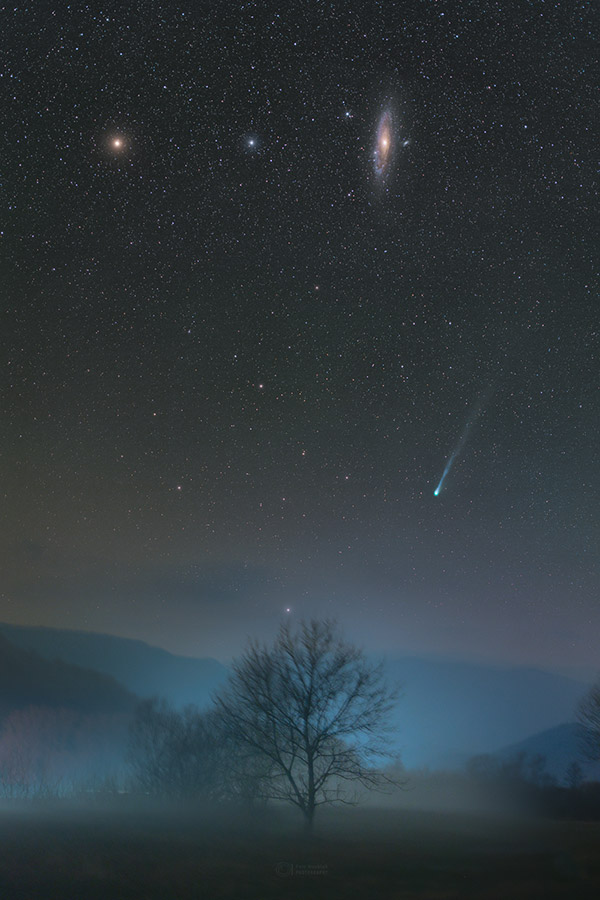
Image: Petr Horálek / Institute of Physics in Opava | |
You still have time to spot comet 12P/Pons-Brooks, a.k.a. the 'Devil Comet', in the early evening sky through mid- April. the comet will be too dim to see with the naked eye by the end of the month. | |
When and How to Spot the 'Devil Comet' | |
|
Comet 12P/Pons-Brooks is one of the brightest known periodic comets. It earned the nickname of “devil comet” in 2023 when an outburst caused the comet to have an asymmetrical appearance, like having horns. It comes around every 71 years and is currently getting brighter as it flies toward the Sun
In the Northern Hemisphere, the comet is best viewed with binoculars or a small telescope – right after the Sun dips below the horizon, look West just beneath the Moon, and just right of Jupiter. An hour after sunset, the comet drops so low, it will be difficult to see without a perfectly clear view of the horizon. The comet then sets an hour later.
| |
What's Up: April 2024 Skywatching Tips from NASA | |
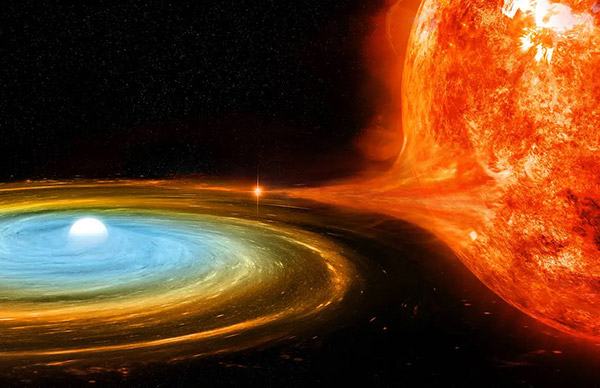
A once in a lifetime nova will be visible in the constellation Corona Borealis to the naked eye between now and September. The binary star system T Coronae Borealis consisting of a red giant and a white dwarf explodes in a runaway thermonuclear reaction approximately every eighty years and is expected to be visible this year. | |
View Nova Explosion, ‘New’ Star in Northern Crown | |
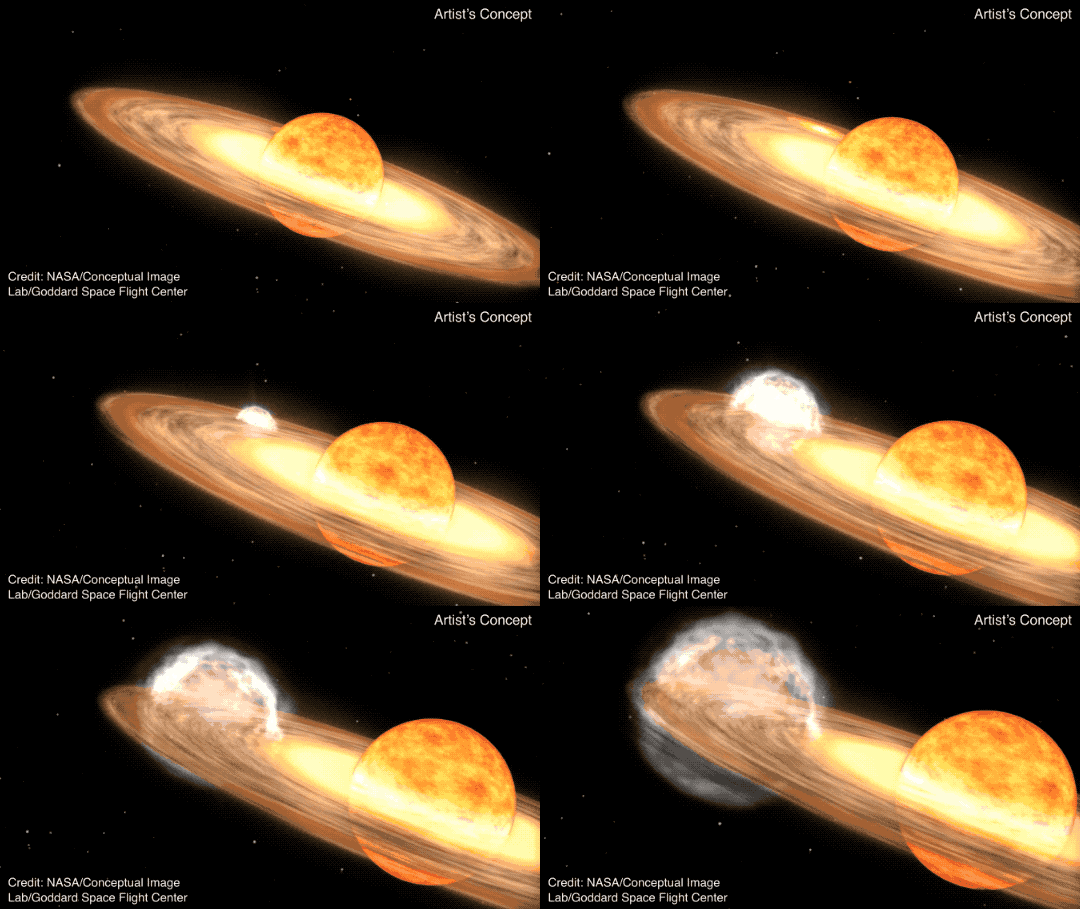
A star system, located 3,000 light-years away from Earth, is predicted to become visible to the unaided eye soon. This could be a once-in-a-lifetime viewing opportunity as the nova ouburst only occurs about every 80 years. T Coronae Borealis, or T CrB, last exploded in 1946 and astronomers believe it will do so again between February and September 2024. | |
|
A red giant star and white dwarf orbit each other in this animation of a nova. The red giant is a large sphere in shades of red, orange, and white, with the side facing the white dwarf the lightest shades. The white dwarf is hidden in a bright glow of white and yellows, which represent an accretion disk around the star. A stream of material, shown as a diffuse cloud of red, flows from the red giant to the white dwarf. The animation opens with the red giant on the right side of the screen, co-orbiting the white dwarf. When the red giant moves behind the white dwarf, a nova explosion on the white dwarf ignites, filling the screen with white light. After the light fades, a ball of ejected nova material is shown in pale orange. A small white spot remains after the fog of material clears, indicating that the white dwarf has survived the explosion.
Credit: NASA’s Goddard Space Flight Center
| |
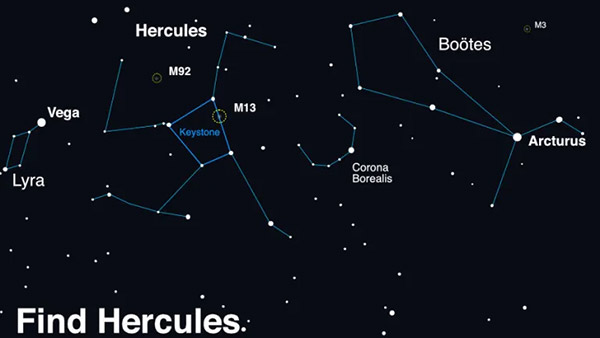
A conceptual image of how to find Hercules and his mighty globular clusters in the sky created using a planetarium software. Look up after sunset during summer months to find Hercules! Scan between Vega and Arcturus, near the distinct pattern of Corona Borealis. Once you find its stars, use binoculars or a telescope to hunt down the globular clusters M13 and M92. If you enjoy your views of these globular clusters, you’re in luck – look for another great globular, M3, in the nearby constellation of Boötes. | |
3. HOLIDAYS: Vaisakhi & Ram Navami
| |
This Saturday , April 13 is Vaisakhi, also known as Baisakhi, one of the most important Sikh Holidays. The spring festival marks the beginning of the new solar year and holds significance to both Sikhs and Hindus. | |
What is Vaisakhi, or Baisakhi and how is it celebrated? | |
|
Vaisakhi is one of the most important dates in the Sikh calendar. Vaisakhi is a spring festival which happens on the 13 or 14 April every year. It is a day to celebrate 1699 - the year when Sikhism was born as a collective faith.
But why is Vaisakhi so important and where did it come from?
History of Vaisakhi
Vaisakhi has been a harvest festival in Punjab - an area of northern India - for a long time, even before it became so important to Sikhs.
In 1699, Guru Gobind Singh chose the festival as the moment to establish the Khalsa - that's the collective name given to Sikhs who've been baptised.
The story goes that at the festival, he came out of a tent carrying a sword and said that any Sikh prepared to give his life for his faith should come into the tent.
Five men disappeared into the tent, and the Guru came out - alone - with blood on his sword. This worried the crowds.
That is until the five men then came out from the tent unharmed and wearing turbans.
They became known as Panj Piare or the 'Beloved Five' - and they were to be the first members of the Khalsa.
They were baptised by the Guru who sprinkled them with Amrit, which is the Sikh word for holy water. He also said prayers.
This ritual became the basis of the Sikh baptism ceremony.
| |
This coming Wednesday is the Hindu Holiday Ram Navami. Navami is the Sanskrit word for "ninth". Ram Navami falls on the ninth day of the Chaitra month in the Hindu calendar. This year, that coincides with April 17th on the Gregorian calendar. I would like to say, "May the divine grace of Lord Rama always be with you." on this holiday. | |
Shree Ram Navami 2024: The Celebration of Lord Rama's Birth | |
From: Vedantu, By; Aiswarya, April 5, 2024 | |
|
Ram Navami Story: The Birth and Legacy of Lord Rama
To truly appreciate Shree Ram Navami, we must first understand the captivating tale of Lord Rama. According to Hindu mythology, Lord Rama was born to King Dasharatha and Queen Kausalya in the ancient city of Ayodhya. His birth is believed to have occurred thousands of years ago, during the Treta Yuga, a time of great virtue and righteousness.
The story of Lord Rama's life is chronicled in the epic Ramayana, written by the sage Valmiki. It narrates the journey of Rama, his wife Sita, and his loyal companion Hanuman, as they face numerous trials and tribulations. From his exile to the forests to his epic battle against the demon king Ravana, Lord Rama exemplifies courage, compassion, and devotion to righteousness.
Ram Navami marks the auspicious day when Lord Rama incarnated on earth to rid the world of evil and establish dharma, or righteousness. His life serves as an inspiration to millions, embodying the values of honor, sacrifice, and love for all beings.
| |
4. NATURE: Penguins in the Southern Ocean
| |
|
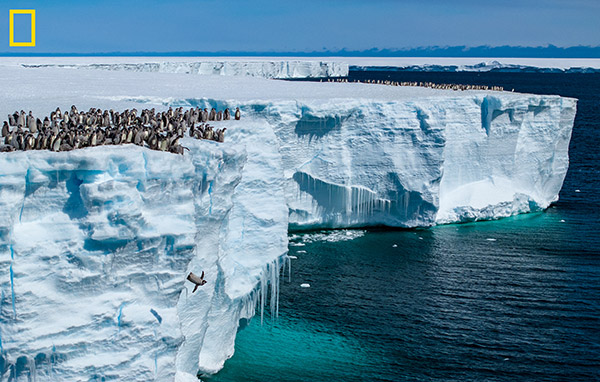
Emperor penguin chicks jump off the ice shelf edge for their first swim at Atka Bay on the Ekström Ice Shelf in Antarctica. Learn about the historic penguin leap at NatGeo.com.
National Geographic/Bertie Gregory
| |
National Geographic Photographers were able to film baby penguins leaping from a 50-foot-high ice shelf into the Southern Ocean for their first swim. This is the first time this behavior has been caught on video. It's truly spectacular footage. | |
Baby penguins seen cliff diving on camera for 1st time | |
|
Nat Geo Explorer Bertie Gregory has spent the last decade traveling to the far off corners of the Earth to capture creatures in the wild. This time, he camped on the Antarctic Peninsula and captured never-before-seen behavior while tracking a flock of baby penguins.
"This colony was about 10,000 strong, so a lot of noise, a lot of fun smells, and a lot of fun characters," he said. "We spent two months camping alongside an emperor penguin colony."
"It's called fledging, when they take their first swim," he said. "Normally they jump off of sea ice, which is one or two feet high. We were noticing that these trains of chicks were going past to a different place. So I launched the drone, flew it over there to see what was going on, and realized they were stacking up on the edge of a huge 50-foot ice cliff. One by one they started to jump off this 50-foot ice cliff to take their first swim in the Southern Ocean."
| |
Baby penguins seen cliff diving on camera for 1st time | |
5. ARTIST'S CORNER: Del Geist Update
| |
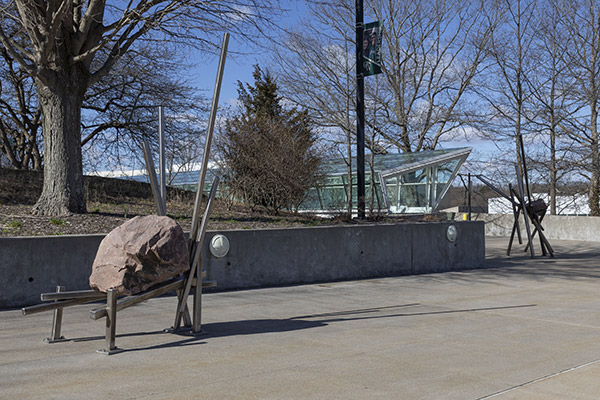
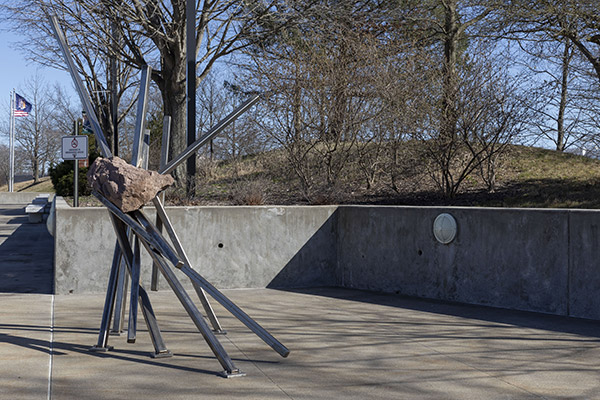
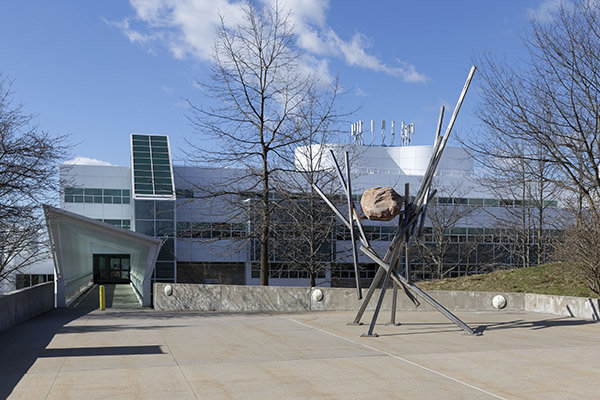
Del Geist is one of our favorite artists at the Flock, we first featured Del and his wife, Patricia Leighton in the August 12th, 2022, issue of The Flock. Del is best known for his public sculptures which often include natural material specific to the location of the piece. Most recently, The State University of New York has added the installation “Cracked Ice" to their Old Westbury campus. I'm always thrilled to see Del's work. | |
"Cracked Ice"- a public art exhibit installed during Spring Break 2024 - is the first new major public art exhibition erected at SUNY Old Westbury in more than 40 years. | |
Created by artist Del Geist, "Cracked Ice" features three structures of stone and stainless steel, symbolizing massive boulders suspended by the remnants of ancient glaciers, now shrinking from the gradual melting of ice over time. The works are sited to appear slightly precarious as a metaphor for climate change, alluding to a precarious situation for the earth. | |
|
Muir
10 feet high x 3.9 feet x 6.5 feet
| |
|
Champlain
10.5 feet high x 4.5 feet x 12.5 feet
| |
|
The presence of these works speaks to our campus' commitment to building a more sustainable world. These sculptures will serve as a discussion and teaching point, offering all on campus the opportunity to experience the artist's craft and consider the questions and concerns around climate change that led to his creations.
– Timothy Sams, president, SUNY Old Westbury
| |
|
Laurentide
18feet high x 10 feet x 11 feet
| |
6. PET'S CORNER: Surprising Friends
| |
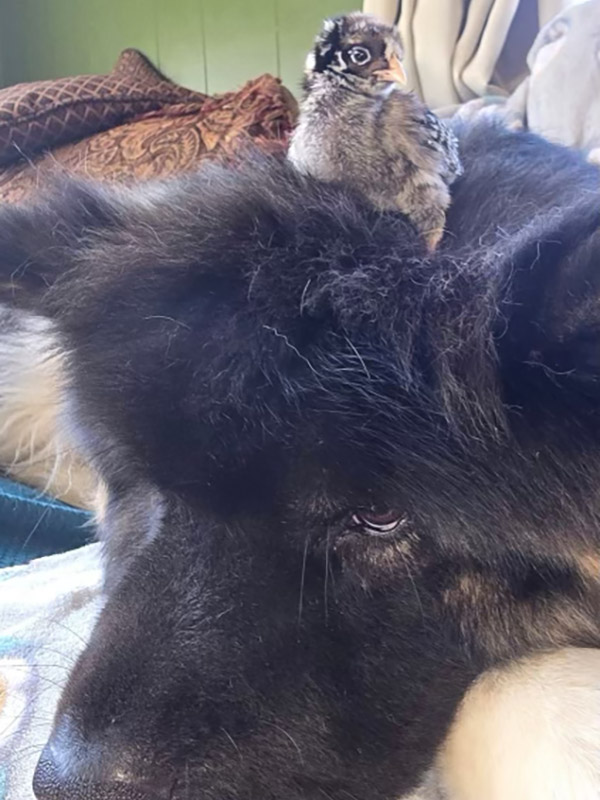
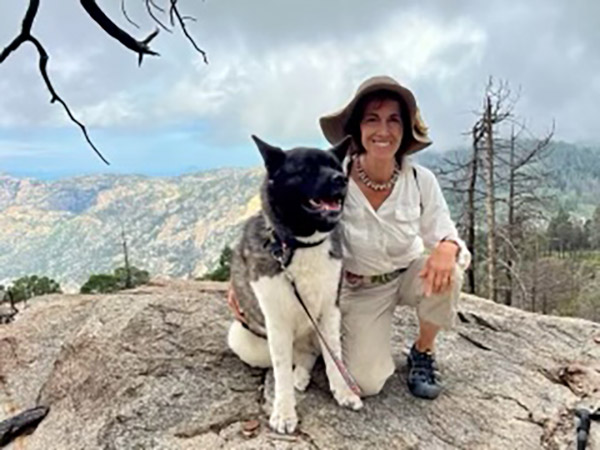
In this weeks Pet's Corner we get to meet some surprising friends. First, we have frequent Flock contributor Cita Scott's Akita, Grim, who just loves his little friend Phoenix.Grim is the brother to Cita's other Akita, Daisy who we first met last year in the May 12, 2023 issue of The Flock Phoenix is a chicken and the two are inseperable. Grim just loves his little friend. | |
Grim with Phoenix when Phoenix was just 10 days old and only weighed two ounces. | |
Grim’s sister Daisy out for a hike with Cita. | |
Rescue Crow Goes On Walks With His Favorite German Shepherd | |
Bear Cub meets fawn for first time | |
|
These Flock regulars are always here for you:
In coming weeks: we'll be sharing more investigative articles from our roving reporter William George, original writing from Flock favorite Dino DeConcini, and an update on the Marolt brother's coming expedition to Argentina.
| |
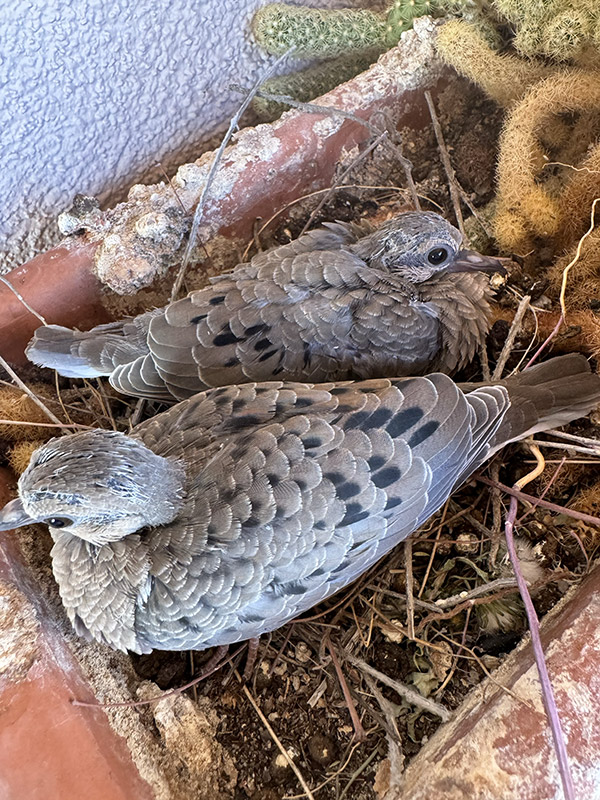
Mourning dove fledglings just outside my door. | |
Beth is in beautiful Kailua-Kona, Hawaii. | |
Don't Be Shy: Share Your Stories! | |
I'm looking forward to sharing more of your personal stories - oral, written, or otherwise, as we enter our second year. I'd so love to present them to The Flock, hit a mailbox below to share your story. | |
Subscriptions & Idea Submissions | |
|
Feel free to forward this email to a friend. If this was forwarded to you and you would like to receive your very own Flock Newsletter, you can sign up here. If you have any questions or suggestions for future Flock resources, don't hesitate to contact me.
Your fan and friend,
Beth
| | |
The information and materials contained or referenced in this newsletter are for informational purposes only and not intended to be a substitute for professional medical advice, diagnosis, or treatment. Always consult a physician or other qualified medical professional with any questions you may have regarding a medical condition or treatment and before beginning a new health care regimen. Do not disregard professional medical advice or delay seeking medical advice or care based on anything contained in this newsletter. | | | | |