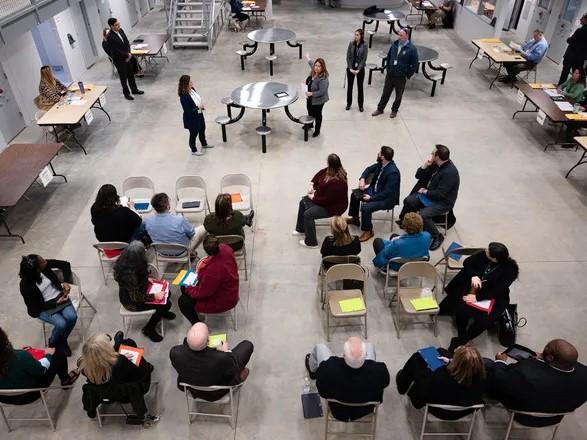
Welcome to the University of Oklahoma Carceral Studies Consortium Newsletter. The Carceral Studies Consortium strives to build a community for intellectual exploration that includes faculty, staff, graduate students, community members, practitioners, and organizers.
Carceral Studies is concerned with the independent function and nexus of the political and social systems that organize, shape, sustain, and entrench practices of punishment, surveillance, incarceration, and harm.
|
|
Featured Consortium Opportunities |
|
Carceral Studies Graduate Student Fellowship
The Carceral Studies Consortium offers an outstanding graduate student with an interest in advancing Carceral Studies a 12-month, .20 FTE position (8 hours per week). This CSC Graduate Student Fellow serves as the student representative on the Carceral Studies Board of Directors, as well as provides critical support for CSC initiatives throughout each academic year (July 1 to June 30). Applications are due by May 6, 2022.
|
|
|
2021-2022 Carceral Studies Consortium Student Work Prize
The Carceral Studies Consortium is inviting original student essays or creative works developed as part of any course in any discipline during the 2021-2022 academic year that engages the topic of Carceral Studies, broadly conceived. Submissions are not limited to essays, but may be in any creative or scholarly format, including but not limited to art in any medium, story maps, and more. Applications are due by May 2, 2022
|
|
|
A recent complaint filed by 10 state and national immigration rights groups allege that the Houston Asylum Office is violating "due process and statutory obligations" when interviewing asylum seekers. One of the major complaints is the mishandling of credible fear interviews conducted to discern the risk of danger for asylum seekers if they were to return to their country. For example, one case found that the testimony of an asylum seeker was incorrectly summarized by an officer who omitted significant events. Further allegations against the Houston Asylum Office include scheduling credible fear interviews without informing the asylum seeker's attorney; forcing asylum seekers to be interviewed in languages in which they are not fluent; applying incorrect standards in evaluating asylum seeker's claims; using adversarial interview techniques on vulnerable people, including children and survivors of persecution and torture. The initial complaint also contains a list of recommendations for correcting the issues present in the Houston office. Vickie Neilson, an attorney with the National Immigration Project, stated that the goal of these recommendations is to get "the asylum officers to do what they are actually supposed to be doing. A lot of it is training, but then there's a real need for accountability for officers who are not following the (U.S. Citizenship and Immigration Services) guidance."
|
|
Bucks County Women's Jail in Pennsylvania recently held a re-entry simulator for community members to experience the monetary difficulties of life after incarceration. Although the simulation could not replicate the many factors that affect the lives of previously incarcerated people, the experiment was designed to let participants witness the lack of support people receive once they have finished serving time. The participants received pouches with a backstory for their character and a combination of common resources such as money or a social security card. Participants then had two hours to attempt to complete a series of tasks ranging from meeting with a probation officer to paying rent while also receiving randomized "Life [event] Cards." Nick Emeigh, the director of outreach and development for NAMI Bucks County, a mental health nonprofit, was one of the fifty participants and he experienced frustration and desperation from a lack of support when trying to accomplish these tasks. Emeigh ultimately failed the simulation when he found himself back in jail within the first month as he could not find a job, pay rent, stay sober, or earn enough on disability to afford reliable transportation. Although Emeigh could not complete the simulation without returning to jail, he believes the exercise could provide a "dry run" for individuals before re-entering their communities and should enlighten community members about the struggles that formerly incarcerated populations face.
|
|
Thomas Northcut / Getty Images |
|
The Illinois Department of Corrections (IDOC) was recently found to have raised more than $55,000 through the use of prisoner labor across eighteen facilities between 2016 and 2018. The IDOC held fundraisers where incarcerated people washed cars, shined shoes, and gave haircuts without adequate compensation during this period. These funds were then directed towards Employee Benefit Funds (EBF), which correctional officers used to hold office raffles, throw holiday parties (including bar tabs), and cover golf tournament entrance fees. As if the practice of prison labor were not bad enough, reports from incarcerated individuals depicted non-monetary exploitation of labor as well. Sources in the IDOC claimed that guards would routinely have incarcerated people wash their personal laundry, provide mechanical work on their vehicles, give free haircuts, and even build playhouses for the children of correctional officers. Bianca Tylek, founder and executive director of Worth Rises, a national organization working to dismantle the prison industry, summarized the atrocities in the IDOC by stating, "to have state-sanctioned prison slavery is bad enough, and to have personal slavery is unconscionable. Those things don't stop at the car wash. They have no problem being masters and slaves, and that's worrisome."
|
|
Chloe Jones / PBS NewsHour |
|
According to Sam Levin, the Los Angeles Sheriff's Department (LASD) "appears to be routinely violating use-of-force policies, with supervisors failing to hold guards accountable and declining to provide information to the monitors tasked with reviewing the treatment of incarcerated people" Human monitors were introduced to the LASD in 2014 in response to a case involving beatings in jails. Currently, monitors Robert Houston and Jeffrey Schwartz found that there has been a rise in "punches to the head[s]" of incarcerated individuals during the last two years. In their report, the monitors cite one instance where a deputy responded to an incarcerated person who had "walked away from him" by slamming the person into the wall and punching him multiple times in the head before another deputy delivered some punches as well. Yet, even with evidence of multiple assaults, the monitors wrote that deputies who used excessive force were only occasionally sent to "remedial training." In addition, their supervisors were often "not held accountable" if they failed to document such violations. Mark-Anthony Clayton-Johnson, executive director of Dignity and Power Now, summarized the "culture and history of the department" as a continued pattern of violence by stating that "after 10 years of exposure, 10 years of scandal, 10 years of reform, this department has had a lot of opportunities to get this right . . . but has continued to revert back to some of the most vicious attacks on Black and brown people."
|
|
Please share recent research you would like to see featured, including your own!
Send it to carceralstudies@ou.edu
|
|
ABSTRACT: A signature feature of the get-tough era in American corrections has been the proliferation of restrictive housing (RH). Although sometimes equated with solitary confinement, this housing encompasses a variety of distinct forms of incarceration. They are unified by an emphasis on restricted movement and privileges—yet vary in their design and uses. Despite that fact, little is known about the prevalence of different forms of housing. To address this research gap, we use a case study of Florida policy and administrative records data to illuminate the variety of RH types and the varying prevalence of each. We then discuss the implications of the findings for the study of RH uses and impacts and for policy.
|
|
ABSTRACT: This is the first comparative empirical study of miscommunication in US police interrogations and UK police interviews with suspects. The research was based on an extensive real-life data consisting of 100 transcripts. The main goal was to detect when and why miscommunication occurs in these two policing contexts, whether and how it gets resolved, and what the consequences of miscommunication may be. Miscommunication arises when speech participants draw opposing inferences from the same communicative exchange. Two main sources of miscommunication were identified: a) inferential ambiguity and b) linguistic complexity. The quantitative and qualitative analyses showed that, while the types of miscommunication are shared in the two jurisdictions, their frequencies and functions differ in some respects. Namely, deliberate miscommunication is more likely to be found in the US context while in the UK miscommunication is more likely to occur inadvertently. On the other hand, linguistic complexity gives rise to miscommunication more often in the UK than in US police communication. We discuss the results with respect to the two different approaches to questioning suspects in the two locales and translate our findings into practical applications for the training of law enforcement and language professionals worldwide.
|
|
EXCERPT: The results of this study affirm the catalytic role of pre-release Medicaid enrollment assistance for reducing barriers to healthcare access in the initial weeks following release from prison. Yet, as Helen E. Jack, MD, writes in her invited commentary, this study "shows us that Medicaid enrollment assistance may be necessary, but is not sufficient, to support people released from prison to link with community-based health care services." It is crucial, Jack says, that "research and implementation efforts consider the social and structural determinants of health that recently released patients face." Homelessness, poverty, racism, and discrimination due to criminal history, can all be "barriers to accessing care and may contribute to poor health outcomes."
|
|
ABSTRACT: BACKGROUND AND AIMS - Incarceration produces a specific public health threat for drug overdose, and correctional settings do not offer medication for opioid use disorder. This study examined the overall impact of jail incarceration on overdose, the specific hazard for those booked on a syringe-related charge and the proportion of all overdose decedents in the community who were in the jail prior to death. DESIGN AND SETTING - A cohort study of fatal overdose outcomes among a sample of individuals booked into and released from jail between 1 January 2017 and 31 December 2019. Marion County, IN, USA. PARTICIPANTS All individuals released from one county jail between 1 January 2017 and 31 December 2017 and decedents who died within the county from an accidental fatal overdose between January 2017 and December 2019. MEASUREMENTS AND FINDINGS Using information on all jail booking events, including charge type, during a 5-year period (January 2015–December 2019), we looked at the hazard of accidental fatal overdose post-release, controlling for age, sex and race. Of all overdose deaths in the county, 21% (n = 237) had been in the county jail within 2 years prior to their death. Each prior booking increased the hazard of mortality by approximately 20% [hazard ratio (HR) = 1.21, 95% confidence interval (CI) = 1.15, 1.28], while the presence of a syringe charge at most recent booking prior to release more than tripled the hazard of mortality (HR = 3.55, 95% CI = 2.55, 4.93). CONCLUSIONS - In Marion County, IN, USA, there appears to be an association between increased risk of fatal drug overdose and both syringe-related arrests and repeat jail bookings.
|
|
Updates, Events & Opportunities |
|
New Carceral Studies Board Member
The Carceral Studies Consortium is pleased to welcome our newest board member:
|
|
|
University of Pittsburgh Hosts First Symposium for Reimagining Educational Work for Collective Freedom: The Labor Strike as a Portal
The first symposium is titled "The longue durée of freedom work: Bridging history and the current movement through the agricultural mass strike." The symposium will present three dialogues open to a global audience from May 19 through May 20. The details about each dialogue and registration can be found in the linked flyer below.
|
|
|
Russell Sage Foundation Race, Ethnicity, and Immigration Grant
The Race, Ethnicity, and Immigration grant is offering individual funding up to $175,000 for research that addresses the “severe consequences of the Covid19-pandemic, including its economic disruptions, and the recent mass protests to combat systemic racial inequality in policing and other institutions have reaffirmed the importance of social science research examining economic, political, racial, ethnic, generational, and social inequalities relevant to public policy and social change.”
|
|
|
OU Libraries and Carceral Studies Consortium Assemble “Racial Capitalism” Library Guide
In a collaborative effort between OU Libraries and the Carceral Studies Consortium, a library guide on “Racial Capitalism” is now available for all students, staff, and faculty. Racial capitalism contends that racist oppression is central to how capitalism operates. Racial subjugation is not one specific manifestation of a larger capitalist system, but rather, capitalism itself is a racial system. The guide includes resources (written, audiovisual, and contacts) for information about the carceral state, crimmigration, and race and labor.
|
|
|
ABOUT
The Consortium Newsletter will offer a roundup of a few selected articles that reflect today’s news, organizing, and thinking related to the carceral state. We understand that freedom work is built on education and engagement. Education requires an understanding of contemporary issues informed by their historical context. We hope that these curated articles will help you analyze the issues that we face and understand the community that we strive to construct.
Join the conversation!
We encourage feedback, suggestions, and article suggestions. Please reach out to carceralstudies@ou.edu with any ideas, thoughts, or recommendations.
If anyone you know is interested in receiving this newsletter and other information from the Carceral Studies Consortium, please forward them this email and they may click this link to subscribe.
|
|
Land Acknowledgment
The University of Oklahoma is on the traditional lands of the Caddo Nation and the Wichita & Affiliated Tribes. This land was also once part of the Muscogee Creek and Seminole nations. It also served as a hunting ground, trade exchange point, and migration route for the Apache, Cheyenne, Comanche, Kiowa, and Osage nations. Today, 39 federally-recognized Tribal nations dwell in what is now the State of Oklahoma as a result of settler colonial policies designed to confine and forcefully assimilate Indigenous peoples.
|
|
The University of Oklahoma is an equal opportunity institution. ou.edu/eoo |
|
|
|
|
|
|