Wednesday June 3, 2020
Greetings!
Question  

While listening to the Live Ask Monty, I had a question about training my gelding. (It is long.)

Some background on my horse: I got him when he had just turned 12 and he has just now turned 15 a week ago. He’s an Anglo Arab (Thoroughbred-Arab cross) that has some distant history as a dressage horse and more recently was a lady’s endurance horse. 

He lived mostly in a stall with small turnout. Now he lives out in a herd of 25 horses on two 60-acre pastures. When I purchased him, he did flex positive for arthritis in his hocks. 

When I ride, I mostly ride out in the open fields and trails, and he loves it. He will NOT pick up his right lead for canter ever, including the round pen. He will do so when he’s running with his buddies in the pasture. He also hates, truly hates, ridden work in any arena at home. Away from home it’s different as he is usually too interested in the new surroundings. He is sluggish at the walk and trot. When asked to canter he balks, swishes his tail and throws up his head. If I get the canter, it’s for a few strides and he quits. I have recently purchased a Giddy Up rope but have not had the chance to use it in the arena yet. 

My question is this: how do I understand the line between potential pain response from him and a learned behavior of getting his own way? 

His previous owner was very indulgent when he didn’t want to do something. He’s extremely intelligent, brave and sensitive. I have learned more from this horse than any of my previous horses.

Thank you for taking the time to consider my question.

Sincerely,
Chelsea Scriven and Blue


Answer  

Dear Chelsea:

A few weeks ago I turned 85 years of age. It seems to me that it is time that everyone around me should understand that I have fully developed the way I want to live. They should realize that I have certain preferences and habits that they may find less than acceptable. Let me say to those people that my life has been established and whether I like it or not the decisions I have made over these past 85 years are, essentially, mine to live with. If my friends, relatives and individuals closest to me do not care for my choices, my message to them would be, “Get over it.” It is my choice to live this way, and it is not appropriate to try to change me at this point in time.

If Blue is 15 years of age, let’s use five times that to establish the age in human terms. This would make Blue 70 if he was human. I suggest that you accept Blue for what he has established is his chosen lifestyle. If it involves anything dangerous, then yes, use the Dually halter, control the danger and go on from there to get along with Blue in the best way you can. As far as the Giddy Up rope is concerned, that is an item to cause the horse to go forward more agreeably than without the Giddy Up rope. With a 15 year old, I’m not sure the Giddy Up rope is the piece of equipment I would suggest. The equipment needed is a human brain that will love a horse named Blue.

In no way do I want you to be unsafe. It is virtually impossible to think of the Giddy Up rope as a piece of equipment to cause a greater amount of safety for the horse or yourself. If Blue is ready for retirement and you are ready to retire him, then do it, but love him in retirement if you ever loved him at all. I remember retiring Johnny Tivio, with four world championships, he was a ‘go-getter.’ He would attempt to be the very best at conquering challenges which required speed and agility. When I retired him, I rode him often and I let him do what he wanted to do. It was fun to sit on his back and watch him make his choices. I loved him and wanted a good retirement for him.

At the time of retirement, Johnny Tivio was 11 years of age and had accomplished a most incredible list of achievements. He died 14 years later, on his exact birth date and his last 14 years were what I believed to be the most fun for him. He was a cutting and reined cow horse. I let him work cattle in those last years. During those years, I never scolded him for making a mistake, but I have to say during that time he was virtually perfect. I often laughed when he did what seemingly impossible. We would simply stop and I would stroke his neck telling him what a great horse he was. Begin to see life through Blue’s eyes, and let him know you appreciate him in retirement.

 Sincerely,
MONTY'S EQUUS ONLINE UNIVERSITY
THIS WEEK'S EPISODE
UPCOMING EVENTS   
USA
June 21 to 23, 2020:  The Movement 2020  at Flag Is Up Farms in California
USA
September 11 to 13 , 2020: CHA Equine Facility Manager Certification at Flag Is Up Farms in California
THE MONTY ROBERTS INTERNATIONAL LEARNING CENTER
July 6 to 17, 2020: Introductory Course of Horsemanship
July 11, 2020: Kids' Course
July 18, 2020: Horsemanship 101
July 24 to 26, 2020: Horse Sense and Healing
August 3 to 7, 2020: Monty’s Special Training (English)
August 8 to 10, 2020: Introductory Course Module 01: First Steps to Monty’s Methods
August 11 to 13, 2020: Introductory Course Module 02: Join-Up
August 14 to 16, 2020: Introductory Course Module 03: Long Lining
August 17 to 28, 2020: Gentling Wild Horses
From Barbara B. , Verified Buyer:

Horse Sense For People

Mr. Roberts shares a beautiful example of building trust & love with all living creatures. I call my daughter "Ellie May". She used Monty's teachings to write her thesis about "serial killers & bonding". Her theory was reviewed by [a] FBI PROFILER, who stated "what a fascinating concept" & one that the FBI will consider in the future. BTW she received an A, and today works with autistic children, while practicing Monty's principles. Thank you.

 
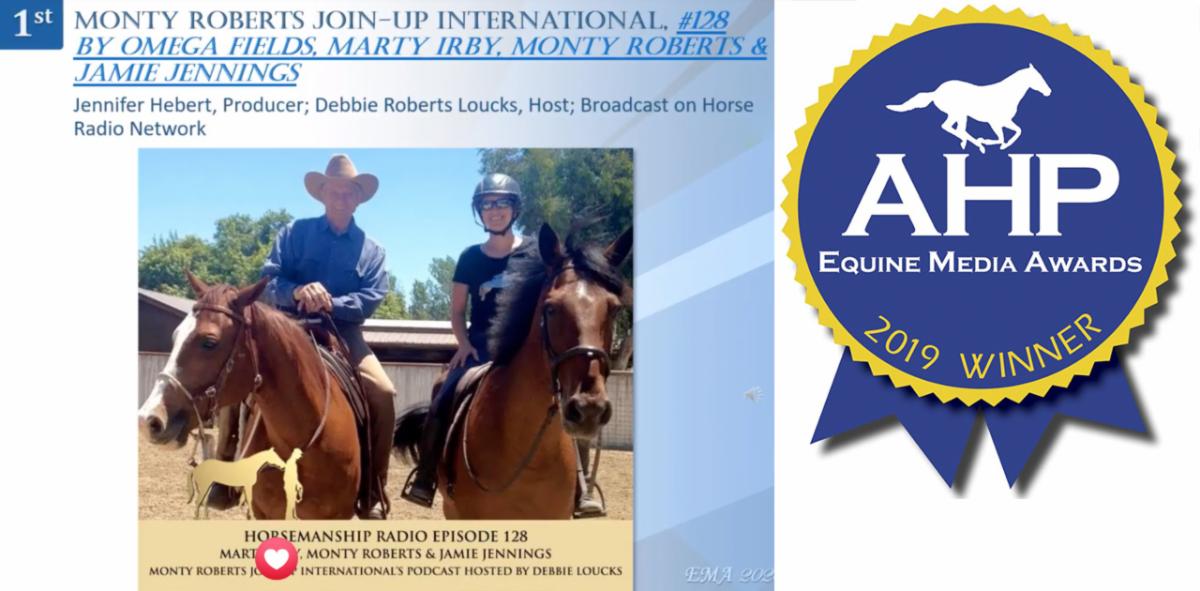
Awarding Excellence in an Equine Podcast: Horsemanship Radio Episode with Monty Roberts, Marty Irby, and Jamie Jennings

"Jamie Jennings made it fun to recap the day and Marty Irby and I firmly believe the achievements we will make with the Tennessee Walking Horse soring issue will be a highlight of my career.” - Monty Roberts

 
MONTY'S CHALLENGE

Test yourself each week as I challenge you to answer the question below. I mean this. Sit down and write an answer. Don't wait for my answer next week. If you have been reading my Weekly Questions and Answers for the last six months, you should be in a position to do this. Send your answer to my team at:  askmonty@montyroberts.com  
 
Why should you bother? Because it will help you focus. There is probably a comparable question in your life that needs answering... or will be. If you can gain insight into how to go about answering a practical question that is loosely related to your problem, this exercise will help you answer your nagging question. Then read my answer. I want all of my students to learn to be better trainers than me.That's good for you and good for horses! 
 
~ Monty 
  
NEXT WEEK'S QUESTION

Dear Monty, 

I hope everything is going well with you. I would like to ask some advice from you about a 7-year-old mare. She is an Oldenburger sport horse. She was been started in a traditional way, and the owner told me she was totally fine with the first rider. She was been started by a young girl who is the daughter of the owner. 

After a couple of rides, she just stopped in the corner of the riding arena and started to kick towards the center, but slowly she became normal again. 
Her jumping carrier started fine, she jumped every fence without any problems. Then at the first competition she refused to jump any fence and started to spin with the rider until the rider fell off. Then the owner asked a professional jumper to ride her and she was jumping at the competitions as well. This has been the situation for more than four years. 

After that, the owner decided that he wants his daughter to ride this horse again, but the old problem came back. She is 100% fine during the training, she is 100% fine when there are more horses in the arena, and she is also 100% fine at the warming up area. But she is only jumps one or two obstacles during the actual competition before she starts to spin around and refuses to go forward again, she rears up and bucks the rider off. 

She is very easy to handle, transport etc. The owner said that this problem only starts at competitions and only when a female rider is on her. When a male rider is going in the arena with her, she is quite nervous at the first jump, but when the rider is confident and rides firmly enough she jumps without any problems. She has been competing at 120 to 130 cm jump height. 

My idea is, that this attitude comes from a lack of confidence and I think she learned this behavior. Do you think it would be a good idea to try to go in the arena at a competition, but much lower height, 80 to 90 cm, jump one or two fences and just finish it, before she decides to refuse to go forward again?
She was checked by the vet, teeth and everything, but because she is fine during the training I do not think that this is a physical problem. 

Please let me know what do you think. 
Thank you Monty! 
All the best, 
Kata