|
FIELD NOTES
Clear the Whole Cube
Why the person we are looking for is so often above us, below us, or behind us, and how to train the eye to find them
By Michael Hadsell, President
Every experienced searcher has a version of the same story. A team works a segment carefully, shoulder to shoulder, eyes on the ground ahead, and reports it clear. Hours later the subject turns up inside that segment: curled into a palmetto thicket a few yards off the line, wedged into a culvert under the road the team just crossed, or somewhere overhead. Nobody was careless. They were looking hard, in the wrong plane.
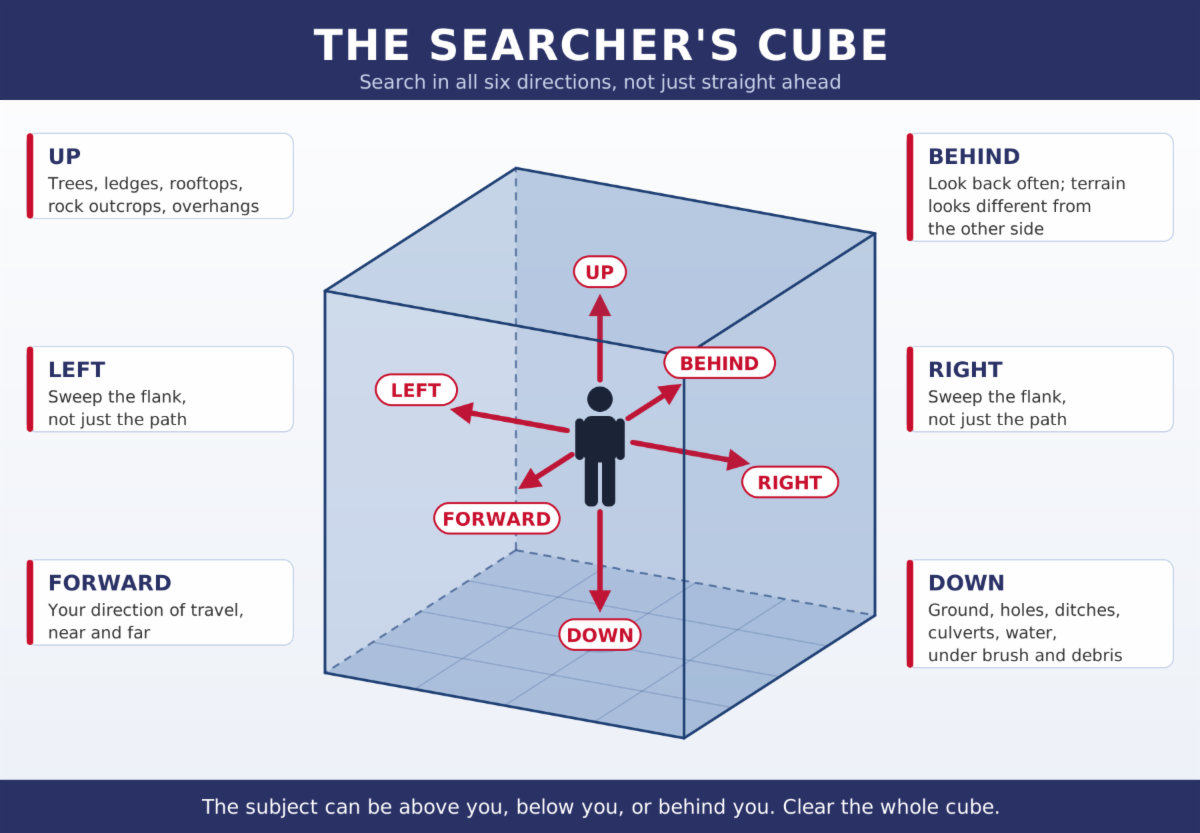
The Searcher's Cube is a simple fix. Imagine yourself standing in the middle of a box. The person you are looking for, or a clue they left, can be on any of its six faces: ahead, behind, left, right, above or below. A searcher who only covers the face in front of them at eye level covers roughly one sixth of the space the person could occupy.
Why we search flat
The draw toward a single plane is not laziness. It is how human attention works. On rough ground the eyes go where the feet are going next, and the more demanding the footing, the narrower the view becomes. Add a Florida summer, sweat in the eyes, and a loaded pack, and a searcher's world can shrink to the next three steps.
Concentration makes it worse, not better. In the well-known 1999 experiment by Daniel Simons and Christopher Chabris, viewers who were asked to count basketball passes in a short video were tested on whether they noticed a person in a gorilla suit walking through the scene. Roughly half did not. Skill does not protect us either. In 2013, Trafton Drew and colleagues at Harvard asked 24 radiologists to search lung scans for nodules; 20 of them, 83 percent, missed an image of a gorilla inserted into the scans, even though eye tracking showed most of them had looked directly at it.
The lesson for us is plain. A searcher who is concentrating hard on one task, such as reading the ground for sign, is set up to miss whatever falls outside that task. The cure is not to try harder. Build a deliberate habit of looking in every direction, so the scan happens whether or not attention is already there.
Where people actually end up
The cube matters because lost and missing people seldom end up neatly in the open, on the path, at eye level. The published research on lost persons is consistent on this point.
People with dementia. In Robert Koester's Virginia study of 87 searches for people with Alzheimer's disease and related dementias, subjects were most often found in bushes or briars (29 percent), followed by creeks and drainages (18 percent). The median subject was found about 30 meters (33 yards) from a road or trail. These people were not far away. They were off to the side and low down, close to routes used by searchers and passersby.
Young children. Toddlers tend to seek shelter and may lie down to sleep under thick brush, inside a hollow log or beneath a picnic table. Preschool-age children may hide when a stranger approaches and may not answer when called. A retired Osceola County Sheriff's Office lieutenant writing on lost-child cases reports finding children asleep in parks, culverts, and playhouses close to where they went missing, some of them in places the parents had already searched.
Subjects who will not or cannot answer. Operational lost-person guidance notes that people with dementia generally do not respond to searchers' calls, that people with intellectual disabilities often hide from searchers, and that despondent subjects usually do not respond and tend to stay hidden from view.
Calling and listening cover distance. It does nothing for a person who will not or cannot answer. For those subjects, the eyes have to do the work, and they have to work in all six directions.
The six faces, in Florida terms
Our ground has its own version of each face. The list below is a starting point for briefings, not a complete list.
• UP: Tree canopy, elevated structures, ledges, anything overhead. In Florida: oak hammock canopy, cabbage palm crowns, hunting stands, bridge and overpass structures, attics and lofts in buildings.
• DOWN: Ground at your feet, holes, water, and under anything that gives cover. In Florida: canals, ditches and retention ponds; culverts under roads and driveways; sinkholes and solution holes; under palmetto, fallen fronds, docks and crawl spaces.
• LEFT / RIGHT: The flanks of your line, especially dense edges you are tempted to skirt. In Florida: palmetto thickets, briar and smilax tangles, mangrove fringes, overgrown fence lines.
• FORWARD: Your direction of travel, both near and far. In Florida: the trail ahead, the far edge of open prairie, the next tree line.
• BEHIND: What you have already passed, seen from the other side. In Florida: the shaded side of logs and stumps, the back of a palm cluster, the far face of a palmetto clump.
One note on the top face. In despondent-subject and recovery work, the person may be elevated. Team leaders should say so in the briefing so no member encounters that possibility for the first time in the field.
The cube on a K9 team
The dog does not search flat, and neither does odor. Scent moves in three dimensions. It tends to lift with daytime heating, settle and pool in low ground in cool, still air, collect against the edges of dense vegetation, and travel with moving water. An elevated, buried, or tucked-under source can put odor on the ground some distance from where the person actually is.
That is why a dog may show strong interest at the base of a tree, under a structure, or along a bank where nothing is visible at eye level. When the dog commits, and you see nothing in front of you, run the cube: look up, look down, and look behind the dog. The handler's eyes finish what the nose starts.
The cube from the air
Aircraft and drones are superb at the top face of someone else's cube. They are poor at what lies beneath it. Tree canopy, overhangs, docks, and the shaded side of structures are blind from above, and dense hammock can defeat a thermal camera as easily as a pair of eyes. Air and ground search are two halves of the same job. A drone pass that clears the canopy doesn't clear what is beneath it, and the segment report should specify which one was searched.
Making it a habit: the cube check
A concept only helps if it shows up under stress. The cube check is short enough to run dozens of times a shift.
THE CUBE CHECK: STOP · UP · DOWN · BEHIND · FLANKS
• STOP. You cannot look up and walk rough ground safely at the same time. Stopping makes the scan possible and keeps you on your feet.
• UP. Sweep the canopy and anything elevated.
• DOWN. The ground at your feet, then under the nearest cover. Get low if you need to.
• BEHIND. Turn around and look back the way you came. The ground you have passed looks different from the other side.
• FLANKS. Left and right, into the edges you were about to skirt. Then move on.
When to run it. Run it at regular intervals in dense cover, and every time the ground changes: an edge, a drainage, a fence line, a structure, the water's edge. Run it any time the dog changes behavior.
For team leaders. In a line search, assign the faces. Flank searchers own left and right; give at least one member responsibility for looking up. At debrief, ask a simple question: "What did you look up at?" If no one has an answer, the segment has not been fully searched, regardless of what the coverage map says.
The point of it
Most of the time the cube check turns up nothing. That is the point. It is how a segment earns the word "clear," and how we make sure that when we tell a family an area has been searched, it has been searched in every direction a person could be.
Prepared for the worst, providing the Best . . . Until All Come Home
Sources
Koester RJ. The lost Alzheimer's and related disorders search subject: new research and perspectives. dbS Productions; Virginia data 1986–1997, n = 87 searches. https://dbs-sar.com/SAR_Research/lost_alzheimer.htm
Koester RJ. Lost Person Behavior: A Search and Rescue Guide on Where to Look – for Land, Air and Water. Charlottesville, VA: dbS Productions; 2008.
Appalachian Search and Rescue Conference. Operations Manual: Lost Person Behavior (draft, March 2007). https://www.archive.asrc.net
Murgado A. How to investigate lost children. Police Magazine. March 10, 2017. https://www.policemag.com/articles/how-to-investigate-lost-children
Simons DJ, Chabris CF. Gorillas in our midst: sustained inattentional blindness for dynamic events. Perception. 1999;28(9):1059–1074.
Drew T, Võ MLH, Wolfe JM. The invisible gorilla strikes again: sustained inattentional blindness in expert observers. Psychol Sci. 2013;24(9):1848–1853.
|