Weekly Digest Number 11 - March 14th, 2023 |
|
Welcome to the RWU Rail & Labor News! This news bulletin is produced and emailed out each Tuesday morning. We hope you find each week's news and information useful. If so, please share with co-workers, friends, and colleagues. If you like, you can sign them up to get all the news from RWU HERE. Or forward them the link. Note: If you read over this news bulletin each week, you will be sure to never miss the important news of what is going on in the railroad world from a worker's perspective!
|
|
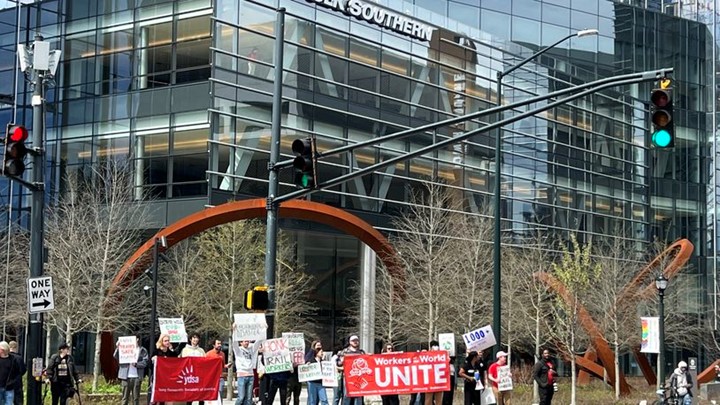
(Editor's Note: Simultaneous rallies and demonstrations were conducted at NS Headquarters in Atlanta, GA; NS property in Norfolk, VA; Boston, MA; and in Lisbon, OH on Saturday, March 11th to protest Norfolk Southern and their recent spate of derailments, fatalities, and safety failings. Protesters called on NS to bear the burden of their irresponsible behaviors, an end to PSR, and public ownership of the railroads, among other things. Events were sponsored by RWU friends and allies Southern Workers Assembly, Ohio Peace Council, and Democratic Socialists of America.) |
|
Protest Over Derailment Held at Norfolk Southern’s Atlanta Headquarters |
|
A few dozen protesters rallied in front of Norfolk Southern’s Midtown Atlanta headquarters on Saturday afternoon, voicing support for rail workers and people affected by the company’s toxic derailment in East Palestine, Ohio.
At the busy intersection of Ponce de Leon Avenue and West Peachtree Street where Norfolk Southern opened a gleaming office tower in 2021, the Atlanta Democratic Socialists of America and students from the Young Democratic Socialists of America at Georgia Tech chanted and held signs with messages such as “Honk for rail workers,” “Norfolk Southern has loco motives” and “Atlanta stands with East Palestine.”
Norfolk Southern says it is “working around the clock to remediate the remaining issues in East Palestine.” The company says it has committed more than $21 million to East Palestine and the surrounding region, including financial assistance to families.
Norfolk Southern CEO Alan Shaw in testimony before a U.S. Senate committee on Thursday said he is committed to improving the railroad’s safety, but fell short of endorsing a rail safety bill that has been introduced in Congress. When pressed on adding more paid sick leave for workers, he committed to continue discussions on “important quality of life issues” with unions.
|
|
(Editor's Note: This article is worthwhile. BUT a few tips when reading: 1 - "Human Factor" caused accidents sound like individual failures of individual workers. But most of the time, those are actually the result of 'Systems Failures". For example, did that worker have proper training, adequate time off, proper rest, the proper tools to do the job, enough staff to assist in the task, etc. And 2 - Since the railroad is moving quite a bit less freight and running fewer trains, we should expect a proportionate drop in accidents, all other factors remaining the same.) |
|
5 Questions You Might Ask About Freight Train Accidents
‘Human factors’ cause greatest share of incidents; rail yard mishap rate has grown
|
|
The Feb. 3 derailment of a Norfolk Southern train near East Palestine, Ohio, has generated a lot of interest not only in rail safety but also in why train accidents and derailments even happen in the first place.
To help inform the discussion about train accidents, FreightWaves examined some of the safety data the Class I railroads have submitted to the Federal Railroad Administration to see what trends, if any, have occurred over the last 10 years. But in order to look for those tendencies, it’s helpful to define what data points to examine.
What are the different types of train accidents?
FRA collects rail safety data on train derailments, accidents at highway-grade crossings, injuries or fatalities and the causes and frequency of different types of mishaps. The agency collects this data from submissions by all U.S. passenger and freight railroads. In 2022, there were 834 railroads reporting accident data to FRA. Railroads report this data because there are federal mandates requiring them to do so.
As a data category, train accidents consist of collisions — head-on, rear-end, side, raking and broken train — as well as fires/violent ruptures and explosions/detonations.
Derailments are also a subset of train accidents. Among all the U.S. freight and passenger
While the agency collects data on highway-rail grade crossing collisions and trespass events, they are not considered train accidents due to being considered incidental to the operation of a train.
What causes train accidents?
FRA breaks down the cause of accidents by five categories: equipment, human factor, miscellaneous, signal and track.
|
|
(Editor's Note: In its quest to get the trains running again as soon as possible, questions abound as to whether NS compromised not only the health and well being of the citizens, but of its own workers as well.) |
|
East Palestine: The Forgotten Rail Workers
|
|
The trains must go through!
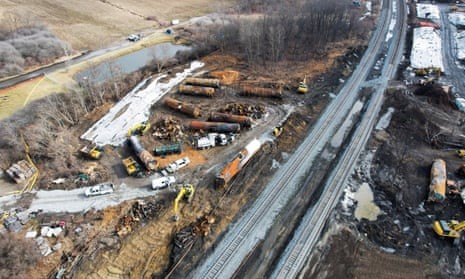
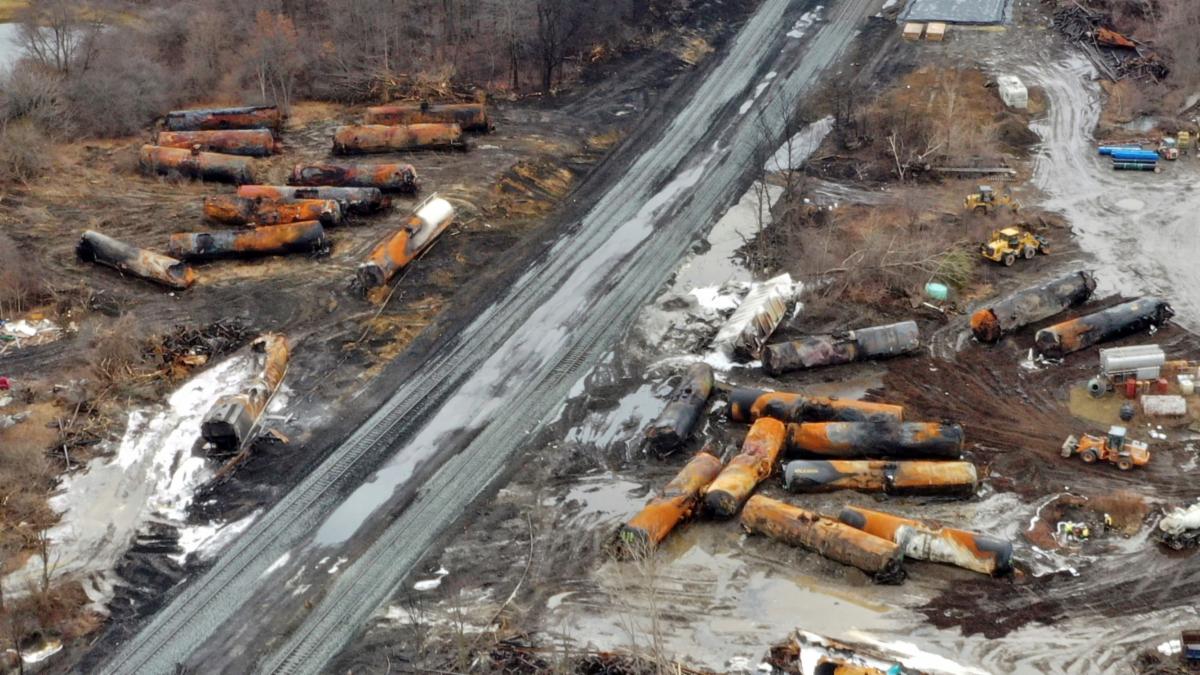
As you might imagine, there was quite a mess to clean up in order to get the rail line running again through East Palestine, Ohio, after 20 rail cars full of vinyl chloride and other toxic materials derailed at the beginning of February. But while the citizens of East Palestine were sheltering-in-place and evacuating, Norfolk Southern, being the responsible custodian of public health that they are, immediately leapt into action, sending 40 of their employees in to start cleaning up the wreckage — and to get the rail line running again.
One might expect a railroad as large and profitable as Norfolk Southern to have a specially trained and equipped Hazmat Team to respond to events like this. Turns out that may not have been the case.
Workers that participated in the cleanup of the train derailment had unanswered questions about their protections, and have experienced lingering migraines and nausea, according to a union representative for workers that build and maintain railways for Norfolk Southern.
Jonathan Long, a union representative for the Brotherhood of Maintenance of Way Employees Division of the International Brotherhood of Teamsters (BMWED), said in a Wednesday letter to Ohio Gov. Mike DeWine (R) that around 40 workers were ordered by Norfolk Southern, which owns the train that derailed in East Palestine, Ohio, last month, to clean up the wreckage.
Long said he had received reports that the workers were not given proper personal protection equipment to help clean up the wreckage, not being offered respirators, eye protection and protective clothing.
And rail workers are not magically immune from the health effects of the substances they’re directed to clean up.
He also said many employees “reported that they continue to experience migraines and nausea, days after the derailment, and they all suspect that they were willingly exposed to these chemicals at the direction of [Norfolk Southern].”
|
|
Norfolk Southern Employee Killed in Cleveland Accident |
|
CLEVELAND — A Norfolk Southern employee has been killed in a collision between a train and a dump truck this morning (Tuesday, March 7), according to news reports.
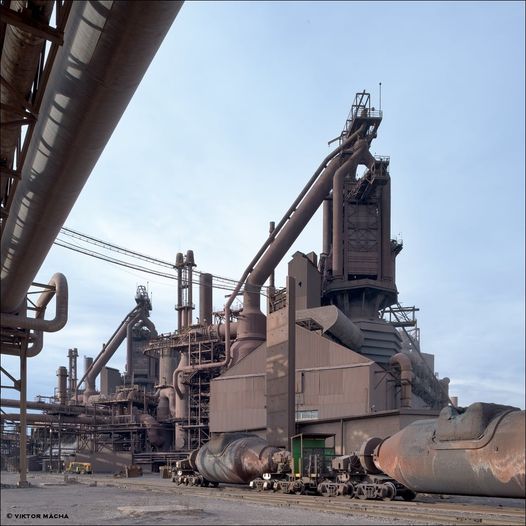
WJW-TV reports the accident occurred early this morning on the rail line through the Cleveland-Cliffs Cleveland Works steelmaking facility, and that the victim has been identified by the Cuyahoga County medical examiner as 46-year-old Louis Shuster of the Cleveland suburb of Broadview Heights. A photo on the station’s website shows the truck appears to have struck a string of tank cars. WOIO reports the accident occurred about 1:19 a.m.
Norfolk Southern said in a statement that officials are reporting Shuster, a conductor, was struck by the truck as the train moved through a crossing.
|
|
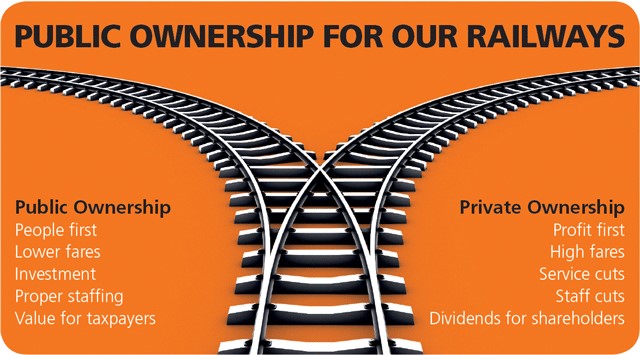
(Editor's Note: The world forges ahead with rail mainline electrification ... except in North America, which just happens to coincidentally be the only region where rail is held privately. One of just many reasons why RWU supports Public Ownership of the Railroads.)
|
|
US Railroads Lag Behind the World in Railroad Electrification, and the Reason is Private Ownership
|
|
Railroads in the United States haveavoided electrification, lagging behind much of the rest of the world. Consequently, American railroads are some of the largest consumers of diesel. In 2018, they used 4.2 billion gallons of diesel, second only to the US military. This diesel becomes quite expensive when prices spike during fuel crises. While railroads often claim to be improving fuel efficiency, they have failed to invest in the obvious solution: electrification. Railroad electrification would massively reduce pollution, improve operating efficiency, lower costs, and clear the way for faster rail service. With all these benefits, why have American railroads failed to electrify? The answer has to do with monopolization, a short-sighted focus on profit, and lack of national planning. However, it is not too late to correct our failures now. The US can still create a world-class, electrified rail network by nationalizing railroad infrastructure and recognizing it as a public good.
The US rail network is privately owned, largely by two sets of regional duopolies: CSX and Norfolk Southern in the east, and BNSF and Union Pacific in the west. These companies are fastidiously opposed to deploying capital that would improve infrastructure. As a result, they are unwilling to fund electrification and focus on cutting costs and services in order to reap higher profits.
This refusal to invest in better rail infrastructure in pursuit of short-term profits is short-sighted at best and downright counterproductive at worst. The operating cost of electrified railways is markedly lower than that of those that run on diesel. A study from the 1980s found that electrification had an “economic advantage” over diesel, with a 19 percent pre-tax rate of return on electrifying 29,000 miles of US mainlines. Additionally, it is more than 50 percent cheaper to power a train on electricity than on diesel, especially considering current price hikes. Plus, with regenerative braking and catenaries, when trains are going downhill or slowing, they can sell power back to the grid.
The cost of electric locomotives is also 20 percent cheaper than diesel-electrics, and maintenance is 25-35 percent cheaper. In addition to lower maintenance costs, the equipment has much greater longevity.
|
|
(Editor's Note: Below is an Editorial reprinted from five years ago by then National Legislative Director of SMART-TD John Risch. With the calamity in Ohio, now is the time to revisit this technology and move forward with its application on freight trains in North America.) |
|
‘For Rail Safety’s Sake: ECP Brake Technology a Must’ |
|
Recently, I was the only labor participant in a technology roundtable before the U.S. House Committee on Transportation and Infrastructure where we discussed emerging technology in the railroad industry.
The focus of my comments was on Electronically Controlled Pneumatic (ECP) Brakes. I have operated trains with ECP brakes and they are the greatest safety advancement I have seen in my 40 years in the railroad industry. They slow and stop trains up to 70 percent faster than conventional brakes and are the safest most advanced train braking system in the world.
The railroad industry, in arguing against the implementation of ECP brakes, has claimed that dynamic brakes and distributive power are better choices. While they are correct that dynamic braking and distributive power are helpful in braking trains, the truth is – these two features are not nearly as effective as an ECP brake system.
Below is my Top 11 list (which is even better than a Top 10 list) on why ECP brakes are better than conventional air brakes:
1. ECP brakes maintain a train’s brake pipe pressure 100 percent of the time, conventional brakes do not. The colder the weather, the thinner the air, the more crucial maintaining brake pressure is.
2. ECP brakes allow for a”graduated release.” That means the engineer can partially release the train’s brakes without having to fully release them. This is vitally important because once a train’s brakes are released it takes time to recharge the train’s brake pipe pressure in order for the brakes to work again. The graduated release feature allows an engineer to maintain the speed of his/her train down steep grades with a partial application of the brakes, without fully releasing and reapplying the train’s brakes repeatedly. The graduated release feature all but eliminates the possibility of a runaway train.
3. When the engineer makes an emergency application of the brakes, every car with ECP brakes applies 100 percent of the time. This is not always true with conventional brakes.
4. ECP brakes would have prevented the terrible Lac-Megantic oil train tragedy that killed 47 people and destroyed the town, a factor cited in Transport Canada’s report on the accident. These brakes would have prevented the accident, because when air pressure on a car equipped with ECP brakes drops below 50 psi, the car automatically goes into emergency mode. So even an improperly secured train will not roll away.
|
|
(Editor's Note: For those who believe that rallies, protests, and raising hell does not accomplish anything, think again. If people and organizations had not protested vociferously, NS would have simply donated a few bucks to each citizen of the town and walked away. Because they raised hell, they are getting better compensation. Because we raised hell, the carriers were backed into a corner and are now bargaining sick time. "Don't waste time mourning, Organize!") |
|
'This Is Not Enough': Under Pressure, Norfolk Southern Agrees to Limited Relocation Plan
"We're going to keep pushing until the community gets the help it is owed," said Ohio River Valley organizers.
|
|
Local organizers in East Palestine, Ohio on Monday said their activism has successfully pressured rail company Norfolk Southern to agree to a limited relocation plan for some residents affected by last month's train derailment, but added they have no intention of backing down from their demand for justice for thousands of people in the area who are struggling in the aftermath of the accident.
The company's plan to offer financial assistance to people who live within a one-mile radius of the crash site "is not enough," said River Valley Organizing (RVO), which last week released a list of five demands for the people of East Palestine and the surrounding area.
While calling the proposal a "win," RVO noted people will only be able to relocate temporarily and said the disaster "has had a far-reaching impact."
"We're going to keep pushing until the community gets the help it is owed," said RVO. "We need to stop letting Norfolk Southern put their profits ahead of the people of our community."
The U.S. Environmental Protection Agency (EPA), which late last month ordered Norfolk Southern to take full financial responsibility for cleaning up contamination from vinyl chloride, a carcinogenic chemical the train was carrying, acknowledged Monday that residents have complained of lingering odors in the town as the company continues to remove thousands of tons of contaminated soil.
"At EPA's request, Norfolk Southern has agreed to provide additional financial assistance to residents of the East Palestine area, including the portions of Pennsylvania within a mile of the derailment site," said the agency. "This assistance may include temporary lodging, travel, food, clothing, and other necessities."
|
|
Two Unions Vote for Strike Against CN in Canada
Unifor unions could walk out as soon as March 21
March 6, 2023
|
|
MONTREAL — Two Canadian unions whose contracts with Canadian National Railway expired at the end of 2022 have voted in favor of a strike, CityNews reports.
Unifor Local 100 and Unifor Council 4000 have voted 98% and 97%, respectively, in favor of a strike. The two unions represent about 3,000 workers in mechanical, intermodal, and clerical positions nationwide.
Unifor says it has held five bargaining sessions with CN since October 2022, and has another scheduled for March 13. In announcing plans for a strike vote in February, the union said it made some progress during sessions in October and November, but the parties remained far apart on key issues, so it filed for conciliation. Unifor says CN responded with an offer seeking “significant concessions;” CN said its offer “includes increases in net pay and benefits. It also resolves outstanding issues between the parties and provides improved working conditions for all represented employees.”
Bruce Snow, assistant to the national officers at Unifor, told CityNews that one of the main sticking points is CN’s desire to change the age for early retirement, which has been 55.
The earliest possible date for a strike against CN in Canada is March 21. CN said it does not expect any labor action to impact operations.
|
|
WEBINAR 1: Why RWU Says it’s Time to Nationalize the Railroads |
|
On this episode of the “Iron Bill” Hohlfeld Show, Bill talks to retired locomotive engineer and Railroad Workers United [RWU] member Mark Burrows about the unfolding train derailment disaster in East Palestine, Ohio — and why members of the RWU say it is time for public ownership of the nation’s railway system.
During the conversation, Bill wonders why stronger regulation alone isn’t enough to address the industry’s unsafe and anti-worker policies and practices.
Listen to the entire conversation below:
|
|
WEBINAR 2: Long Train Runnin'
Fritz Edler, Special Representative, Railroad Workers United, joins host Tony Castańeda and the Thursday morning edition of the 8 O’Clock Buzz to discuss the ongoing saga of railroad safety issues in light of recent derailments. According to Fritz the response at the federal level has been encouraging, but meaningful regulations will be required to improve health and safety issues in the railroading industry. The current version of the Railroad Safety Act of 2023 being considered at the federal level should be considered a good start, but Fritz warns that as currently written it has loopholes that a freight train could drive through. Self-imposed limits undertaken by the industry will not be sufficient and regulations must address standards for the use of early warning sensors and train lengths.
|
|
WEBINAR 3: RWU Discusses Ohio Train Derailment
In December, President Biden got Congress to make it illegal for the railroad workers unions to strike for better benefits and working conditions. Nick Wurst of RWU discusses issues with the recent train derailment in East Palestine Ohio and provides an update on labor issues. WIth Mark Dunlea for Hudson Mohawk Magazine.
|
|
(Editor's Note: Prem Thakker has written an important series of articles the past month or so. See some of the best below, together with other articles about how NS and the Class One carriers influence government through money.) |
|
Norfolk Southern Has Thrown Roughly $100 Million Into Politics Since 1990
If you’re wondering how the train derailment in East Palestine, Ohio, happened, here’s one clue
|
|
In 1993, the Wu-Tang Clan summed up everything you need to know about American politics: “Cash Rules Everything Around Me.” And the rail industry has certainly fulfilled that idea, spending more than $756,700,000 to lobby the government since 1998, according to data from OpenSecrets. In other words, railroad companies have thrown three-quarters of a billion dollars, or more than Poland’s current GDP, toward currying favor with the government meant to oversee them. This gargantuan figure does not include an additional nearly $100 million in direct campaign contributions over that same time period.
Take the culprit rail company, Norfolk Southern, for example. Beyond joining its fellow corporations in lobbying the government to strip regulation, like the Obama-era rule that mandated train cars carrying hazardous materials (like those derailed in East Palestine) to have better brakes, Norfolk Southern has also contributed millions of dollars directly to politicians. The $55 billion company has spent nearly $80 million since 1998 on lobbying; since 1990, it has sent about $17 million directly to candidates’ coffers.
|
|
(Editor's Note: While the rail industry cannot simply pickup and leave the country like many industries have done and threaten to do to extract concessions and increase profits, the rail industry can and does contract work to non-union "non- railroad workers at every chance. And the y use the threat of this to intimidate the existing workforce. And in this case below, they simply violate the union contract to scab out work.) |
|
Unions Sue BNSF Over Outsourcing of Locomotive Repairs
March 7, 2023
Suit claims move fails to act in ‘good faith’ under labor agreements; unions raise safety issues
|
|
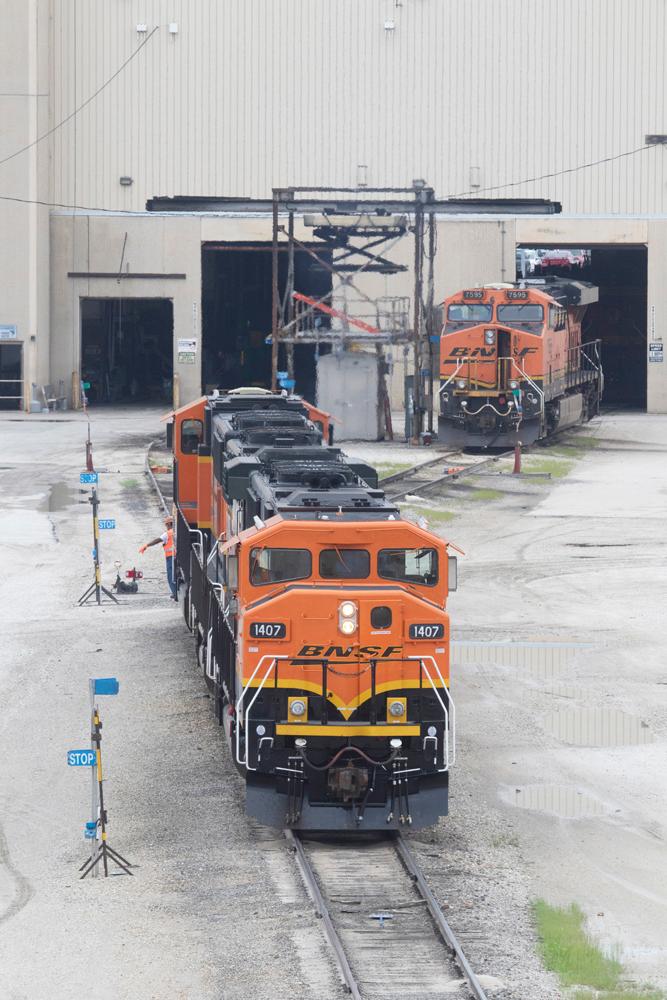
WASHINGTON — A group of unions announced today (Tuesday, March 7) that they have filed suit against BNSF Railway over outsourcing of locomotive inspections, maintenance, and repairs, claiming the railroad is cutting its mechanical workforce to boost profits and failing to act in good faith under its existing labor agreements.
The suit by the International Brotherhood of Electrical Workers, International Association of Machinists and Aerospace Workers District 19, and SMART-MD (International Association of Sheet Metal, Air, Rail and Transportation Workers-Mechanical and Engineering Department) was filed Feb. 24 in U.S. District Court for the Western District of Missouri.
The suit, available here, says BNSF created the need to outsource locomotives to address a maintenance backlog through a “bad-faith course of action,” which it outlines to include the closing of shops; furloughing of employees and failing to recall them in a timely fashion; failure to maintain adequate staffing; a 0% overtime initiative for 2023; and deferral of locomotive inspections and maintenance.
In today’s statement, the unions seek to connect the BNSF move and the Feb. 3 Norfolk Southern derailment in East Palestine, Ohio, by questioning the safety impact of outsourcing the locomotive work.
“BNSF has been shuttering maintenance shops and delaying basic locomotive inspection and maintenance at the same time it has earned record profits,” IBEW International President Kenneth W. Cooper said. “As we continue to learn of the prolonged and severe impacts coming out of Ohio, it’s important now, more than ever, that inspection and repair of locomotives are performed by the experienced and trained members of the IBEW and other unions.”
SMART General President Joseph Sellers Jr. claimed the railroad had cut its workforce to create a situation where it can “now claim an emergency need to contract out core mechanical work to contractors who qualifications and work standards are unknown. Cutting corners on safety leads to predictably unfortunate results.”
|
|
(Editor's Note: While the feds play politics with crew size legislation and regulation, the movement to enforce minimum crew size has found some new momentum in a number of states including Michigan, New York and New Mexico.) |
|
Train Crew Size Bill Advances in New Mexico Legislature
Rule requiring at least 2 crew members would apply to Class I and II railroads operating in the state
|
|
A bill requiring freight trains to have at least two workers in the locomotive cab has passed the House of the New Mexico Legislature and now awaits action in the Senate.
The bill, introduced by state Reps. Eliseo Lee Alcon, Patricia Roybal Caballero, Eleanor Chávez and Michael Padilla on Jan. 19, calls for at least two people to run a freight train operated in the state by a Class I or Class II railroad. Exceptions would be for remotely controlled locomotives running in rail yards as well as during hostling and helper operations.
A first violation would result in a fine of up to $1,000; subsequent violations would yield fines of up to $5,000 each.
This bill passed the New Mexico House of Representatives by 43-25 on Feb. 20 and is waiting to be reviewed by the Senate Tax, Business and Transportation Committee.
“While it has been a long and tough road at times, we are seeing more gains on two person crew legislation this year than ever before,” the Brotherhood of Locomotive Engineers quoted Ashley Long, president of the New Mexico Federation of Labor, as saying.
|
|
(Editor's Note: A game-changing concept, and one that would dovetail nicely into ECP braking - see article above - as the two could easily compliment each other. While the Class Ones would balk at the cost, remember that they cried about the $10 billion price tag of Positive Train Control - PTC - implementation, and made record profits the whole time it was being installed.) |
|
Wheel Bearing Expert: To Prevent Derailments, Railroads Should Equip Freight Cars with Sensors
Unlike wayside detectors, on board sensors can detect bearing defects months before they become a safety hazard
|
|
Installing sensors on freight cars is the only way to prevent another disastrous derailment like the Feb. 3 Norfolk Southern hazardous materials wreck in East Palestine, Ohio, a wheel bearing expert says.
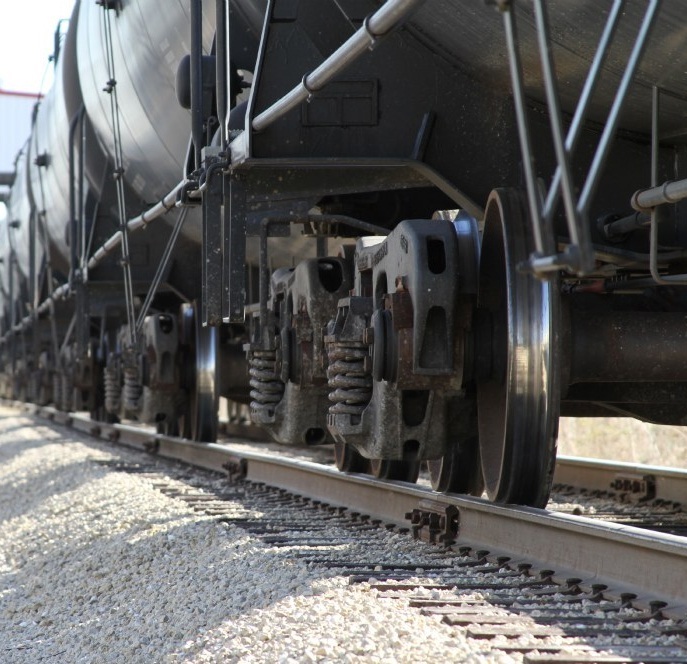
Constantine Tarawneh, a mechanical engineering professor who heads the University Transportation Center for Railway Safety at the University of Texas Rio Grande Valley, says adding more wayside hotbox detectors won’t be enough to eliminate derailments caused by wheel bearing failures.
“Temperature is just not the way to measure the condition of a rotating object. Period. It’s a good secondary measure, but not a primary measure. And so I don’t care how close you space them … it’s not going to help,” Tarawneh said in an interview last week.
The Rail Safety Act of 2023, which was filed last week in the Senate, would require railroads to place hotbox detectors every 10 miles. Today detectors are spaced an average of 25 miles apart, according to the Federal Railroad Administration.
There’s no question that hotbox detectors work. Train accident rates caused by axle and bearing-related factors have dropped 81% since 1980 and 59% since 1990 due to the use of hot bearing detectors, according to the FRA.
But bearings can overheat quickly, the FRA says, and can burn off in as little as 1 to 3 minutes. Hotbox detectors failed to diagnose 124 severely defective bearings in the U.S. and Canada from 2010 to 2018, 117 of which resulted in derailments.
“The one in East Palestine caught everyone’s attention because of the hazardous materials,” Tarawneh says. “These are accidents waiting to happen. They might not happen that often, but they will continue to happen because we’re just taking a shot and hoping that these wayside detectors are effective.”
The shortcoming of both hotbox detectors and wayside acoustic detectors is that they are reactive and can only catch late-stage defects that pose an immediate safety threat, Tarawneh says.
|
|
(Editor's Note: This is at least the third incident in as many years where a freight train has hit a landslide along a river in inclement weather, derailed, and gone into the river. With modern technology in combination with simple visual inspection prior to train movement, this type of event should not be happening in this day and age.) |
|
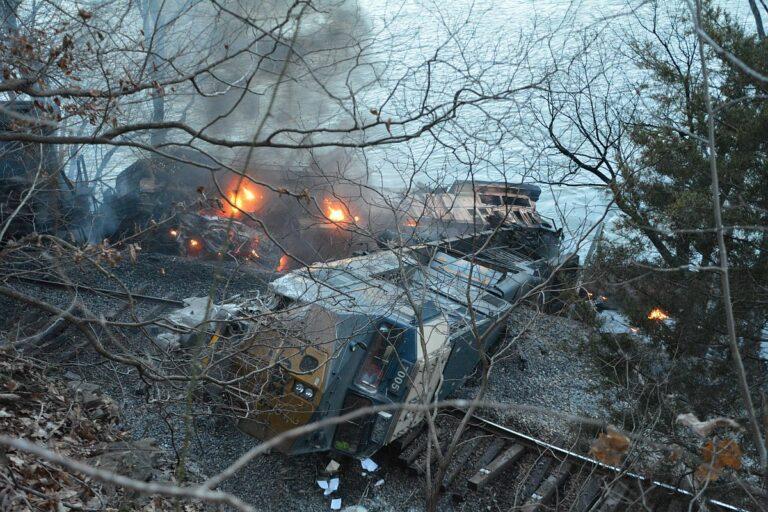
Train Derails in Summers County, WV, Three Hurt |
|
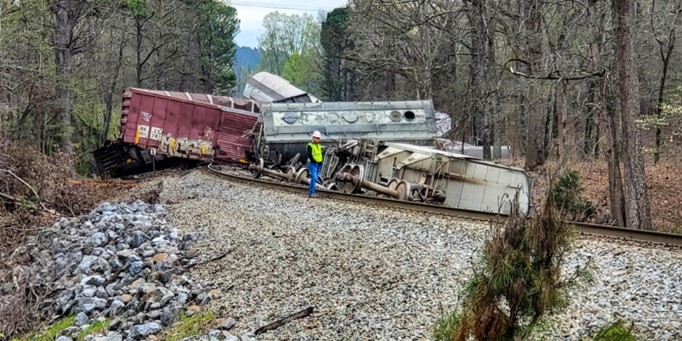
SANDSTONE, W.Va. — Three employees of CSX were taken to the hospital after a train derailment early Wednesday morning along the New River in Summers County, W.Va.
According to the company the train, pulling empty coal cars, derailed about 4:51 a.m. after it struck a rockslide which covered the track. A statement from CSX indicated the lead engine had three crew members on board. They were a conductor, engineer, and an engineer trainee. All three crew members were taken to the hospital with non-life threatening injuries.
Four of the locomotives along with nine empty coal cars jumped the track. One locomotive caught fire. The company said an unknown amount of diesel fuel and oil spilled from the locomotives and environmental containment measures are being taken to protect the waters of the nearby New River. CSX said there were no hazardous materials being transported.
Sam Richmond lives near the scene and walked into the area from National Park Service property above soon after the incident. ...
... “There’s one engine over the embankment and one engine partially in the water. There was quite a bit of fire, quite a bit of smoke and there was some debris from the incident floating down the river burning. They were about one foot chunks. I don’t know what they were, but they floated,” he said.
|
|
(Editor's Note: Note the similarities between the Greek and U.S. situations. The decline in traffic, infrastructure, service, and safety in both countries is driven by the same cost-cutting frenzy that is propelled by private interests in the pursuit of personal gain without regards to workers, passengers, shippers or communities, and even the long term viability of the rail industry itself. In both countries, workers have warned of the dangers to no avail.) |
|
Greece’s Tragic Rail Accident Was Caused by Austerity and Privatization
|
|
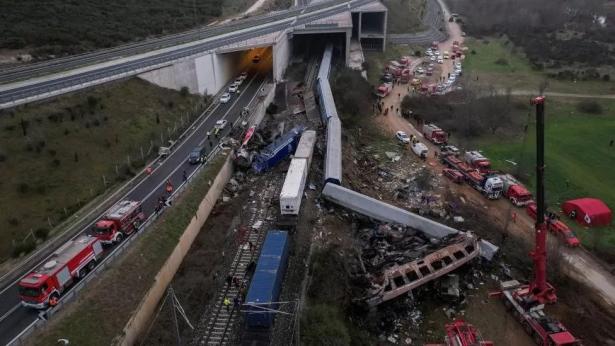
The devastating railway accident near the Vale of Tempe in central Greece, which lies between Athens and Thessaloniki, has had a profound impact on the nation. The majority of the fifty-seven fatalities (the exact number is still unclear) were young students, either on their way back to the University of Thessaloniki or returning home from a trip to Athens after a three-day break.
The collision was one of Europe’s deadliest rail accidents in a decade. The passenger train was traveling at 160 km/h when it collided head-on with a cargo train moving at 110 km/h. The force of the impact generated temperatures high enough to melt steel. It is unlikely that some victims’ remains will ever be retrieved; others will only be identified through DNA testing
Now millions in Greece are asking: How was it possible that two trains could travel for all of twelve kilometers on the same railway line, in opposite directions, without anyone noticing? Why weren’t telematics or other safety measures in place?
Worker Unions Rang the Alarm
There were plenty of indications that a severe accident was around the corner. Greece’s railway unions predicted the accident in advance, weeks before it happened. A series of union notices publicly warned of danger. In an official notice sent on February 7 to the Hellenic Railways Organisation (OSE), unions described the state of disrepair on the railway system and warned management of forthcoming industrial action: “We are not going to wait for the coming accident to see them shedding crocodile tears and making declarations.”
|
|
|
|
|
|
|