|
October 2024: Elections Edition
| |
Illinois Civics Hub Newsletter | |
A newsletter for Illinois teachers to support the implementation of the Illinois middle and high school civics course requirements and K–12 social science standards. | |
Resources for Teaching about Voting, Elections, and the Presidency from Street Law | |
The 2024 election season is upon us, and it's the perfect opportunity to deepen your students' understanding of democratic processes.
Street Law has gathered a collection of our essential resources to help you explore critical topics in your classroom related to elections, voting, and the presidency.
It features a curated selection of Supreme Court case materials, engaging deliberation activities, and comprehensive lesson plans that explore critical topics like voting rights, gerrymandering, the Electoral College, campaign finance, and the role of the presidency in American democracy.
The materials are conveniently organized into the following themed sections:
- Voting, Voting Rights, and Gerrymandering
- Elections and the Electoral College
- Campaign Financing
- The Presidency
| |
Teaching Presidential Elections with the Bill or Rights Institute | |
The Bill of Rights Institute has a variety of resources to support instruction around the 2024 elections and beyond. Resources include:
| |
Politicking Vidoes from Retro Report | |
Retro Report recently debuted two new installments of their series on presidential campaigns, and they are now available. These films examine the run-up to the 1832 and 1840 elections, showing how choosing a running mate and connecting to the masses can play a central role in running for office.
-
Picking a Partner: The V.P. Relationship: Personal conflicts have played a significant role in shaping U.S. political history. Almost 200 years before the falling out between President Donald Trump and Vice President Mike Pence, the American public was captivated by a scandal in Washington society and a feud over states’ rights that led to a bitter split between Andrew Jackson and John Calhoun.
-
Charm Offensive: Why Politicians Reach for Relateable: William Henry Harrison's 1840 campaign for the presidency set the stage for modern-day political campaigning. Harrison flipped the script, turning an insult into a winning strategy with parades, songs, and a log cabin image. These early tactics mirror today's campaigns, where image and public appeal can have an outsize impact.
-
Mud-Slinging and Deadly Duels: How Negative Campaigning Evolved: Explore the history and impact of negative campaigning in U.S. presidential elections.
| |
Celebrate Our Republic with the District Courts Annual Contest | |
The United States Courts of Appeals along with the United States District Courts in the Seventh and Eighth Circuits are hosting the fifth annual Bill of Rights Day contest and we want YOU to be a part of it!
Students in grades 5-12 from Arkansas, Illinois, Indiana, Iowa, Minnesota, Missouri, Nebraska, North Dakota, South Dakota, and Wisconsin are encouraged to submit art and essays on the importance of the Bill of Rights. Be as creative as you like!
A grand prize winner from each grade level category will be awarded a $500 cash prize, be able to take part in a virtual event on Wednesday, December 4 with Federal Judges and other legal experts on the enduring rights afforded to Americans by the Bill of Rights, and have their name and submission shared on the websites of the participating United States District Courts. Finalists from each grade level category will receive a $50 prize. There are four grade level categories: Grade 5-6, Grades 7-8, Grades 9-10, Grades 11-12.
Submissions will be accepted through 5 pm on Friday, November 1, 2024.
Finalists will be notified by Thanksgiving, and grand prize winners will be announced at the virtual event on December 4. Finalists must be present to win the grand prize.
Detailed contest prompts, guidelines, and online submission form can be found here: www.JudicialLearningCenter.org/bill-of-rights-day
Even if you don’t choose to enter the contest, all are welcome for the virtual event on December 4 at 6 pm CT (7 pm ET). There will be chances to win additional prizes!
Event registration is required. Register here:
www.JudicialLearningCenter.org/bill-of-rights-day
Teachers: Be sure to tell your students to list you on their submission forms! All teacher names submitted will be entered into a raffle for valuable gift cards. The more students you have enter, the more chances you have to win. NOTE: There is a bulk-submit option for teachers. Contact us through the website for instructions on how to submit for your entire class. Teachers are strongly encouraged to use the bulk-submit option if multiple students are entering.
| |
iCivics Election Headquarters | |
The best way to strengthen our democracy is to teach it. Presidential elections provide one of the most visible teachable moments for civic education.
By discussing the election, the processes surrounding it, and the role of the people, we have the opportunity to build young people’s confidence in our country.
With iCivics free election-focused games and nonpartisan teaching resources specific to high school, middle school, and elementary students, you can help young people understand the power of their voice and vote; learn about state, local, and federal election processes; and become informed and engaged participants.
iCivics Election HQ contains curated, nonpartisan teaching resources to help students learn about the presidential election process. These, include games, lesson plans, slide decks, videos, infographics, and more.
| |
Media Literacy PD from KQED | |
With so much AI-generated media and misinformation online, it is getting harder to know what information to trust. Teachers across all grades and subject areas tell us that they want to build their own skills and learn tips on how to teach students to identify credible information, spot misinformation, and navigate AI-generated media. Join KQED for Evaluating Online Sources: Checking Facts and Identifying Misinformation, a free, self-paced online course for K-12 educators. You’ll earn a Certificate of Completion for 8 hours of professional development and can receive graduate units, too.
Not ready to sign up for a course? Come to one of KQED's one-hour live PD workshops, designed to prepare you to teach your students how to tackle misinformation and identify reliable sources.
| |
|
A special seven-episode season of On Our Minds, a teen life podcast from PBS News Student Reporting Labs (SRL), has begun, and you can find the first episode here or wherever you download podcasts.
This season will focus on the issues and impacts of the 2024 election for young people. On Our Minds: Election 2024 will include interviews with America’s youngest political candidates and cover topics like how students’ conceptions of America have changed, the electoral college, who gets to vote and make decisions, free speech and censorship, and how to tackle election disinformation.
| |
Voting Lessons from Share My Lesson | |
The cornerstone of democracy lies in the power of the people to elect their representatives, a process that is both fundamental and transformative. The journey toward voting rights in America has been one of struggle, triumph, and ongoing progress. Share My Lesson from AFT has curated over ninety lessons to explore the key historical moments and current issues surrounding the U.S. voting system, providing engaging content that helps students understand the importance of civic participation.
Check out the resource bank here!
| |
Explore Election Research from CIRCLE | |
With the 2024 presidential election just weeks away, CIRCLE continues its work to study and support young people's political engagement.
Recent research highlights young people's extraordinary potential to shape this election and the future of our democracy. It also underscores that young people still need information and support to register and vote, especially those who have historically been less likely to participate or youth in places where electoral participation can be more challenging.
Here's some of what we know right now:
Explore CIRCLE 2024 Election Research with your students
| |
|
Civics Hive Podcast:
How can we engage youth in a meaningful way in the 2024 election?
| |
The Civics Hive is a NEW podcast that takes you on a journey through the intersection of civics and technology, preparing students for active civic engagement in the 21st century.
In each episode, hosts MJ Warden and Mary Ellen Daneels will explore essential questions with expert guests, including leading educators, tech innovators, and passionate advocates, all sharing their wisdom and experiences to empower you with the knowledge you need to make a difference.
This month's episode features Kei Kawashima-Ginsberg from the Center for Information and Research on Civic Learning and Engagement (CIRCLE) at the Jonathan M. Tisch College of Civic Life at Tufts University. This essential question is addressed: "How can we engage youth in a meaningful way in the 2024 election?"
If you missed our past episodes, it's not too late to catch up on our thought-provoking discussions with:
| |
|
Election 2024 Misinformation Dashboard
from the News Literacy Project
|  | |
The News Literacy Project (NLP) recently debuted their Misinformation Dashboard: Election 2024. This free online resource collects examples of viral rumors, doctored images, conspiracy theories and AI-generated fakes. Election misinformation poses an existential threat to democracy, and individual fact-checks are not adequate to counter this danger.
The dashboard goes above and beyond by doing the following:
- Highlighting of-the-moment data.
- Analyzing common trends and topics within a larger context
- Featuring dynamic visualizations that quickly illuminate information
- Providing educators with real-time examples for the classroom and enhancing the understanding of journalists and researchers diving into election misinformation
Everything on the dashboard is interactive.Click on the two options at the top of the dashboard to explore election misinformation by theme or type. You’ll find examples of fabricated or manipulated content, false or misleading context and many forms of AI-generated deceptions. NLP is tracking the trends regarding election integrity, party platforms and the candidates themselves.
Check out the dashboard!
| |
Illinois Civics Hub Curriculum Toolkits |
Looking for resources to meet the Inclusive History Mandates and commorate the diverse groups that have make up, "We the People"? Check out the Illinois Civics Hub Curriculum Toolkits to build mirrors where students can see themselves, windows to understand the lived experiences of others, and sliding doors to take informed action as members of their communities. Make the telling inclusive stories "more than a month." We have toolkits for:
Check them out today.
| |
Join Teaching American History for Free PD |
You are invited to attend a seminar offered by Teaching American History for a discussion-based exploration of the story of America as it was written by those who lived it. Join us for these in-person seminars hosted by ROE 3, Professional Development Center in Vandalia, Illinois, from 8:30 am – 2:15 pm CT.
Washington and the Constitution – October 29, 2024, Discussion Leader: Todd Estes
This seminar examines George Washington’s influence on the Constitution and on the Office of the President through a careful reading of original letters and documents. We will especially focus on Washington’s character as a leader and his actions as the first President of the United States. The goal is to understand Washington’s lasting influence on the office of President in our constitutional system of government.
The Roaring 20s – October 30, 2024, Discussion Leader: Eric Pullin
What made the 1920’s “roar,” and what did that mean for politics, policy, the economy, and society of America? Study these questions and multiple perspectives on them through a collection of original documents, in a seminar format.
| |
2024 Geography Education in the 21st Century Virtual Conference |  | |
The Illinois Geographic Alliance, LLC (IGA) and the Department of Geography, Geology, and the Environment at Illinois State University are excited to announce the 2024 Geography Education in the 21st Century Virtual Conference, a conference for geography educators via Zoom that focuses on methods, lessons, and resources for teaching geography.
-
What: Virtual conference for geography educators that includes a keynote and breakout sessions*
-
When: Saturday, November 2, 2024, from 8:30 a.m. to 12:00 p.m.
-
Where: Zoom (Link will be emailed to you a day or two prior to the conference.)
-
Who: This virtual conference is applicable for a wide range of geography educators, including pre-service and in-service elementary school teachers, middle school/junior high teachers, high school teachers, and community college/university instructors and professors.
-
Why: This conference is a fantastic opportunity for you to connect with geography educators from around the state. The conference includes a keynote and a variety of breakout sessions* presented by experienced educators.
-
Cost: Registration is free! PD hours (CPDUs) are provided to in-service Illinois K-12 educators at no charge.
-
Registration: Please complete the online registration form to register for the conference.
-
Questions: Please contact the Illinois Geographic Alliance, LLC, at IGA@IllinoisState.edu
*Note: We are looking for additional presenters for the breakout sessions! If you or one of your colleagues is interested in sharing a lesson, activity, resource(s), or experience, please reach out to the Illinois Geographic Alliance, LLC, at IGA@IllinoisState.edu.
| |
Retro Report Civic Engagement Challenge | |
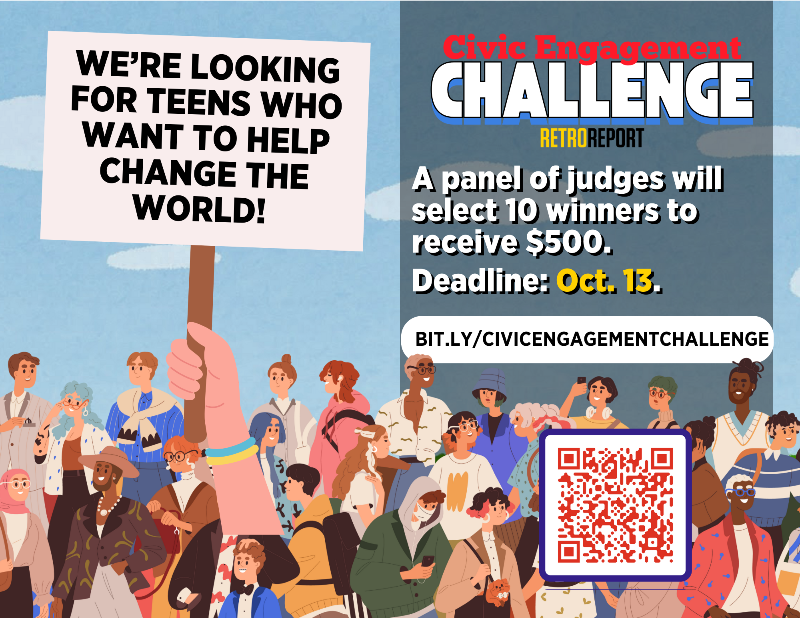
The Retro Report Civic Engagement Challenge submission portal is now open. Retro Report is asking students ages 13–18 to spotlight civic issues they are passionate about by creating an essay or 90-second video. Judges will select 10 entrants to receive $500. Students can submit entries until Oct. 13.
Did you know that Retro Report is committed to helping teachers make Civic education engaging and relevant to current events? In addition to this Civic Engagement Challenge, also in the works are a television series that will premiere on PBS on Oct. 8 about the We The People competition, skill-based videos, and dozens of free resources for teachers.
Explore Retro Report's Civics Resources Now.
| |
|
FREE Webinars from Asian Americans Advancing Justice
to support the TEAACH Act
| |
With its historic passage in April of 2021, the Teaching Equitable Asian American Community History (T.E.A.A.C.H.) Act amended the Illinois School Code, ensuring every public elementary and high school student in Illinois learns about the contributions of Asian Americans to the economic, cultural, social, and political development of the United States.
The Illinois Civics Hub is partnering with Asian Americans Advancing Justice to offer FREE PD hours to K–12 educators looking to deepen their own understanding of Asian American Pacific Islander (AAPI) history, and to gain classroom resources to support cross-cultural education for all students in Illinois, aligned with the revised social science standards.
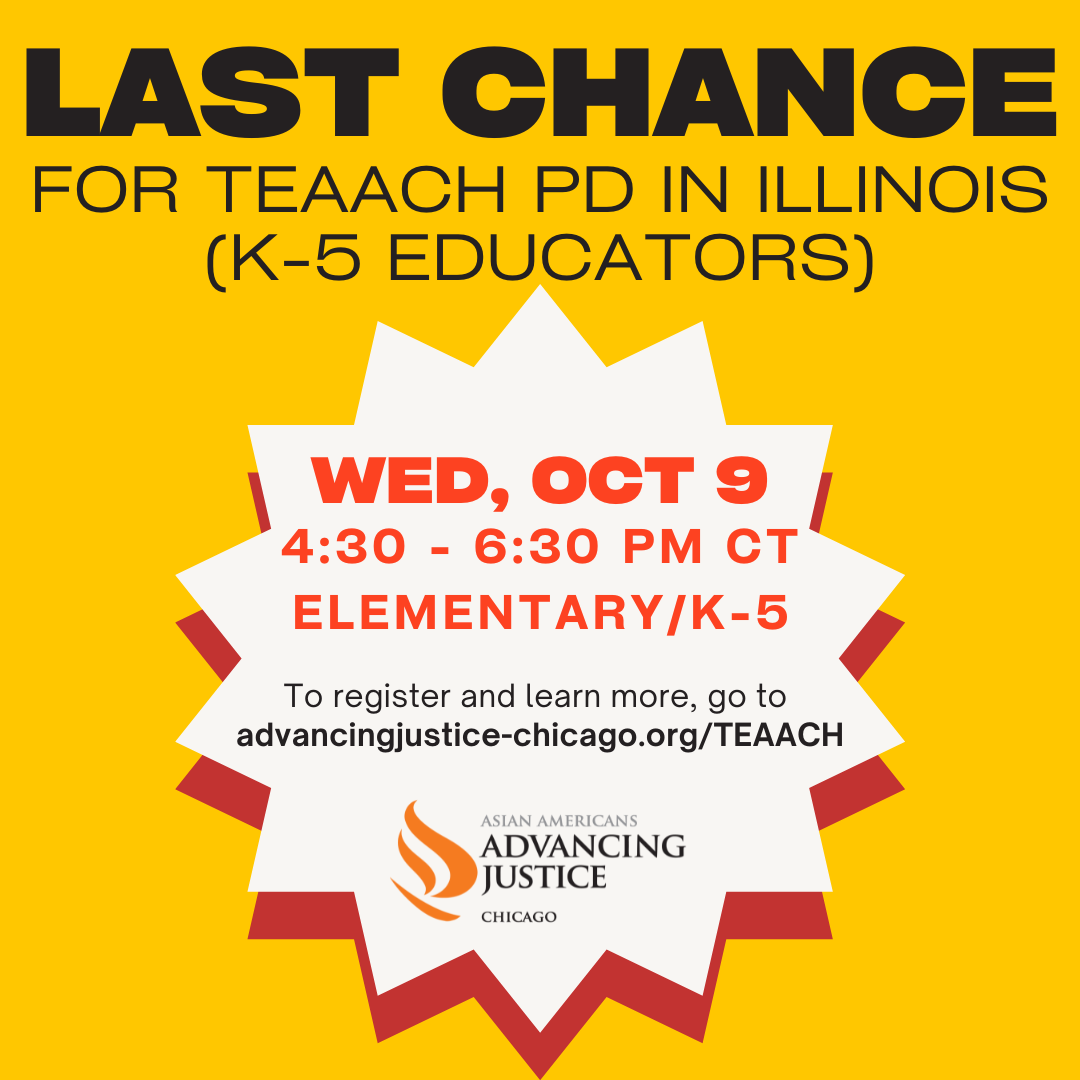
To register for the Elementary Level webinar on October 9, 2024,
from 4:30-6:30 p.m. via Zoom, click here!
| |
|
November 8, 2024
2024 Annual Conference for Teachers in Civics, Law, and Government
| |
The Constitutional Democracy Project’s Professional Development Conference for Teachers in Civics, Law, and Government is a one-of-a-kind working conference that brings together teachers, professors, lawyers, judges, civic leaders, cultural institution scholars, civic education specialists, and others to highlight best practices for teaching young people awareness of the law, the legal system, and their rights and responsibilities as engaged citizens.
This year’s Annual Conference for Teachers in Civics, Law, and Government will focus on the theme of “Navigating Controversy: Empowering Educators in Challenging Times.” The keynote speaker for this event is Dr. Diana Hess, former dean of the University of Wisconsin's School of Education and the leader of The Discussion Project, which has, since its founding in 2017, provided intensive professional development on how to create more engaging and inclusive classroom discussions.
Interested in submitting a conference proposal?
Visit the CDP website for more information.
| |
|
Mark Your Calendars for Media Literacy Week
October 21-25
| |
Help the National Association for Media Literacy Education (NAMLE) make the 10th Annual U.S. Media Literacy Week (October 21-25) the most impactful yet! Throughout the week, NAMLE unites educators, students, organizations, and community members to celebrate and promote media literacy.
Whether enhancing your curriculum, advocating in your community, or spreading awareness, there's a place for everyone. Together, we ensure media literacy is widely taught and highly valued as an essential life skill. Register as a participant now to access all NAMLE-hosted events, including the Media Literacy Resource Showcase and Awards Ceremony.
| |
|
Earn Your Microcredentials
Become a Guardian of Democracy Educator
|  | |
The Illinois Civics Hub has partnered with the Lou Frey Institute at the University of Central Florida to provide educators the opportunity to earn microcredentials in the proven practices of civic education embedded in the middle and high school civics course requirements in Illinois. Courses include:
- Current and Controversial Issue Discussions—Learn from academic experts Dr. Diana Hess & Dr. Paula McAvoy as you explore the purpose, role, and function of discussion strategies as pedagogical tools to equip young people to be engaged citizens. This course will enhance the practice of educators with strategies and resources to create a classroom climate in which there are equitable opportunities for ALL students to engage in dialogue about essential questions across the curriculum.
- Simulations of Democratic Processes—Learn from academic experts Dr. Walter Parker & Dr. Jane Lo as you explore how democratic processes and procedures occur as part of the regular functioning of government, in each of the three branches of government, and at each level of government. This course will guide you through the purpose, planning, and implementation of three simulations: town hall meetings, legislative hearings, and moot courts.
- Informed Action through Service Learning—Learn from academic experts Dr. Joseph Kahne and Jessica Marshall as you explore the purpose, role, and function of informed action through service learning as a pedagogical tool to equip young people with the knowledge, skills, and dispositions to be active members of their community. In this course, you will interact with strategies and tools you can use in your classroom to support student-centered informed action through service learning.
-
NEW: Constitutional Democracy as Content and Practice—Learn from academic experts Dr. Kei Kawashima-Ginsberg, Dr. Shawn P. Healy, and Dr. Bonnie Laughlin Schultz as you explore how the Educating for American Democracy Roadmap can help teach constitutional democracy as both content and practice across disciplines K-12.
Registration information is available on the Guardians of Democracy homepage. Those who successfully complete the 5-week online course will earn a Bronze Certified Guardian of Democracy Educator badge via Badgr and the University of Central Florida Center for Distributive Learning.
Participants can earn 15 PD hours through the DuPage Regional Office of Education. Please note that due to some changes in our funding, the Democracy School Network will no longer be offering a stipend to participants.
There are three strands of courses for each proven practice of civics education. Graduate credit is available through the University of St. Francis for completing all three courses. For more information, please visit the Guardians of Democracy homepage.
| |
|
ICSS Fall Conference—Friday, October 11, 2024, Harper College
| |
Navigating Controversial Topics in Today’s Digital World
The Illinois Council for the Social Studies conference provides opportunities to contribute to the professional dialogue through session presentations and networking with colleagues across and beyond Illinois. ICSS invites presentations from all areas of social studies, particularly sessions that explore one or more of these areas of immediate interest.
The ICSS Fall Conference engages practicing PK-12 social studies teachers, preservice teachers, university faculty, social studies researchers, and concerned citizens. Participants will explore a variety of topics and sessions that are pertinent to social studies students and teachers in the field across grade levels and social studies content areas.
- Conference date: Friday, October 11, 2024
- Conference location: Harper College, Palatine, Illinois
Visit the ICSS webiste for more information.
| | | | |