|
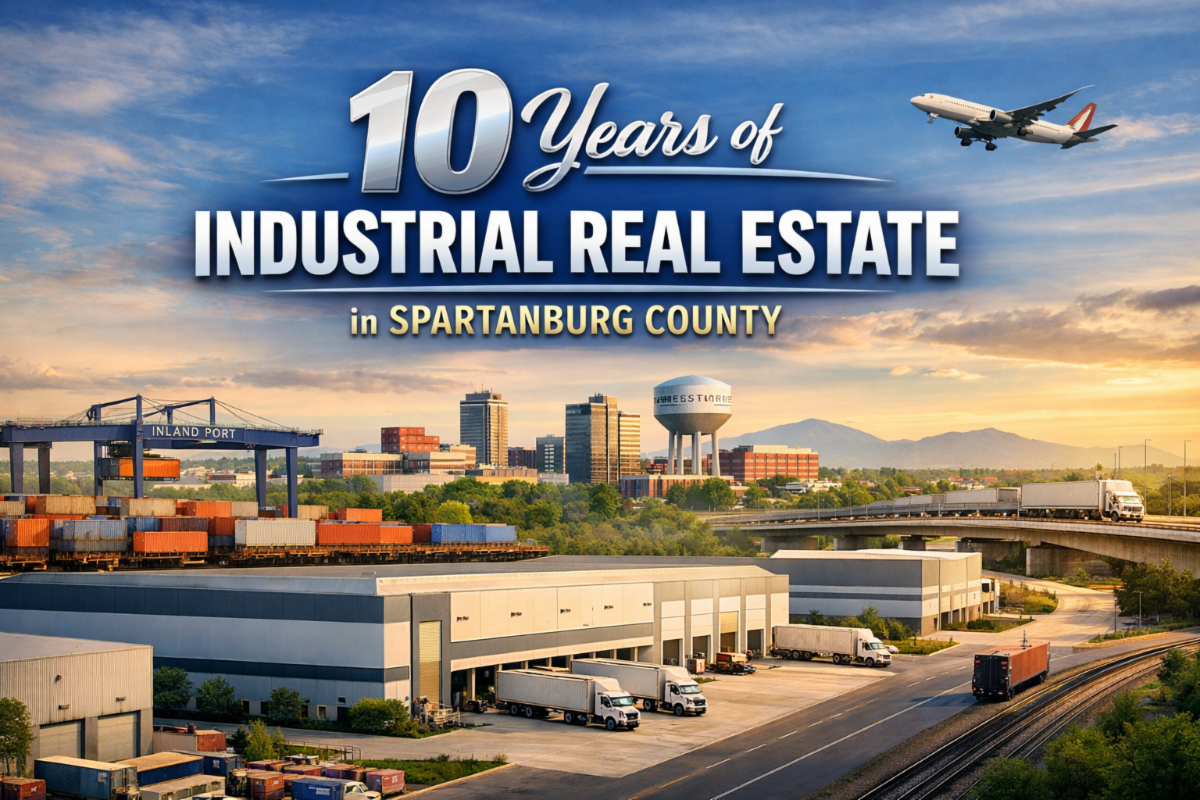
Over the past decade, industrial real estate in Spartanburg County has quietly transformed from a steady secondary market into one of the Southeast’s most closely watched logistics and manufacturing hubs.
Ten years ago, inventory sat around the mid 80 million square foot range, rental rates were modest, and new construction was selective. Spartanburg was viewed as a practical, affordable alternative, not necessarily a primary target for institutional capital.
Fast forward to today, and the story looks very different.
Industrial inventory has expanded dramatically, adding tens of millions of square feet as developers worked to keep up with demand. Asking rents have nearly doubled over the decade, and sale prices per square foot have followed a similar trajectory. While recent years have seen vacancy rise as new supply delivers to the market, a natural phase after rapid expansion, the long-term trend tells a clear story of sustained growth driven by fundamentals rather than speculation.
So what changed?
Logistics Infrastructure Changed the Game
One of the most important catalysts has been the continued expansion of Inland Port Greer, which reshaped how companies view Upstate South Carolina. By providing direct rail access to the coast, the inland port allowed Spartanburg to function as an inland distribution hub rather than a tertiary location.
At the same time, investments and capacity growth at the Port of Charleston strengthened global connectivity. For many occupiers, Spartanburg now offers proximity to a major port without the congestion and costs associated with coastal markets.
The result has been a powerful logistics corridor connecting manufacturing, distribution, and international trade.
A Cost Advantage That Still Matters
Another major driver is simple economics.
Compared to larger Southeast industrial markets such as Atlanta, Charlotte, or coastal port cities, Spartanburg has consistently offered lower land costs, competitive labor access, and fewer barriers to development. For occupiers making long-term decisions, those savings compound quickly.
Even today, many companies can secure newer facilities here at pricing that would be difficult to replicate in competing markets. That affordability helped attract both first-time entrants and companies expanding existing regional footprints.
Manufacturing Momentum Created Stability
Industrial growth in Spartanburg was not built solely on speculative warehouse demand. It has been anchored by long-standing manufacturing investment.
Companies like BMW Manufacturing and Michelin North America helped establish the Upstate as a global automotive and advanced manufacturing center. Their presence created a deep supplier network, which in turn generated consistent industrial absorption year after year.
More recently, large-scale distribution users, including groups like Amazon, accelerated demand as e-commerce reshaped supply chains and pushed companies to position inventory closer to population centers.
The Pandemic Acceleration and Normalization
The 2020 through 2022 period marked an inflection point. Supply chain disruptions forced companies to rethink logistics strategies, increasing inventory levels and driving record absorption across the region. Developers responded with unprecedented construction activity.
Today’s higher vacancy rates reflect that wave of new supply delivering, not weakening demand. In many ways, the market is transitioning from an overheated expansion phase into a more sustainable equilibrium.
Looking Ahead
What stands out most over the last decade is not just growth, but resilience.
Spartanburg’s industrial market evolved because multiple forces aligned: infrastructure investment, manufacturing strength, population growth across the Southeast, and a lasting cost advantage.
If the past ten years were about discovery, companies realizing what Spartanburg offers, the next decade will likely be about refinement, including smarter site selection, more specialized facilities, and continued institutional investment.
Industrial real estate here did not rise overnight. It was built step by step, project by project, over years of strategic growth. And based on the fundamentals in place today, Spartanburg remains positioned to stay an important player in the Southeast industrial landscape for years to come.
|