Rail Workers Weekly News Digest
Number 4 - April 16th, 2019
|
|
Below is a series of article compiled over the previous week.
They are of interest to railroad workers
_____________________________________________
|
|
2019-3 Article 1
Trump plan to ship natural gas by rail stokes ‘bomb train’ fears
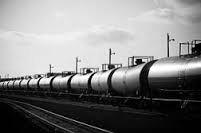
President Donald Trump wants to allow natural gas to be shipped in railroad cars, a move that would open new markets hungry for the fuel but could risk catastrophic accidents if one were to derail.
Trump on Wednesday ordered the Transportation Department to write a new rule permitting super-chilled natural gas to be shipped in specialty tank cars. The order follows a multiyear lobbying campaign by railroads and natural gas advocates, who argue it is needed to serve customers in the U.S. Northeast, where there aren’t enough pipelines, and making it possible to use the gas to power ships and trains.
“There are all sorts of new opportunities where you can use rail much more efficiently,” said Charlie Riedl, head of the Center for Liquefied Natural Gas trade group.
The effort, which could help offset falling rail shipments of coal, mirrors how the oil industry turned to trains to ship crude when there weren’t enough pipelines to meet demand. But a series of spills and other accidents -- including a runaway oil train that derailed and killed more than 40 people in a small Quebec town in 2013 -- have safety advocates warning against putting gas on the rails.
“It’s a disaster waiting to happen,” said Emily Jeffers, a staff attorney with the Center for Biological Diversity, who added that Trump’s initiative evokes earlier concerns about crude-filled “bomb trains” traveling through American cities. “You’re transporting an extraordinarily flammable and dangerous substance through highly populated areas with basically no environmental protection.”
|
|
2019-3 Article 2
Railroads Sue Kentucky for the Right to Block Streets
LOUISVILLE (CN) — It’s the scourge of harried commuters and families across the nation who, already running late, come to an abrupt halt at a railroad crossing to find an endless line of train cars blocking their path to work or school.
For residents of Richardson Lane in Pulaski County, the problem has become more than just a minor if irritating inconvenience, with aggravated residents reporting that Norfolk Southern trains have been blocking the entrance to their small cul de sac for hours at a time.
One resident complained in early 2017 that he had missed a close friend’s funeral. Another said that an ambulance could not reach her mother for more than an hour to treat her for heat exhaustion.
“I have a lot of health issues with my heart. I worry all the time that I’m probably going to be waiting on a train if I do have to go have some medical attention,” Michael Hill told local NBC affiliate LEX 18 after neighbors protested Norfolk Southern at a closely watched court hearing.
Kentucky has a law designed to tackle the problem, called an “anti-blocking” statute. But the Association of American Railroads, an influential lobbying group for the nation’s largest railroads, sued the state and county in federal court to defend the right of railroads to keep residents waiting for seemingly interminable amounts of time.
Read more ...
|
|
2019-3 Article 3
B
y Jason Doering and Matthew Parker
All day, every day, through cities, rural areas and everywhere in between, in Nevada as well as around our country, freight trains are rolling. In many cases, they’re the only practical way to safely transport hazardous chemicals, oil, hazardous waste, consumer goods, and vehicles to their intended destinations. That hasn’t changed for years.
Trains aren’t going to disappear. Tracks aren’t going to disappear.
But what about the crews?
Back in the era of steam engines, there would be five or even more crew members operating the train. Beginning in the 1980s, that went down to three people — remember the caboose? Trains in most cases now have two-person crews — a certified engineer and a certified conductor — to operate the train and perform many tasks as they travel.
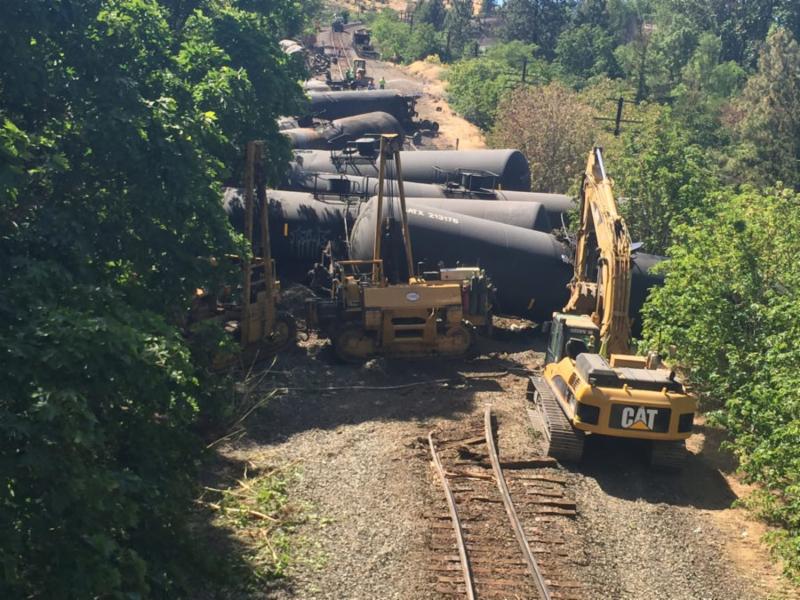
Here’s the big question: What if something happens on a freight train, some of which today are close to three miles in length? What if tank cars carrying hazardous chemicals or flammable materials derail near a residential area? What if there’s a collision at a grade crossing, a derailment, or if one of the members of the crew is incapacitated?
Read more ...
|
|
2019-3 Article 4
BLET President Criticizes Precision Scheduled Railroading!
Precision Scheduled Railroading: Short Term Gains at What Cost?
INDEPENDENCE, Ohio, April 8 - Much is being made in the railroad industry and other transportation media about the Precision Scheduled Railroading (PSR) wildfire sweeping from coast to coast. Proponents of PSR will tell you that it will prove to be the industry's savior. But it also begs the following question; just what does the industry need to be saved from?
According to transportation industry news provider Transport Topics, the combined operating income of the Class I railroads topped $16 billion for the first half of last year, based on company reports. The carriers are now well into their second decade of ever increasing profits, setting new records virtually every year.
So, why the stampede toward PSR? And what does PSR really mean for railroad workers, shippers and the nation as a whole? While everyone seems to have a slightly different definition of PSR, there are a couple of common threads in all the definitions.
|
|
2019-3 Article 5
Positive train control: Class I railroad installation of the safety technology, by the numbers
The nation’s railroads continue to work toward completion of positive train control installation.
While the process seems like it might be inching along, railroads have made significant strides in the past two years installing the complex safety system.
Congress approved the PTC requirement as part of the Rail Safety Improvement Act of 2008. The law initially mandated railroads install PTC on tracks that carry passengers or so-called toxic-by-inhalation materials by the end of 2015; an extension was granted, giving railroads until the end of 2018.
Read more ...
|
|
2019-3 Article 6
CSX: Employee struck by locomotive, killed at Tennessee rail yard 4/13/19
A CSX employee was killed when he was struck by a locomotive at a rail yard in Chattanooga.
"At approximately 5:00 pm Saturday, CSX employee Allen Lowe was fatally struck by a locomotive while he was working in our rail yard in Wauhatchie, TN," a CSX spokesperson told Channel 3.
CSX is working with local law enforcement to investigate.
See more ....
|
|
2019-3 Article 7
railroad grade crossing collisions and rail trespass deaths increased in 2018
Operation Lifesaver, Inc. (OLI) Executive Director Rachel Maleh recently revealed that railroad grade crossing collisions and rail trespass deaths increased in 2018.
Citing preliminary
Federal Railroad Administration (FRA)
statistics, Maleh said U.S. crossing collisions rose 4.3%, crossing deaths remained constant and crossing injuries decreased 2.9% from 2017 to 2018. Total casualties—deaths and injuries—from rail trespassing were up 2.8%, trespass deaths grew 12% and trespass injuries fell 6.3% in 2018.
States with the most crossing collisions in 2018, according to
the rail safety education nonprofit
, were Texas, California, Indiana, Georgia, Illinois, Florida, Louisiana, Alabama, Ohio and Pennsylvania. States with the most trespasser casualties last year were California, Texas, Florida, New York, Illinois, Pennsylvania, Ohio, Georgia, North Carolina and New Jersey.
Read more ...
|
|
2019-3 Article 8
UK Locomotive Engineers Union Takes up the Issue of Menapause
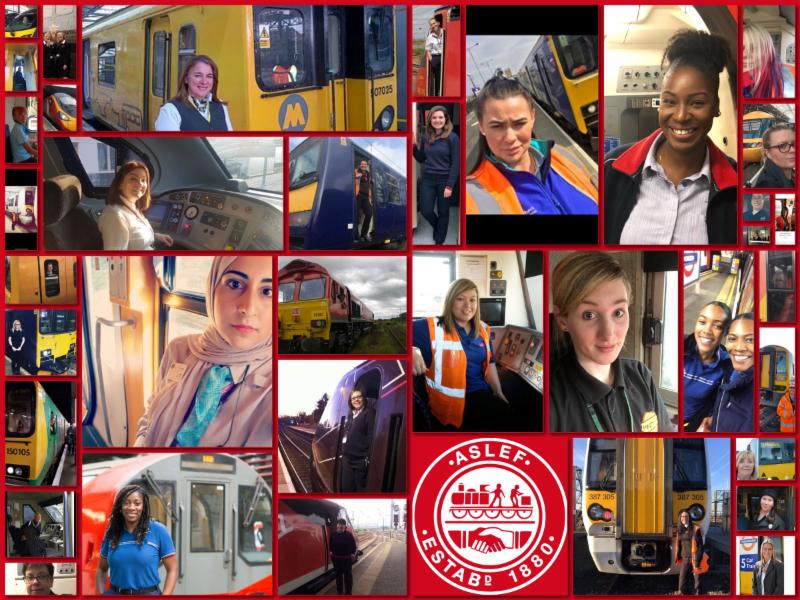
Deborah Reay, Northern Line Branch Secretary and Chair of ASLEF's Women's Representative Committee, writes for the
May 2019 ASLEF Journal
, available soon:
The railway industry, as it began, and developed, in the 19th century, was designed for men. Facilities, policies, uniform and ergonomics were all geared to suit the male driver. Well, why wouldn't it be? There were no female drivers, so why would you cater for them?
Last year we marked 40 years since the first woman drove a train in Britain – Hannah Dodds, the first female London Underground driver, passed out on 5 October 1978 and began driving tube trains on the District Line – but the industry has been slow to adapt to these 'strange creatures'.
|
|
Railroad Workers United
Solidarity -- Unity -- Democracy
|
|
|
|
|
|
|