June 7, 2021
HOUSE DEMOCRATS RELEASE $547 BILLION
SURFACE TRANSPORTATION REAUTHORIZATION BILL

House Democrats on Friday introduced a $547 billion surface transportation reauthorization bill proposing increased investment for highway, public transportation and rail programs.The INVEST in America Act also calls for numerous policy changes to existing formula programs, creates new discretionary grant programs, and would bring back earmarks, rebranded as “member designated projects."

The bill is scheduled for a hearing this Wednesday, June 9 in the House Transportation & Infrastructure Committee, and is expected to face Republican opposition unlike the bipartisan, highway-only Senate bill recently passed by the Senate Environment and Public Works Committee. The current authorization will expire on September 30 and Speaker Pelosi has expressed her intent to see the bill passed by the July 4 recess.

Below are the key takeaways from the bill, broken into funding levels and policy changes that would impact our industry.

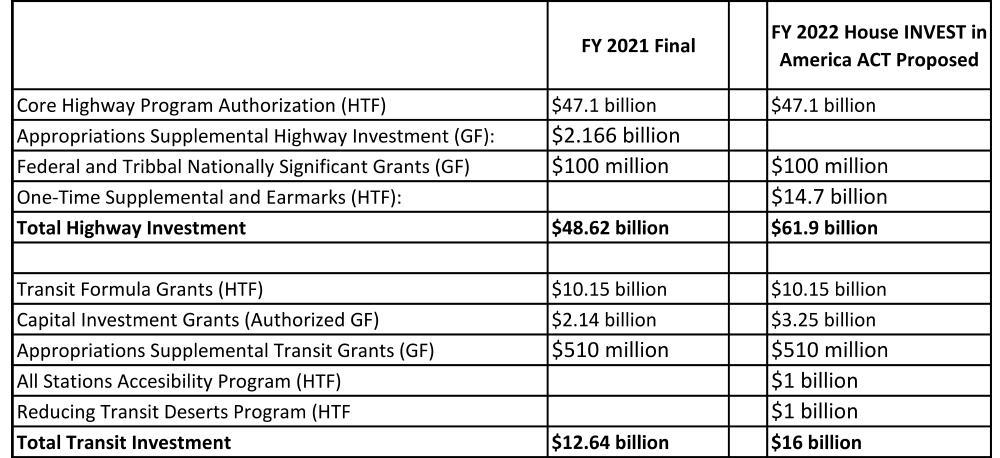
Funding for highways remains flat at FY21 levels with an additional $14.7b for earmarks, although the list of projects is not yet available. Formula funding for transit also maintains FY21 levels, but is bolstered by an additional $3b in grant funds. See below for line items by program.
The INVEST Act also includes a number of policy changes worth noting, many of which appeared in 2020's H.R. 2, a mega-infrastructure package passed by the House but not the Senate. There is a definite focus on resilience and sustainability a well as equity throughout the bill.

Policy items of note:
  • Establishes a 5-year national vehicle miles traveled (VMT) pilot program. Directs the Secretary to solicit participants from all 50 states and the District of Columbia. Incorporates passenger and commercial vehicles, including vehicle fleets. Provides flexibility for the type of revenue-collection mechanism used in the pilot, including successful VMT pilots implemented at the state level. Directs collected revenue to the Highway Trust Fund.
  • Reauthorizes the Disadvantaged Business Enterprise (DBE) program and eliminates the gross receipts cap (currently $26.29 million, averaged over three years) that is currently one requirement for DBE eligibility. Instead, the Small Business Administration’s annual volume caps for relevant North American Industry Classification System (NAICS) codes will apply. The annual small business cap for highway, street and bridges construction is $39.5 million, and those for several subcontracting disciplines are $16.5 million.
  • Expands Buy America requirements to include “construction materials” and directs USDOT to issue regulations that will ensure the continued availability of those materials to carry out federal-aid highway projects. Also requires USDOT to research supply chains and domestic availability of items covered by Buy America.
  • Directs USDOT to review the procurement processes used by state DOTs to select construction materials for federal-aid highway projects.
  • States and Metropolitan Planning Organizations (MPOs) are required to consider climate, resiliency, and equity in transportation plans.
  • Creates a “carbon pollution reduction apportionment program,” where states are rewarded or penalized based on annual greenhouse gas (GHG) emissions on their public roads. States which demonstrate the highest reductions in GHG emissions are allowed increased flexibility as to how federal funds may be spent, while states with the lowest GHG reductions will be required to dedicate additional federal funds to projects that reduce GHG emissions.
  • Bridges: Requires states to implement corrosion management requirements to improve the lifespan of bridges and ensure state of good repair. Allows for bundling of bridge resiliency projects and creates a new minimum bridge investment requirement that ensures states spend no less than 20 percent of their two largest apportioned programs on bridge repair and rehabilitation projects.

The UTCA provision that would establish a toll credit marketplace has unfortunately been watered down to a directive for USDOT to study the viability of the concept. We have reached out to our Congressional delegation (who are champions of this issue) and to a federal lobbyist in order to engage Chairman DeFazio directly and advocate for this important language. Our preferred language was approved in the Senate EPW highway bill, which means the measure still has the chance of advancement.

While a gap remains between the House and Senate reauthorization bills, the fact that policies are moving in both chambers is a good sign. Coupled with the ongoing negotiations between the Biden Administration and Congress on a possible infrastructure stimulus plan, UTCA remains hopeful that increased federal funding is on the horizon.

 We will keep you updated as the policy progresses.

PO Box 728 Allenwood, NJ 08720 Phone: (732) 292-4300 Fax: (732) 292-4310
Copyright © 2016 Utility and Transportation Contractors Association