|
Greetings!
When people shop for a home, they usually focus on negotiating the lowest possible purchase price. That makes sense; a lower price means borrowing less money. But a price cut is not the only way a seller can help a buyer afford a home, and it may not produce the most reduction in the monthly mortgage payment.
Depending on the buyer's goals, using seller funds to reduce the interest rate can provide much more immediate relief. To see why, consider three ways to use essentially the same amount of seller assistance: a price reduction, a permanent rate buydown, and a 2-1 temporary buydown. One Home, Three Approaches.
Assume a buyer purchases a $500,000 home with 10% down and a 30-year conventional mortgage at 6.75%. (7.120% APR) Without any seller assistance, the monthly principal and interest payment would be approximately $2,919.
Now assume the seller is willing to give up about $10,367 in proceeds to help make the deal work. How that amount is used makes a meaningful difference.
A lower purchase price.
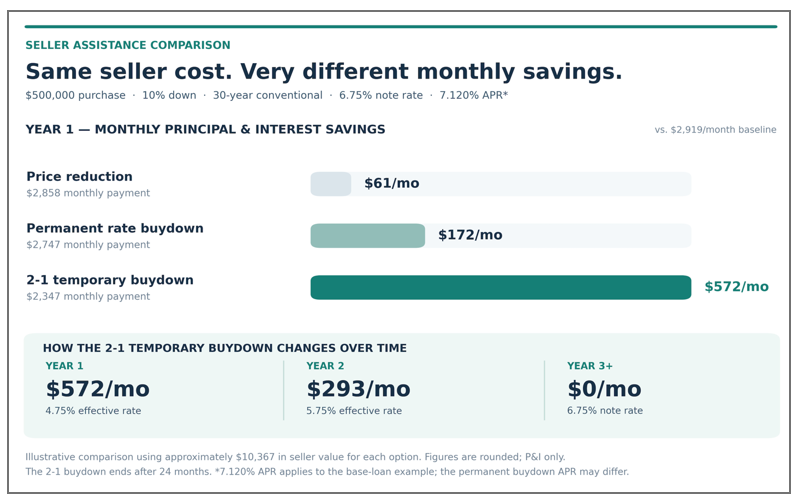
If the seller reduces the price by $10,367, the new price is $489,633. With the buyer still putting 10% down, the monthly principal and interest payment falls to approximately $2,858. That saves $61 per month. The buyer also needs a slightly smaller down payment and begins with a lower mortgage balance. Both are real, lasting benefits.
A permanent rate buydown.
Instead, those seller dollars could cover discount points that lower the loan's interest rate for as long as the mortgage remains in place. Using an illustrative rate of 6.17% (7.120% APR), the monthly principal and interest payment drops to $2,747— a savings of $172 per month. That is about 2.8 times the monthly savings of the price reduction, for essentially the same seller cost.
A 2-1 temporary buydown.
With this approach, seller funds cover part of the payment during the first two years. The buyer's effective rate is 4.75% in year one and 5.75% in year two, while the actual note rate remains 6.75% (7.120% APR). The first-year principal and interest payment is approximately $2,347, saving $572 per month. In year two, it rises to roughly $2,626, still about $293 below the original payment.
What the Payment Difference Looks Like
The comparison is striking when we focus only on the first year. The permanent buydown produces nearly three times the payment savings of the price reduction. The 2-1 temporary buydown, in turn, produces about 3.3 times the first-year savings of the permanent buydown. Compared directly with the price reduction, that is about 9.4 times the monthly savings.
Timing Matters. For a buyer facing moving costs, repairs, and other expenses of settling into a home, an extra $572/month during the first year can be especially useful. That is the main advantage of a 2-1 buydown. It concentrates payment relief at the beginning of your loan, when cash flow may matter most.
The trade-off between permanent and temporary buydown is just as important. The temporary assistance lasts only 24 months, and beginning in year three, the buyer makes the full payment of approximately $2,919 based on the 6.75% (7.120% APR) note rate. Buyers must qualify at that full rate and should be comfortable with the full payment even if refinancing never becomes attractive or possible.
A price reduction may be the better choice for someone who wants to start with a smaller loan balance. A permanent buydown may fit someone planning to keep the mortgage for many years. But if the immediate goal is making the first two years more manageable, a 2-1 temporary buydown can make the same seller dollars go considerably further in terms of monthly payment relief.
The point we are trying to make by comparing these three options is this: before negotiating only on price, buyers should also ask what the same seller dollars could do for their monthly payment. The best deal is not always the one with the lowest purchase price; sometimes, it is the one structured around the buyer's actual priorities.
Listen below for more information:
Check out the Reliant Mortgage Solutions Podcast!
|