PRODUCT STEWARDSHIP UPDATES |
|
PSI Presents to OECD on EPA Packaging Leadership |
|
The Product Stewardship Institute was the only nonprofit focused on EPR to join a stakeholder consultation meeting organized by the Organization for Economic Cooperation and Development (OECD) in Washington D.C. PSI was invited to the meeting, which also included national nonprofits Ocean Conservancy and Surfrider, among others, at the request of the U.S. Environmental Protection Agency (EPA) and was recommended by OECD, which works closely with PSI and had previously invited the organization to present on U.S. EPR activity at an OECD event in Tokyo.
With 38 member countries, the OECD works to establish international standards to help solve social, environmental, and economic problems. The focus of the September meeting, which also included waste management experts, was to assess the performance of the United States in regards to the environmental — and, especially, environmental justice — impacts of “marine litter.” (Also known as “marine debris,” this refers to waste discharged into a coastal or marine environment; the majority is plastic.)
Participants assessed national and international commitments and contributed recommendations for improvement. Scott Cassel, PSI’s CEO and Founder, presented on how state packaging EPR laws will reduce plastic pollution, especially when considered with other legislative measures, and pointed out that the nation’s fragmented recycling infrastructure and policies, lack of a consistent materials management policy, and depleted technical capabilities are challenges to the implementation of statewide packaging EPR policies. He noted that although waste management is delegated to the states, there is a critical need for greater state harmonization or a national solution that could be found in the federal Break Free From Plastic Act (PSI’s model also informed that bill’s EPR component).
Although it is unclear what authority the United States EPA has to promote policy that is not directly delegated by Congress, Cassel highlighted that it does have the ability to provide guidance and technical support on issues such as packaging labeling; a standard definition of recycling; and goals for source reduction, reuse, recycling, and post-consumer recycled content. He also asked EPA to support national efforts driven by state and local governments. Read more on the blog.
|
|
California Enacts Battery EPR Law |
|
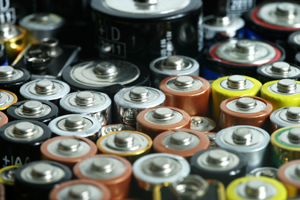
Have you checked our EPR Laws Map lately? California just changed color! This month, Governor Gavin Newsom signed into law battery EPR legislation, championed by the California Product Stewardship Council and Californians Against Waste, that includes strong collection convenience standards and performance goals, comprehensive education and outreach requirements, and aspects that seek to advance equity. The state now has 11 EPR laws in place – a national record.
Known as the Responsible Battery Recycling Act of 2022, AB 2440 requires producers to establish, fund, and operate a stewardship program to collect and recycle covered batteries and battery-embedded products, including primary, rechargeable, and lithium-ion batteries, which can explode or cause fires. Read more on the blog.
|
|
Members and Partners receive regular legislative updates and can track EPR bills and laws in our Legislation Library.
|
|
On October 20th in Chicago, IL, the Paper and Plastics Recycling Conference will host a panel on “EPR and Sustainable Packaging” that includes Myles Cohen, Founder & Managing Director of Circular Ventures, who is also an advisor to the Pack Green Coalition, a PSI Partner.
Scott Cassel, PSI's CEO and Founder, will present on a panel that explores how Extended Producer Responsibility (EPR) and other key regulations impact recycling in North America at the Plastics Recycling World Conference in Cleveland, OH on November 9th.
|
|
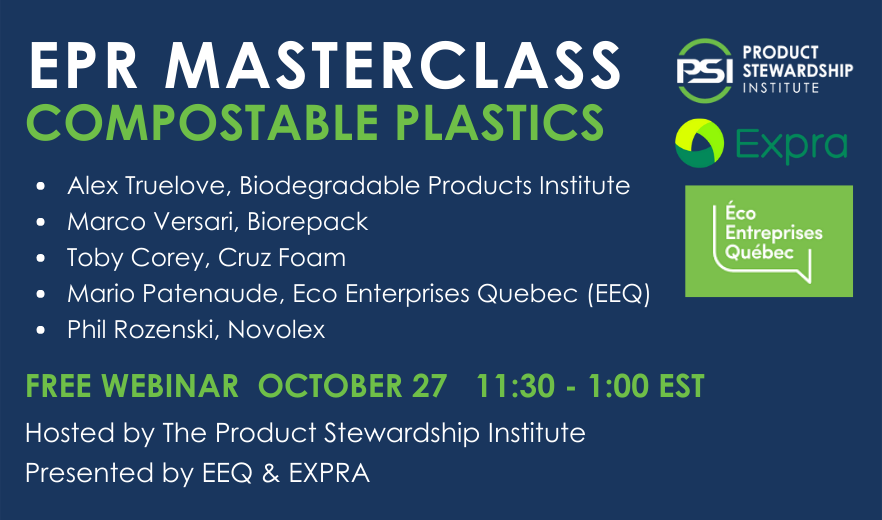
On October 27th, PSI will gather a group of experts to discuss the opportunities and challenges of compostable plastics, including achieving clarity on definitions and labeling, addressing materials in packaging EPR laws, how EPR funding can be used to create new infrastructure for compostable plastics, and strategies for best managing these materials in a rapidly evolving industry. This webinar is presented by EXPRA and Éco Enterprises Québec (ÉEQ). Space is limited; please register today.
|
|
Paint & Coatings Industry noted that “The International Paint Recycling Association (IPRA), which is facilitated by the Product Stewardship Institute (PSI) and was developed by PSI in partnership with recycled paint manufacturers, has released some impressive statistics in its 2021 Annual Report.”
|
|
How can businesses address their EPR challenges? Covanta, a PSI Partner, authored a PSI blog that answers this question by examining a concept foundational to EPR: The transition from a “linear” to a “circular” economy.
Covanta also published an article to help businesses reduce their environmental impact by strengthening their recycling efforts.
|
|
In September, CalRecycle approved the Mattress Recycling Council (MRC) 2023 Budget and 2021 Annual Report, which showed that MRC increased collection for the sixth consecutive year, diverted from disposal 76.9% (by weight), and made more than 66 million pounds of steel, foam, fiber, and wood available for use in making new products.
Encorp Pacific’s Beverage Container Stewardship Plan has been approved by Canada’s Ministry of Environment and Climate Change Strategy. The approval letter and plan, which specifies a recovery rate of 83.6% to be achieved by 2023, is posted online.
In September, Circular Materials announced that it had acquired the operations of the Resource Recovery Alliance, formerly known as the Canadian Stewardship Services Alliance.
BC Used Oil Management Association (BCUOMA) seeks stakeholder input on their revised Extended Producer Responsibility Plan, which will be presented present to Canada's Ministry of Environment and Climate Change Strategy on December 1st. Full details about the consultation process, along with a copy of the proposed plan and other supporting materials, can be found on their website.
|
|
Last week in California, Governor Newsom signed into law legislation that prohibits the manufacture, distribution, and sale of textiles and cosmetics that contain per- and polyfluoroalkyl substances — known as PFAS — but vetoed a bill that would have created a publicly accessible database of consume items that contain the toxics. Newsom also vetoed SB 1256, which would have banned single-use, one-pound propane cylinders, saying that “an outright ban without a plan for collection and refill infrastructure could inhibit the success of building a circular system in California.”
New report finds that three years into a five-year plan to reduce plastic waste, Alliance to End Plastic Waste members have achieved just .04% of recycling targets. Describing operations as “sophisticated greenwashing,” the report also points out that many AEPW members are also members of the American Chemistry Council, the primary opponent to the Break Free From Plastic Pollution Act, the landmark federal legislation that would implement a national packaging EPR program and container deposit requirement, among other measures to address plastic pollution. The BFFPA failed to pass the House and Senate in 2021 and 2022 and may be re-introduced next year.
During a recent webinar hosted by the U.S. Plastics Pact, participating brands indicated that more “harmonized” federal legislation could help achieve goals of making all plastic packaging 100% reusable, recyclable, or compostable by 2025.
We regularly share information like this on LinkedIn, Twitter, and Facebook. If you'd like to get these updates in real time, please follow our accounts. Thanks!
|
|
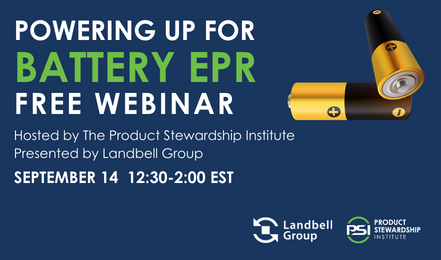
Global efforts to stabilize our climate have resulted in an increased use of electric bikes, scooters, and vehicles — and the batteries that power them. Extended producer responsibility for batteries provides an effective solution to preventing fires and environmental contamination, recovering valuable critical minerals, reducing greenhouse gases, and creating recycling jobs. PSI recently convened experts for a free "Powering Up for Battery EPR" webinar to discuss the past, present, and future of battery EPR; the recording is now available to PSI Members and Partners.
|
|
The Product Stewardship Institute is a policy advocate and consulting 501(c)(3) nonprofit that powers the emerging circular economy. We rely on the generosity of our members, partners, and supporters to convene diverse stakeholders to build extended producer responsibility (EPR) policies, programs, and laws. Thank you!
|
|
The Product Stewardship Institute, Inc. is an equal opportunity employer and provider. Persons with disabilities who require alternatively formatted materials to ensure effective communication should contact Amanda Nicholson at amanda@productstewardship.us or 617.236.4855, TTY: use 711 or 800-439-2730; MassRelay.
|
|
|
|
|
|
|