|
Plastics News Alert
A publication of the KIN Plastics in Humans Working Group
(Join the What'sApp Group here.)
| | Dr. Sarah McCue, Chair, KIN Plastics in Humans Expert Working Group | | |
What we can learn from a coffee cup
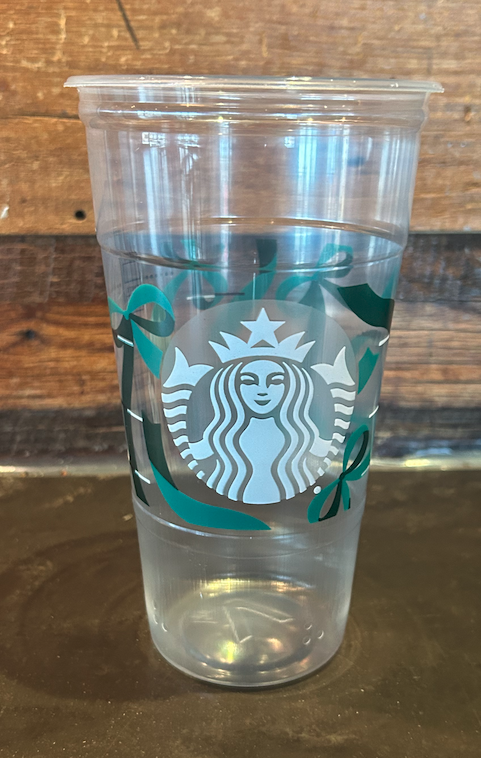
Before you sip another coffee on the go, consider the amount of plastic released from a single paper cup. Estimates range from 25,000 nanoparticles in three ounces of hot water to more that five trillion plastic particles in a single 12-ounce cup.
Please send this important Plastic News Alert to friends and family, and your members of Congress listed here, requesting legislation that ensures plastic doesn't leach into our beverages and food.
| | |
"Coffee, so much a part of the enjoyment of our daily lives, has created an abundance of issues with the plastic used in its single-use paper and plastic cups, and in this issue we have used Starbucks as one of the leading examples. We all love Starbucks and look forward to the company finding solutions."
Alain Chetrit, Co-Founder, Chairman, Knowledge Impact Network
| |
Google AI on Starbucks coffee cups
| | | |
First, how many cups?
Starbucks is estimated to use approximately 4 billion paper cups per year globally.
This figure specifically refers to the paper hot cups. When you combine paper (hot) and plastic (cold) cups, the total number of disposable cups used is estimated to be over 6 billion annually.
Key Factors Changing This Number
The number of paper cups used is shifting due to a massive change in how people drink coffee:
1. The "Cold" Shift (Paper vs. Plastic) Historically, Starbucks was a hot coffee company, meaning most cups were paper. Today, over 75% of Starbucks sales in the U.S. are cold drinks.
-
This means the company now uses significantly more clear plastic cups (polypropylene #5) than paper hot cups in its largest market.
-
While the "4 billion paper cups" figure is a long-standing industry estimate, the plastic cup count is likely growing faster than the paper count.
2. Reusable Cup Adoption is Low Despite aggressive goals to reduce waste, actual adoption of reusable cups remains low. According to Starbucks' 2023 sustainability data, only about 1.2% to 2% of all beverages sold were served in reusable cups (either personal cups brought by customers or "for-here" ceramic ware). This means nearly 98% of all drinks still rely on single-use cups.
The "Waste" Impact
To visualize the scale of 4 billion paper cups:
- Trees: It takes approximately 1.6 million trees harvested every year to produce this many single-use cups.
- Weight: Disposable cups account for about 40% of Starbucks' total packaging waste by weight.
- Lining: Because these 4 billion paper cups are lined with plastic (polyethylene) to prevent leaking, the vast majority are not recycled and end up in landfills.
| | |
What about the paper cups?
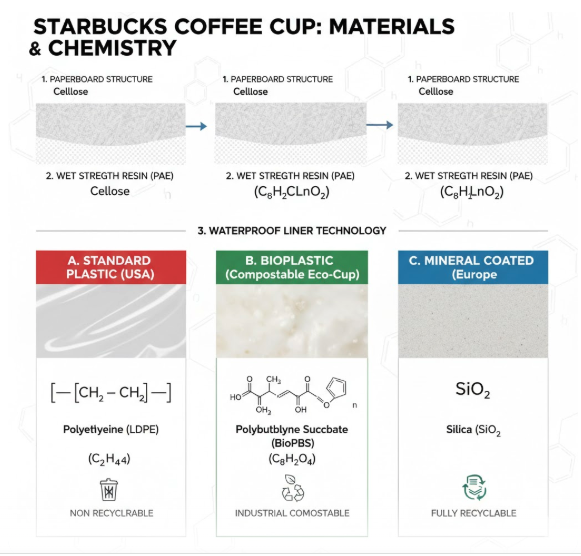
While they look like simple paper, standard Starbucks hot cups are actually a complex composite material.
- The Material: They are made of white paperboard lined with a thin layer of Polyethylene (PE) plastic.
- Why it's used: Paper is porous. Without this plastic liner, your hot coffee would turn the cup into mush and leak out within minutes. The PE liner provides a waterproof barrier.
-
The Recycling Problem: This is the "recyclability paradox." While paper is recyclable and plastic is recyclable, they are extremely difficult to recycle when bonded together. Most recycling facilities cannot separate the thin plastic film from the paper fibers. Consequently, most Starbucks hot cups put in recycling bins are sorted out as trash and sent to landfills.
- The "Europe" Exception: In many European countries (UK, France, Germany), Starbucks has recently switched to a mineral-based coating (using silicon dioxide, a material similar to sand/glass) instead of plastic. This makes the cups fully recyclable in standard paper mills. This technology has not yet been widely rolled out in the US.
| |
How about the cold drink plastic cups? Do they release plastic particles? | | | | |
Yes, they do.
While most news headlines focus on hot coffee cups releasing microplastics due to heat, cold plastic cups (like those at Starbucks) also release plastic particles into your drink, though for different reasons.
Here is the breakdown of how and why this happens with Starbucks' specific cold cup material.
1. The Material: Polypropylene (#5)
Starbucks cold cups are made of Polypropylene (PP).
- The Good News: This plastic is generally more stable and heat-resistant than other plastics (like the PET used in water bottles).
- The Bad News: It is not immune to shedding. Recent research indicates that polypropylene cups can release thousands of microplastics (visible under a microscope) and nanoplastics (invisible, capable of entering cells) per liter of liquid.
2. Why Cold Cups Shed Particles (Without Heat)
Since you aren't melting the plastic with hot coffee, the release of particles in cold cups is driven by chemical and mechanical factors rather than thermal ones:
- Acidity (The "Lemonade" Factor): Many Starbucks cold drinks are highly acidic. Lemonade, Refreshers, and Coffee (especially iced coffee) are acidic liquids. Studies show that acidic fluids strip microparticles from the walls of polypropylene cups at a much higher rate than plain water. The acid chemically interacts with the surface, loosening polymer chains.
- Mechanical Abrasion (The "Ice" Factor): Cold drinks are turbulent.
- Ice: Hard ice cubes constantly hitting, scraping, and swirling against the soft plastic walls act like microscopic sandpaper, physically scouring off microplastic fragments.
- Straws: Friction from inserting and stirring with a straw (even a paper one) abrades the bottom and lid of the cup.
- UV Degradation: If you drink your iced coffee outside in the sun, UV rays accelerate the degradation of the plastic, causing the surface to become brittle and shed more easily, though this takes time.
3. Does the "New" Cup with 20% Less Plastic Help?
In 2024, Starbucks rolled out new cold cups that use 10-20% less plastic.
- Environmental Impact: This is good for landfills (less total mass of waste).
-
Health Impact: This likely does not reduce microplastic shedding into your drink. In fact, thinner plastic is more flexible. If the cup flexes or crinkles in your hand, that mechanical stress can cause "micro-cracks" in the polymer structure, potentially releasing more particles than a rigid, thicker cup.
| | |
The Verdict
You are likely ingesting thousands of microplastic particles with every Starbucks cold drink.
However, this is significantly less than what you ingest from a hot drink in a plastic-lined paper cup, where the heat actively melts the liner.
| | |
Describe in more detail the primary issues using plastic to line paper coffee cups
The issues fall into three distinct categories: the mechanical impossibility of recycling, the health risks of heating plastic, and the environmental longevity of the waste.
1. The Recycling "Glitch"
The biggest operational issue is that the cup is a hybrid material—two different materials fused together that need opposite recycling methods.
- The Separation Problem: To recycle the paper, mills mix the cup with water and churn it in a giant blender (a pulper) to turn it back into pulp. However, the plastic lining does not break down. It floats in the mixture and clogs the screens and filters of the machinery.
-
The Economic Reality: While it is technically possible to separate the plastic from the paper, it requires specialized "hydro-pulping" machinery that is expensive and rare. For most recycling centers, it is cheaper and safer to send the cups to the landfill than to risk clogging their machines or producing low-quality, plastic-contaminated paper pulp.
2. Health Concerns (Microplastics & Leaching)
Recent research has highlighted that lining a cup with plastic and then filling it with near-boiling liquid creates a chemical reaction.
- Microplastic Release: When hot liquid hits the polyethylene liner, the plastic degrades at a microscopic level. Studies suggest that a single paper cup can release billions of microplastic particles into your coffee in just 15 minutes. You essentially drink a "tea" of microscopic plastic fragments.
- Chemical Leaching: The heat can also cause the liner to leach additives and heavy metals (like lead, chromium, and cadmium) that are used in the plastic manufacturing process. While these are in trace amounts, they are not present when drinking from ceramic or glass.
3. Environmental "Zombie" Trash
Because of the plastic liner, the cup essentially becomes "zombie trash"—it looks like paper but acts like plastic.
- Methane Production: If these cups end up in a landfill (which ~99% do), the paper eventually decomposes anaerobically (without oxygen), producing methane, a greenhouse gas roughly 25 times more potent than CO2. The plastic liner, however, remains intact, breaking into smaller microplastics but never truly disappearing.
- Compost Contamination: Well-meaning customers often throw these cups into compost bins. The paper rots away, but the plastic liner remains, contaminating the soil with plastic film that ruins the compost for farmers.
| | |
Recommendation from Google Gemini ... and from the KIN Plastics in Humans Working Group
If you want to avoid this entirely, the only solution is to bring your own reusable non-plastic container.
Starbucks allows this for all drinks (even drive-thru) and it eliminates the plastic interaction completely.
| | Inspiring Newsletters We're Reading ... | | Read Matthew Von Hendy's newsletter here ... | | |
From Our Sponsor
... with the compliments of Philippe Chetrit
| | |
Too healthy to be a shake.
Too good to be a smoothie.
| | |
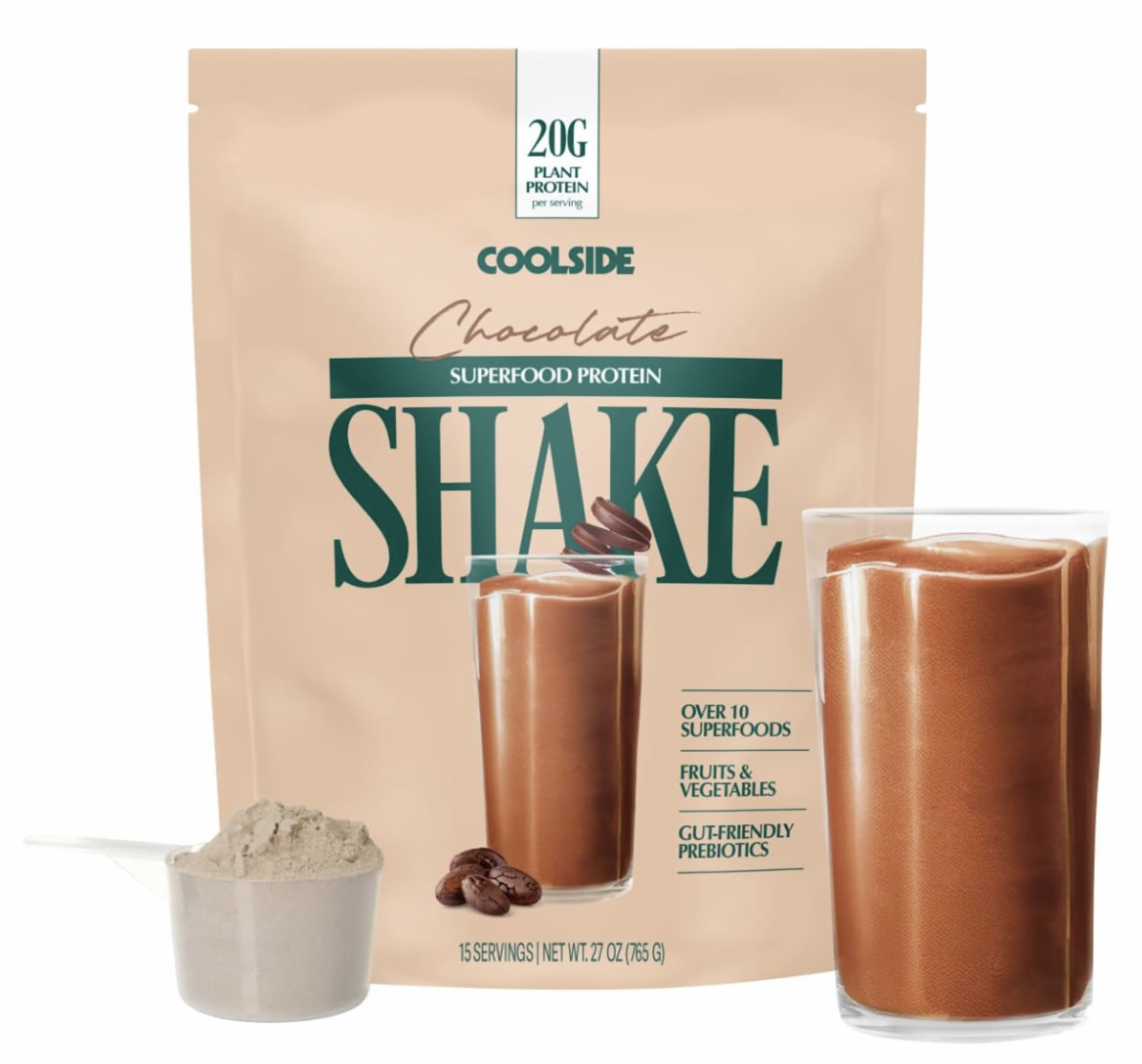
Coolside Superfood Protein tastes like a treat, but fuels like a plan.
Packed with plant protein, prebiotics, and real superfoods, served in 3 indulgent flavors - chocolate, vanilla and strawberry. They’re built to keep you energized, smiling, and moving through real life — with real strength.
Plant protein. Superfoods. Prebiotics.
Nothing extra, nothing complicated — just simple, indulgent, powerful fuel for everyday movers.
Available only in the United States, and with every order Coolside will make a donation to KIN.
Pick your flavor here.
| | |
Filmmakers to Discuss Plastics Awareness Documentary
The Knowledge Impact Network Plastic In Humans Expert Group will host a private "Ignite Round" on Friday, December 5th for filmmakers, leading researchers and solution providers to discuss a potential documentary featuring research on plastics found throughout the human body, their links to various diseases and disorders, and emerging solutions for testing and removal.
This initiative aligns with our expert group goals to raise global awareness regarding vast health harms from ingestion of toxic microplastics and our advocacy efforts to establish a global fund to remove toxic particles that are trapped in the body, soil, water, and air.
| |
|
Remember to watch
"The Myth of Recycling Plastic Video" here
| | |
To submit news items or letters to the editor for the Plastics News Alert, please write
to Leland Schwartz at info@knowledgeimpactnetwork.org.
Read our previous newsletters here.
| | |
About The Knowledge Impact Network:
Dedicated to repurposing and redistributing knowledge -- one of the world’s most underutilized assets -- the Knowledge Impact Network is a nonprofit organization founded in 2020 by a group of impact-driven YPO members.
KIN showcases leading experts and their initiatives to accelerate scalable social impact.
| KIN Plastics in Humans Working Group curates some of the most informative news updates on the plastics crisis and amplifies the work of the leading experts in the field. | |
Knowledge Impact Network™ is a 501(c)(3) tax-exempt
organization. FEIN number is 85-3426545
| | | | |