|
Club Vice President
By: Pete Whitworth - Club Vice President
Hi Everyone. I am Pete, the Vice President and as such it is my responsibility to run our club invitational shoots. Along with our President Al Wiscovitch, I also deal with the day to day running of the club in general, and specifically we handle any complaints or issues that any of you have. Naturally you are always free to voice any issues at our club meetings held on the second Tuesday of every month at 7:00 PM in the clubhouse, however; Al and I are here to keep things running smoothly on a daily basis. So, when problems arise, you should always feel free to contact either of us for immediate help.
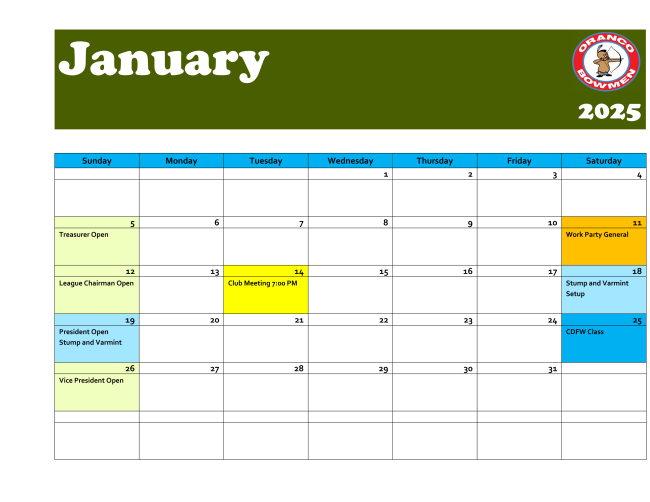
My next tournament, the Stump and Varmint shoot is scheduled for this month on the 19th. It is an all-paper shoot that is an ORANCO classic that I am bringing back this year. Since it is all paper, the setup is simple and we will be doing cleanup as well as pinning up paper targets on Saturday the 18th. There will be no take down work party on Monday, because; it’s all paper, and we leave them up for a while for the membership to enjoy while they last.
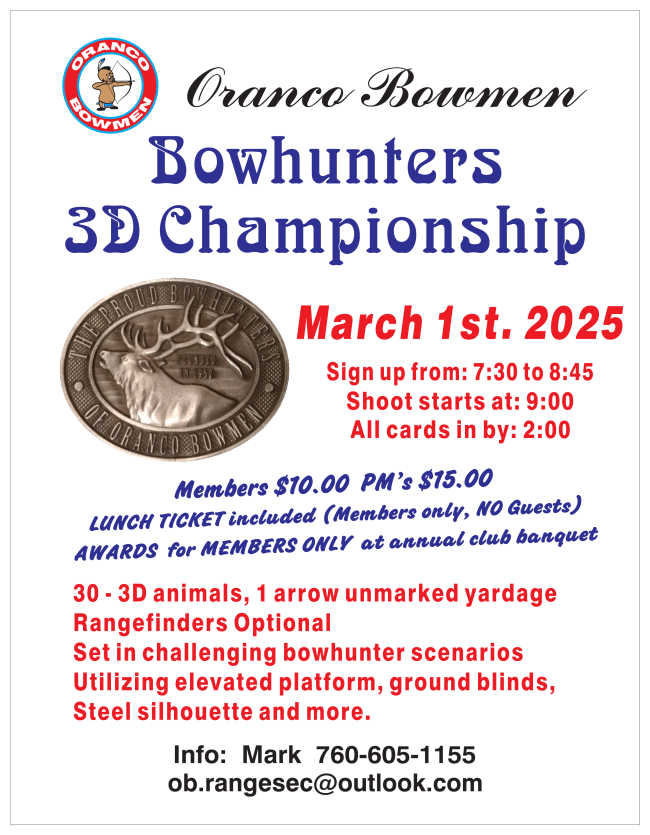
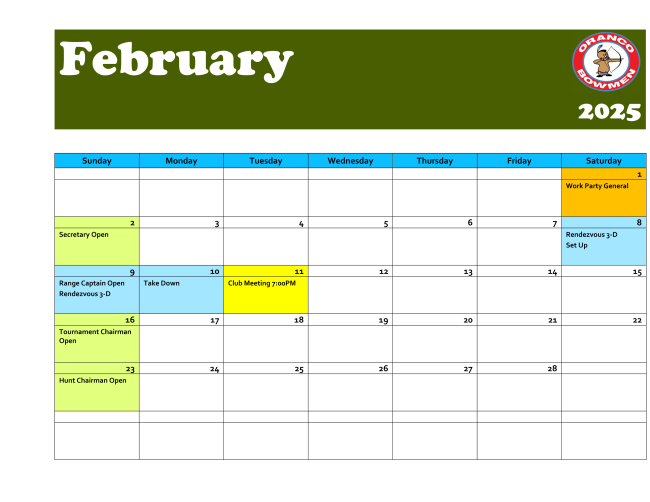
Before we have our next regular 3D Invitational tournament (The Rendezvous on February 9th.), I want to explain in some detail how we set up and run these tournaments and why we do things the way that we do.
Our Invitational tournaments differ from all of our other club shoots, (those being our leagues and our club championship shoots), in that our Invitationals are geared for and intended to be a lead in to State, National, and International tournaments. This means that I have some basic rules that I need to follow when setting up Invitationals. First and most important is that with 42 targets, it is always a challenge to keep the shot angles safe given our limited 45-acre property size. Shooting lanes must be relatively unobstructed. There needs to be room for at least two people to stand and shoot at the same time to avoid slowing down the entire flow of groups on the range. The animals need to be well maintained so that the scoring rings are in good condition and that they stay that way for the entire field of shooters all day long. The animals need to be set up in areas that are safer for arrow breakage. In general, there are also distance requirements that are set by State and National organizations that I need to keep within.
Our leagues and club championships can and do lean more towards interesting shots through small gaps in foliage, behind brush piles, etc.
All that said, it is always my plan to make our Invitationals as interesting as possible while generally keeping within the restrictions that I mentioned. We can set up targets through somewhat tight gaps between trees, or through holes in the foliage, but we also need to try to make it possible for two people to shoot at a time. (So not as tight as we may like). We do take a “little” liberty from time to time with long shots or tight shots, however; we are bound to keep that to a minimum.
OK, now, how do we do this? We do it with your help. The day before every shoot, I gather a group of members like yourself. I rely on your help to develop an interesting shoot. The way this works is that in the days leading up to the shoot, I assess the condition of the range and get a feel for the upcoming weather. Do we have fallen branches all over? Is it going to rain on Thursday and if it does, will the ground be dry enough for us to drag a trailer over the hills without destroying the roads? From this I determine a route for us to follow around the range and knowing that route allows me to let you know which animals (what size) to load on to the trailer in reverse order so that we won’t have to dig under animals to get the ones out that we need for a particular length of shot. We load 14 animals including does for a buck doe combo if one is within those 14 targets. So, we load the trailer three times to do 42 targets.
Now here is where you come in. We head out to the beginning of the chosen path of travel and drop an animal. The crew (you) have a lot of leeway in where we place the animal exactly, and in many cases determining the angle of the shot, including finding a path through the trees. I always have two guys on the crew that are setting the stakes along the angle that we determine, and it is their job to set those distances. Naturally, I keep an eye on how this is going so that I can maintain safety, and I will step in if the shot distances seem to be either too long, too short or the angle is unsafe with respect to other shots in the area. The crew also keeps an eye on safety in that respect as well. For the most part, once the target seems to be safe, I head off to keep the trailer moving along the right path, making sure we stay on course and making sure we don’t miss any opportunities for a good shot (remember, we have limited acreage and 42 positions to set up). We can’t afford to get to the end and still have three targets left on the trailer to set up. That creates a chaotic shuffle where we have to go back and put animals in places we missed and reorganize all the number stakes to fix the mess. We also can’t afford to see a situation where we would have people shooting directly at someone who is behind a target trying to find arrows, so this all has to be thought out as we go. If you have never joined us to do this, you will be amazed at what it takes to keep things safe within a 45-acre property.
Tournament set up requires 3-dimensional thinking. One example of that always comes to mind. A few years ago, as we entered Bear Valley, one crew member had an idea for a target. I had to tell him; you can’t shoot in that direction. He asked why. The answer I gave him was that the bridge was out, over at the tree stand. About three of the crew looked at me and said, what does a bridge over at the tree stand have to do with this shot in Bear Valley? So, I explained that if you shoot in this direction, you can’t go through Bear valley and back around this hill to get over to the Savanah because you will be shooting at people right here. They said, we don’t need to come around the hill, we can go over the hill like we do all the time. To that I explained that they would be shooting directly at the Joe Dotterer Dam, and since the bridge had been washed out, the only way we could get people across the creek was to have them walk across the dam. So… as Paul Harvey would say, now you know why I always assess the range before planning my loop. The loop is one thing that I do not alter on the fly. Just about everything else is always up for discussion, and I encourage everyone on the crew to be creative.
Every now and then I get a complaint that things would move faster if I had a more rigid plan and just told everyone what to do. All I can say to that is that if time is that important, then this job isn’t for you. Personally, I can’t wait to see what you guys (and girls) come up with next. This takes a dedicated team, and I can’t do it without you. Somehow you always take an otherwise boring shoot and turn it into something cool.
Thank you to every one of you, and to those who will be joining us in the future.
On that note, let me point out that there are a couple of “perks” that are only available to our set up crew. If you WILL be shooting the tournament the following day, you can sign up for a target assignment on Saturday before going home, so you get first choice of where to start. If you are NOT shooting the tournament, you are welcome to shoot around the course that you helped set up before going home. Just follow the rules of the tournament. Shoot from the stakes, shoot one arrow (or 2 if it is a 2-arrow tournament). Please keep one eye open for safety as you do this in case I am still running around putting out antlers, caution tape or double checking the safety of the course.
Right now as I am typing this, we are having a Santa Ana wind condition, blowing branches and trees down at the range. This Saturday (the 11th), there is a work party to try to clear up the mess before the upcoming Stump shoot on the 19th. So, let me take this opportunity to remind everyone that when the wind is blowing out there on the range, it’s not a safe place to be. Don’t park under any trees, and don’t be standing under any trees either. Park in an open area away from trees (The area to the west of the broad head pit lane in the Oranco Lake is somewhat safe). If it is as windy as it is out there today, you should leave the range entirely. Don’t be a hero, it’s not worth it.
That’s all for now folks.
Pete.
Pete Whitworth
ob.vicepres@outlook.com
(909) 223-5822
|