Methodist Federation for Social Action
Oregon-Idaho Chapter
| | |
|
Reflecting on Annual Conference
You may be wondering why I am writing to you about Annual Conference. That happened months ago! You are right. Annual Conference took place in June and yet what happens at Annual Conference has an impact on the rest of the year. So I’m writing to remind you about the legislation that was passed at Annual Conference and to ask you to consider how this legislation might be claimed by you and your church.
First of all, the entire legislative process was different this year. MFSA did not submit completed legislation for Legislative Assembly to consider. Instead, anyone with legislation was asked to fill out a form with details about the legislation, including who else had been consulted and could be included in carrying out the legislation, what kind of outcome was hoped for, and what resources were needed and/or available for implementing this legislation. Even the Standing Resolutions that were about to sunset (expire at the end of 3 years) used this form for submission. The result of this process was that members of legislative assembly then worked on perfecting pieces of legislation, along with the person who submitted the idea. More people were involved in writing the legislation and learning about the issues involved in the legislation.
Here's a picture of some of the legislation that passed. (And you can find more details in the conference journal.)
This year there were 8 action requests passed at Annual Conference. I want to highlight 3 of them. An action request is legislation that requires some kind of action by the Annual Conference, churches in the conference, and/or individuals in the churches.
AR 02 Establish Conference Creation Care and Resilience Team with Coordinators. This action request appoints co-conveners of a creation care team. During this year, the team will begin to work with local church and district green teams to advance the Creation Care ministry priority identified last year. Is this a place you or your church is ready to become involved?
AR 03 Education about LGBTQ+ Advocacy. Did you know that we have a conference LGBTQIA+ Advocacy Team? That team will be working this year to help us all better understand sexual orientation and gender identity and how our ministry settings can be supportive of the transgender community that is being targeted and marginalized. Watch for updates from the team and consider how your church might attend a training.
AR 04 Education and Advocacy about Death Penalty in Idaho. Don’t stop reading just because you live in Oregon. This legislation came about when our MFSA board was asked to submit a proposal for legislation to show our support for folks in Idaho who are dealing with the death penalty. Idahoans wanted to be able to point to church values when they protested the death penalty. That blossomed into two pieces of legislation including a standing resolution: 6. OPPOSING THE DEATH PENALTY (2025), and a much more involved Action Request that has some work for the people of Idaho and Oregon to do in this coming year. Take a look at the full legislation in the conference journal.
Standing Resolutions are legislation that helps us state the values of our Annual Conference. They remain in place for 3 years and can be renewed at that time.
2. ADVOCATING FOR COMPREHENSIVE IMMIGRATION REFORM (2010, revised 2013, 2016, rewritten 2019, 2022, 2025) You can see that this standing resolution has been around for a long time! Not only does it state our AC values about immigration, it calls on all of us to do some advocacy work. Where can you and/or your congregation engage in this important work? One of the roles of MFSA is to share what different groups are doing so that we can all support one another in this work. Let us know what your congregation is doing. Email us your stories and your plans.
4. ALIGNING INVESTMENTS WITH VALUES REGARDING PALESTINE & ISRAEL (2015, 2018, 2019, 2022) This one is short and to the point: avoid investing in any companies involved in Israel’s occupation of Palestine.
5. CONFRONTING RACISM AND WHITE SUPREMACY (2021, 2024)
“We, the members of the Oregon-Idaho Annual Conference, abhor the evils of racism and white supremacy that exist in our denomination, our congregations, and our hearts. We pledge to seek out and break down the institutional roots of racism in our conference structure, churches and leadership practices.” This legislation is no small task – and there’s even more in the full document! It is work that we all need to do, and we can support one another in doing this work. Where do you and your congregation find yourselves in doing this work? How can MFSA support you and learn from you?
Next time someone says not much happened at Annual Conference, you can share with them what you have read here or help them find even more info in the conference journal. There’s always justice work to do – and we do it better together! Let’s keep working for justice.
May God’s peace and love surround and fill you,
Karen Nelson
| | | | NEWS, OPPORTUNITIES AND ACTION | | | |
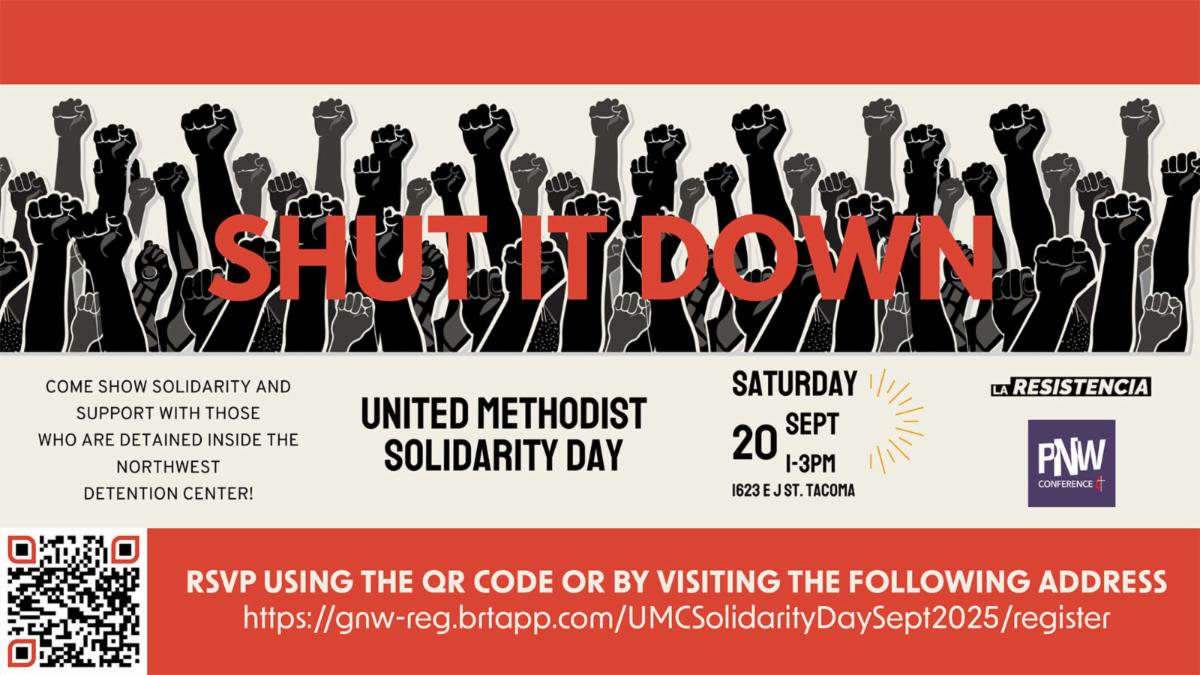
Join the Pacific Northwest United Methodist Church, fellow followers of Jesus, and all people who love justice, as we practice solidarity with those who are detained inside the Northwest Detention Center!
Please RSVP so we can plan accordingly and consider volunteering in one of the important support roles (hospitality, greeters, safety team, music).
As followers of Jesus, we are mandated to care for our immigrant neighbors. As United Methodists, we vehemently oppose the mass deportation plans of this administration and join our voices with La Resistencia in an effort to shut down the Northwest Detention Center and Free Them All!
We follow the lead, and accept the invitation of La Resistencia, a group of community members who listen first to those most impacted on the inside of NWDC, in a campaign to free them all and shut down the Detention Center once and for all.
| | |
Jan Nelson
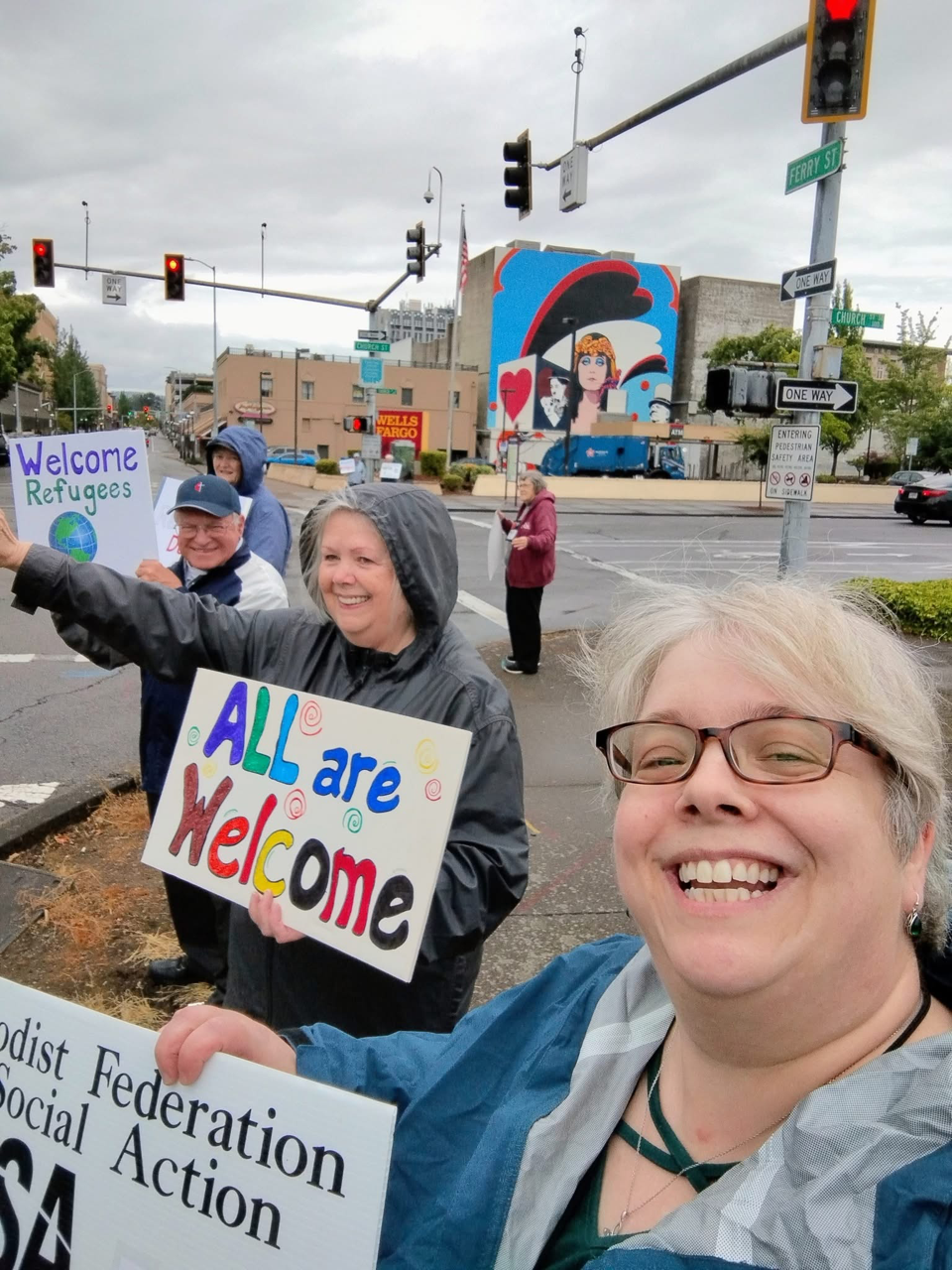
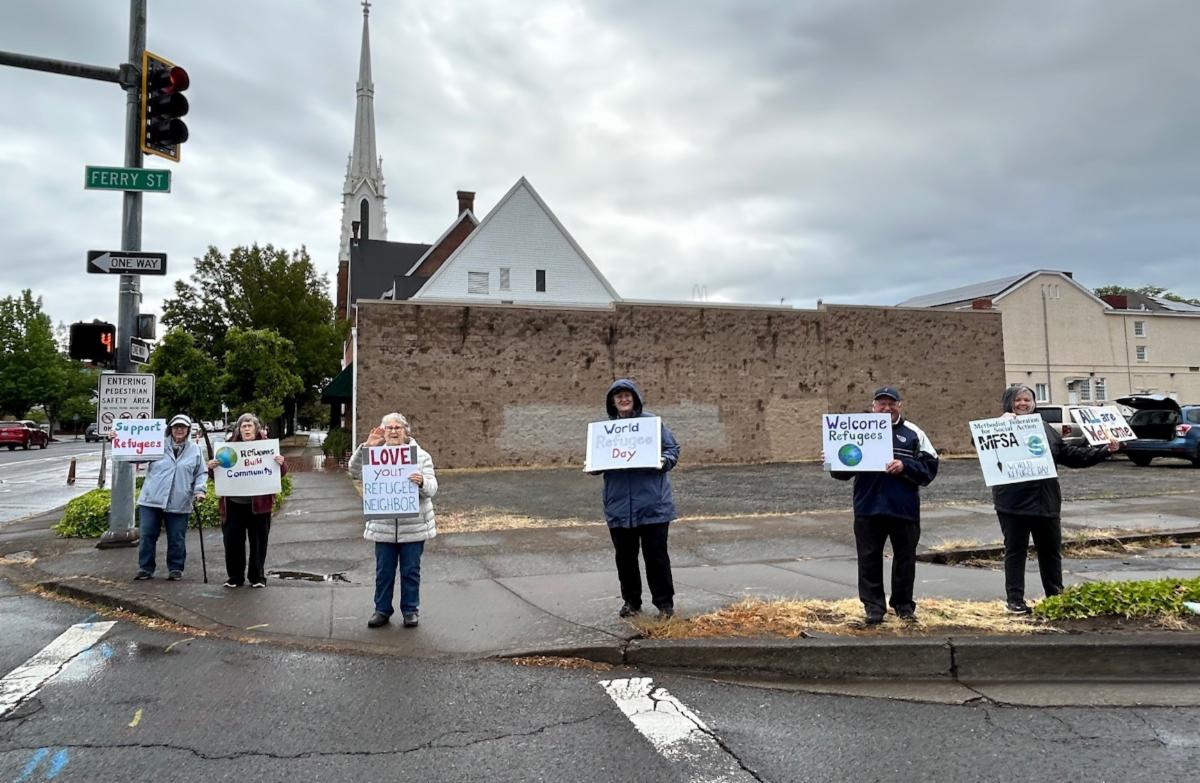
World Refugee Day is June 20, and this year that fell on the second day of our annual conference session. MFSA decided to celebrate the presence of refugees in our communities and their needs for support. A group made signs to greet commuters coming into downtown Salem near the site of the conference. The signs had positive messages such as “Welcome Refugees” and “Love Your Refugee Neighbor”. There were lots of friendly waves from the passing cars. One person parked and came to take a picture.
As conference attendees arrived, they were greeted with a blue ribbon to wear and an invitation to donate to one of the refugee support organizations in our two states. Although the Trump administration has stopped the arrival of new refugees, these organizations provide valuable services to help those refugees already here. The federal government money they have received in the past has been cut, so donations are more important than ever.
These groups will be happy to receive your donation now or any time:
· UN Refugee Agency (national)
· Ecumenical Ministries of Oregon/SOAR (Portland area)
· Salem for Refugees
· Agency for New Americans (Idaho)
| | | CREATION CARE AND RESILIENCE THE FOCUS OF NEW ANNUAL CONFERENCE MINISTRY | |
Bob Wilson
As floods, fires and other environmental disruptions lead the news on a near-daily basis, the Oregon-Idaho Annual Conference created, in June 2025, its first-ever team focusing on our faith’s call to tend and keep God’s creation.
The work of the team will begin bringing creation hope by identifying and gathering the congregations and bodies in the Annual Conference who already have green teams or are doing the work of creation care. As it solidifies and expands this group, the team will identify needs in the conference, and marshal resources to support Conference churches’ environmental work, through sourcing and creating materials, developing online learning opportunities and more.
Climate justice and resilience will be a high priority but the group plans to deal with a variety of creation care topics, from helping churches to solarize their buildings to supporting the greening of church campuses. In fact, the first on-line “webinar”, now in preparation will provide information and resources on planting native vegetation and developing pollinator gardens.
For more information, or to join this work, email interim co-coordinators Pattie Sloan or Bob Wilson at Creation.Care.Resilience.UMOI@gmail.com.
| |
OREGON RECYCLING
Jan Nelson
New recycling standards in Oregon took effect on July 1 of this year. Thanks to legislators and the advocates who encouraged them, there is now a statewide list for recycling. All local governments are required to provide collection for everything listed. You can download the list at this page on the state government website. Put a copy on your refrigerator. Better yet, share it with your congregation and your neighbors. Find a lot of other information on recycling in Oregon here.
Recycling is one piece of caring for creation. Reducing the amount of waste we generate is even better. Reducing the use of plastic is important because of the difficulty of recycling and the length of time plastics take to break down. Reducing food waste is important because food is the major source of methane emission from landfills. There are many sources of ideas to help in these and other areas.
In addition to working on our personal and family habits of consumption and disposal, we must make changes on a larger scale. Pay attention to decisions about waste management at the local government level. It is a complex matter, and not everyone involved has the best interest of the earth in mind. Be ready to advocate for the environment and the planet. We’re all in this together.
| |
THE ORANGE BAG RECYCLING PROGRAM
Debbie Mallis
In the spring of 2018, the Hefty Orange Bag Recycling Program began in Boise, Idaho. Now known as the Hefty ReNew Program, it is a way to recycle plastics that aren’t accepted in the standard recycling program. This program is now also available in Eagle, Garden City, Meridian, and unincorporated Ada County.
How does orange bag recycling work? Residents can purchase Hefty orange bags in local stores. Hard to recycle plastics are placed in the bags. Full bags are tied and placed on top of the other recycling in the blue recycle cart. The recycling truck comes on a regular schedule and picks up all recycled materials.
What goes into the orange bags?
-
Plastic bags and wraps: Plastic grocery bags, food storage bags, pet food bags, and plastic packaging and film wraps.
-
Flexible plastic food packaging: Clean and dry candy wrappers, chip bags, energy bar wrappers, and stand-up pouches.
-
Foam products: Foam cups, egg cartons, plates, and take-out containers.
-
Plastic dinnerware: Items like straws, utensils, and plastic cups.
-
Other plastic containers: Yogurt tubs, pudding cups, plastic bottle caps, and some dairy tubs. (#4-7)
-
Packaging materials: Bubble wrap, air pillows, and shrink wrap.
What happens to the plastic that goes into the orange bags?
In Ada County, Idaho, these bags are taken to a local Western Recycling facility to be sorted. Next, they go to end markets. Some plastics that are hard to recycle are sent to GeoCycle where they’re used as a fuel source for cement kilns, replacing coal. Other plastics are sent to ByFusion and other companies which convert the plastic into construction materials such as building blocks and lumber.
A couple of years ago while enjoying Art in the Park in Boise, I came across a booth run by Dr. Scott Phillips. He is a professor at the Micron School of Material Science and Engineering at Boise State University. Dr. Phillips is a researcher who studies ways to use plastics from the orange recycling bags. Along with his students, he focuses on repurposing the hard-to-recycle plastics collected by the Hefty ReNew program. His work has resulted in a number of innovative approaches:
-
Low-temperature material creation: His team developed a process that combines shredded plastic and a waste binding agent then presses it into ready-to-use sheets.
- Alternative plastics from sugar
-
Art and furniture design: Dr. Phillips founded a company called Remix Materials. They use orange bag plastics to create items like furniture, countertops, and art pieces. This company helps process a significant portion of Boise's yearly orange bag waste.
At his Art in the Park booth Dr. Phillips and his wife had a number of their company’s products on display. It was fascinating to see what they created from our waste.
The plastics recycled in the orange bags could have ended up in the landfill or have been incinerated. This program is relatively new so it will be interesting to see what new ways researchers discover to use recycled plastics.
| | | |
WHY I JOINED MFSA
Bill Watts
Note: you might wonder why people join MFSA. The National MFSA Board have been asking that question, and this is one response.
My MFSA story started in 1995.
Even though I’m an optimist by nature, I was scared to death for my daughter Andrea twice in her life. Once when she had spinal meningitis, and once when she came out to us. Her meningitis was treated with good medicine, skilled doctors in white lab coats, and a heavy dose of parental love. But when we were faced with her coming out, I had to ask: Where was the good theology? Where were the spiritual leaders?
At first, I told her it was a sin. She remembers those words. And now, with the weight of hindsight, I understand how deeply they must have hurt. But I took them back quickly. I was her papa. I had driven her to Sunday School, youth group, the Conference Council of Youth Ministries, and Lakeside Institute. I had cheered her on at what felt like a thousand track and cross-country meets. GO ANDREA! She won nearly every award her high school had to offer. I knew she didn’t choose to be different or wrong—because she wasn’t.
My love for her—as her father—overcame the harmful theology I had grown up with. Joy, my wife, dug into the theology and sought out support—we’ve got the library to prove it! As for me, I was just always there for my sweetie. But I still feared for her. What would people think? Would she be safe? We were warned that gay men are often targeted with physical harm, and that queer women face sexual violence too. The world didn’t feel safe. Why would we tell anyone?
In college, Andrea taped a sign to her wall that read:
DON’T LET THE PEOPLE WHO DWELL IN FEAR AND HATE GOVERN HOW YOU LIVE.
She was braver than we were. And we began to realize: silence was not love.
If it weren’t for Methodist Federation for Social Action, and other progressive United Methodist organizations like Reconciling Ministries and congregations that welcome fully and freely, we wouldn’t have been able to stay in the United Methodist Church. But in those spaces, we could breathe again. We could feel God’s goodness again.
So today, I’m still here—to continue that love, to help change the church, our state, the nation, and the world. MFSA gives me hope. It connects me to a long and proud history of faithful justice-seekers. It lifts up spiritual leaders who challenge injustice, promote inclusive theology, and offer educational opportunities for all. MFSA advocates for civil rights, addresses inequality in healthcare and poverty, and continues to push our church and world toward justice.
Being part of MFSA means I’m not standing alone. Together, we raise our voices, challenge injustice, and live out our faith with courage. I’m proud to be part of this community.
Bill Watts (he/him/his) is a longtime MFSA supporter and former board member who has served in leadership roles with the East Ohio chapter for over a decade. He’s also been active in Reconciling Ministries and volunteered at the last three General Conferences with the Love Your Neighbor Coalition. Bill retired from Goodyear after a 48-year career that took him to 53 countries as a Rubber Mixing Technology Specialist. He now coordinates a regional eyeglass recycling center and continues to advocate for LGBTQIA+ inclusion, racial justice, immigration reform, and equity for all.
| IT'S NOT TOO LATE TO JOIN/RENEW YOUR MFSA MEMBERSHIP | |
As a member of MFSA, you will receive an E-Newsletter with action alerts and resources, news from regional MFSA communities and members, and reviews of resources to put your faith into action. When you join/renew at the basic $60.00 membership level, please consider adding a gift to our Chapter and National. MFSA is a 100% membership supported organization; contributions to MFSA are tax deductible.
| | | |
OREGON-IDAHO MFSA ANNUAL MEETING WAS HELD TUESDAY, JULY 8
Steve Mitchell
Oregon-Idaho’s Methodist Federation for Social Action (MFSA) Chapter’s Annual Meeting was held on Tuesday, July 8 on Zoom. Six Board members and four members participated.
Convenor Karen welcomed participants and introduced Board members Jan Nelson, Treasurer; Louise Kienzle, Membership and Newsletter; Steve Mitchell, Secretary, and Claudia Roberts and Debbie Mallis, At-Large Board members. Board member Tom Orquiza-Renardo was absent in order to attend a family wedding.
Karen summarized the purpose of MFSA: MFSA is an independent movement of progressive United Methodists taking action on issues of Justice, Peace, and Liberation. The Methodist Federation for Social Action calls upon The United Methodist Church to expand its understanding and embodiment of the radical call of the Gospel to be an inclusive, justice seeking, risk-taking Body of Christ.
We support and augment peace and justice ministries through and beyond The United Methodist Church. Through MFSA, we live out our belief that to be a faithful witness to the Gospel of Jesus Christ is to be involved in the transformation of the social order.
Karen then shared a prayer written by Ted Loder and invited participants to put in the chat ways they have been involved in justice issues. As a group we are involved in a multitude of actions and witness for social justice!
Reports:
1. Finance – Jan Nelson
The closure of our account late last year was necessitated due to a signer who was hacked; we now have an account at Interfaith Credit Union with about $800 in savings and $809 in checking. Chapter expenses include Constant Contact and website fees as well as Board program expenses.
2. Membership – Louise
We have 30 members at present. The trend has been downward; let’s invite people to join us!
3. 2025 Annual Conference presence:
- We had a Resource Room table at Annual Conference.
- Friday of Annual Conference was World Refugee Day (noted above). There are possibilities for further work on the refugee issue, in light of the priorities of the current U.S. Administration’s policies.
Jan Nelson proposed that we give a $100 donation each to an Oregon and Idaho organization. Her motion passed by a unanimous vote.
-
In Oregon the donation will be given to Salem for Refugees.
-
In Idaho, it will be given to Agency for New Americans.
4. MFSA national work reported by Karen:
- A Racism Audit has been an ongoing work for about 3 years. A weekend meeting of the Audit team will be held in September. Plans are being made for local chapters to do their own racial audit work.
- Watch for the national MFSA newsletter to know the breadth of work being done.
- The national MFSA website is another good choice for information about the Racism Audit and general information about MFSA.
5. Election of new board members
Board members are elected to two-year terms and can be re-elected. Debbie Mallis was elected to a second term as an At-Large member; we value the connection she gives us with the needs and work in Idaho.
The main program was a presentation on Christian Nationalism, coordinated by Greg Nelson, using material available from the Western Methodist Justice Movement. The Western Methodist Justice Movement (WMJM) website has recordings of presentations, as well as PowerPoint. Material by Jerry Gale, a main worker with the jurisdiction on this topic, was shared. This information is available on the WMJM website. Also, you can request permission to view the recording by emailing WMJM. Limited viewing will be available for a short time. For more information on Christian Nationalism, contact Jerry Gale at jerrygalenm@gmail.com.
The media presentation was followed by a Discussion of Christian Nationalism among our meeting participants, with starter questions as led by Karen.
Karen closed the meeting with thanks to all participants and encouragement to stay involved and to invite others to join us in this important ministry for justice and peace.
| | NOW'S THE TIME FOR ACTION | | | Now is the time to continue to push for broad systemic change. Besides the calls to action found in the articles above, here are a few other ways you can take action to seek justice: | |
[ ]TAKE ACTION: Tell The U.S. Department of Homeland Security to End the 287(g) Program. The
287(g) program uses financial incentives to recruit local law enforcement officers to act as federal immigration
agents causing harm carried out on immigrant children families and communities.
[ ]AIDNW continues to serve 50+ newly release guests outside Tacoma’s NW ICE Processing Center at the RV Welcome Center each day. They are in desperate need of volunteers and supplies. Find out how you can help!
[ ]Support studying and developing a system of reparations to make up for our many sins as a nation.
[ ]The Americans of Conscience Checklist features clear, well-researched actions for Americans who value democracy, equality, voting, and decency. We are a big tent for all people who want a kinder, flourishing nation.
[ ]The MFSA Voices list for more ways to continue to push for broad systemic change.
| | OREGON-IDAHO CHAPTER EXECUTIVE COMMITTEE | | | | | |