San Francisco Bay Region: LMI News & Updates |
|
The San Francisco Bay Center of Excellence (COE) for Labor Market Research strives to provide useful labor market data and information to the 28 community colleges we serve. We know it is paramount that colleges stay informed as they adapt programs and prepare students to transition to a post-pandemic labor market. This newsletter provides a brief snapshot of the labor market in the San Francisco Bay Region for June 2020. |
|
In keeping with how the California Employment Development Department (EDD) provides the data, data in this newsletter on unemployment and industry employment are presented by metropolitan statistical areas (MSAs). Table 1 below provides a crosswalk of how these metropolitan areas align with counties and the sub-regions established by the California Community College Chancellor’s Office (CCCCO).
|
|
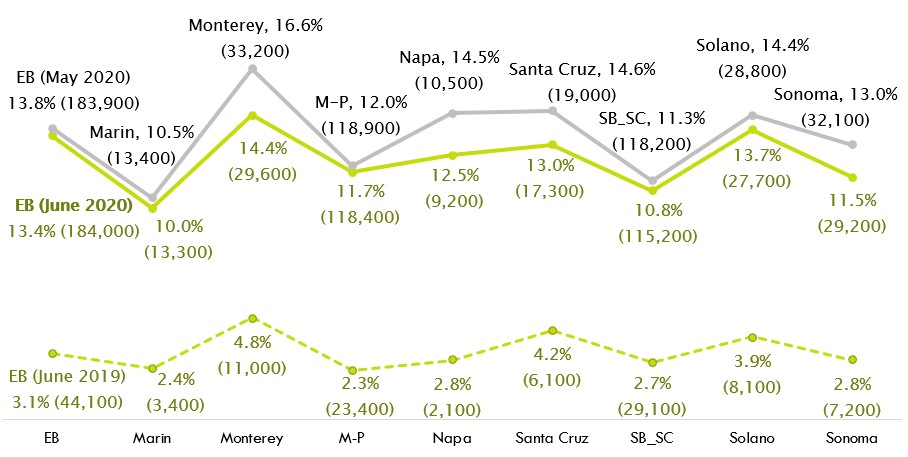
There was limited change in unemployment between May-June 2020 in the Bay Region, with a drop of only 0.3% in the Mid-Peninsula and 2.2% in Monterey.
Since March 2020, the unemployment rate has been significantly higher than last year at this time. For example, rates of unemployment in June 2020 are 9.1% higher, on average, than in June 2019, as shown in the figure below.
Read more here for understanding the unemployment rate especially during Covid-19.
|
|
Data source: Labor Market Information Division of the California Employment Development Department (EDD). Data collection was conducted during the 2nd week of June 2020. |
|
Employer Activity: Layoffs and Business Closures |
|
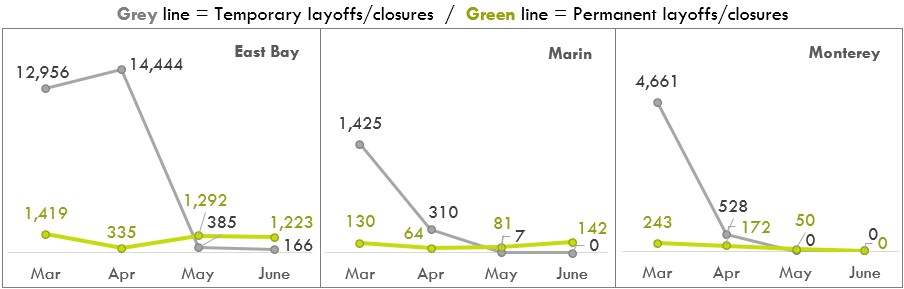
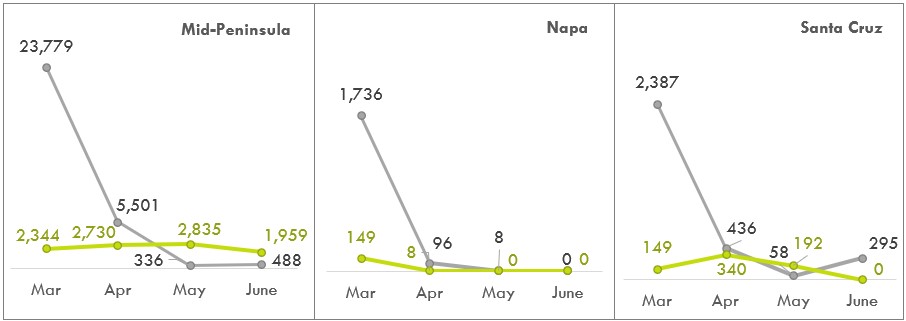
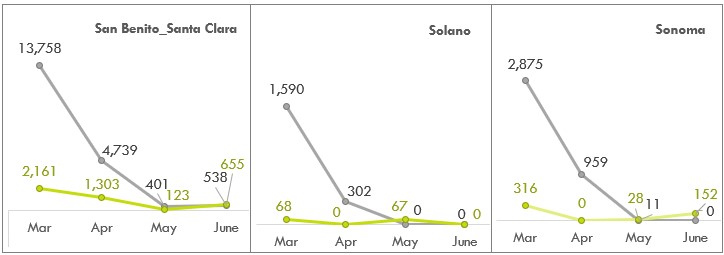
Delving further into unemployment, the figure below shows the numbers of workers who were affected by layoffs or business closures across the Bay Region between March-June 2020.
Temporary layoffs and closures spiked In March and April, shortly after stay at home orders began in the Bay Region. Since May, employers have submitted fewer notices of temporary layoffs and business closures, however the number of workers let go due to a permanent layoff or closure has begun to rise. Three sub-regions (Monterey, Napa and Solano) saw zero layoffs or business closures in June 2020.
|
|
Data source: Labor Market Information Division of the California Employment Development Department (EDD); Worker Adjustment and Retaining Notification (WARN) Information for Employers. Data posted on 3rd and 19th of each month. |
|
Note regarding WARN notices:
Federal and State laws (known as the WARN Act) require certain employers to give notice prior to a business closure or mass layoff, referred to as Worker Adjustment Retraining Notifications (WARN). WARN notices are only required for full-time employees, those working 20 or more hours per week, and not part-time employees. For this reason, the broader economic impact on employment is likely underrepresented when examining WARN notices alone. Similarly, reasons for a layoff or closure are not included in publicly available data regarding WARN notices, and we are unable to confirm if employees were let go during this time due to the COVID-19 pandemic or for other reasons. For more information on the WARN Act, read more here.
Please note an announcement from EDD (below) regarding issues with prior WARN reports. The EDD found that duplicate data had been generated for all WARN notices filed since the beginning of State Fiscal Year 2020.
“We were experiencing issues with our WARN report a few weeks ago where the report was generating duplicates for all WARN notices that had been filed since the beginning of the State Fiscal Year 2020. Please be advised that the report that is posted reflects the correct data.”
Accordingly, the data on WARN notices that we reported for the Bay Region in our May newsletter included an incorrectly elevated number of workers impacted by layoffs and closures than actually were. Data presented in the current newsletter is based on the most recent data on WARN notices released from the EDD, which have been reviewed for accuracy and non-duplication.
|
|
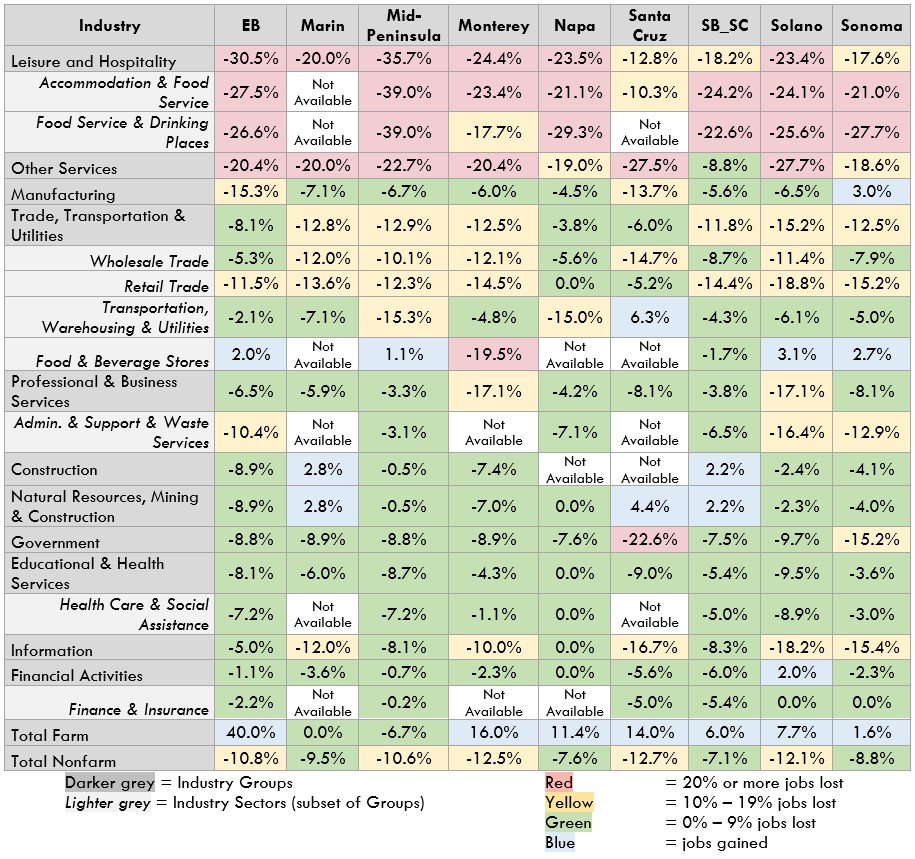
Examining job losses by industry, the table below reports percentages of jobs lost since March 2020, across industry groups and sectors. Job losses continued, but at a slower pace in June. Employment remains significantly lower than levels seen prior to the Covid-19 pandemic. In total, the Bay Region reported 416,100 fewer non-farm jobs, and a gain of 7,800 farm jobs in June compared to March, likely reflecting seasonal employment trends for this time of year.
While Leisure and Hospitality continues to be the most impacted industry group, June saw a slight gain back of jobs lost since March in select sub-regions, including Santa Cruz, Sonoma and San Benito/Santa Clara. Food and Beverage businesses and the Construction industry reported a slightly greater number of jobs in June compared to March.
Read more about the NAICS classification and definitions of Industry Groups and Sectors.
|
|
Data source: Labor Market Information Division of the California Employment Development Department (EDD). Data collection was conducted during the 2nd week of June 2020. |
|
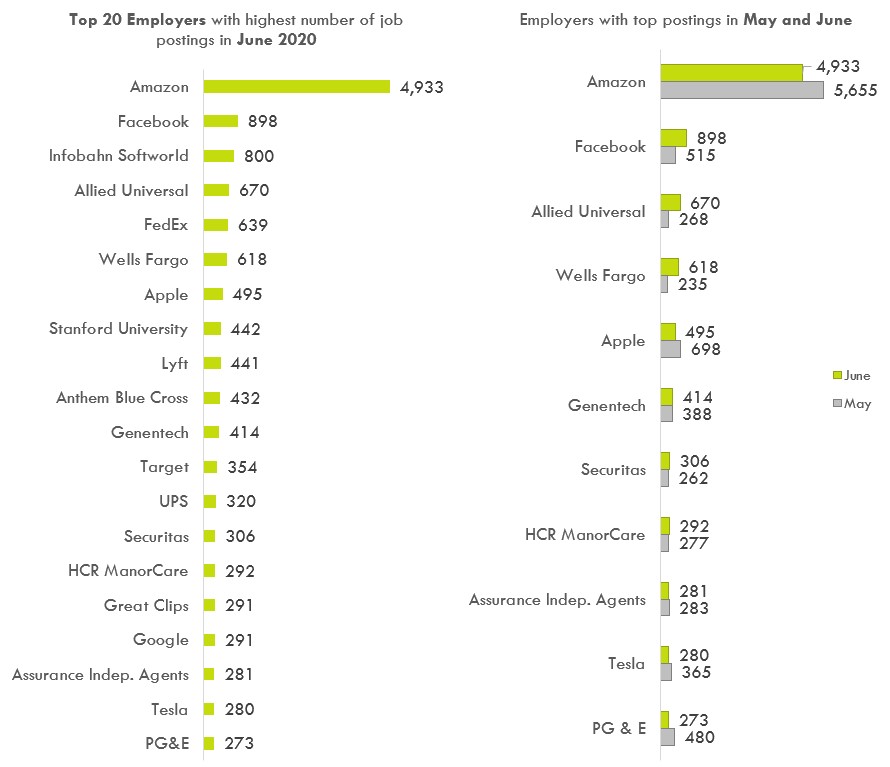
Shifting focus to job postings, more than 128,700 jobs were posted in June across the Bay Region. Among employers, Amazon once again had the greatest number of job postings in the region for June (4,933), as it did in April and May. Facebook had the second highest number of openings posted (898), followed by Infobahn Softworld (IT and staffing services) at 800, and Allied Universal (security systems and solutions), with 670 postings. Amazon, Facebook and Allied Universal were also among the top employers in May, as shown in the right figure below.
|
|
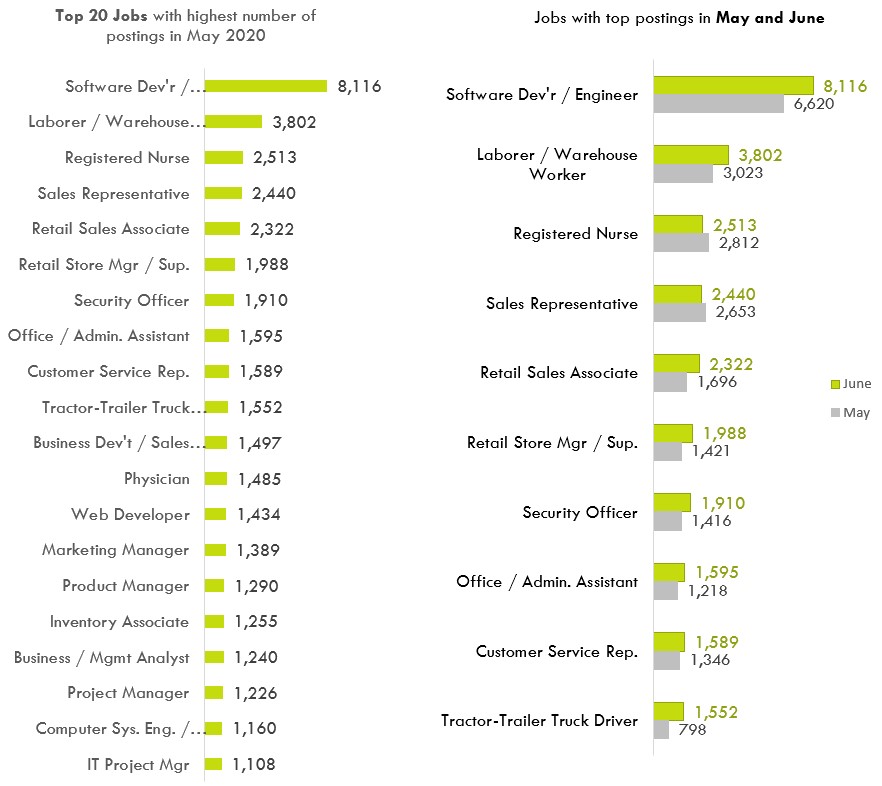
In terms of specific jobs that employers looked to fill, many of the top jobs in June were among the top jobs in May, as shown in the figure below. Software developer/engineer was the top job posted in June by far at over 8,000 postings. Laborer/Warehouse Worker (3,802) and Registered Nurse (2,513) ranked second and third among job postings in June, similar to May.
|
|
Data source: Burning Glass Technologies. burning-glass.com. 2020. |
|
Industry Spotlight: Retail, Hospitality & Tourism |
|
|
|
Bay Area Regional Director
Retail, Hospitality & Tourism
ph: 707.292.5754
|
|
Closing out the newsletter, this month our industry spotlight focuses on the Retail, Hospitality and Tourism industry. Thank you, to Audrey Le Baudour, the San Francisco Bay Regional Director for Retail, Hospitality and Tourism, who shared a few words on her view of how the industry has been impacted during this time.
Q: What is the status of Retail, Hospitality and Tourism (RHT) in the Bay Region right now?
Q: What employers or industries within Retail, Hospitality and Tourism are hiring?
Due to the health crisis, non-essential retailers are struggling. J.C. Penney and smaller retailers are closing or requesting rent relief. Projections indicate that anywhere from 25% to 50% of malls could go out of business altogether.
High-end “A” malls are in the best shape to navigate the crisis as their luxury retail tenants have higher profit margins and thus are better able to withstand the downturn. But, “B” and “C” malls, which have lower-priced stores and more vacancies, are facing a high risk of closure.
Some segments in the Retail sector are growing, including:
· Grocers (Safeway, Raley’s, Mollie Stones)
· Big box (Target, Costco, Walmart, Best Buy)
· Do it Yourself-ers (Ace Hardware, Home Depot, Lowe’s)
· E-Commerce (Amazon, Zappos)
In Hospitality, takeout and delivery of food is growing due to pivoting of services. On premise dining is shut down due to COVID-19.
Tourism is also struggling. Most tourist attractions and venues (e.g., Six Flags, Museums, Sports Arenas) all shut down due to COVID-19.
Air travel is also at historic lows and losses continue. International travelers are unable to travel to California and spend on RHT.
Several larger employers in the Bay Area are hiring for jobs in security, delivery and online services, in addition to Census takers.
Q: What are some strategies the industry is taking to help train or re-train in your sector?
Q: Can you tell us about projects you are currently working on with industry/colleges?
There is a new industry-recognized certification with an Associate degree: Facilities Management (FM) and Hospitality Certificate (25 units with internship). With a Job Gap of 6,000+ people in California, Facilities Management workers in Hospitality are busier than ever, from industry sources needing to hire/manage staffs to maintain RHT facilities. Starting wages are $70k/annual salary, and an average of $90-$100K for managers.
Another cross-sector initiative is Hospitality to Health (H2H): This involves transitioning furloughed hospitality personnel to work in the health industry, namely skilled nursing, assisted living environments and contact tracers. High-level skill sets required of contact tracers include soft skills already developed by the hospitality industry.
There is also work on certificate redesign for culinary programs to include dietician coursework, allowing students varying pathways to employment.
Finally, we are launching a YouTube Campaign to bring attention to RHT programs and community colleges as resources to reach new student audiences, including displaced workers or those seeking to focus on education during the economic downturn and uncertainty.
|
|
For additional labor market information for California and the Bay Region, visit:
|
|
This newsletter is intended to provide useful labor market data and information relevant to the San Francisco Bay Region. Please contact us if you have any questions, or suggestions for additional data and information you would like to see in future newsletters.
John Carrese, Director
Chris Lee, Assistant Director
|
|
|
|
|
|
|