Long Island Swimming Officials Association 
Serving Long Island Swimmers for 64 years! 
January 2021
Let's see how this goes ...

I am so impressed with your calmness in the storm, your perseverance, your dedication and your sense of duty. This will be remembered as a swimming and diving season like no other. The potential danger and the unknown. The constant updates and changes.

I know some of you had very difficult, unpleasant, and scary experiences. Each of those situations, we tried to rectify so that subsequent meets with those teams or at that venue were improved. Both Section XI and Section VIII have been very responsive to our concerns and have communicated directly with those Athletic Directors to correct those conditions. Unfortunately, you had to endure those episodes.

As we finish with one more week of the dual meet season, hopefully now every team and facility will be on board with the protocols and we finish out February with successful championships.

Thank you,
George Fleckenstein
president 
CONGRATULATIONS ELECTED LISOA OFFICERS AND BOARD OF DIRECTORS

PRESIDENT - George Fleckenstein
VICE PRESIDENT - Nelson Gonzalez
TREASURER - Barbara Wendt
SECRETARY - Christine Duong
DIRECTOR - Douglas Virkus
DIRECTOR - Larry Wachter

THANK YOU CHRIS ZIMMET FOR YOUR MANY YEARS OF SERVICE TO THE LISOA AS THE ASSOCIATION SECRETARY!
THANK YOU CYNA BUCKLEY FOR YOUR SHORT BUT PRODUCTIVE TENURE AS VICE PRESIDENT
Championship Meet Information

  • Maintain accurate availability
  • If you are selected, respond promptly
  • Arrive 45 minutes before the meet scheduled time
  • Please arrive in your officiating uniform - nice and clean. (shoes can be changed to not track in dirt)
  • Section VIII will have a break after the 50 free.
  • Bring your own snacks and/or drinks
  • If you have a stop-watch please bring that
  • Have a pencil or pen with you
  • Key positions will be informed prior to the meet - referee, starter
  • Otherwise your role will be:
  1. stroke judge OR
  2. turn judge/timer/relay takeoff judge
The 2021 LISOA Scholar-Athlete Award Application Deadline has been extended until February 6, 2021. Please inform any Varsity teams that you will be officiating this week!
New Tabs on the LISOA Web Site

If you have not visited the LISOA web site lately, webmaster Walter Gustafson has added two new tabs with important material.
When you get on to our site, these tabs run down the left side. The two highlighted have been added in the past few weeks. They contain useful links.

liswimofficials.com
PLEASE REMEMBER TO RATE THE VARSITY TEAMS THAT YOU OFFICIATE FOR THEIR SPORTSMANSHIP ON OUR WEB SITE!

Go to the "members" link and click on the "Sportsmanship Ballot"
Thank you to our early morning officials - Jacky Spierer and Julie Barnola! They will be working the February 1, 5:00 A.M. YES, 5:00 A.M. Swimming and Diving Meet in Oceanside.

For their dedication, commitment, and going above and beyond the call of duty, we appreciate them going where (and when) no one else wanted to go.
They will receive a $10.00 Dunkin Donuts gift card!
Championship Dates

2/8 - Section VIII Division Diving NCAC 5:00 pm
2/9 - Section VIII Div. A Championships NCAC 5:00 pm
2/10 - Section XI League I Championships
Sachem North 4:00 pm
2/10 - Section VIII Div. B Championships
NCAC 5:00 pm
2/11 - Section XI League II Championships Hauppauge 4:00 pm
2/11 - Section VIII Div. C Championships
NCAC 5:00 pm
2/18 - Section XI Diving Championships Hauppauge 4:00 pm
2/20 - Section XI Sectional Championships
To Be Determined 10:00 am
2/24 - Section VIII Diving Championships
NCAC 5:00 pm
2/26 - Section VIII Swim Trials NCAC 6:30 pm
2/27 - Section VIII Swim Finals
NCAC 12:00 pm
diving-board.jpg
Things Every Diving Judge Should Know...

... A diver assumes the starting position for a forward dive. The diver twice lifts his/her heels before taking a step to begin forward motion of the approach. The diving referee determines this is not a balk and the dive continues and is scored. RULING: Correct procedure. COMMENT: The diver had not started a forward motion by the vertical movement when lifting the heels. (9-5-5)

A door slams shut as a diver begins the takeoff from the board. After the diver leaves the water, his/her coach rushes up to the referee and requests the diver be permitted to repeat the dive. RULING: Request denied. Notice must come from the diver immediately after the execution of the dive during which there was interference. (9-6-2h)

The diver performs dive #5223 (back somersault 1½ twist). The diver’s shoulders are not within the legal limit when the feet contact the water. The diving referee declares a failed dive. RULING: Correct procedure. COMMENT: The diving referee judges the degree of the twist by the position of the shoulders at the moment the diver contacts the water. (9-7-5g)

A diver performs a #5211A (back dive ½ twist) and (a) doesn’t stop the board from oscillating before or after taking the starting position; (b) twists manifestly on the board. The judges deduct ½ - 2 points in (a) and (b). RULING: Correct procedure. (9-8-2a, f)
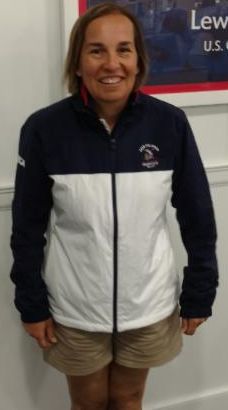
You have seen me wearing shirts and a jacket with our LISOA logo and thought.........
where can I get something like that?

Well, through Lands End Business Outfitters, we can purchase anything in their business catalog with this logo embroidered onto it.

Shirts with this logo are NOT for the official shirt that we wear while we officiate but for our personal use. 


CURRENT PROMOTION UNTIL FEBRUARY 14
FREE LOGO
FREE SHIPPING
on orders over $100.00

Choose any shirt or items, any color, no minimum purchase. You will need to create an online account with Lands' End Business Outfitters to place an order and then make sure that they are applying logo #1517851 to your personal account. 

YOU CAN CHANGE THE THREAD COLOR ON ANY PART OF THE EMBROIDERY
The logo stands out on my black jacket as I changed the words lettering to yellow.

To associate the logo to your online account, at the top of the home page, it will say "Hi (Your Name)." Hover over this and choose My Logos from the menu. On the next page, click on Associate a Logo to my Account.

Enter the logo number 1517851 and Customer Number 6973431. This logo will appear online and you are now ready to select your items. As you shop, make sure you apply the logo to each item before you add it to your shopping bag by clicking on the Apply Logo button after you have selected the color, size and quantity of each item.

Orders can also be placed over the phone by calling Lands' End Business Outfitters at 1-800-497-6566 and a Sales Consultant will assist you with your order.

Lands' End Business Outfitters often has sales and specials, you can check them out on their website. 
STAY SAFE ON WINTRY ROADS
AAA
“The top three winter driving tips include slowing down, increasing the space between yourself and other vehicles, and braking, THEN turning,” said Mike Formanowicz, manager of driver programs at AAA Western and Central New York.
There are three common mistakes that drivers should avoid in the winter, according to Formanowicz.

WINTER DRIVING: WHAT NOT TO DO
❎ Don’t continue at the same speed you would be traveling in clear, dry conditions. Drivers should slow down to regain the traction that is lost due to the weather.
❎ Don’t follow other vehicles as closely as you would when driving in normal conditions. Slick roads mean your vehicle cannot slow down as quickly.
❎ Don’t brake and turn at the same time. Asking your vehicle to do two things at a time makes it more likely that your tires will lose traction.

If you do go off the road in icy or snowy conditions, stay with your car and remain calm. “Avoiding panic can go a long way toward keeping you safe while driving in the winter,” Formanowicz said. If you are in an emergency situation, call 911. If you get stranded in your car, keep your tailpipe clear of snow to ensure proper ventilation and keep your window cracked open a bit until help arrives. Always keep a cellphone charger or power bank in your vehicle, along with snacks and a blanket.

Try to avoid driving when visibility is poor. If you must drive, keep your speed low, use your low-beam headlights and pull off to a safe spot if conditions worsen.

WHAT TO DO IF YOU GET STUCK
✅ Clear a path for several feet in front of your wheels by driving forward and backward or by shoveling.
✅ With your wheels pointed straight to minimize rolling resistance, shift to “drive” (or second gear for manual transmissions) and apply gentle pressure to the accelerator without spinning the wheels. If you let the wheels spin, you will only dig deeper into the snow.
✅ If you need more traction, use traction mats, kitty litter or one of the abrasive materials that you included in your emergency winter driving kit. Don’t let anyone stand directly ahead or behind the vehicle.
✅ If you are still stuck, rock your vehicle out of the rut by applying the accelerator slowly in low gear, releasing when you stop moving forward, and re-applying when you stop rolling backward. Repeat in rapid succession using minimum power to avoid spinning wheels.
Swimming Situations
At the finish of the backstroke, the swimmer reaches for the wall and immediately before he touches, his body is completely underwater. RULING: Illegal, the swimmer is disqualified. COMMENT: Some part of the swimmer's body must remain at or above the surface except for the 15 meters following the start or at each turn. If completely submerged immediately prior to the finish touch, the swimmer is disqualified.


A breaststroke swimmer turns in such a manner that the body is on the back when the feet leave the wall; but, prior to the first arm pull or leg kick, the body returns to breast. RULING: Illegal. The shoulders shall be at or past the vertical towards the breast when the feet leave the wall (8-2-2g)
A butterfly swimmer inadvertently: (a) drags one arm in the water and fails to make a simultaneous arm recovery; (b) catches one arm under a lane marker and fails to make a simultaneous arm recovery. RULING: In both (a) and (b) the stroke is illegal and the competitor is disqualified. (8-2-3c, 8-2-3 Penalty) 

In the individual medley event, the swimmer rotates to his/her stomach while finishing the backstroke leg. An official disqualifies the swimmer for the position of the body during the finish of the leg. RULING: Correct procedure. COMMENT: The transition from backstroke to breaststroke is a finish during the individual medley. Swimmers shall be disqualified for violating the backstroke position before touching the finish end. (8-2-1b, 8-2-5, 8-2-5 Penalty)
Become Unflappable with Emotional Control
Referee Magazine
When people say, “There’s no need to get emotional,” that’s probably more true for officials than for the average person. Put a regular guy or gal referee in front of hundreds, maybe thousands, of screaming fans, a couple of intense coaches and a bunch of psyched-up, keyed-up and fired-up athletes, and emotional control is easier said than done.

Don’t ignore your emotions — control them
You, on the other hand, don’t have the luxury to feel what the average person feels — you’re an official and there’s a job to do. But emotions shouldn’t be ignored, either. Controlling your emotions means controlling your game and controlling your game is your job. To be effective, an official needs to be a rock, but not a robot. A listener, but not a passive abuse-taker. A professional, but not an egomaniac.

Confidence is one of the “good” emotions that you probably don’t need to control too much (unless you become overconfident, which could lead you to become arrogant, which leads to egomania!).

Being able to handle pressure starts with confidence in your ability. You have to develop a level of confidence that you know the game and you know what you’re doing out there. You develop a feel for the game and what’s going on around you. It allows you to defuse problems before they happen. Knowledge is power and when you’ve mastered your game, a sense of control will follow.

Stay cool when the pressure gets hot. All the knowledge in the world will only take you so far when there’s a lot on the line. Let’s face it, the outcomes of some games have outrageous implications. Some officials are put in charge of events involving tens of millions of dollars, with maybe hundreds of millions of people watching — and careers often hang in the balance. There’s pressure there and you can’t deny it.

Don’t think that only happens at the pro, international or major college levels, though. The folks sitting in the stands at a local high school football or basketball game, or a Little League baseball or youth league soccer game, can be just as — and sometimes more — personally invested in the outcome of a game. The ire of a handful of parents can be more disquieting than the anonymous roar of 20,000 spectators.

Develop personal stress management skills
It is essential to develop stress-management skills so you can keep focused during the actual contest, when the pressure gets turned up. A big mistake officials make is trying to pretend they have no emotions and nothing can get to them. Though it doesn’t pay to display your emotions for everyone to see, denying your feelings exist can lead to trouble.

Self-talk can help. Instead of trying to be an unfeeling robot, you’re better off being able to identify when you’re feeling stressed and then having a strategy to deal with it.

It can be as simple as developing a quick conversation with yourself:
  1. Acknowledge the pressure, direct your mind to focus on the game and assure yourself that you’re in control in a relaxed, calm way.
  2. Fairly assess your performance and commit to minimizing mistakes, but also be prepared to move on and develop a tolerance for being less than perfect.
  3. Be wary of when your internal conversation becomes hostile. If you find your self-talk starts to run along the lines of, “Damn, I blew that one!” “I don’t belong out here!” “I stink!” or other similarly denigrating comments, stop it immediately, and approach your thinking in a calmer way by turning an intense focus back to the game.

When it gets really ugly. Let’s face it, as an official, you’re not going to be the most popular person in the building or on the field. You’re often going to be the scapegoat for the frustration of players, coaches and fans. You probably already know not to expect hugs and kisses, but what about when the people involved really start to push your buttons?

Maintaining composure can be a real challenge when the words get unkind and the talk gets personal. It’s not enough to have tough skin; you have to anticipate what might come and deal with it. The most important skill to have is the ability to avoid taking anything too personally, which you can do with some mental strategy.

Officiating is not designed to get people to like you
It is essential that you keep in mind up front that officiating is not an activity designed to get people to like you. You may love the game; you may love staying close to it, but don’t come into it thinking you’re going to make friends. If you have a strong need for approval from others, spending your nights and weekends officiating sporting events is going to be a nice introduction to hell. Take an inventory of what draws you to the sports you officiate and be honest with yourself. If getting lots of slaps on the back and camaraderie from the others involved in the game is what drives you, maybe your time would be better spent driving the team bus or manning the Gatorade bucket.

Women often face challenges men do not, especially if they’re officiating games involving male athletes. On top of the usual, “You’re blind!” comments, women will hear catcalls suggesting they aren’t good enough or should “go back to the kitchen.”

In those cases, focus your energy into the game, not on the negative comments or even desperately trying to prove anything to anyone. Whether it is a personal attack, unfair criticism or just plain harassment, the key to keeping cool and performing well is maintaining your focus where it should be — on the game.

When you know you blew one. Every official kicks one once in awhile and everyone knows it. The adage that no one’s perfect really isn’t much of a comfort in our business despite its truth, but there are steps you can take to keep your focus after the occasional and inevitable mistake occurs.

Sometimes — not always — admitting a mistake to a coach earns their respect. But doing that too often destroys your credibility. Insisting on perfection in your own performance will backfire, not just in the relationships you develop with the players and coaches, but it will also interfere with your performance. It sets you up for unrealistic expectations and you’ll wind up trying to convince yourself that you’re always right or feeling that you’re incompetent and don’t belong in the profession.

It’s often said that the legendary Bill Klem, the late Hall of Fame baseball umpire, could often be heard proclaiming that during his entire 35-year NL career he felt he “never missed a call.” Officials who hear that story usually roll their eyes.
Instead of demanding perfection of yourself, your focus should be on doing the best you can and searching for ways to improve.

All things in balance. Keeping your emotions under control is a matter of keeping everything at the game, and in the rest of your life, in perspective. Balance is the key. Too much of anything — mistakes, ego, abuse from the spectators, etc. — can throw your emotions all out of whack. Not everyone is born with the skill to perform with grace under pressure, but it is something you can learn. The key is to know your game, know yourself and understand human nature.

If your motivation is to be the best official possible — and that’s a pretty good motivator for any official — putting it all together is simply a matter of practice and self-awareness.

The primary role of the official is to ensure fair competition which is conducted in a positive, safe and healthy environment and that actions of the competitors, coaches and other team personnel are in compliance with the rules.
The purpose and goals of the LISOA and its members shall be to:  
Officiate all meets in a competent and professional manner.
Have its members actively work to improve interscholastic swimming and diving officiating.
Provide a consistent interpretation and administration of interscholastic swimming and diving rules.
Service and collaborate with the swimming and diving community for the improvement of swimming and diving.
The official must establish the best possible competitive climate for fair competition with the attention on the athletes, rather than on the official. The conduct of each official affects the public’s attitude toward all officials. Therefore, every official must uphold the honor, integrity and dignity of the profession.
OUR OFFICERS
President:
George Fleckenstein
Vice President:
Cyna Buckley
Secretary:
Chris Zimmet
Treasurer:
Barbara Wendt
Directors:
Doug Virkus
Larry Wachter
]
Rules Interpreter:
Bob Kersch
Past President:
Frank Dowd
OUR FOUNDING MEMBERS (1957)

Charlie Schlegal
George Columbo
Jim McAllister
Dick Atwater
Jack Reilly
Frank Krayer


NYSCSO Distinguished Service Award Members

Laurette Tekverk (2020)
Jim McAllister (2019)
Doug Virkus (2011)
Mush Masters (2008)
Pete Moeschen (2004)
Stan Adler (1993)
Bob Kersch (1990)

liswimofficials.com