February Updates From The Chromosome 18 Clinical Research Center

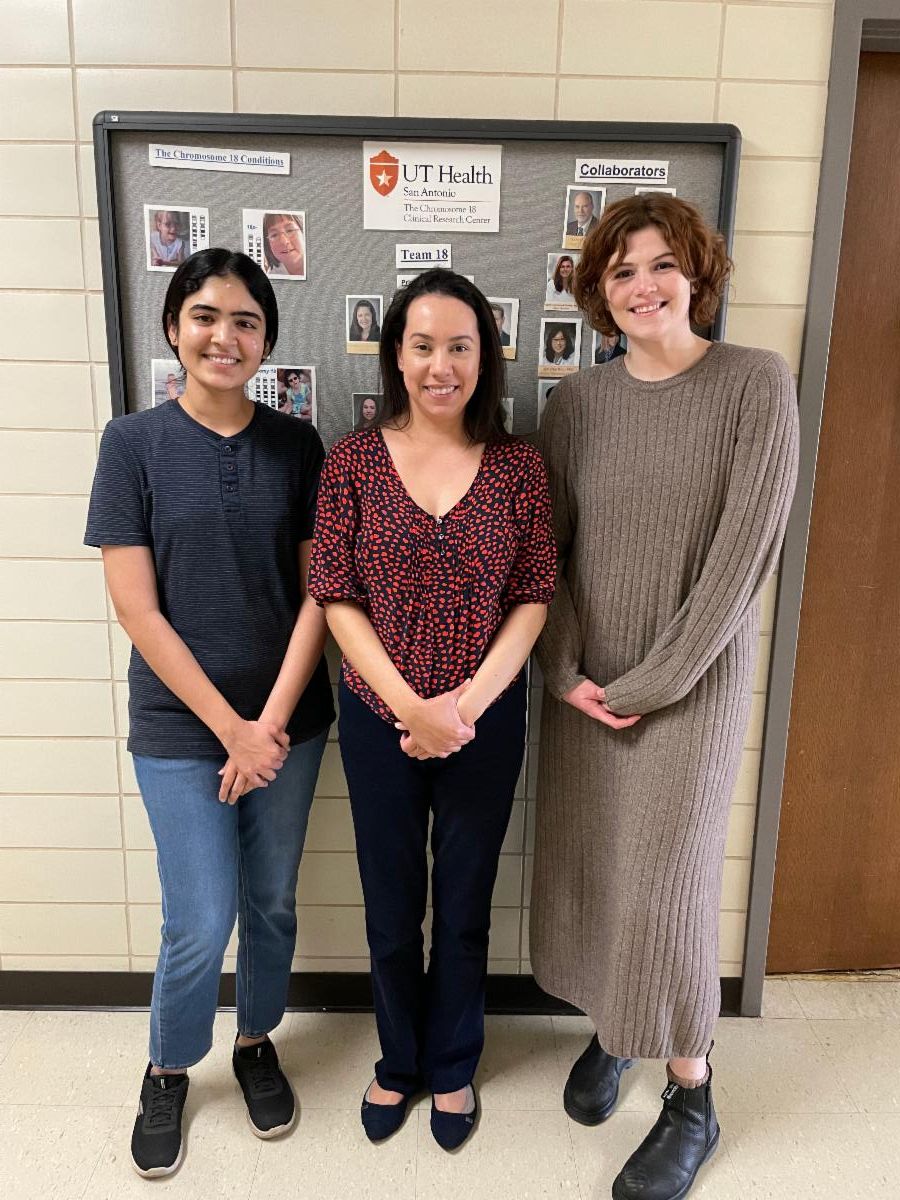
Pictured above are 3 of the Chromosome 18 Clinical Research Center staff and from left to right: Aamuktha Pentala (Research Associate), Brittany Antopia (Program Data Manager), and Catherine McCarthy Participant Coordinator). You can view the rest of the team here.

Updates on the projects the Chromosome 18 Clinical Research Center:


  • 18p- videos for speech and muscle changes are continuing to be recorded by families and evaluated by Drs. Karkar, Tawil (neurology) and Lu (speech). 
  • The seizure survey sent to 596 participants with 333 responses. Data are being analyzed.

This month, Dr. Cody discusses a paper that was just published describing adult triplets in Denmark with an interstitial deletion of 18p. Please enjoy the article below:

New 18p Data

A most remarkable paper was just published describing adult triplets with an interstitial deletion of 18p. This paper is important and remarkable for several reasons. First, people with deletions that include only the middle section of 18p are exceeding rare. There is only 1 other person in our study with an interstitial deletion out of the nearly 150 enrolled to date.


Second, the health history of each of the triplets is amazingly identical and supports the idea that the variability between people with a chromosome 18 condition can be significantly impacted by all the other genes on their other chromosomes. There are some who argue that the differences between people with the same genetic change are due to chance alone and that mere changes in the number of genes are just risk factors and are not independent and distinct causes of disease. While there is likely some aspect of truth to this statement, the triplet’s similarity supports the idea that while some genes are directly causative, others that are just risk factors are impacted more by all the other genes in the genome than by mere chance. In this case, all three ladies have the same autoimmune disorder, while other people with 18p- who develop an autoimmune disorder may have any one of the many autoimmune disorders. There are not autoimmune disorders that are more common in someone with 18p-. (I know, I am the only one who finds this aspect interesting.)


The third important aspect of this paper is that because they are adults, we are able to learn much more about their medical and developmental history.


The young ladies live in Denmark and have an 18p deletion that includes 21 of the 66 genes on 18p. A diagram showing the location of their deletion is shown below.

At the time of their evaluation, they were 37 years old. They are 5 feet 4 inches tall and weighed between 150 and 172 pounds. They had delayed speech development and continue to have verbal and motor dyspraxia. They did not walk until age 2 years and currently have a wide-based and clumsy gait. They were each diagnosed with Graves disease (hyperthyroidism) between the ages of 7 and 9 years. They each have cardiomegaly with normal cardiac function and Raynaud’s phenomenon (reduced blood flow to the fingers) both potentially a consequence of the Graves disease. Additionally, they all have a skin condition with a likely autoimmune origin which manifests differently in each triplet. The two with gynecological data had late menarche and ovarian cysts. Of the two with psychiatric data, one had the diagnosis of obsessive-compulsive disorder (OCD) and the other not formally diagnosed had compulsive behaviors. All three experience daytime urine accidents. 


The published report just described them as having mild to moderate intellectual disability. Finding this to be insufficient, the primary author of the paper was kind enough to provide us with is this additional information:


  • Educational level is finishing public school (I guess it is equal to junior high in the US). They attended regular school with support. After graduation, they attended a school specialized in children with ID.
  • They currently live in individual apartments in a group home with support.
  • They work in a protected environment for people with disabilities. I am not aware of the details regarding this employment.
  • They all have a partner, but do not have children.
  • Speech: They do have intelligible speech, however, the communication overall must be kept simple for them to follow. They seem to have some difficulties expressing themselves. My interpretation is that it may be mixture of finding the words but definitely also issues regarding pronunciation. In general, their parents, especially their mother, have been accompanying them to all hospital visits and much communication and planning go through the parents.


Although we had several genes on 18p that we thought might be significant factors impacting cognitive development, the data in this paper has helped us to focus on just one of them. We will be pursuing future funding to investigate the role of this gene when present in too many or too few copies and ways to normalize it’s regulation. There are instances on other chromosomes in which a gene is responsible for disability when present in a deletion and a duplication, meaning that this may well be an important gene for understanding the molecular basis of Tetrasomy 18p as well.


Many thanks to Morten Krogh Herlin, MD, PhD, Aarhus University Hospital, Denmark for his helpful additional information. 

The recorded sessions from World Chromosome 18 Day 2024 are now available on our website. These sessions with expert speakers are a great resources for things like research updates, independent living skills, endocrinology 101, epilepsy and seizures, and much more: https://www.chromosome18.org/get-involved/world-chromosome-18-day/

To view Dr. Cody's chromosome 18 basics and FAQ videos, please click the link below:

VIEW ALL FAQ VIDEOS NOW
Do you have questions about anything in this email? Contact Catherine McCarthy at the Clinical Research Center for more information.
Chromosome 18 Registry & Research Society | 210.657.4968
STAY CONNECTED
Facebook  Twitter  Instagram  Linkedin