Weekly Digest Number #19 - May 10th, 2022 |
|
Welcome to the RWU Rail & Labor News! This news bulletin is produced and emailed out each Tuesday morning. We hope you find each week's news and information useful. If so, please share with co-workers, friends, and colleagues. If you like, you can sign them up to get all the news from RWU HERE. Or forward them the link. Note: If you read over this news bulletin each week, you will be sure to never miss the important news of what is going on in the railroad world from a worker's perspective!
|
|
(Editor's Note: The nation's big rail carriers are under attack by shippers, environmentalists, communities, and government agencies for their bungling and mismanagement. The rail unions and their members - who have perhaps the biggest gripe of all with the Class Ones - need to engage in more actions like the one reported on below. The carriers are on the defensive. It is high time we upped the ante and went on the offensive. This is what we need - pickets, rallies, demonstrations, "practice strikes," and other forms of membership involvement to pressure the carriers and let them know we mean business.) |
|
Union Members Protest at Stockholder Meeting of BNSF Parent |
|
Railroad union members, who have been increasingly vocal about working conditions and the lack of a new contract, protested Saturday at the annual meeting of BNSF Railway parent Berkshire Hathaway, picketing and handing out leaflets outside the meeting site.
The Brotherhood of Locomotive Engineers and Trainmen has also taken out ads in the Omaha World-Herald [see “Union ad takes aim at BNSF, UP leadership …,” Trains News Wire, April 22, 2022] and employed two mobile billboards to circulate during the Berkshire meeting weekend.
The International Association of Sheet Metal, Air, Rail and Transportation Workers-Transportation Division was among other unions also participating in morning and afternoon protests at the CHI Health Center, site of the Berkshire meeting. The SMART-TD website indicates “about 60” protesters were present.
The World-Herald reports that Dennis Pierce, president of the Brotherhood of Locomotive Engineers and Trainmen, said in a Friday press conference that BNSF and Union Pacific are both “off the rails” for their current labor practices. Along with calling for a resolution to negotiations for a new national labor contract now well into their third year, Pierce criticized attendance policies at both railroads.
|
|
(Editor's Note: Regulation, nationalization, employee ownership? There are all sorts of options folks. There are many ways to run a railroad. More and more, the American people are beginning to ask of the current system: "Is this any way to run a railroad?") |
|
Should the Freight Rail Industry be Overhauled? |
|
Service disruptions at the Class I railroads have come to a head in recent weeks, and shippers and the unions representing rail workers are clamoring for changes to the freight rail industry of a magnitude to match the disruptions.
Some examples of subpar rail service: Excessive dwell times at the origin, resulting in the doubling of transit times between the Midwest and West Coast for grain shippers and tardy arrivals that pressure flour and feed mills and ethanol plants to temporarily cease operations or curtail production.
Meanwhile, the National Grain and Feed Association estimates that the combined cost to the grain industry of revenue losses and additional freight expenses was over $100 million in the first quarter of 2022.
The Surface Transportation Board is considering short-term measures — such as the submission of rail service improvement plans — to address these issues. These measures would potentially provide immediate relief to shippers and could be deployed within a 30-to-60-day time frame.
However, the board, the railroads and rail’s stakeholders are under pressure to tackle tough questions in ways that could more comprehensively affect how the railroads run their operations. These questions also touch on the long-term health and viability of freight rail in a transportation sector bent on an automated future.
|
|
(Editor's Note: This is the first of hopefully many more regulations and rules that the STB will promulgate to reign in the nation's rail carriers in the face of the hearings held in late April. Note the final paragraph where Chair Oberman states that, “Requiring additional reporting from railroads may not be the final result of our hearing on service issues." Let's hope this is just the beginning.)
|
|
Federal Regulators Order Railroads to Provide More Service Data, Recovery Plans |
|
WASHINGTON – Federal regulators have ordered Class I railroads to provide more detailed operational and staffing metrics and will require the big four U.S. systems to submit service recovery plans in light of widespread service problems that were spotlighted during hearings last week.
The Surface Transportation Board, in a decision issued on Friday, said “immediate action is needed to address the significant service problems” as rail service has worsened this year.
“Our freight rail service hearing highlighted the grave concerns of shippers and others regarding freight rail service,” Chairman Martin J. Oberman said in a statement. “While the railroads have faced certain challenges over the last few years, the evidence produced at last week’s hearing is overwhelming that the railroads’ longstanding practice of reducing operating ratios by cutting employment levels, mothballing locomotives, and eliminating other essential resources are the central reasons why farmers have been hours away from depopulating herds, manufacturing facilities have reduced operating hours, and shippers cannot get their products to market on time or receive essential raw materials for their companies. These failures are harming the nation’s economy and, in my view, are contributing to the inflationary forces affecting food and fuel in particular.”
All Class I railroads will have to provide much more detailed performance metrics every week for the next six months. The railroads already report a range of data weekly, but the board said it needed more information in order to get a better idea of the extent of congestion, service failures, and the impact of crew and locomotive shortages.
Among the data sought: Dwell information for smaller terminals; the weekly average number of train starts per day, broken down by train type; detailed freight car information, including the number of miles cars travel per day; and the weekly average number of trains that must be recrewed due to the federal hours of service law, along with the recrew rate.
|
|
(Editor's Note: This relatively small demonstration by rail workers in a small terminal in upstate Wisconsin is an example of rank and file revolt that is breaking out. We need more of this to take place at rail terminals across the country. The carriers are on the defensive. We have the moral high ground. Let's seize the moment and fully exploit this historic opportunity! Kudos to the fellow workers in Wisconsin!) |
|
Canadian National Workers in Stevens Point Protest Wages, Sick Days, Compensation |
|
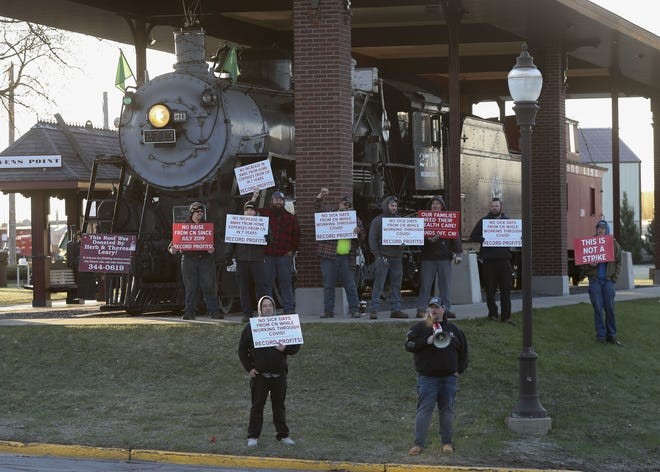
STEVENS POINT – About 20 railroad workers gathered early Wednesday morning in Stevens Point at an informational picket demonstration, protesting worker treatment by Canadian National Railroad.
Joe Letizia, a union representative for railroad workers in Stevens Point, said workers have not had a raise or wage increase in the last three years, and there has been no increase in per diem or away from home expenses in the last seven years, while many workers are working 500 miles or further from home, paying for gas, hotels and food. Letizia also said workers have had no sick days, even while working outside in the snow, heat and a pandemic.
Railroad worker Andy Fritsche said he attended the demonstration because he and his coworkers haven’t seen a raise since 2019, while the cost of living has skyrocketed. He said CN gives $85 a day per diem that is supposed to cover gas, hotel and food, but the money doesn’t go far. They often have four or five people sharing one hotel room to save money.
The lack of paid sick days is also a problem, Fritsche said.
“If we’re sick, we’re expected to come into work, and we’re getting others sick,” he said. “And that’s in the pandemic, too.
Letizia said workers have been trying to bargain and negotiate with CN since January 2020, but the company has not given any comprehensive proposal or offered anything fair, he said.
|
|
Railroad Workers are Being Ground to Dust - An Interview with RWU Members
The Real News Network viewers may remember a recent interview we published at the beginning of February in which Editor-in-Chief Maximillian Alvarez spoke with retired railway engineer Jeff Kurtz about a US District Court blocking railroad workers at BNSF Railway from striking over the recent implementation of an oppressive new attendance policy.
|
|
Even if the story has faded from the headlines, the struggles railroad workers are facing have not gone away in the slightest, and workers and their families have reported that BNSF’s “Hi-Viz” policy has been a disaster for them and for the railroad industry. In this crucial follow-up report, Alvarez speaks with Jeff Kurtz and Ron Kaminkow of Railroad Workers United about what workers have been going through since the implementation of this new attendance policy and what can be done about it.
Jeff Kurtz was a railway engineer and union member for 40 years. He served as a union officer most of his career, including eight years as president of BLET Local 391 and chairman of the BLET Iowa State Legislative Board, where he oversaw safety and legislative matters for the union in the state for four railroads for 10 years. He retired in 2014 and served as state representative for one term in the Iowa House after winning the 2018 election in his House district. He now works in a volunteer capacity with Railroad Workers United and the local labor chapter of the Iowa Federation of Labor. Ron Kaminkow is currently serving as General Secretary of Railroad Workers United. Prior to hiring out as a brakeman with Conrail in 1996, he served as President of AFSCME Local 634 in Madison, WI. In 2005, Kaminkow helped to found Railroad Operating Crafts United (ROCU), an RWU predecessor. A former brakeman, conductor, and engineer for Conrail and later NS in Chicago, he formerly worked for Amtrak in Milwaukee and Chicago. He currently is working as an Amtrak engineer in Reno, NV, where he is the Vice President of BLET Local 51.
|
|
(Editor's Note: Biden signed into law a bill that authorizes historic monies for Amtrak, and includes language to reform the Amtrak Board, in an attempt to make the Board of Directors members be more experienced and knowledgeable in rail. Then he appoints 5 people - most of whom - have limited direct experience in rail. |
|
Biden’s Amtrak Board Nominations Lack Qualifications Demanded by Congress: Analysis |
|
WASHINGTON — In theory, any organization’s board of directors must possess enough expertise in the business it oversees to analyze and pass judgement on whether management’s policies fulfill the organization’s goals.
In Amtrak’s reauthorizing Infrastructure Investment and Jobs Act enacted last November, Congress was clear it now requires board members exercising such oversight to possess geographic diversity and operational experience. The goal: strengthening all aspects of the national network, not any one region.
Given those conditions, and evaluated as a group, the nominees presented by President Joe Biden for approval by the senate don’t check all those boxes [see “Biden to nominate five to Amtrak board,” Trains News Wire, April 29, 2022].
The legislation passed in November [see “Infrastructure bill addresses Amtrak priorities …,” News Wire, Nov. 8, 2021] replaced language calling for a 10-member board with “balanced representation of the major geographic regions served by Amtrak” with specific requirements:
— Two members residing along Amtrak’s Northeast Corridor
— Four “geographically distributed” outside the Northeast, with two from states served by state-supported service, and two from states served by long-distance trains. A single individual cannot fill both a state and long-distance slot.
|
|
(Editor's Note: The freight shippers in this country are not interested in operating ratios, stock prices, operating plans or all the rest. What they ARE interested in is delivery to - and pulling cars from - their facilities on-time. And in this regard they are extremely unhappy. The rail industry may blame any one of a number of external factors for their failures, but as this article makes clear, if the carrier does not offer good local service, shippers will simply not ship by rail if they can avoid it.) |
|
The Fate of Carload Traffic Hinges on Local Service: Analysis
By not showing up on schedule, Class I railroads leave profitable revenue on the table.
|
|
Let’s set aside the railroad industry’s current bout of temporary service problems and discuss something more important. Class I railroads’ local service — which ranges from OK to downright embarrassing — for years has been where the rubber meets the road.
Shippers divert rail shipments to trucks when a local regularly fails to show up, doesn’t deliver the right empties, or can’t pull loads on schedule. Ultimately, frustrated shippers decide to give rail a smaller share of outbound volume. The problem is not rail, per se, but Class I local service that’s often infrequent and generally unreliable.
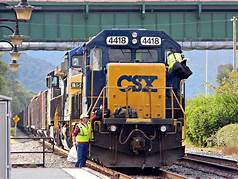
In a seven-day stretch spanning February and March, for example, CSX Transportation completely missed or only partially switched 1,260 customers. Customers can complain, but the squeaky wheel doesn’t always get oil — even when a railroad is in hot water. Sanimax, a shipper in the Twin Cities, has hauled Union Pacific before federal regulators because it unilaterally reduced service to three days a week from five. Yet service has only gotten worse, with Sanimax saying UP has skipped half of its scheduled switches.
Now consider this: Short line operator Genesee & Wyoming did an analysis of companies that have facilities located on its short lines and Class I railroads. Plants located on G&W shipped 12% more volume by rail than the plants located on Class I lines. Why the difference? Short lines earn this business by offering reliable and frequent service.
G&W’s figures suggest that the big systems are leaving a lot of potential carloads and revenue on the table. Some back-of-the-envelope math says that last year the U.S. Class I railroads would have handled a million more carloads and pocketed more than $3 billion in additional revenue simply by showing up.
|
|
(Editor's Note: This a long in-depth but well presented piece worth the read. However, the title is inappropriate. It should read, "People vs. PSR", not "People vs. Cargo", because freight and passenger trains are potentially very compatible, but NOT when the rail carrier is hell bent upon drastic cost cutting, and running three mile long trains whenever they wish, both of which are hallmarks of PSR.) |
|
People vs. Cargo: How a Battle Over Amtrak’s Gulf Coast Line Could Shape the Future of Passenger Rail |
|
Ever since Hurricane Katrina swept across the Deep South in 2005, shredding the region’s railways, it’s been impossible to take a train heading east from New Orleans to the rest of the Gulf Coast. For years, Amtrak has been trying to restore service in the form of a twice-a-day line between New Orleans and Mobile, Alabama. But it’s met fierce resistance from two rail giants — CSX and Norfolk Southern — which own most of the tracks that the agency wants to use.
The freight companies argue that, without significant changes, any resumption of passenger services would ensnare their routes with traffic, sending costly delays down the country’s supply chain at a time when businesses are already plagued by shortages and slowed shipments.
The dispute is before federal regulators, with hearings set to restart May 9, and experts say their ruling will have far-reaching implications for the future of passenger rail in America. President Joe Biden, once known as “Amtrak Joe,” is eager to boost rail, allotting Amtrak $66 billion of last year’s infrastructure package. That would help cut emissions from transportation — the U.S.’s biggest source of greenhouse gasses. But any growth in rail service will need to take place on privately owned railways.
Advocates for public transit worry a loss could embolden freight companies to stymie passenger rail service elsewhere. “If CSX and Norfolk Southern are successful in blocking this, then dreams of expanded passenger rail will begin to wither and die in every part of the country,” said John Robert Smith, previously the mayor of Meridian, Mississippi, and now chairman of the advocacy group Transportation for America.
|
|
(Editor's Note: We do not print every train wreck and derailment in this weekly newsletter, because they are fairly routine. But there have been a number of these 10 and 15 car pile ups lately which deserve out attention as rail workers.) |
|
BNSF Train Derails, Catches Fire in North Dakota |
|
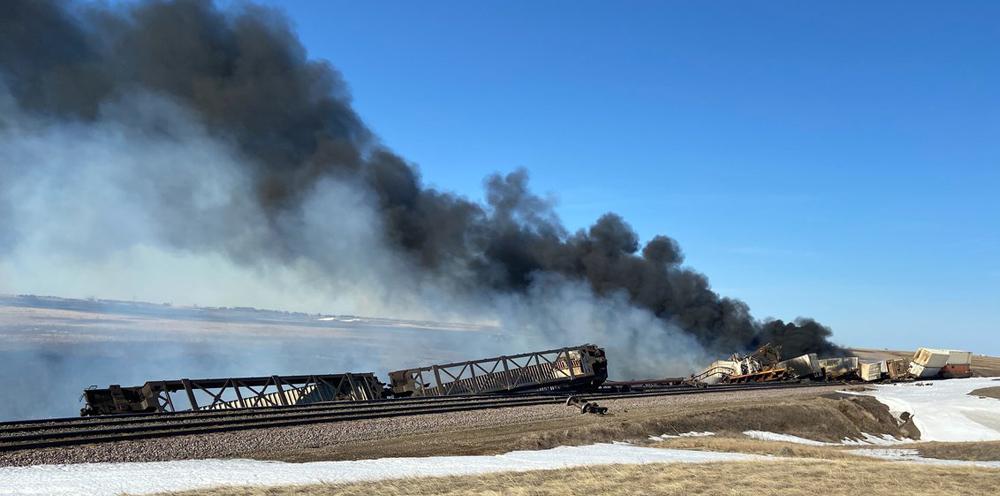
BURLINGTON, N.D. — Fifteen cars of a BNSF Railway intermodal train derailed early Sunday near Burlington, with some cars catching fire, closing the railroad’s Glasgow Subdivision main line just west of Minot, N.D.
KMOT-TV reports that while the derailment occurred about 1 a.m., as of 3:15 p.m., the fire was still burning because firefighters were facing difficulties in reaching the scene, with fire trucks becoming stuck in mud while en route. A North Dakota National Guard helicopter was dispatched to help fight the fire.
KFYR-TV reports the line reopened about 2:30 a.m. Monday. Cleanup is continuing.
BNSF said in a statement that the containers involved carried paper products and frozen foods, and that cars with containers carrying hazardous material had not derailed and had been removed from the scene. No injuries were reported.
The derailment and fire led to cancellation of both directions of Amtrak’s Empire Builder on Sunday between Minot and Shelby, Mont.
|
|
(Editor's Note: Make sure to read the final paragraph. Before we all conclude that his death was HIS fault, we need to understand that it is management that manages the corporation. Clearly explaining and delineating close clearance locations in switching operations was simply not a priority for NS. ) |
|
Close Clearance in Yard Led to 2019 NS Conductor Fatality |
|
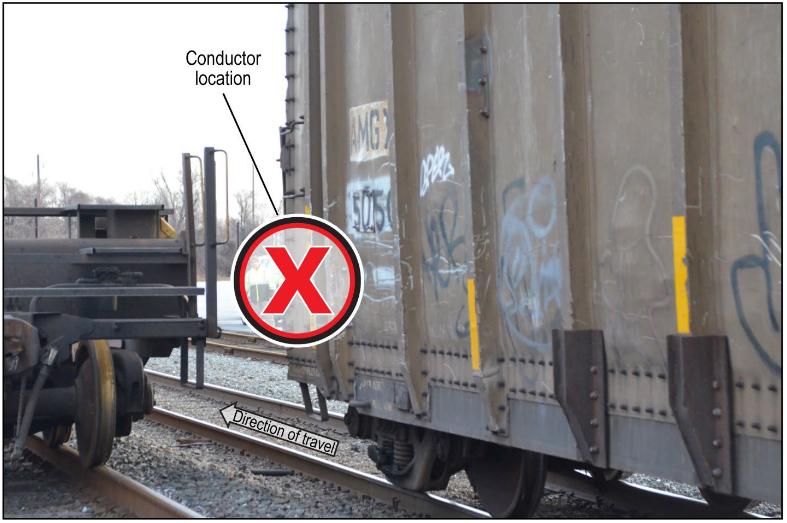
WASHINGTON — A Norfolk Southern conductor killed in a February 2019 accident in Baltimore was riding on the side of a car in a close-clearance area — contrary to rules prohibiting such an action — when he was pinned between his train and a car on an adjacent track, according to a National Transportation Safety Board report.
The accident Feb. 19, 2019, at about 7 a.m., at NS’ Bayview Yard occurred at a location where the distance between the train the conductor was riding on and cars on an adjacent track decreased to just 9 inches.
While the conductor’s action led to his death, the NTSB also found information regarding close-clearance areas in the governing timetable’s terminal instructions was inconsistent and lacked clear messaging, and that the NS training program did not emphasize and test on close-clearance restrictions in the Baltimore terminal. The NTSB recommended revising the terminal instructions and the training program to address these issues.
|
|
California High-Speed Rail Speeds Ahead |
|
High-speed rail in California made significant progress this week.
The California High-Speed Rail Authority's Board of Directors approved four important milestones for the project, effecting every region along the line.
1. The San Jose to Merced Environmental Impact Statement (EIS)
2. Modernization of Los Angeles Union Station
3. Design Process for Central Valley Stations
4. The 2022 Business Plan.
These are all important milestones in the effort to build the first high-speed rail network in the U.S, and we have more details.
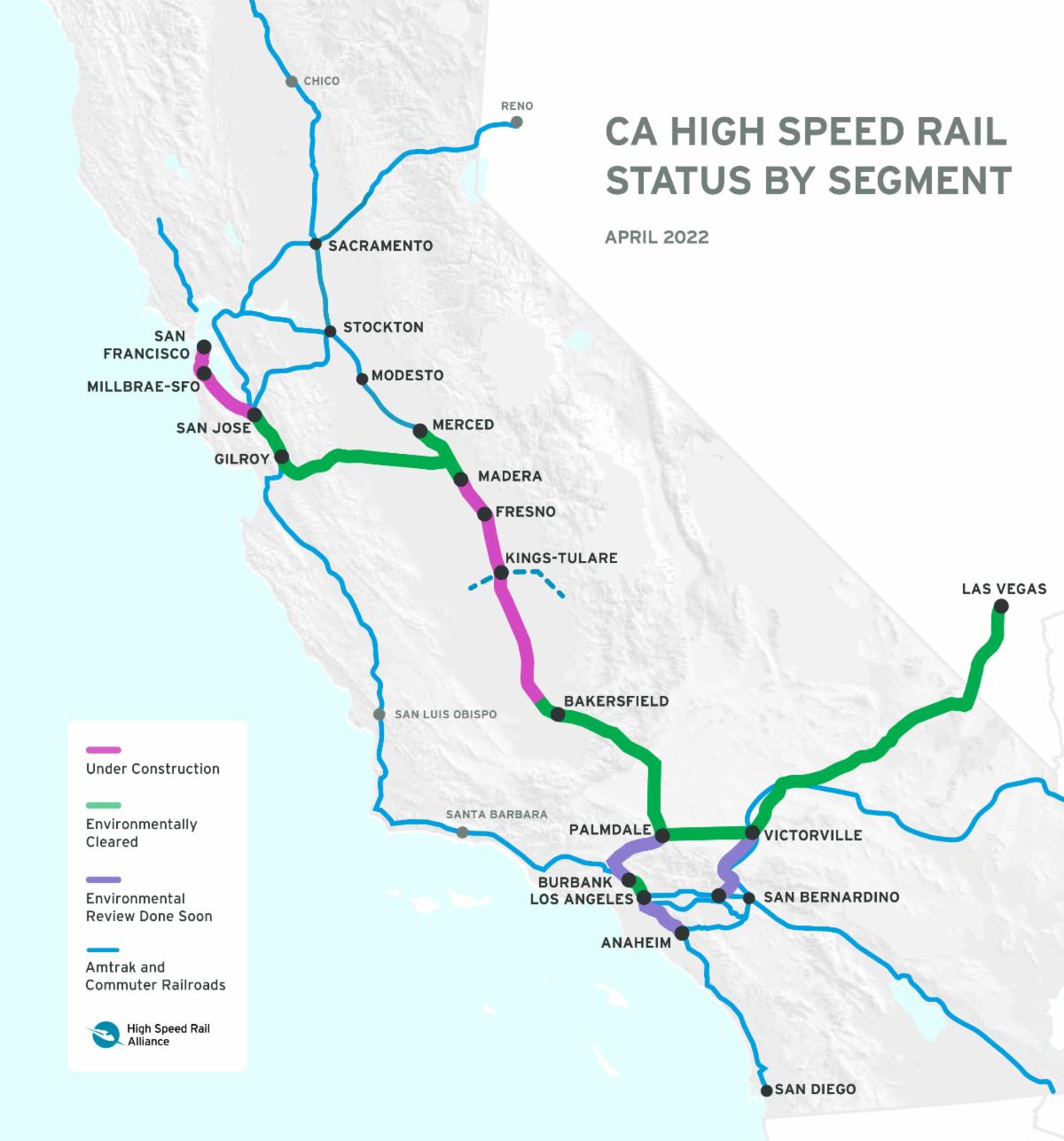
With the Board’s approval of the San Jose to Merced EIS, nearly 400 miles from San Francisco to Palmdale are environmentally cleared. The Authority can now move forward with pre-construction work and aggressively seek federal funding.
The approximately 90-mile section will connect the Central Valley to the Silicon Valley by way of the Pacheco Pass. This is the first railroad crossing of the Pacheco Pass, which will provide new economic opportunities and better mobility throughout the region.
With the approval of this EIS, the project is now environmentally cleared from San Francisco to Palmdale, in the Los Angeles area, and that’s a big reason to be excited.
|
|
(Editor's Note: There is so much wrong here. For a CEO of a rail company to show such disdain for the government oversight board is outrageous. As the nation creeps in a fascist direction, the nation's CEOs have become emboldened and more arrogant, believing they should be running the country, not the government. Author Frank Wilner - not someone we normally feature in this News Summary because of his reactionary and anti-union views - was even incensed by Foote's behavior, and hence we reprint the article here.) |
|
CSX CEO Lost Situational Awareness |
|
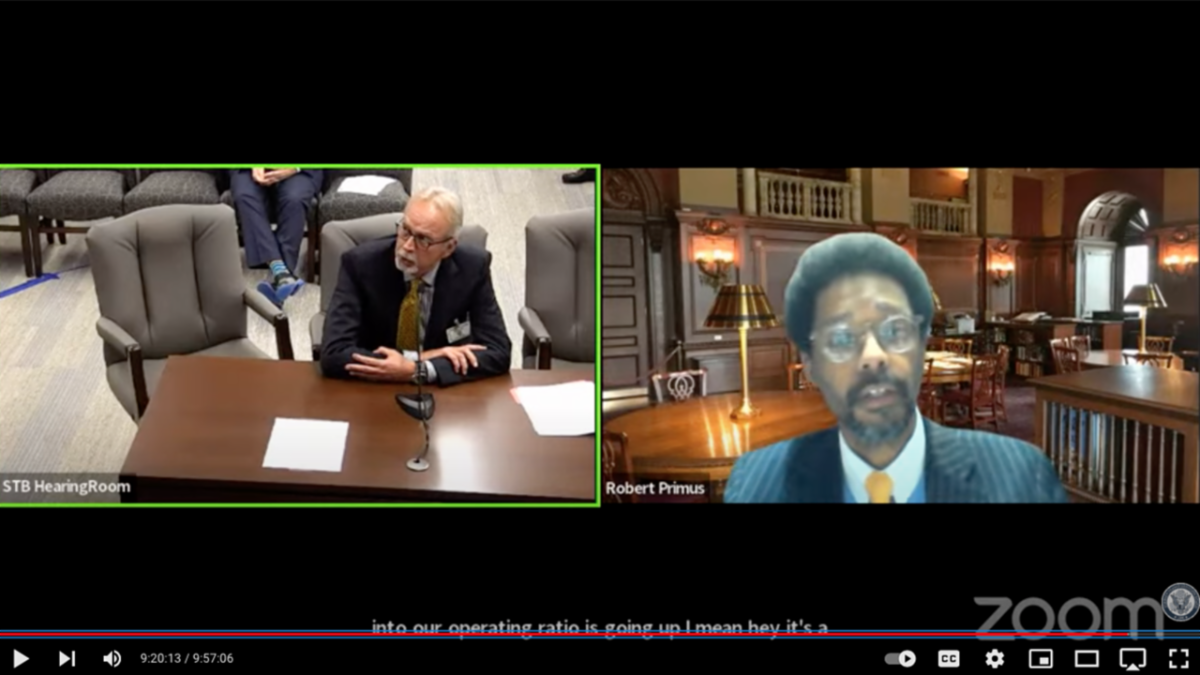
Whatever was CSX CEO James M. Foote thinking when he testified before the STB’s “Urgent Issues in Freight Rail Service” hearing April 26? His display of disdain for the agency - in particular, White House-nominated and Senate-confirmed STB member Robert A. Primus - was evident in mannerisms and sarcastic responses.
For the usually well-respected, third generation railroader whose track record is one of investor-satisfying performance, Foote’s April 26 appearance is best not bookmarked. Kudos to Primus and STB Chairperson Martin J. Oberman for remaining composed through Foote’s loss of situational awareness. Indeed, the acolyte of legendary railroad CEO E. Hunter Harrison could have fared worse.
How much worse? Clyde B. Aitchison, who served on STB predecessor Interstate Commerce Commission for 35 years (1917-1952), was known to swivel in his chair and turn his back on disrespectful witnesses. Sen. Daniel Patrick Moynihan, when chairing the Senate Finance Committee, admonished a truculent witness “never” to return factually unprepared. And John Dingell, when chair of the House Commerce Committee when its portfolio was railroad oversight, was known to use investigative staff to disturb the sleep of out-of-favor witnesses.
So, what went on during that ninth hour of the hearing’s first day causing Foote’s foot-in mouth malady? All began following Primus’ welcome, informing Foote, “It is important that you are here [because] the buck stops with you … you’re the one who pulls the lever.”
Questioned by Primus about the rail industry’s treating as the Holy Grail an ever-lower operating ratio (operating expenses divided by operating revenue), Foote insisted, “We don’t operate from an operating ratio.” In fact, Foote was quoted in the June 6, 2019, Jacksonville Daily Record that operating ratio “tells you by looking at one number whether or not you are running the company effectively and efficiently. It is what I call a scorecard.”
|
|
(Editor's Note: It is great to see a union official responding to industry mouthpiece Frank Wilner's anti-union invectives. Even more pleasing is to see his words printed in an industry mouthpiece like Railway Age. Note that, when the RWU General Secretary wrote a rebuttal to Wilner's diatribe lauding the single crew member Tentative Agreement on BNSF in 2014 - despite a promise from that magazine that they would print his piece - Railway Age never did. You can read it HERE.)
|
|
‘A Disconnect From Reality’ - BRS President Responds to Industry Mouthpiece Frank Wilner |
|
As a labor leader, I often give little attention to the political pawns and one-sided opinions of writers that attempt to create a public illusion for the Wall Street puppets running the railroads. However, when opinions like [Railway Age Capitol Hill Contributing Editor Frank N. Wilner’s] attack on the Brotherhood of Railroad Signalmen (BRS) demonstrate ignorance as to the facts and the law, a correction of the record is proper.
The writer/opinion commenter here demonstrates a disconnect from reality and a willingness to carry the water for the railroads involved in national bargaining who are desperate to divert attention from their lack of good faith in bargaining. Rather than acknowledge the stalling tactics of the railroads and unwillingness to make a meaningful wage offer while proposing to diminish industry health and welfare benefits, [Mr. Wilner] decided to interject [himself] into the internal process and Constitutional provisions of this union.
To begin, I am sure the writer should have been aware of the fact that the BRS recently requested a proffer of arbitration and release from mediation; yet, he conveniently omits this important piece of information from the article. At the moment, we await the National Mediation Board’s action on our request for release; if the BRS is released, there is a 30-day cooling-off period before self-help is permitted under the Railway Labor Act (RLA). During that period, the President [of the United States] can determine that a strike or lockout by the carriers would deprive a part of the country of essential transportation services and appoint a Presidential Emergency Board (PEB) to investigate the dispute and make recommendations.
|
|
Former CSX Employee Sues Railroad, Union, Arbitration Board Over Dismissal |
|
TOLEDO, Ohio — A former CSX Transportation crew member dismissed over a social media post is suing the railroad, the Brotherhood of Locomotive Engineers and Trainmen, and an arbitration board, seeking to overturn his dismissal.
Kirk E. Knopp, of Fostoria, Ohio, filed suit in April in U.S. District Court for the Northern District of Ohio, Western Division. The suit says a social media article posted in May 2019, about the death of a 21-year-old man struck and killed by a CSX train in Fostoria, included a derogatory comment posted under Knopp’s name. Following an investigation, Knopp was terminated for violating the railroad’s social policy; Knopp contends he did not mention the railroad and did not violate its policy.
The case went to the National Railway Adjustment Board Special Board of Adjustment No. 1185, used by CSX and the BLET to arbitrate matters including claims of wrongful termination. In the suit, Knopp says he was told it was not necessary for him to attend and that he therefore was denied his opportunity to participate and provide testimony; that the board did not consider the harshness of termination for one violation of policy; and that his social media activity was protected by the First Amendment.
|
|
|
|
|
|
|