|
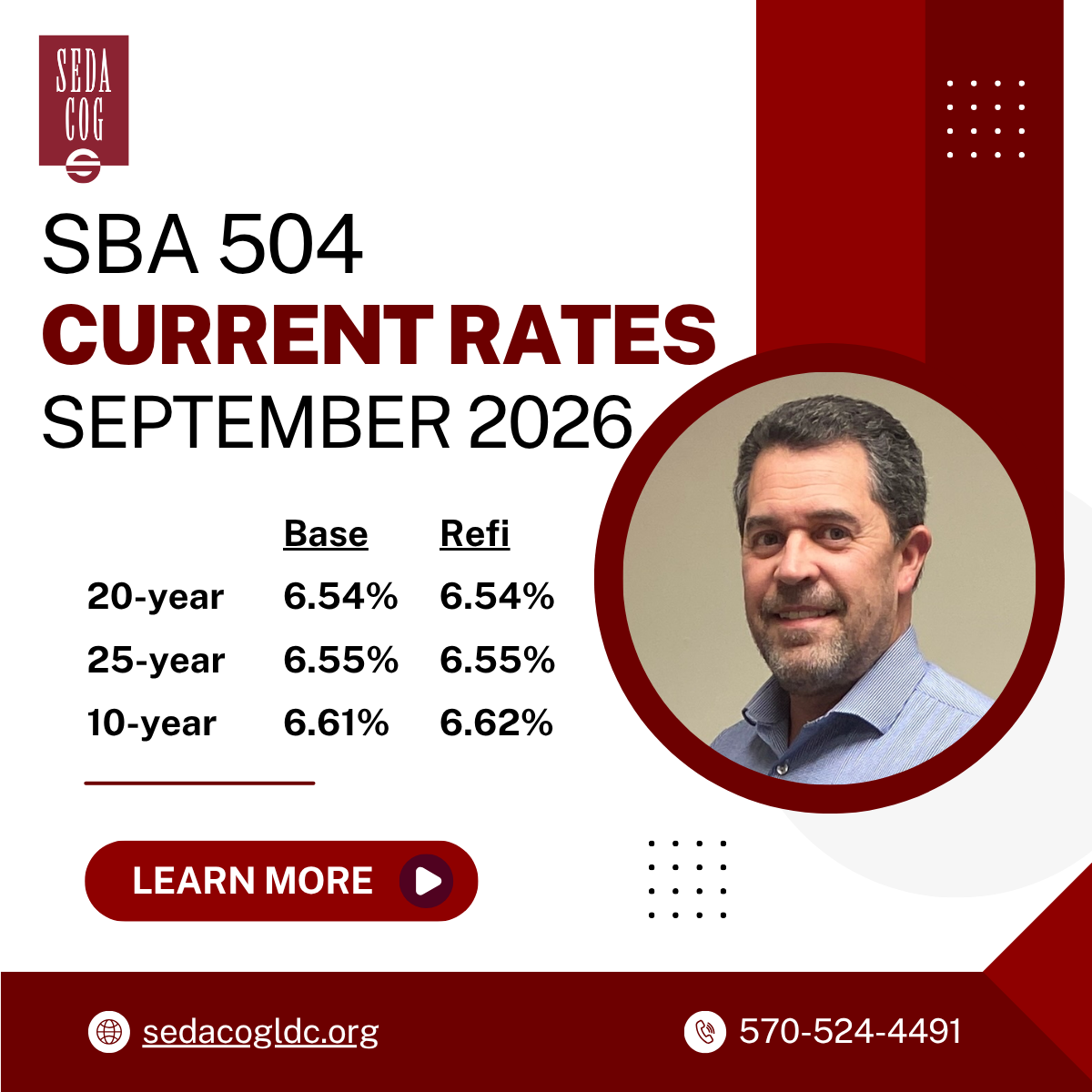
NADCO, the trade association for the nation's Certified Development Companies (CDCs), has released the SBA 504 fixed interest rates for September 2026. Eagle Compliance, the Fiscal Agent for the SBA 504 Loan Program, responsible for the marketing, pricing, and selling of the debentures sold to investors to fund the SBA 504 Loan Program, stated that September saw SBA interest rates continue to rise amid the bond market's concern over inflation.
According to Eagle Compliance, a week before the SBA bond sales:
Good News?
Friday’s Non-Farm Payroll report was 3X higher than expected at 162,000 and also saw an upward revision to +21,000 for the July report that previously was negative. The market reaction was adverse for both stocks and bonds as participants perceive this strength removes most objections to why the Fed shouldn’t raise rates next week. Strong corporate earnings and an Unemployment Rate of 4.1% leave the central bank with only a stubbornly high inflation rate to deal with, and Friday’s CPI report will provide the August update ahead of that meeting.
Markets
Even with Friday’s reversal, equities eked out modest gains for the week, with the S&P 500 index up 13% year to date. Brent Crude oil gained 8.2% as renewed activity in Iran pushed the price of diesel fuel to $5.85 a gallon, its highest price ever and surpassing the previous record from 2022. The strongest performer of late has been Bitcoin with a closing price of $79,600, a gain of 27% from its recent low in mid-August.
As we approach the September debenture sale for the SBA 504 program, Treasury rates continue to rise, closing the week at 4.79%, far above its 50 and 200-day Moving Averages. That is 15 bps higher than when the August debentures were priced, with the futures market estimating a 59.4% probability of a 25 bps rate hike on September 16 as the market continues to do the Fed’s work.
Though the move up in rate from 3.94% in March has been dramatic, it has been orderly with no adverse effect on credit spreads, which continue to remain stable.
With that FOMC meeting coming up, it is ironic that Kevin Warsh had been blamed for weak market performance after press conferences when he declined to offer forward guidance on rates and then was identified as causing more weakness after his Jackson Hole speech affirmed the Committee’s commitment to combat inflation if higher rates were needed.
Following the bond sales, Eagle Compliance reported:
Be Careful…Light At the End of a Tunnel Can Be An Oncoming Train!
As we approached the September SBAP sale, the tone in the fixed income markets was far from positive, perhaps heading toward outright negative. Increased concern over U.S. fiscal policy had permeated the market; the FOMC was now leaning in a hawkish direction, the conflict in Iran and the war in Ukraine continued without sign of dissipation, oil prices were on the rise, and a significant amount of new issue ACMBS supply was anticipated. The week’s activity/expected releases included the U.S. Treasury refunding, the release of U.S. Treasury details on their debt repurchase plans, and the PPI and CPI reports. Certainly, a full week!
Early last week, since the July 10-Year pricing, 5-Year UST yields had risen significantly by 22 bps to yield 4.51%, and 10-Year UST yields were up 12 bps since the August pricing to yield 4.76%. Month over month, comparable ACMBS new issue and secondary market spreads were wider by approximately 3 bps, as was the MBS to U.S. Treasury OAS basis. The 2/10s, 5/10s, and 7/10s portions of the UST curve continued their flattening trend at 42 bps, 25 bps, and 13 bps, respectively. On a brighter note, SBAP paper in the secondary market had not widened, was in-fact was trading at mildly tighter levels, and there was very little supply of it available. Preliminary guidance about the September debenture offerings suggested $6.9 million of a 10-Year, $26.9 million of a 20-Year, and $630.4 million of a 25-Year; likely our largest monthly offering in 4 years. Collectively speaking, these factors painted a rather negative picture; however, the positive condition of SBAP paper in the secondary marketplace provided confidence that the suggested initial pricing spreads on the September offerings could be +38 bps on the 10-Year SBAP (over the 5-Year UST), +43 bps on the 20-Year and +50 bps on the 25-Year SBAP (both over the 10-Year UST). The 10-Year SBAP initial pricing spread was 2 bps narrower, the 20-Year SBAP 1 bp narrower, and the 25-Year SBAP unchanged; each from the last pricing of each issue.
Investor response to the $7.2 million 10-Year, $26.9 million 20-Year, and $632.9 million 25-Year 504 offerings was positive at the initial pricing spreads; although the 25-Year did take a bit longer to distribute than the other issues. As such, it was decided the spread on each issue would remain at the initial pricing spreads. Unfortunately, U.S. Treasury yields continued to climb throughout the week in reaction to disappointing Treasury buy-back details, oil price increases, and news on inflation. The 10-Year, 20-Year, and 25-Year SBAP offerings were priced at +38, +43, and +50 bps, respectively. The September debenture rate for the 10-Year was 5.09%, for the 20-Year it was 5.34%, and for the 25-Year it was 5.41%. The coupon level on the 10-Year issue was 40 bps higher than the prior offering; the 20-Year and 25-Year were 26 bps and 27 bps higher, respectively. The 25-Year rate is 6 bps over the program life average of 5.35%, and the spread over Treasury (+50) was 28 bps below its program life average of T+78.
U.S. Treasury yields climbed to fresh multiyear highs on Wednesday after details of the Treasury Department’s repurchase program were released. Although the Treasury conveyed intent to repurchase $6 billion of long-term debt (3 times the usual amount), some investors had anticipated/hoped for a larger amount. Oil prices also surged last week, with Brent crude hitting $108 a barrel on Thursday as fighting in the Strait of Hormuz and Red Sea intensified. On Thursday, the PPI rose 0.4% (as expected); year-over-year, the PPI climbed 5.4%, significantly accelerating from the 4.8% annual gain in July. Finally, on Friday the CPI rose 0.4% (as expected); year-over-year, the CPI rose 3.4% in August, also in line with expectations.
The ongoing storyline of accelerating price pressures and further upside risks stemming from elevated fuel costs should be enough to warrant firmer monetary policy. However, several FOMC Committee members still appear satisfied with taking a more patient approach to policy. Last month, Federal Reserve Chairman Kevin Warsh reiterated the Fed’s commitment to eventually reinstating price stability. This was a welcome sentiment but nonetheless still left many market participants skeptical of a rate increase next week and of additional hikes into year-end. Many feel the Fed should raise rates, but the question remains: Will they?
Next week will thankfully be relatively light from an economic release perspective; the focus of the week will undoubtedly be the FOMC’s announcement/rate decision on Wednesday*.
*On Wednesday, the FOMC raised its benchmark interest rate by 25 basis points to a target range of 3.75% to 4.00%.
_________________________________________________________________
Despite the recent rising rates, SBA 504 loans continue to be very attractive, as it reduces the down payment on commercial real estate projects to as low as 10% and provides a 20- or 25-year fixed rate for up to 40% of the borrower's financing need.
For more information about the SBA 504 loan program, visit sedacogldc.org.
|