|
The American Society of
Le Souvenir Français Inc.
Monthly Bulletin - Vol. V, No. 10
October 2025
| | |
Alsatian legacy in the
United States
| | |
Editorial
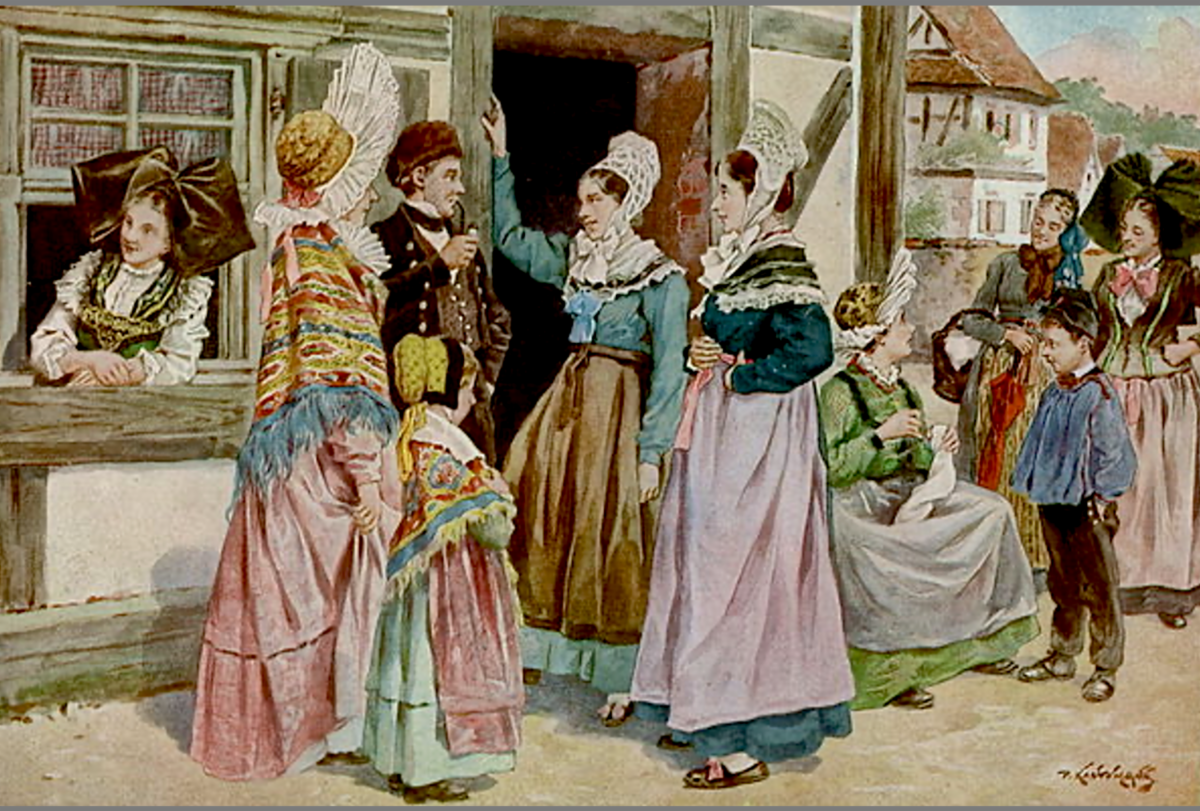
France is composed of many singular regions, historical provinces with a strong personality and culture. France being itself a land of immigration, French immigrants to the United States were much smaller in number than their other European counterpart. Among these immigrants, those coming from provinces such as Alsace, Brittany, Basque country, brought along their customs, and maintained it in great part even after many decades.
We invite you in this bulletin to visit with us several historical Alsatian sites, and meet several outstanding Alsatian immigrants who left a mark in their adopted country. We are thankful to Mr. Francis Dubois, member of our Board, and a prominent member of l'Union Alsacienne in New York (one of the oldest French associations in the city) for sharing in a foreword his personal take on the Alsatian community in the United States.
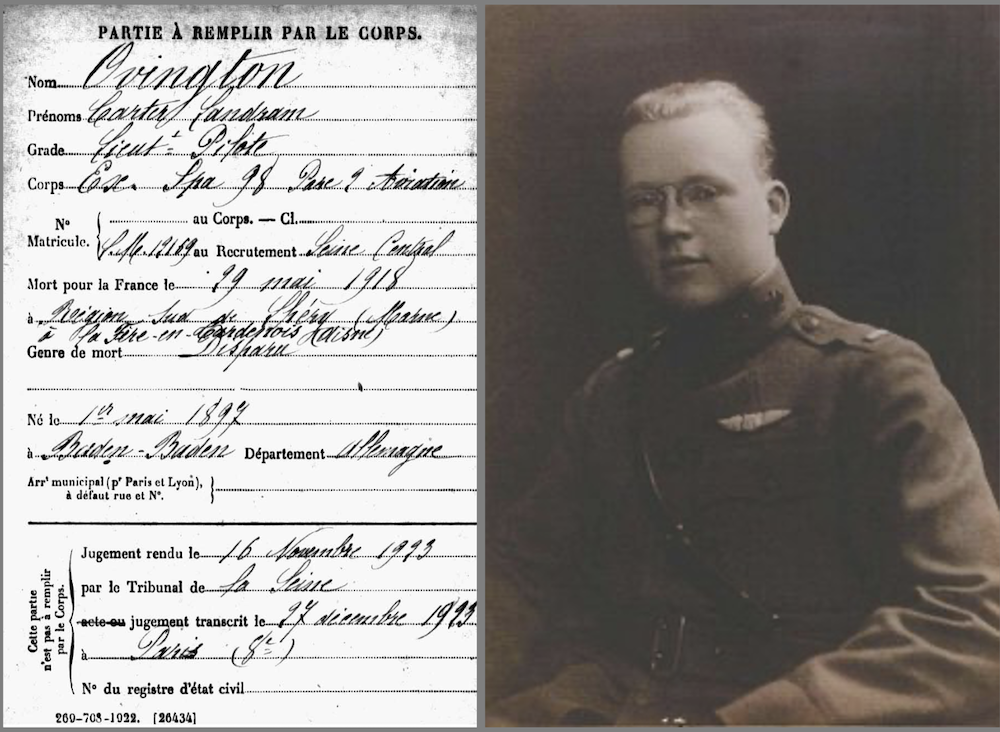
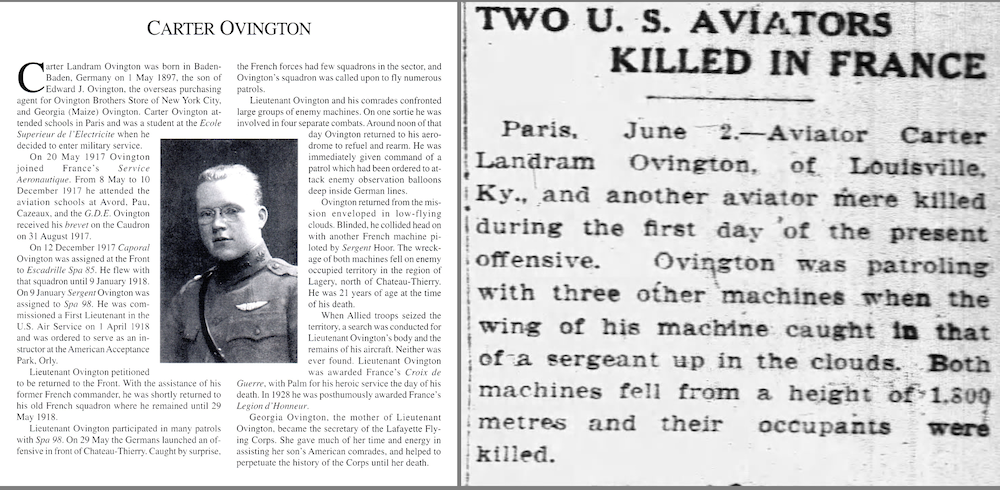
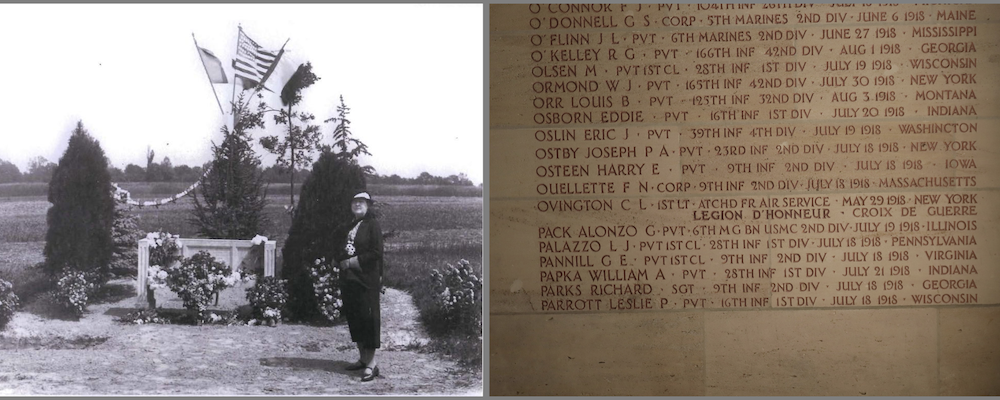
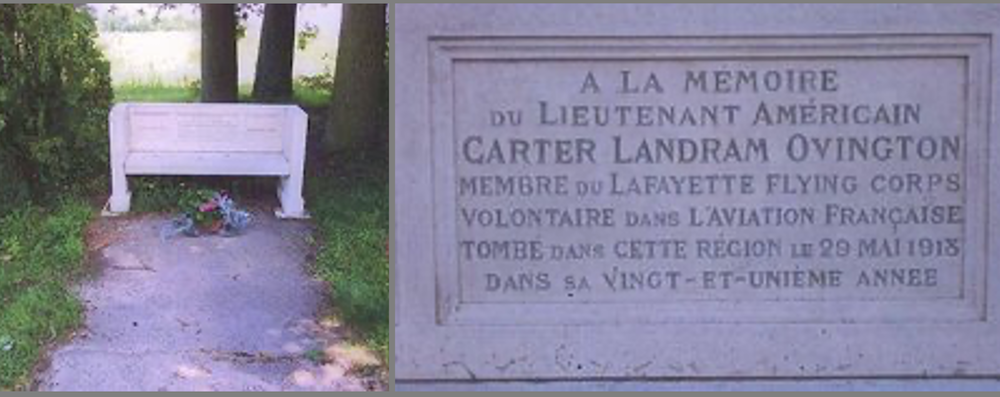
Please scroll down to Part Two of our Bulletin to honor this month another brave American volunteer who "Died for France " in World War One: First Lieutenant Carter Landrum Ovington who was killed in action on May 29, 1918 near Lagery, in the Marne département in Eastern France.
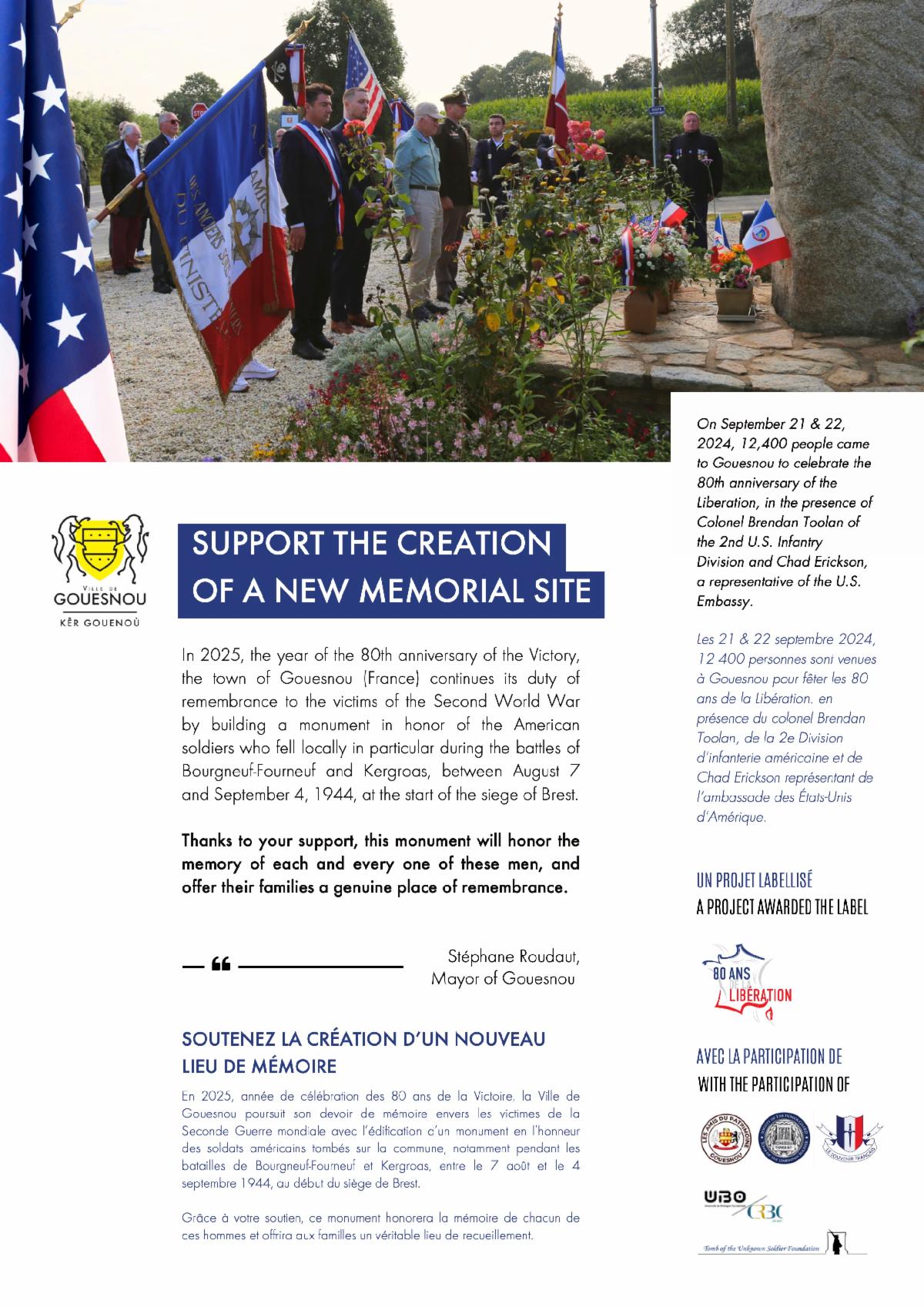
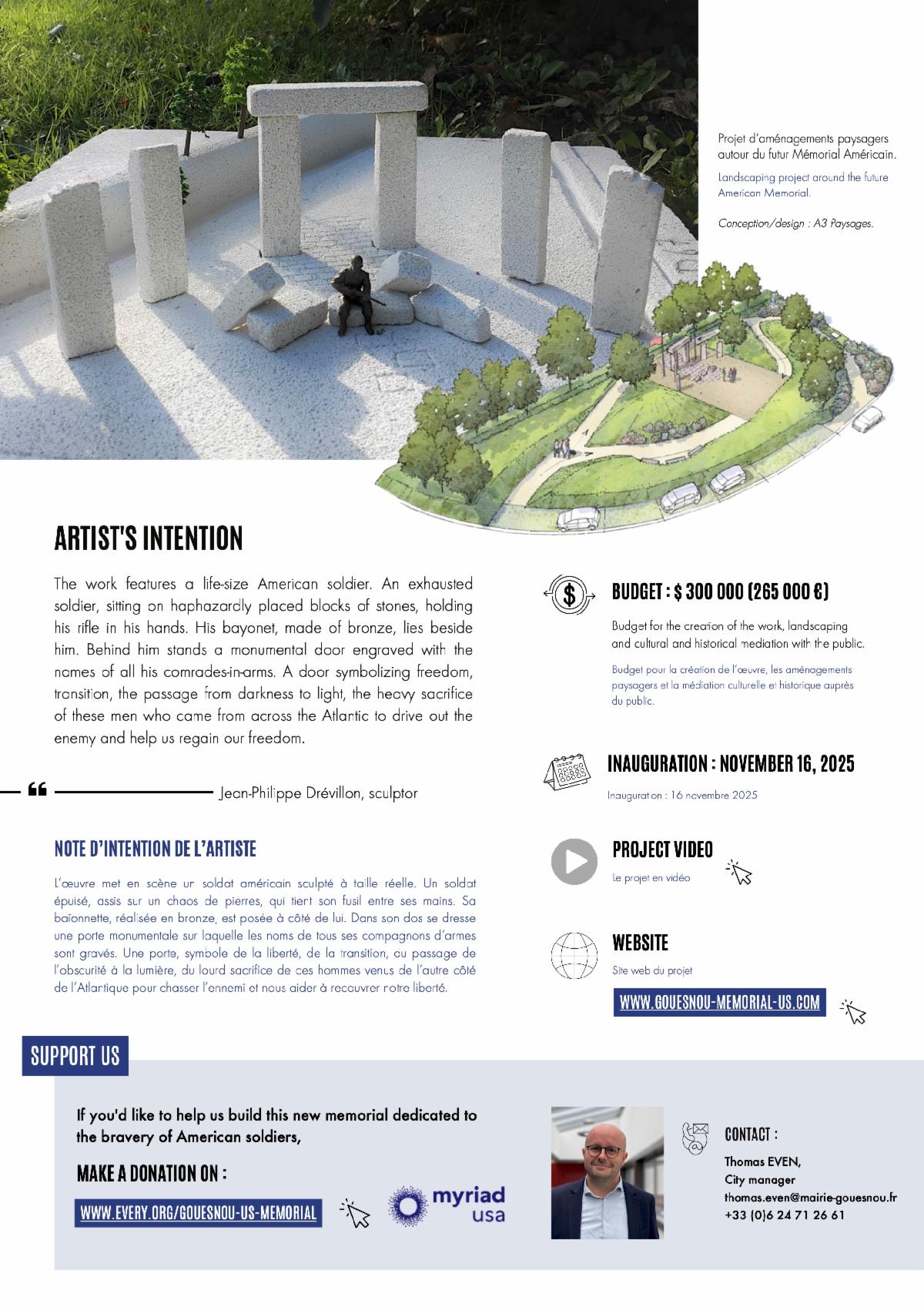
Part Three, "News and Save the Dates" will cover events since our last Bulletin. We will also share the latest news from other civic and patriotic associations, as well as our own updates on several important projects your Society has been actively pursuing. One event which will be held in November is of particular importance: the inauguration of the memorial in Gouesnou, Brittany, listing the names of the 229 U.S. Army G.I.'s who died for the liberation of Brest in August and September 1944. Our Society reached out to our partners and friends at the Tomb of the Unknown Soldier Foundation, namely Richard Azzaro and J.R. Neubeiser, respectively co-Founder and historian, to make sure that all the names of these valiant G.I.'s were carefully vetted and no one would be left behind.
We thank you for sharing our Bulletins and activities with friends and acquaintances, and for encouraging them to join us or support one of our worthy causes - - all furthering the long historical ties of friendship and alliance between the United States and France.
On behalf of the Board of Directors,
Thierry Chaunu
President, The American Society of Le Souvenir Français, Inc.
| | |
Part One:
Alsatian legacy in the United States
| | |
Foreword by Francis Dubois
We are grateful to the American Society of Le Souvenir Français, and especially to its President Thierry Chaunu for this special edition dedicated to Alsace.
The relationship between Alsace and the United States is a very important one.
Let us remember Miss Liberty, this wonderful Alsatian lady, who has welcomed millions of
immigrants, arriving in this land of opportunities in the harbor of New York.
Let us not to forget that the very name of America was put together at the beginning of the sixteenth century by two scholars, one being Matthias Ringmann, a true Alsatian from a small village, Eichhoffen.
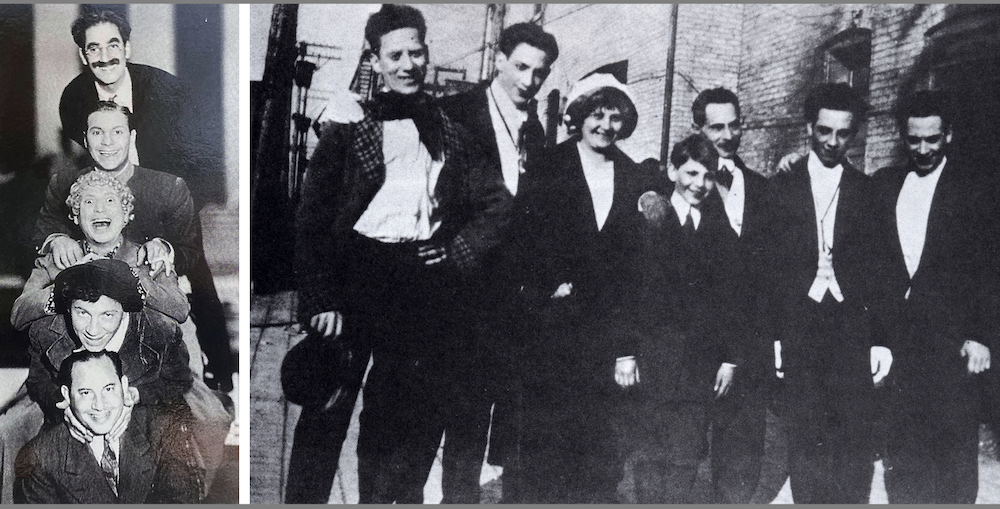
And through the years, the contribution of Alsatians in the New World has been extraordinary : the Marx Brothers, William Wyler in the movie industry, Jean-Georges or Gabriel Kreuther in the restaurant business to name a few. Their role at the United Nations from its inception has been crucial.
The Union Alsacienne of New York is one of the eldest francophone Club in the city: for 155 years, their mission to promote Alsatian identity is very much alive, and this in harmony and friendship. Our Society's Honorary President, Françoise Cestac, former United Nations Assistant Secretary-General for Conference Services, (in charge of the 6 official languages), is a long-time active member and Vice President of the Union Alsacienne.
To be an Alsatian in New York is like being a true Alsatian everywhere: open to the world!
Francis Dubois
Board Member
Former Deputy Coordinator of the UN Secretary General, Palestinian Territories, and Head of the UN Office (with the rank of Ambassador) in Irak, in Algeria and in Tunisia.
| | |
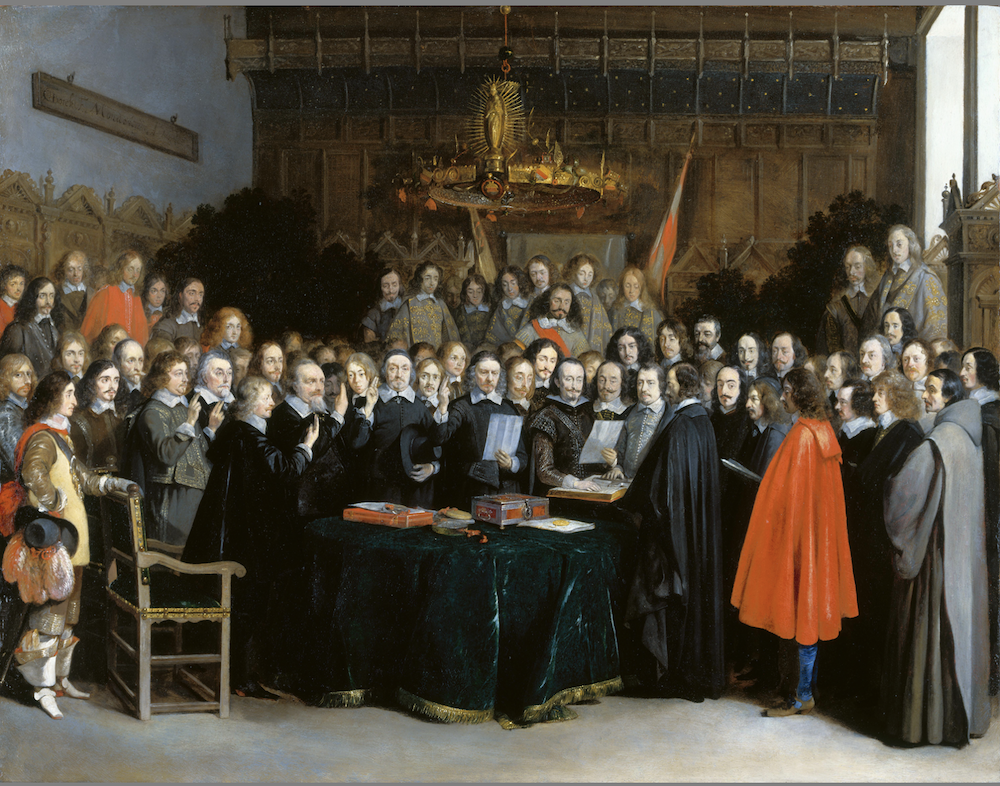
Alsace became part of France gradually over the 17th century, primarily through the Peace of Westphalia in 1648 and subsequent annexations.
The Key Stages:
• Before 1648: Alsace was part of the Holy Roman Empire, consisting of a patchwork of independent cities, bishoprics, and territories ruled by various German princes and nobles.
• Peace of Westphalia (1648): At the end of the Thirty Years' War, France acquired most of Alsace, including the Habsburg territories in the region. However, this didn't include everything - ten imperial cities (the Décapole) retained some autonomy, and Strasbourg remained independent.
• Strasbourg (1681): Louis XIV annexed the important city of Strasbourg in 1681, bringing the region's largest city under French control.
• Treaty of Ryswick (1697): This formalized French control over additional territories.
Alsace's integration into France was a gradual process spanning roughly 1648-1697, with 1648 marking the beginning of French sovereignty over most of the region.
This long history as part of France (over 220 years by 1870) explains why the majority of Alsatians identified themselves as French, despite their German dialect.
| | |
• Alsatians immigrated to the United States in the 18th Century. In fact, many Amish came from Alsace, as we will see further below.
• The Alsatian immigration to the United States started in earnest in the first half of the 19th century, after the Napoleonic wars. It was primarily an economic migration.
• In Alsace, the population increased quickly, going from 800,000 in 1814 to 914,000 in 1830 and reaching 1,067,000 in 1846. Economic and demographic issues caused hunger, a shortage of housing, and limited job opportunities for young people.
• Many Alsatians moved to large cities like Paris or abroad, such as Austria, Crimea, the Volga river Valley... Others started to travel to the United States, settling in various regions between 1820 and 1850. In 1843 and 1844, ships carrying immigrant families from Alsace docked at New York's port, such as the ships Sully (in May 1843) and Iowa (in June 1844) which brought entire families.
• After 1850, Alsatian immigration continued steadily, driven by ongoing economic pressures and the allure of cheap land in the American Midwest.
Alsatian immigrants established communities in New York and Pennsylvania (early destinations), the Midwest: Ohio, Illinois, Iowa, Wisconsin, and Missouri. Some notable Alsatian settlements included areas around St. Louis and rural farming communities in Iowa and Illinois. Others moved to Canada, settling in southwestern Ontario.
As we will see, many Alsatian immigrants played significant roles in the economic growth of 19th-century America.
The Franco-Prussian War's Role:
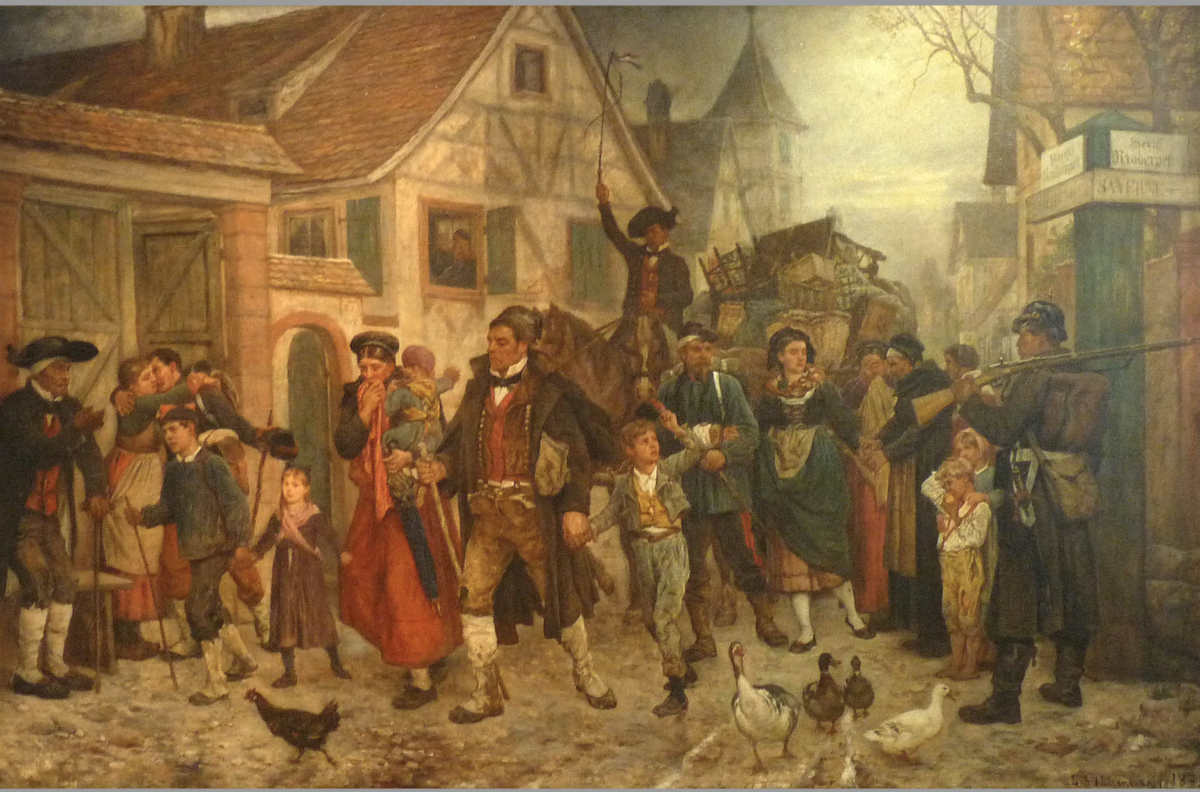
When the Franco-Prussian War occurred in 1870-71, it added a political dimension to what was already an established migration stream. The annexation by Germany gave people additional reasons (political/cultural oppression, military conscription) to join an emigration movement that was already well underway for economic reasons.
As we will see, many markers refer to them as "German", when in fact they were born in France, or, less often, from "Alsace-Lorraine", when in fact they were born precisely in Alsace.
| | |
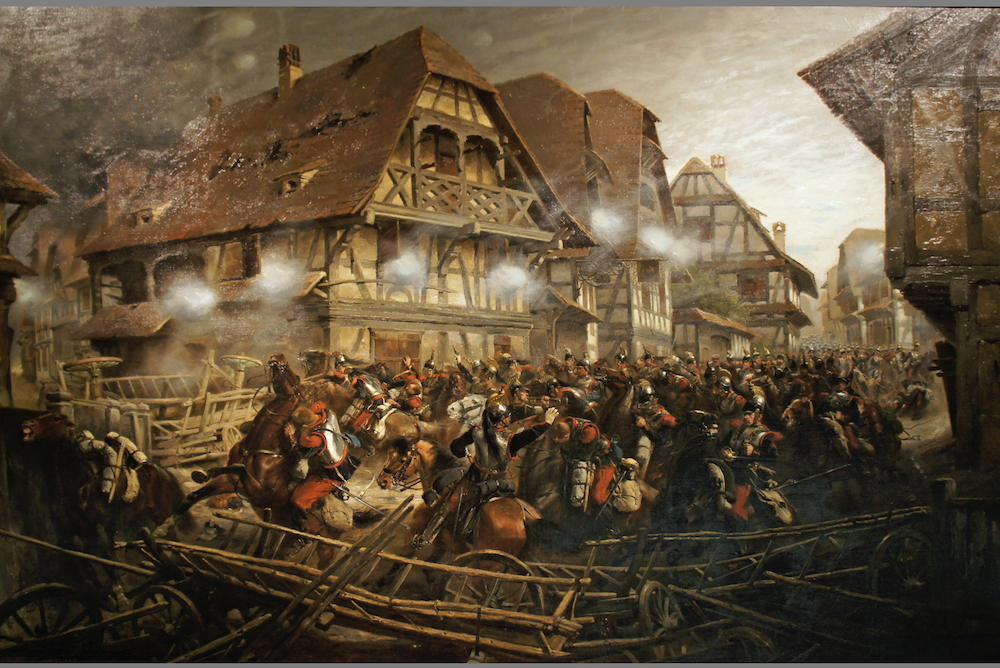
Above:
Charge of the 9th Cuirassier Regiment at Morsbronn-les-Bains (Alsace) on August 6. By Édouard Detaille — Own work; Garitan, Public domain, https://commons.wikimedia.org/w/index.php?curid=19261774
Morsbronn is famous in history for the famous cavalry charge ofAug 6, 1870, known, incorrectly, as the Reichshoffen charge. It was in this village that the survivors of the 9th French Cuirassier Regiment were wiped out by gunfire from the houses where the Prussians had entrenched themselves.
| | |
The Franco-Prussian War of 1870-71 had a significant impact on Alsatian immigration to the United States, though the full story is somewhat complex.
Immediate Impact of the War.
When Prussia defeated France in 1871, Alsace (along with part of Lorraine) was annexed by the newly unified German Empire. This created a major upheaval for the region's population. Alsatians, who had been French citizens with a distinct regional identity, suddenly found themselves under German rule. The German government imposed Germanization policies - requiring German language in schools and administration, and eventually instituting military conscription.
The Immigration Response
The annexation triggered several waves of migration:
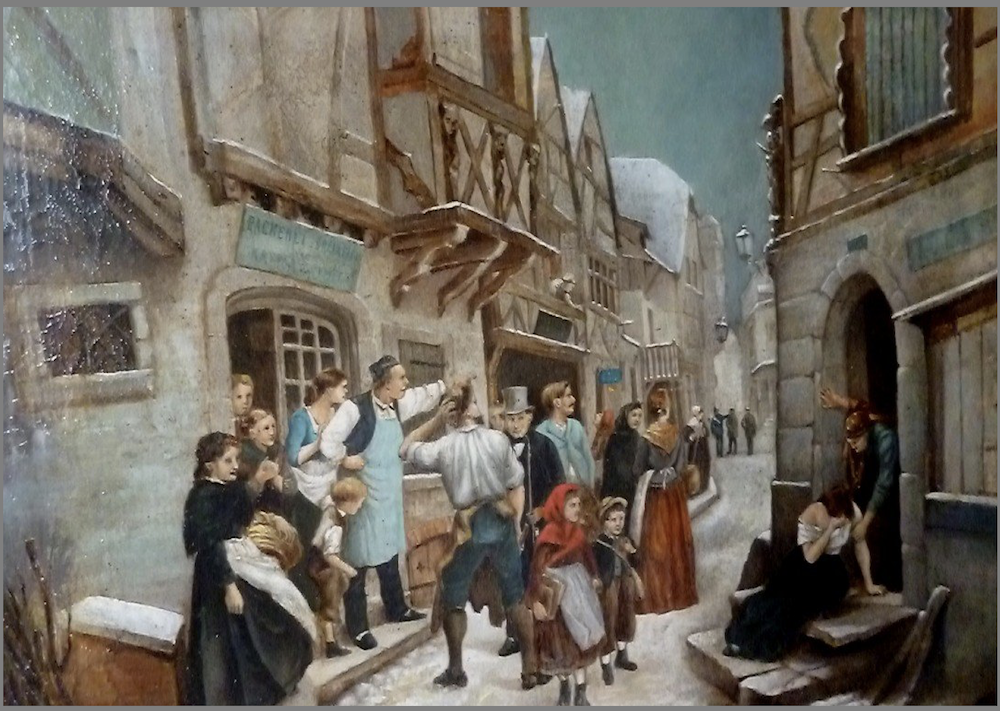
• Initial departure (1871-1872): France allowed Alsatians to retain French citizenship if they emigrated within a specific timeframe. Many chose to leave for France itself, but others, particularly those seeking economic opportunity or wishing to avoid German military service, emigrated overseas to the United States.
• Continuing emigration: Throughout the 1870s-1890s, Alsatians continued leaving, particularly young men facing conscription into the German army. The cultural suppression and economic disruptions made emigration attractive.
Many who wanted to remain French left for French North Africa, where they played a significant role in the development of the region. In America, Alsatian immigrants settled particularly in areas with existing German-speaking or French communities - places like New York, Pennsylvania, and increasingly the Midwest (Illinois, Wisconsin, Iowa). Their unique position as French-identified but German-speaking people gave them flexibility in where they settled.
The war essentially created a "push factor" that accelerated Alsatian emigration that had already been occurring for economic reasons, adding political and cultural motivations to leave their homeland.
We will therefore follow their footsteps—and deeds—throughout many states, by visiting several monuments and plaques in their honor.
We will start in New York, and arguably, with the most famous Alsatian in America - - and most famous Alsatian lady in the world.
| | |
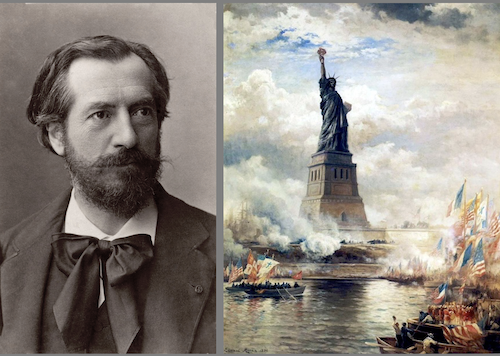
Frédéric Auguste Bartholdi
Sculptor, 1834-1904
| | |
• Frédéric Auguste Bartholdi (August 2, 1834 – October 4, 1904) was born in Colmar, France. He was born to a family of Alsatian Protestant heritage, with his family name romanticized from Barthold.
• He served in the Franco-Prussian War of 1870 as a squadron leader of the Garde Nationale. He constructed several monuments celebrating French heroism in the defense against Prussia.
• In 1871, he made his first trip to the United States, where he pitched the idea of a massive statue gifted from the French to the Americans in honor of the centennial of American independence. The idea, which had first been broached to him in 1865 by his friend Édouard René de Laboulaye, resulted in the Statue of Liberty.
Sculpture and Marker, “Frederic Auguste Bartholdi (1834 – 1904)”
Liberty Island, New York, NY 10004
GPS: 40.689864, -74.044730
• Inscription:
“A French sculptor and friend of De Laboulaye,
he created the Statue of “Liberty Enlightening the World” and selected its site.
Inspired by his first view of New York Harbor, Bartholdi later wrote:
“The Statue was born for this place which inspired its conception”.
• While the Statue of Liberty is his world-famous masterpiece, few know that he did other sculptures in New York City:
| | |
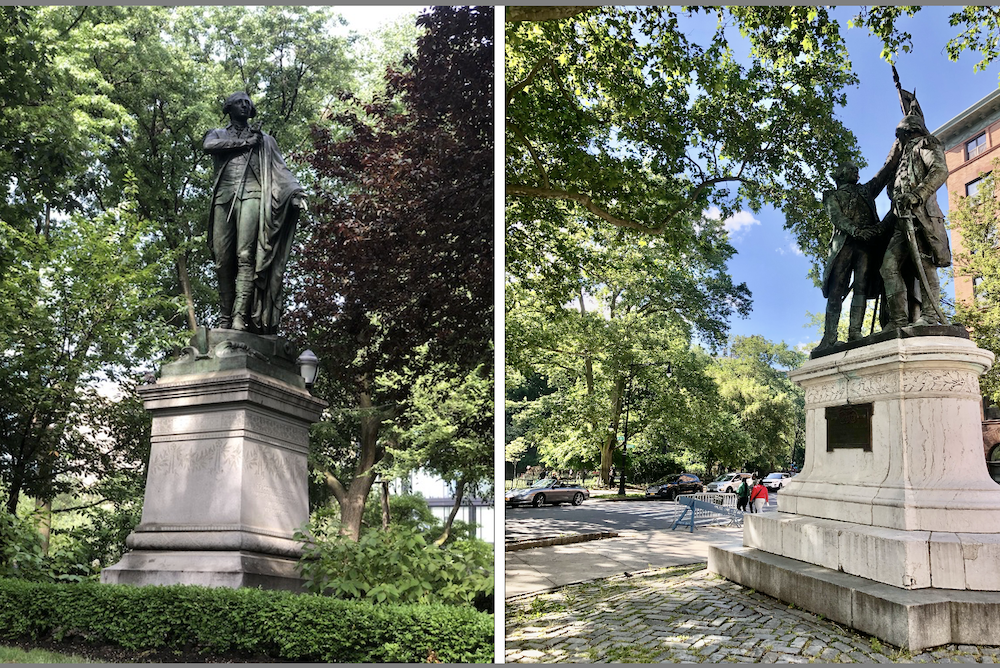
Above:
Left: Statue of Lafayette, Union Square, Manhattan
Right: Statue of Lafayette & Washington, Morningside Avenue, Manhattan
Photos: Thierry Chaunu © ASSFI 2021
| | |
There are not one, but two statues representing Lafayette, all sculpted by Barthodi, in New York City!
• The bronze sculpture at Union Square is the oldest one honoring the Marquis de Lafayette. Cast in 1873 and dedicated on September 6, 1876, it is a gift from the French government and French residents of New York for the aid New York provided to Paris during the Franco-Prussian War (1870-1) -- thus the inscription “in remembrance of sympathy in times of trial.”
• The larger-than-life-sized figure was sculpted by Frédéric-Auguste Bartholdi. The granite pedestal designed by H.W. DeStuckle was donated by French citizens living in New York.
•The statue rests on a Quincy granite pedestal. In 1991, it was conserved by the Municipal Art Society and the New York City Art Commission's joint Adopt-A-Monument Program.
Statue of Lafayette, Union Square
Union Square, New York, NY 10003
GPS: 40.735680, -73.989970
• Inscriptions:
North Side:
"As Soon As I Heard of / American Independence,
My Heart Was Enlisted" / 1776
South Side:
“To The City of New York, / France,
In Remembrance of Sympathy / In Times of Trial / 1870-71”
• Lafayette Square is located in the Morningside Heights section of Manhattan. The City of New York acquired this property by condemnation on July 28, 1870 along with the land used to build Morningside Park.
• The square contains large, shady sycamore trees and a monument entitled “Lafayette and Washington.”
• Frederic-Auguste Bartholdi designed the bronze statue, which depicts both figures on a marble pedestal, clothed in colonial uniforms, and shaking hands with the flags of their respective countries behind them. Famed publisher, Joseph Pulitzer (1847-1911) commissioned the sculpture based on the artist’s previous major accomplishment: the Statue of Liberty in the New York Harbor. Bartholdi completed the original “Lafayette and Washington,” which was installed and dedicated in the Place des États-Unis in Paris in 1895.
• On April 19, 1900, department store owner Charles Broadway Rouss bequeathed this fine replica to the residents of Morningside Heights.
Statue of Lafayette & Washington
Lafayette Square, New York City
Manhattan Avenue, 114th Street, and Morningside Avenue, New York City
GPS: 40.803740, -73.958048
• Inscription:
“Presented to the City of New York
by Charles B Rouss
April Nineteenth – Nineteen Hundred
Erected 1900.”
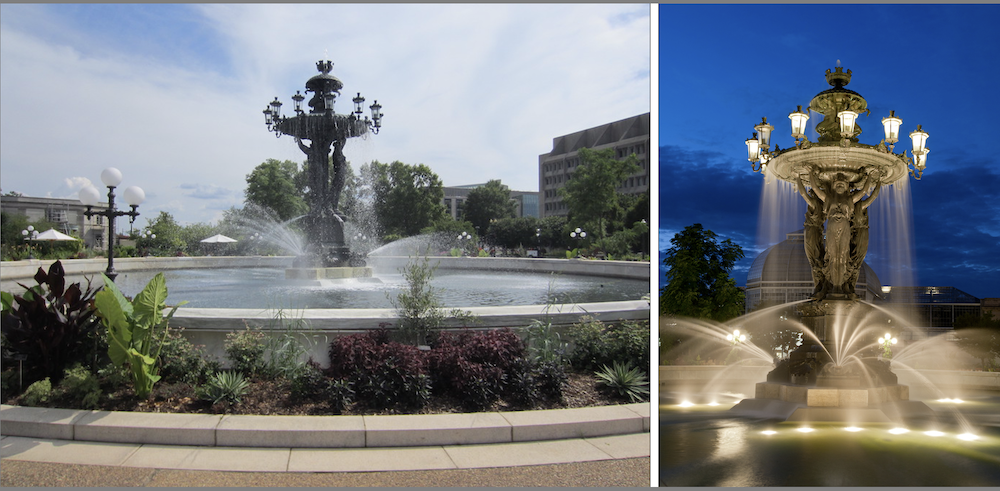
• Even fewer people know that he created a fountain gracing the grounds of the U.S. Capitol in Washington, D.C.:
The Bartholdi Fountain
| | |
• The Bartholdi Fountain is a monumental public fountain, designed by Frédéric Auguste Bartholdi, who later created the Statue of Liberty. The fountain was originally made for the 1876 Centennial Exposition in Philadelphia, Pennsylvania, to celebrate the 100th Anniversary of the United States.
• At the end of the Exposition, there was no buyer, but the US Congress offered $6,000, half the original asking price, and placed it at the base of Capitol Hill. It one of the first monuments in Washington, D.C. to be lit at night, and therefore a popular evening destination in the 1880s. • It was removed in 1926 and relocated in 1932 to its present location in the Bartholdi Park section of the Botanical Gardens in US Congress grounds. It has been entirely renovated in 2008.
Marker, “The Bartholdi Fountain”
Bartholdi Park, 245 First St SW, Washington, DC 20024
GPS: 38.887200, -77.012467
• Inscription (excerpts):
“The Fountain of Light and Water was designed by Frédéric Auguste Bartholdi for the 1876 Centennial Exposition in Philadelphia, PA. The namesake of Bartholdi Park is best known for designing the Statue of Liberty (Liberty Enlightening the World) installed on Liberty Island in New York, NY. The U.S. Congress purchased the cast-iron fountain in 1877 and placed it with the original U.S. Botanic Garden where the Capitol Reflecting Pool is located today. It was moved to its present site in 1932. The original gas lamps were converted to electricity in 1881, making the fountain a major attraction. The design features turtle-like aquatic beasts and large shells around the base, three sea nymphs and fish on the pedestal, and three youthful Tritons holding seaweed just under the top crown. The fountain stands 30 feet (9m) tall and weighs more than 15 tons (13,600 kg).”
Erected by United States Botanic Garden.”
Note: While in Alsace, visit the Bartholdi Museum in Colmar:
https://www.visit.alsace/en/235016023-bartholdi-museum/
| | |
Other Alsatian Immigrants in New York
George Zent and Prosper Peuquet,
Brewers
| | |
• George Zent was born in Wingen, Alsace (Dept. du Bas-Rhin). His family moved to the US in 1854 and made their home in Getzville.
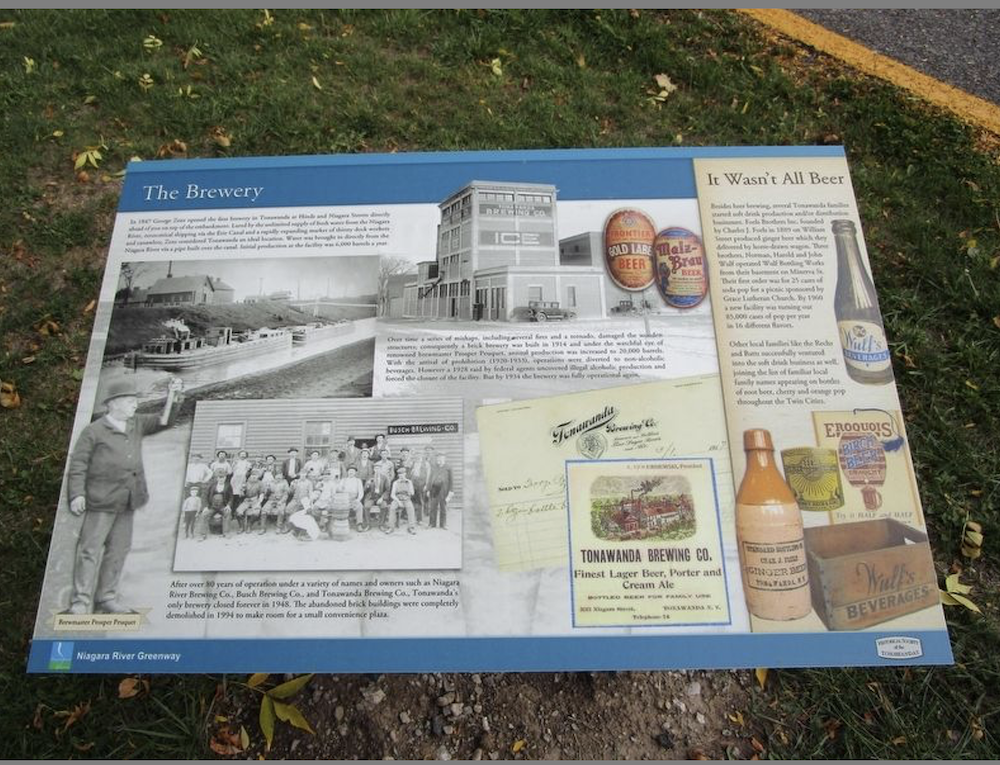
• Prosper Peuquet (1844-1906) was born in Belfort*, Alsace, France. At 12 years old, he moved to America with his family. After his father's death, his mother remarried, and he went to live with the George Zent family. George Zent ran a brewery on Main Street close to Ellicott Creek in Williamsville, N.Y. during the 1860s. In 1867, George Zent relocated with his family and Prosper Peuquet to the city of Tonawanda. Prosper Peuquet learned the brewing craft from George Zent and became the longest-serving brew master at the brewery in Tonawanda.
Marker, “The Brewery”
Riverwalk, along Niagara Street, Tonawanda NY 14150
GPS: 43.013883, -78.898733
• Inscription (excerpts):
“In 1847 George Zent opened the first Brewery in Tonawanda at Hinds and Niagara Streets directly ahead of you on top of the embankment. Lured by the unlimited supply of fresh water from from the Niagara River, economical shipping via the Erie Canal and a rapidly expanding market of thirsty dock workers and canalers, Zent considered Tonawanda an ideal location. Water was brought in directly from the Niagara River via a pipe built over the canal. Initial production at the facility was 6,000 barrels a year. [...] ... a brick brewery was built in 1914 and under the watchful eye of renowned brewmaster Prosper Peuquet (1920-1933), operations were diverted to non-alcoholic production and forced the closure of the facility. But by 1934 the brewery was fully operational again. [...]
Erected by Historical Society of the Tonawandas.”
Note: * Belfort was originally part of Alsace, but after the Franco-Prussian War (1870-71), when Germany annexed most of Alsace and part of Lorraine, Belfort remained French. This created the separate Territoire de Belfort department, which has remained distinct ever since—even after Alsace was returned to France following World War I.
"The French Settlement"
| | |
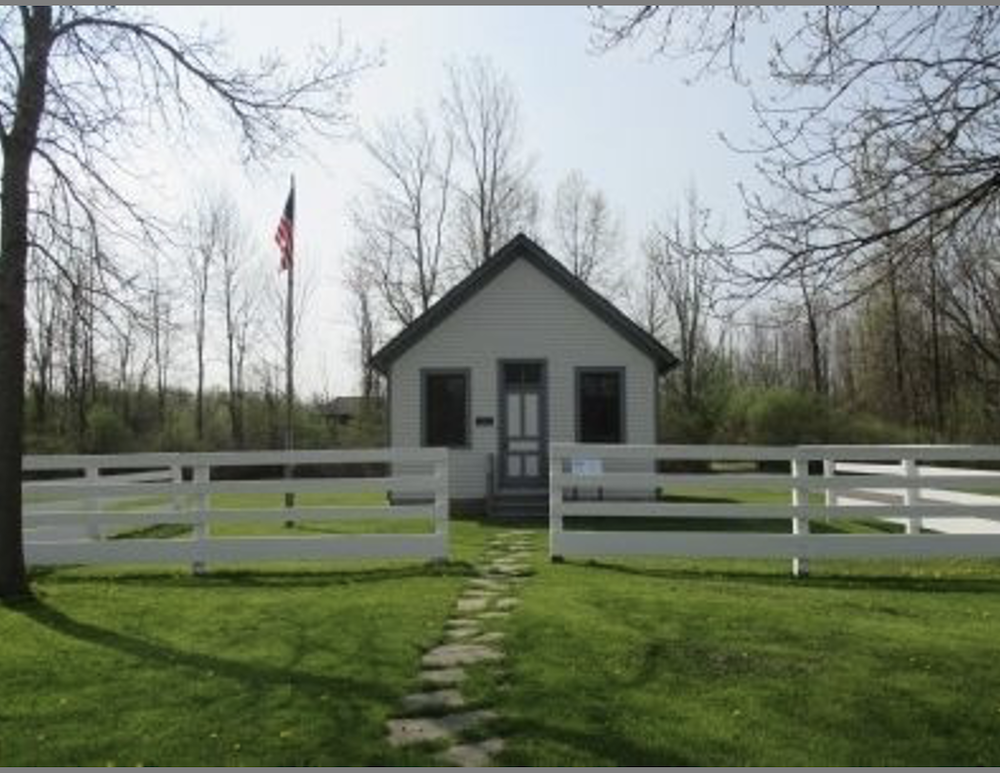
Marker, “Sweet Home Common School No.15 - c.1847”
Buffalo Niagara Historical Village, 3755 Tonawanda Creek Road, Buffalo NY 14228
GPS: 43.082017, -78.729733
• Inscription:
“Sweet Home Common School #15 was originally located on the east side of Sweet Home Road, south of Tonawanda Creek Road, 1/4 mile from the Erie Barge Canal. German-speaking families, who had emigrated from the Alsace-Lorraine region on the border of Germany and France, populated this area of northwest Amherst known as the "French Settlement." These settlers traveled the Erie Canal to their new homes in rural Amherst, where farmland was plentiful” [...] The Sweet Home School was built in 1847 and used as a one-room school for grades 1-8 until 1948. [...] As with any immigrant community, construction of a school was a top priority. [...]
Erected by Buffalo Niagara Heritage Village; marker sponsor: Amherst Women's Interclub Council.”
| | |
Alsatians in Pennsylvania
Jacob Hochstetler, Amish pioneer
| | |
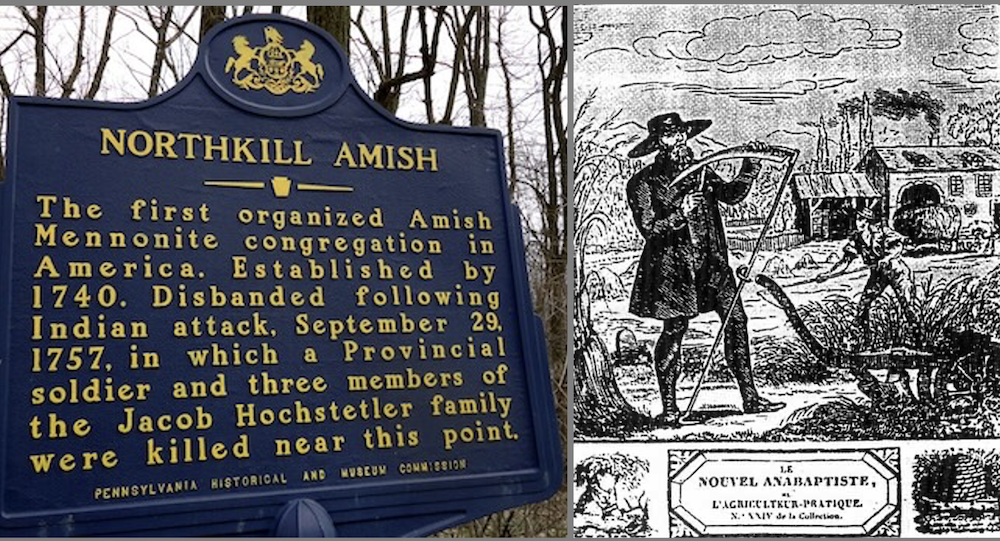
• Jakob Ammann, who started the Amish community, was born in 1644 in the Bern canton of Switzerland. Due to persecution, he relocated to Heidolsheim, Alsace by 1693, where his father passed away and was laid to rest in the nearby village of Baldenheim. Shortly after his father's death, Ammann moved to the head of the valley at La Petite Lièpvre (Klein Leberau), close to Markirch (now known as Sainte-Marie-aux-Mines), Alsace. He stayed there until October 1712, when an edict from Louis XIV expelled all Anabaptists from the region. After this time, there are no further records of Jakob Ammann. It is likely that he went to live with friends or family in Lower Alsace. Many Amish people originated from Alsace and later immigrated to America.
• This marker remembers Jacob Hochstetler and his family. Jacob and his wife Anna were born in Alsace in 1712 1710 respectively, possibly at or near St. Marie-aux-Mines (Research continues). They immigrated to America on 9 November 1738, on the ship Charming Nancy, with their eldest daughter.
https://www.findagrave.com/memorial/38361359/jacob-hochstetler
Marker, “Northkill Amish”
Hex Highway/Old Route 22, Bernville PA 19506
GPS: 40.511933, -76.120033
• Inscription:
“The first organized Amish Mennonite congregation in America. Established by 1740. Disbanded following Indian attack, September 29, 1757, in which a Provincial soldier and three members of the Jacob Hochstetler family were killed near this point.
Erected 1959 by Pennsylvania Historical and Museum Commission."
Albert Weis, merchant
| | |
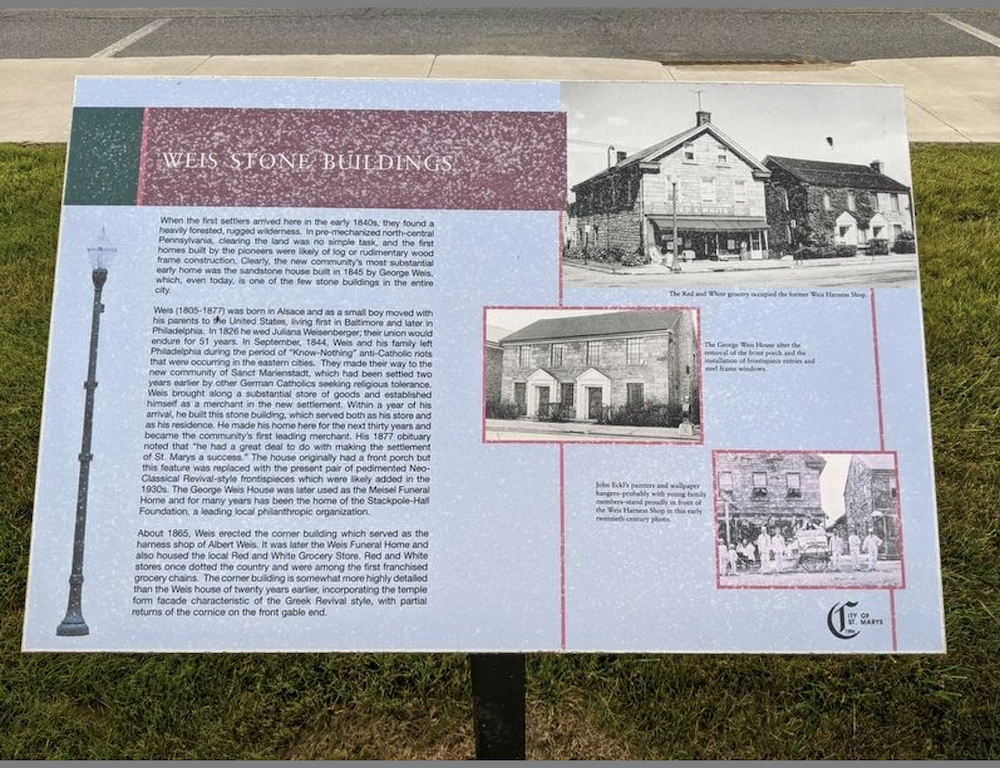
Marker, “Weis Building”
40 S St Marys St, Saint Marys PA 15857
GPS: 41.426633, -78.561217
• Inscription (excerpts):
“When the first settlers arrived here in the early 1840s, they found a heavily forested, rugged wilderness. In pre-mechanized north-central Pennsylvania, clearing the land was no simple task, and the first homes built by the pioneers were likely of log or rudimentary wood frame construction. Clearly, the community's most substantial home was the sandstone built in 1845 by George Weis, which, even today, is one the few stone buildings in the entire city. Weis (1805-1877) was born in Alsace and as a small boy moved with his parents to the United States, living first in Baltimore and later in Philadelphia. In 1826 he wed Juliana Weisenberger; their union would endure for 51 years. In September 1844, Weis and his family left Philadelphia during the "Know-Nothing" anti-Catholic riots that were occurring in the eastern cities. They made their way to the new community of Sanct Marienstadt, which had been settled two years earlier by other German Catholics seeking religious tolerance. Weis brought along a substantial store of goods and established himself as a merchant in the new settlement. Within a year of his arrival, he built this stone building, which served as both his store and his residence. He made his home here for the next thirty years and became the community's first leading merchant. His 1877 obituary noted that "he had a great deal to do with making the settlement of St. Marys a success”. [...] About 1865, Weis erected the corner building which served as the harness shop of Albert Weis. It was later the Weis Funeral Home and also housed the local Red and White Grocery Store. Red and White stores once dotted the country and were among the first franchised grocery chains. The corner building is somewhat more highly detailed than the Weis house of twenty years earlier, incorporating the temple form facade characteristic of the Greek Revival style, with partial returns of the cornice on the front gable end.
Erected by The City of St. Marys.”
Christian Dorflinger, glass maker
Eugene Dorflinger, Sr., merchant
Eugene Dorflinger, Jr., photographer
| | |
Marker, “When Christian Dorflinger Melded His Art with History......Glassblowing Became the Heart and Soul of White Mills - The White Mills Community Trail - ”
Main Street (US 6) White Mills PA 18473
GPS: 41.526067, -75.202883
• Inscription (excerpts):
“Christian Dorflinger was born in 1828 in the village of Rosteig* in the Alsace-Lorraine region of France. At the age of ten he apprenticed to an uncle to learn the art of glassmaking at the Cristalleries de Saint Louis. At eighteen, he finished his apprenticeship and came to the United States, first working in a glass factory in Camden, New Jersey. He opened a glass factory in Brooklyn, New York, in 1852, making kerosene lamp chimneys. In the same year, he married Elizabeth Hagen with whom he had ten children. Within ten years he had opened two more glass factories, including the Greenpoint Flint Glass Works. According to the family history, the strain of operating these factories was too much. He bought a farmhouse in the small village of White Mills in 1862. By the mid-1860s Dorflinger built a glass factory here where he concentrated on making the finest lead crystal for glass cutting. The company operated until it closed in 1921. Christian Dorflinger died in 1915.
Erected by Dorflinger-Suydam Wildlife Sanctuary, Lackawanna Heritage Valley, DCNR, Lackawanna Wonderful, and National Park Service.”
• Inscription (excerpts):
“Eugene A. Dorflinger Sr., Christian Dorflinger’s cousin who had also emigrated from Alsace, established a general store in White Mills in 1869. The family home was behind the store on Charles Street across from the St. Charles Hotel. Eugene’s property also included a carriage barn and a small gazebo. When the Erie Railway came to White Mills, Eugene Sr. served as the station agent until 1901 when he was killed in a rail accident.
Eugene Jr. became an amateur photographer and built a small photography studio near the house. Many of his original glass negatives still survive and document much of life in White Mills at the turn of the nineteenth to the twentieth century. In 1915 Eugene became head of the Dorflinger factory’s etching department. The Eugene A. Dorflinger property was added to the National Register of Historic Places in 1978.” [...]
Erected by Dorflinger-Suydam Wildlife Sanctuary, Lackawanna Heritage Valley, DCNR, Lackawanna Wonderful, and National Park Service."
Note: * Rosteig is actually in Alsace (Département du Bas-Rhin)
| | |
Alsatians in Tennessee
John Hagey, Patriot
| | |
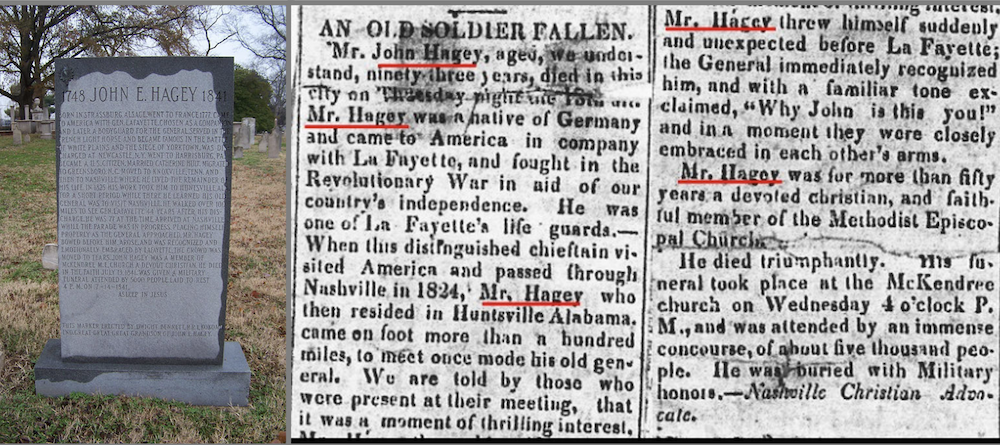
• There are doubts as to the veracity of all the claims on the tombstone, that he was at the service of Lafayette. His name is variously spelled Hague, and his wife Hault.
Tombstone, “John E. Hagey 1748-1841“
Nashville City Cemetery, 1001 4th Ave S, Nashville, TN 37203
GPS: 36.147083, -86.770517
• Inscription:
“Born in Strassburg, Alsace. Went to France 1777*. Came to America with Gen. Lafayette. Chosen as a companion and later a bodyguard for the General. Served in the French Light Horse and became famous in the Battle of White Plains and the Siege of Yorktown. Was discharged at Newcastle, N.Y. Went to Harrisburg, PA. Became a U.S. citizen. Married Catherine Hult. Migrated to Greensboro, N.C. Moved to Knoxville, Tenn. and then to Nashville where he lived the remainder of his life. In 1825, his work took him to Huntsville, Ala. for a short period. While there he learned his old general was to visit Nashville. He walked over 100 miles to see Gen. Lafayette 44 years after his discharge. He was 77 at the time. Arrived at Nashville while the parade was in progress. Placing himself properly as the general approached, Mr. Hagey bowed before him, arose, and was recognized and emotionally embraced by Lafayette. The crowd was moved to tears. John Hagey was a member of McKendree M.E. Church. A devout Christian, he died in the faith July 13, 1841. Was given a military funeral attended by 5,000 people. Laid to rest 4 p.m. on 7-14-1841. Asleep in Jesus”
Erected by Dwight Bennett, R.R. 1, Great-Great-Great-Grandson of John E. Hagey.”
Note: *Strasbourg had been part of France since 1681.
| | |
Alsatians in Georgia
Francois Joseph Springer, theater owner
| | |
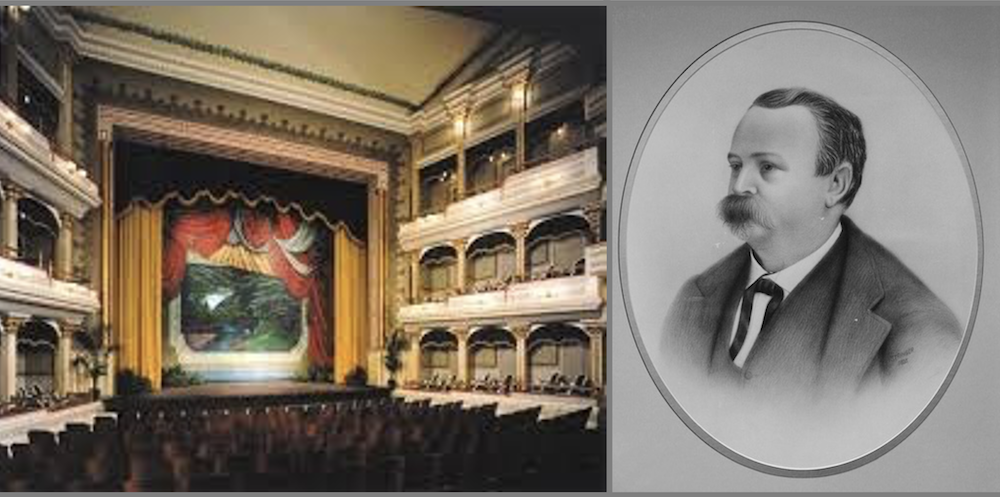
• In May 1870, Francois Joseph Springer (March 7, 1834 – November 17, 1882), a successful businessman from Marlenheim, (Département du Bas-rhin, Alsace), decided to construct a new theater where his grocery store was located. Springer had a passion for theatre, music, and dance, and he envisioned a European-style theater in Columbus. He became the largest shareholder of the Public Hall Association and increased his ownership by buying out the other stockholders until he owned the entire facility.
• The building was listed on the National Register of Historic Places in 1970 and was designated a National Historic Landmark in 1978.
Marker, “Springer Opera House”
103 10th Street, Columbus GA 31901
GPS:32.464867, -84.991517
• Inscription (excerpts):
“Theater in Columbus found its finest home on February 27, 1871, when Francis Joseph Springer, originally of Alsace, opened his opera house. The Springer’s forty-foot deep stage held a continuous round of shows of every description. Here Edwin Booth played Hamlet, February 15, 1876, on his first Southern tour after the War. “Blind Tom” Bethune, the Negro musical prodigy born near Columbus, performed here often. Oscar Wilde and Williams Jennings Bryan lectured here; John L. Sullivan, the world champion gave a boxing exhibition, and Mrs. John Drew, grandmother of the Barrymores, starred in She Stoops to Conquer. Here, in 1928, Franklin Delano Roosevelt delivered a “Happy Warrior” speech in behalf of presidential nominee, Al Smith. In 1902 the Springer sons completely renovated their opera house. From that time until it became a movie house in 1941, the Springer continued to be the city’s cultural center…. Erected 1966 by Georgia Historical Commission. (Marker Number 106-31.)”
Simon Schwob, textile magnate
| | |
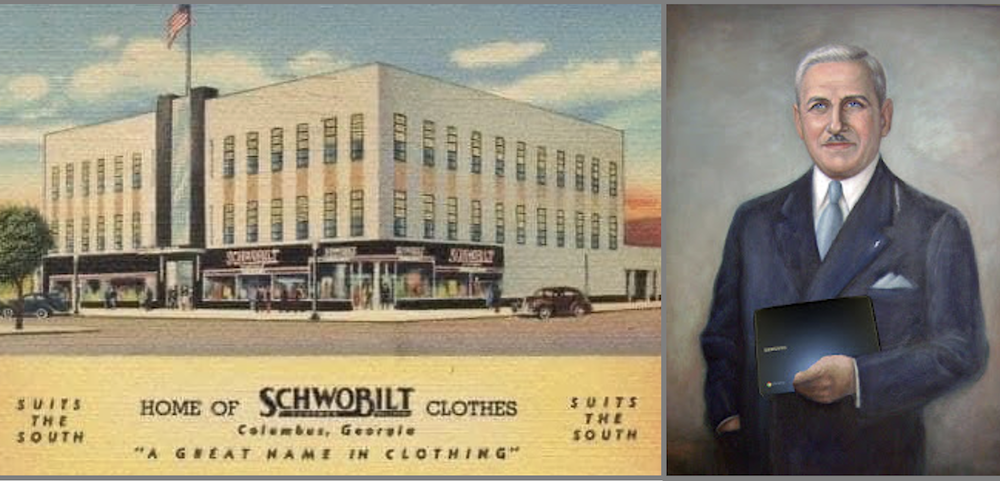
• Simon Schwob (born in Hattstatt, Département du Haut-Rhin, Alsace on October 25, 1886, - died August 8, 1954, Columbus, GA.) was a tailor who became the leading industrialist and philanthropist in Columbus.
• He utilized his tailoring skills to grow the Standard Tailoring Company in downtown Columbus in 1912, initially selling ready-made suits but soon incorporating his own designs.
• This venture evolved into Schwobilt in the 1940s, which manufactured high-quality clothing until 1976, becoming one of the largest clothing producers and retailers in the South.
• Reflecting his interests, the Simon Schwob Foundation was founded in 1949. • Upon his passing in 1954, he bequeathed $50,000 to support the creation of Columbus College, which became Columbus State University in 1958. The Library was inaugurated in the fall of 1959 and was renamed the Simon Schwob Memorial Library in 1973. His descendants Joyce & Henry Schwob help found in 1974 the Schwob School of Music at CSU.
Simon Schwob is buried at Riverdale Cemetery, Columbus, GA, Jewish Plot 2.
Marker “Garrett and Sons”
11 9th Street, Columbus GA 31901
GPS: 32.462983, -84.994050
• Inscription (excerpts):
“[...] Many businesses occupied this building between 1900 and 1934 when Simon Schwob, a tailor from Alsace-Lorraine, opened Schwob Manufacturing Company. With the “factory to consumer” approach, it became the largest manufacturer and retailer of menswear in the South. In 1978, Schwob Manufacturing became Joy Fashions and operated here until 1988.
Erected 2002 by Historic Chattahoochee Commission; the Stone Tree Group, LLC; and the Historic Columbus Foundation, Inc.”
| | |
Alsatians in Ohio
Christian Augspurger Sr., Amish leader
| | |
Above:
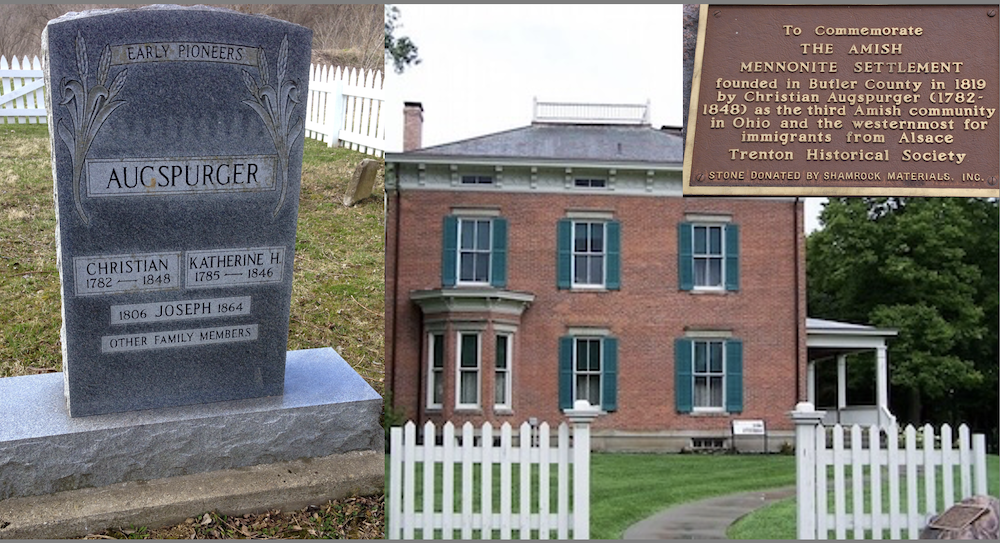
Left: gravesite of Christian Augspurger Sr., Augspurger Family Cemetery, ("… on the farm owned for many years by Samuel Augspurger, near Woodsdale, and contains only about fifteen graves. Here rest the remains of Christian Augspurger, the pioneer, and his wife..." Published: "Mennonites of Butler County, Ohio" by Rev. W. H. Grubb, 1916)
https://www.findagrave.com/memorial/95282254/christian-augspurger
Right: The Amish Mennonite Settlement Farmhouse
Inset : close-up of bronze marker (visible on the lower right next to the face)
Photos: Rev. Ronald Irick, August 21, 2018 https://www.hmdb.org/m.asp?m=122555
| | |
• Christian Augspurger Sr. was born in 1782 in Ste. Marie-aux-Mines, Haut-Rhin, France.
Before coming to America, he was awarded the Decoration of the Lily Flower for excellence in farming by French King Louis XVIII. He moved to America in 1819 and settled initially in Pennsylvania.
He was the leader of a group of six Amish farming families and a little later, he traveled west to the Miami Valley in Butler County, Ohio.
• He chose to make this area his home, but as a friend of society in a foreign land without acquaintances, he felt discouraged. In 1818, he returned to France with his family. Upon returning, he discovered that the farm he had managed was leased to someone else for several years. This led him to decide to go back to America to establish his permanent home and seek his fortune. In the spring of 1819, he left France again, this time with his family and a group of 36 other families.
Marker, “The Amish Mennonite Settlement”
2070 Woodsdale Road, Trenton OH 45067
GPS: 39.444250, -84.461833
• Inscription:
“To commemorate
The Amish
Mennonite Settlement
founded in Butler County in 1819
by Christian Augspurger (1782*-1848)
as the third Amish community
in Ohio and the westernmost for
immigrants from Alsace
Erected by Trenton Historical Society.”
Pasteur Jean-Frédéric Oberlin, spiritual leader
| | |
Above:
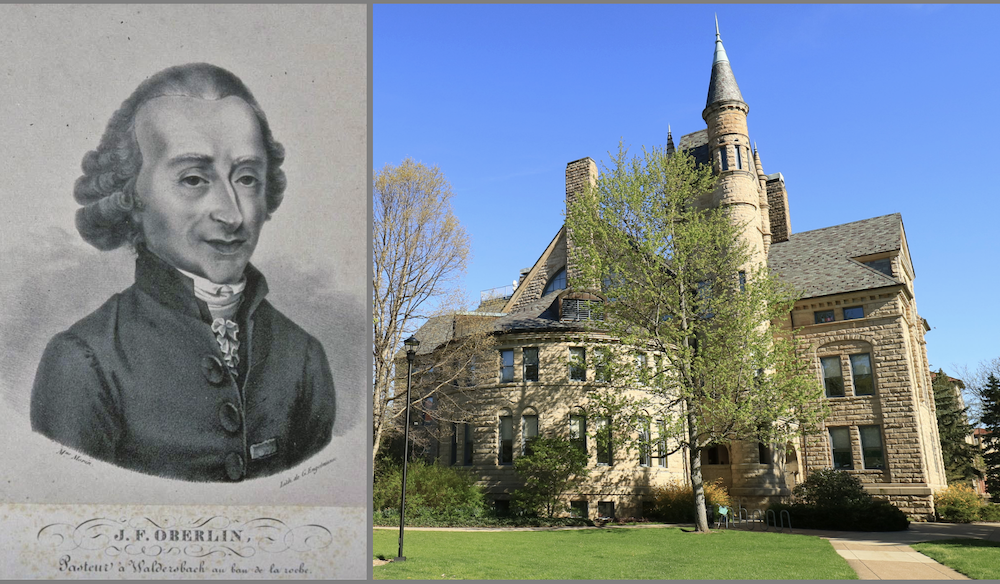
Left: J.F. Oberlin, Pasteur à Waldersbach, Buste, by Morin, Auteur : Engelmann, Godefroy (lithogr)1820, Strasbourg Bibliothèque nationale et universitaire de Strasbourg, NIM16843, Public Domain , https://commons.wikimedia.org/w/index.php?curid=40508614
Right: Peters Hall, Oberlin College, in Oberlin, Ohio.
Photo credit: John Seyfried, https://www.oberlin.edu/about-oberlin
| | |
• Jean-Frédéric Oberlin (born Johann Friedrich in Strasbourg, 31 August 1740 – 1 June 1826) was a pastor and philanthropist. In 1766, he became the Protestant pastor of Waldbach (now Waldersbach), a remote and desolate area in Ban de la Roche, located in the Vosges mountains. He delivered three sermons in French and one in German each month.
• Oberlin aimed to enhance both the physical and spiritual well-being of the local people. He started by promoting the building of roads in the valley and the construction of bridges, inspiring the farmers to join in through his own actions. He implemented a better agricultural system. Solid cottages were built, and different crafts were introduced. He created a traveling library, started infant schools (which were the forerunners of today's nursery schools in France), and set up a regular school in each of the five villages within the parish.
• He was buried with great respect and love in Fouday, Bas Rhin. Oberlin was a uniquely spiritual man, often referred to as "a saint of the Protestant church".
• Although he didn't physically emigrate to America, he had a profound spiritual influence in Alsace and in this country. To wit, Oberlin, Ohio, established as a Christian community, and its main institution, Oberlin College, a liberal arts college, were named in his honor when they were founded in 1833. Oberlin, Louisiana, is another place named after him. For this reason we include him in this bulletin.
Plaque, “Oberlin College and Community”
73 S Professor St, Oberlin OH 44074
GPS: 41.289533, -82.219083
• Inscription:
“Oberlin College and Community. Founded in 1833. Reverend John Jay Shipherd and Philo Penfield Stewart envisioned an educational institution and colony dedicated to the glory of God and named in honor of John Frederick Oberlin*, a pastor in the Alsace-Lorraine region of France. Early colonists signed a covenant pledging themselves to the plainest living and highest thinking. Oberlin (known as the Oberlin Collegiate Institute until 1850 when it was renamed Oberlin College) was the first coeducational institution to grant bachelor’s degrees to women and historically has been a leader in the education of African Americans. In fact, African American and white children studied together in the town’s one-room schoolhouse, in defiance of Ohio’s “Black laws” forbidding this practice. The schoolhouse, built 1836 -1837, is part of the Oberlin Heritage Center.”
Erected 2003 by the Ohio Bicentennial Commission, the Longaberger Company, Oberlin Heritage Center / O.H.I.O., and The Ohio Historical Society. (Marker Number 13-47.)
Note* The plaque should have read: "Jean-Frédéric Oberlin". J.F. Oberlin spiritual legacy is universal even though he didn't travel outside of France. J. F. Oberlin University in Tokyo, Japan, took its name from Oberlin College.
Frederick Kindelberger, mason
| | |
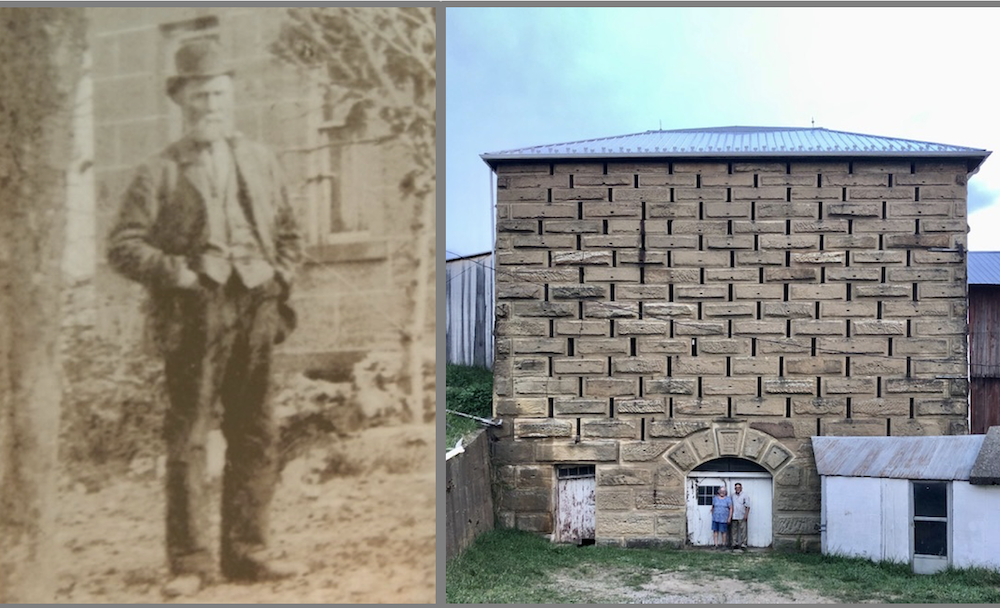
• There is at least another Frederick Kindelberger in the same county but who was born in Germany in 1837. Also, because the county is called Switzerland, it is a source of confusion as some people think he is Swiss.
• Consider the size of these stones on the photo above to appreciate the amount of labor this construction represents.
Marker, “Frederick Kindelberger Stone House and Barn”
50037 German Ridge Rd, Beallsville, OH 43716
GPS: 39.830767, -80.906067
• Inscription:
“These structures stand as an exception to the usual wood frame or brick construction of farm buildings in this region in the late nineteenth century. The house and barn, built circa 1871 and 1883-1885 respectively, reflect Frederick Kindelberger's (1835-1911) creativity and vision to instill a responsibility to the land. The Kindelberger family purchased the farm in 1846, after they had emigrated from Alsace-Lorraine. The walls of the barn were created using a distinct architectural design, whereas they taper from 25 inches thick at the base to 12 inches thick at the top. Stonemasons and family members labored using sandstone, which was quarried on the eighty-acre farm, to construct the buildings. Due to their stone construction, the house and barn were placed on the National Register of Historic Places in 1980.
Erected 2002 by Ohio Bicentennial Commission, The Longaberger Company, The Baumberger Family, and The Ohio Historical Society. (Marker Number 2-56.)”
Georges Buchy, meat-packing magnate
The Buchy dynasty
| | |
Marker, “buchy’s - A ‘Lot’ of History”
428 Tiffin Ave, Sandusky, OH 44870
GPS: 41.449467, -82.723267
• Inscription:
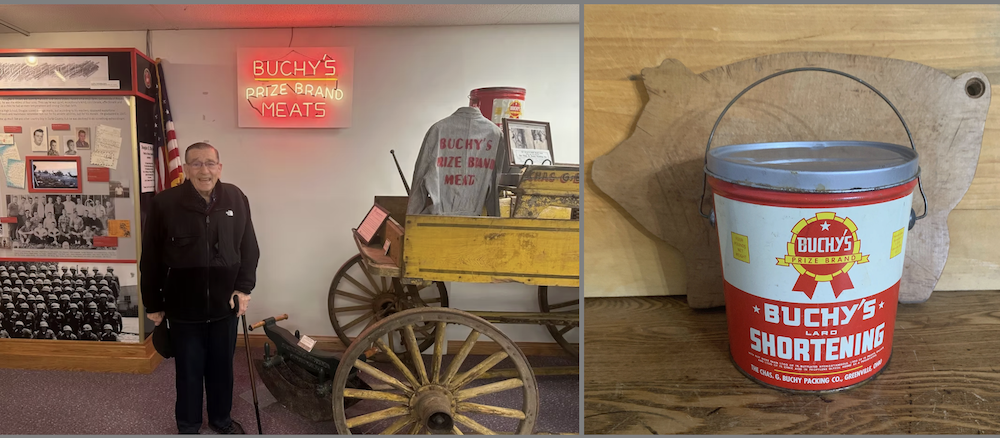
“In 1870, George Buchy fled the Alsace-Lorraine region when it was invaded by Germany and immigrated to the United States with the equivalent of $.85 to his name. He continued his travels from New York to Pittsburgh along the Ohio River then to the Miami Valley while working as a butcher, and eventually he was employed in Greenville in 1871 by his relative Albert Klee, who was operating a slaughterhouse. Seeking the entrepreneurial experience a few years later, George ventured out on his own in 1878 and eventually expanded his business, the George Buchy Slaughterhouse, with the brick building. But, upon his death in 1897, the business was sold to Albert Bailey. Wanting the business to remain in the family, George's son Charles quit school, saved money, and borrowed additional funds to buy the business back in 1901 subsequently changing the name of the operation from the George Buchy Slaughterhouse to the Charles G. Buchy Packing Company.[....] Upon the death of Charles Buchy in 1963, his son George J. became the third Buchy to steward the company. [...] Jim, the fourth-generation Buchy to be involved with the business, started doing odd jobs at the plant when he was 12. Through the years, he swept floors, drove a delivery truck, cut meat, and advanced to company president in 1978. While still at the helm of Buchy Food Services, Jim also served Greenville and the state well as a 12-term member of the Ohio House of Representatives. [...] Ultimately in 2012, ownership of Buchy Food Service was transferred to Sysco Cincinnati-thus, ending an era.”
| | |
Alsatians in Indiana
Father François Rudolf
| | |
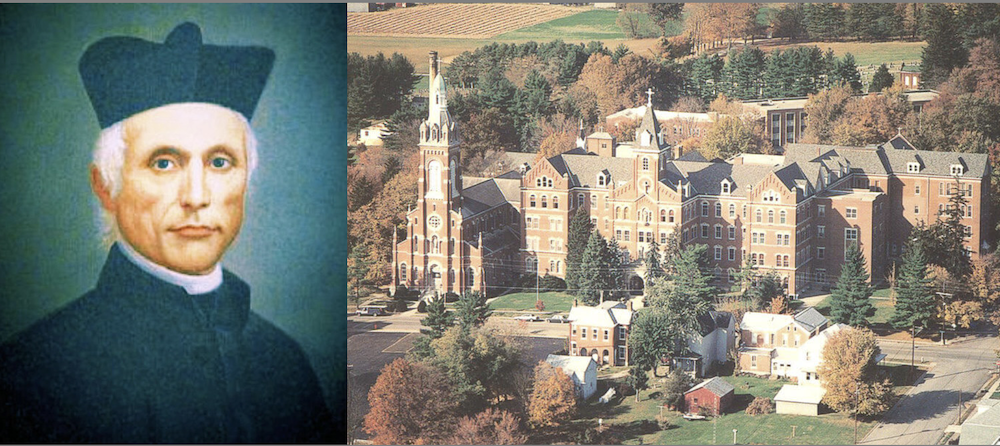
• François Joseph Rudolf was born on 23rd April 1813 in Battenheim, Dept du Haut-Rhin, Alsace. At the age of 18, he left to study theology at the Grand Séminaire in Strasbourg during six years, and was ordained in 1839. In 1841, Reverend Father Julian Benoit, the second pastor of St. Augustine's Church in Fort Wayne, Indiana, went to Europe to seek donations and brought back with him Fr. Rudolf to serve as an assistant. In 1844 he was sent to Oldenburg, a village also known as the "Village of the Spires" due to the church he constructed. He also served as the spiritual leader for the surrounding communities.
Marker, “Father Franz Joseph Rudolf” (sic)
3027 Pearl St, Oldenburg, IN 47036
GPS: 39.340383, -85.203817
• Inscription:
“Born in Battenheim, Alsace,
April 23, 1813
"Founder of Village of Spires"
Appointed Pastor 1844
Built Stone Church 1845 – Present Church 1862
Founded Convent of Sisters of St. Francis 1851
Served as Civic Leader and
Missionary in Area
Buried June 1, 1866 Below
Church Sanctuary
Erected 1968 by Holy Family Parish.”
| | |
Alsatians in Minnesota
Father Valentine Sommereisen
| | |
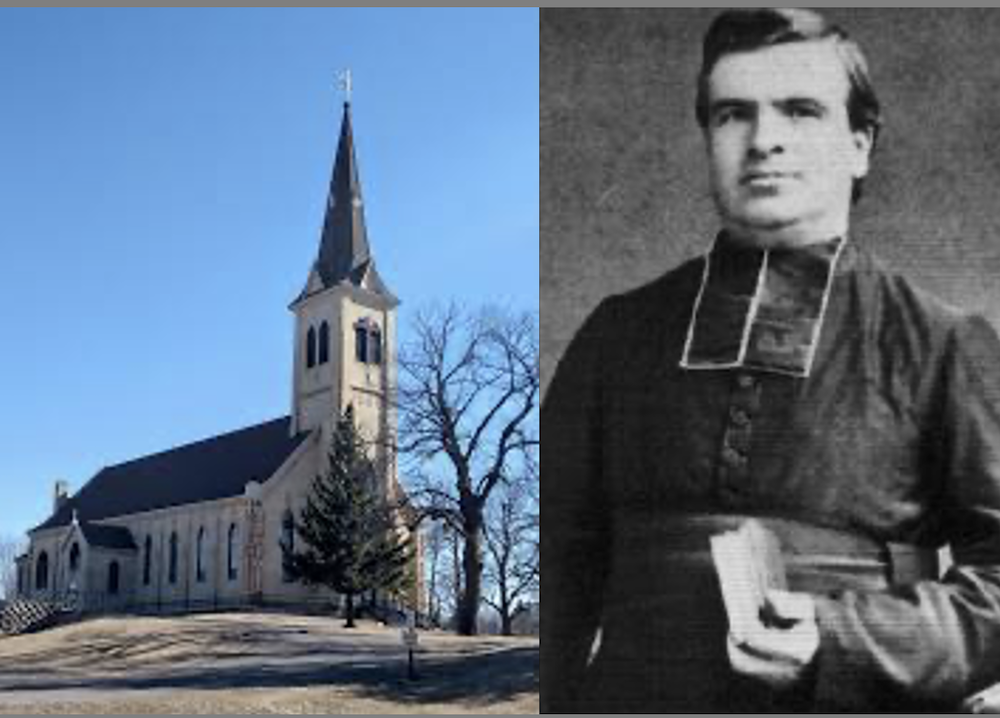
• Valentin Sommereisen was born in Rouffac, Département du Haut-Rhin, Alsace.
Marker, “Father Valentine Sommereisen, Pioneer Missionary Priest“
St Josephs Cemetery, New Ulm, MN 56073
GPS: 44.268883, -94.452800
• Inscription (excerpts):
“Valentine Sommereisen was the first resident Catholic priest in three large areas of the American West: southwestern Minnesota, the Dakota Territory, and western Kansas. Born 28 May 1829 in Rouffach, Alsace, a German–speaking part of eastern France, he was one of seven theology students who followed the great missionary, Fr. Augustin Ravoux, to Minnesota in 1854. Sommereisen was ordained by Bishop Joseph Cretin 8 March 1856 in the second Cathedral of St. Paul. [...] From there he ministered to 36 communities in 14 counties in southwest Minnesota. Many area families can trace ancestors’ baptisms, marriages, and funerals to his signature on parish records.
This is the site of St. Joseph Church, the first Catholic church in Brown County, completed in 1861. Fr. Sommereisen celebrated the first Mass. [...]. Fr. Sommereisen accompanied fr. Ravoux, baptizing and consoling 33 of the 38 Dakota Sioux who were hanged in Mankato on 26 December 1862. Fr. Sommereisen moved west in 1871 to Yankton, then the capital of Dakota Territory. From there he visited various forts and stations along the Missouri River.[...] In 1876 Father Sommereisen was appointed pastor at Hays, Kansas, with the care of six nearby Volga-German settlements and various railroad towns along the Kansas Pacific. [...] He died 25 January 1897 at age 67 and is buried in St. Joseph's Cemetery in Hays.”
Erected 2011 by the Fourth Degree Knights of Columbus Bishop Cretin Assembly, with research done by Fr. Eugene Hackert and George L. Glotzbach. "
Jean Orth, brewer
| | |
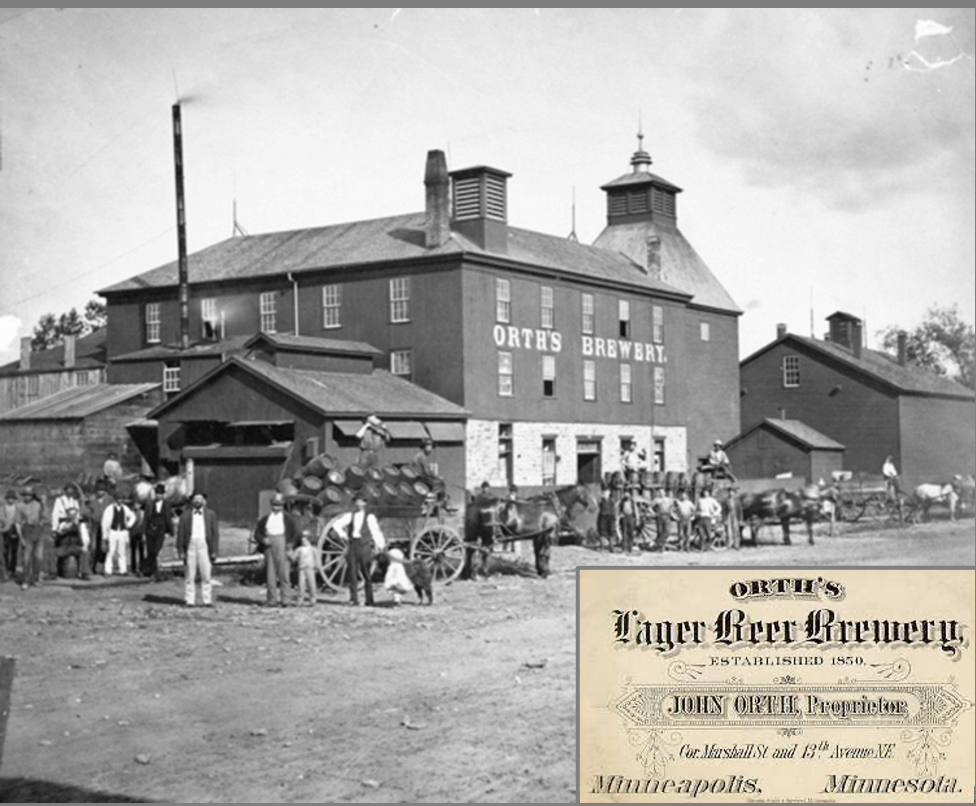
Marker, “Orth Brewery Plaza“
1225 Marshall Street Northeast, Minneapolis MN 55413
GPS: 45.000050, -93.269717
• Inscription (excerpts):
"I am now ready to supply the citizens of the Territory with Ale and Beer, which will be found equal—yes, superior—to what is brought from below. I am now demonstrating that malt liquors of the very best quality can be manufactured in Minnesota. Try my Ale and Beer and you will be convinced of the fact.”
John Orth, Minnesota Democrat [newspaper], December 17, 1850
Northeast Minneapolis has a longstanding heritage of brewing. The neighborhood boasted the city's first commercial brewery—the John Orth Brewing Company, established on this site in 1850. Thirteenth Avenue was originally called Brewery Street. John Orth first brewed in a small, wood-framed building and cooled his beer in caves on Nicollet Island. By 1861, he had upgraded to a three-story, wood and stone brew house. The demand for beer surged in the late nineteenth century as a wave of German immigrants settled in Minnesota, the largest group to arrive here between 1860 and 1900. Saloons and beer gardens were integral to their cultural heritage and provided outlets for breweries, including several founded by German-Americans. Although Orth hailed from Alsace, France, that province's culture was strongly influenced by Germany, which was just across the border. […] Today, the landmark brewery has been revived for new uses and the complex is a National Register historic district. The massive brew house and the company's office, to your right, are also locally designated by the City of Minneapolis. This plaza, the site of the original John Orth Brewery, is included in the historic district. Although Orth's brewery was demolished around 1900, foundation walls, structural materials, and other ruins are preserved below the ground. The paths in front of you show areas in the brew house that were used for malt and barley storage, the malt mill, and the engine and boiler room.”
| | |
Alsatians in Missouri
Louis & Salomé Mertz, farmers
| | |
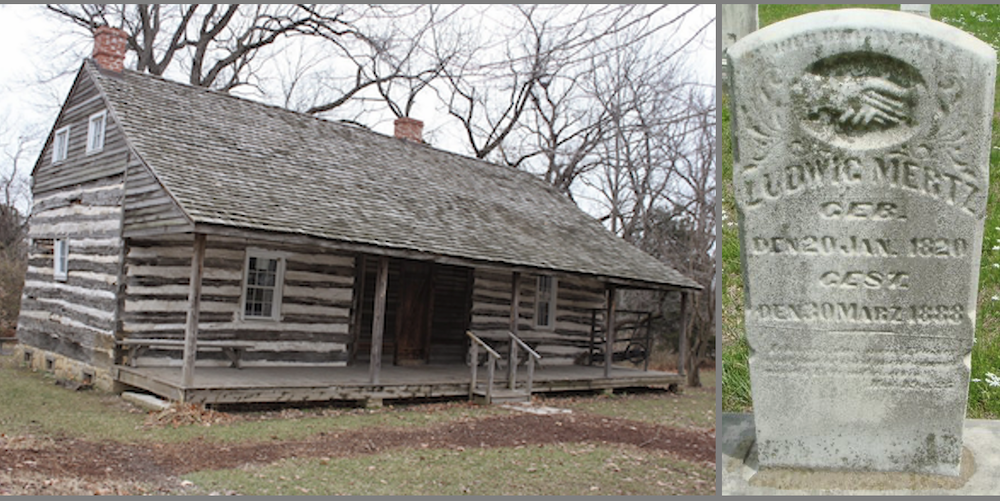
•The house was originally built in 1848 by Louis (Ludwig, aka Lewis) and Salomé Mertz, following their immigration from Alsace. Ludwig was born in Lembach, Département du Bas-Rhin, Alsace, on Jan. 20, 1820 and married Catherine Salome Hiller in 1840. They immigrated in 1845 and raised their Ludwig and Catharina had seven children; Louis, George, Salomea, Barbara, Gottfried L., Maria Dorothea and Barbara in their home. They cultivated beans, peas, corn, and potatoes on their thirty-acre farm, had eight dairy cows. With the establishment of the railroad in the 1880s, they started producing wine and grew wheat, which became a significant export to Europe.
Marker, « Mertz log home »
Faust Historic Village, 1040 Gerhardt Trl, Chesterfield, MO 63017
GPS: 38.666400, -90.540783
• Inscription:
Built: The first single room building was built in 1849. The house was expanded over the following 10 years.
Built by: Ludwig and Salome Mertz.
Original location: Campus of present day Maryville University.
Facts:
• The Mertz family immigrated from Alsace- Lorraine in 1847.
• The original location of the house was known New Alsace due to the high population of immigrants from Alsace-Lorraine living in the area.
• The front yard vegetable garden is called a Nutzgarten or useful garden.
• The Mertz compound includes the Wiehage Smokehouse, an insecticidal and dye garden, woodshed, outhouse and beehive oven.
Donated by: Baur Properties"
| | |
Alsatians in Louisiana
Abraham Kahn, merchant
| | |
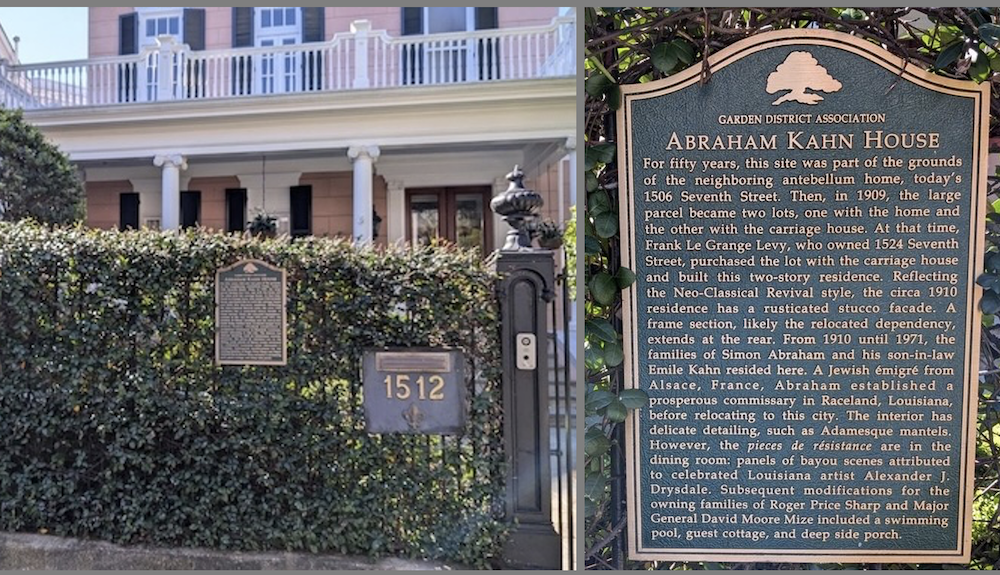
• Abraham Kahn was born in Reischoffen (German: Reichshofen; Alsatian: Risshoffe) in the Département du Bas-Rhin, to a Jewish family.
• His obituary, in The Shreveport Journal, Shreveport, LA, Mon, Jan 2, 1939, reads:
“Mr. Abraham was well known in New Orleans and South Louisiana, where he had been in the mercantile business at Raceland in La Fourche parish since 1870. He was one of the founders of Raceland. Born Feb. 28, 1848, in Reischoffen, Alsace, he came to the United States as a youth of about 19 years to reside with his sister, whose husband founded the Klotz-ville community in South Louisiana. Later he entered the mercantile business and his firm, Abraham, Inc., became one of the best known in that area.”
Plaque, “Abraham Kahn House”
1512 Seventh St, New Orleans LA 70115
GPS: 29.928783, -90.087533
• Inscription:
“For fifty years, this site was part of the grounds of the neighboring antebellum home, today's 1506 Seventh Street. Then, in 1909, the large parcel became two lots, one with the home and the other with the carriage house. At that time, Frank Le Grange Levy, who owned 1524 Seventh Street, purchased the lot with the carriage house and built this two-story residence. Reflecting the Neo-Classical Revival style, the circa 1910 residence has a rusticated stucco facade. A frame section, likely the relocated dependency, extends at the rear. From 1910 until 1971, the families of Simon Abraham and his son-in-law Emile Kahn resided here. A Jewish émigré from Alsace, France, Abraham established a prosperous commissary in Raceland, Louisiana, before relocating to this city. The interior has delicate detailing, such as Adamesque mantels. However, the pieces de résistance are in the dining room: panels of bayou scenes attributed to celebrated Louisiana artist Alexander J. Drysdale. Subsequent modifications for the owning families of Roger Price Sharp and Major General David Moore Mize included a swimming pool, guest cottage, and deep side porch. Erected by Garden District Association.”
| | |
Alsatians in Montana
The Zimmermann brothers, ranchers
| | |
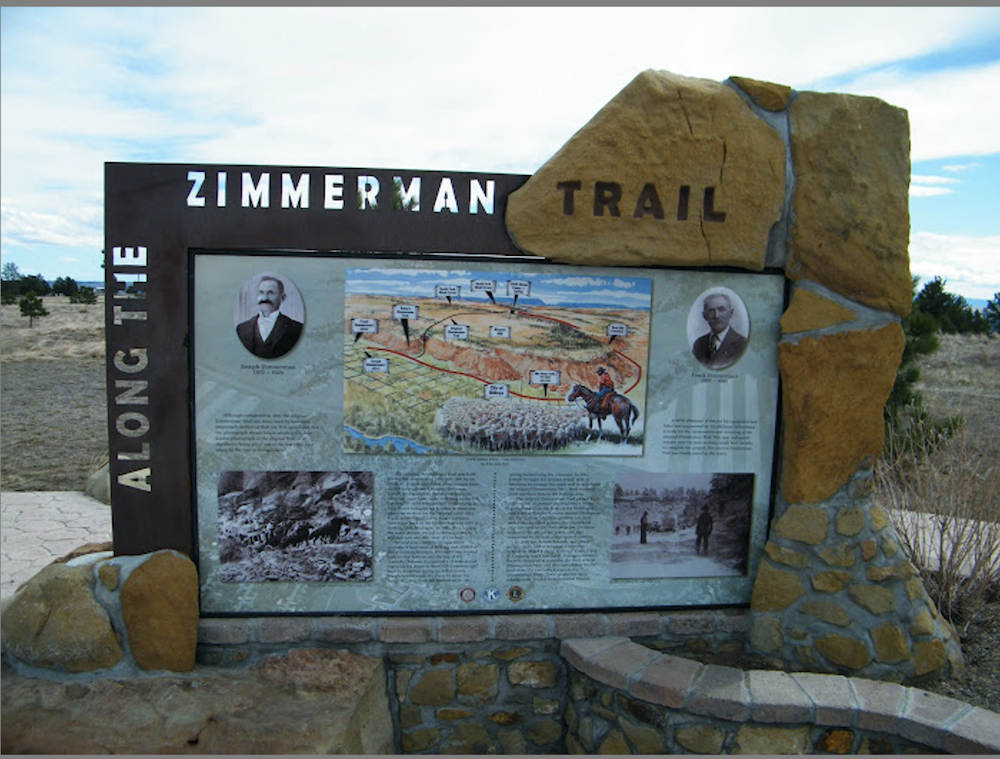
• Joseph “Joe” ZImmerman was born on 4 Jan 1855 in Fellering, Département du Haut-Rhin, Alsace, France, and not Germany, as the marker erroneously states. His brother François-Xavier "Frank" Zimmerman was born 3 year later, on May 11, 1858 in the same village. There were not born in Germany, as it is often erroneously stated in several websites. François-Xavier's U.S. passport even clearly states France as the country of birth.
• The Zimmerman brothers moved to the United States in the 1870s. Joseph got there in 1872 and joined the U.S. Cavalry, which took him to Montana Territory. In 1874, Frank followed his brother west and worked for the Northern Pacific Railway until 1883.
• After working with the railroad, François-Xavier went back to Alsace for a short time. In 1885, he returned to the United States and began farming in Michigan. After leaving the Army in 1883, Joseph opened a clothing store on Montana Avenue in Billings. He saved enough money to purchase three sections of land to start a sheep ranch.
• Joseph’s land was split between the top and bottom of the Rimrocks. Since there was no other way through the Rims, Joseph had to take a long trip east, around Boothill Cemetery, and then west to reach his property, making a 32-mile round trip. Tired of this journey, he called for his brother to assist with the ranch and create a quicker route to his land in the valley. Between 1890 and 1891, the Zimmerman brothers and a local miner known as “Thompson” built a two-and-a-half-mile trail through the Rimrocks.
• In 1938, the Lions, Kiwanis, and Rotary clubs bought the land that included the old trail and the right-of-way to construct a new road through the Rims. In the 1940s, the new “Zimmerman Trail” was built.
• The Zimmerman brothers spent the rest of their lives in Billings, with Joseph passing away on Oct. 30, 1929 and François-Xavier on Sept. 11, 1943. They are buried at Mountview Cemetery, Billings, Yellowstone County, Montana
Marker, “Along the Zimmerman Trail”
U.S. Highway 3 and Zimmerman Trail, Billings MT 59102
GPS: 45.805600, -108.604833
• Inscription (excerpts):
“The original Zimmerman Trail was built during the summers of 1890 and 1891 by the brothers Joseph and Frank Zimmerman, born in Fellering, (Alsace-Lorraine) Germany (sic). Joseph immigrated to the United States in 1872; two years later, upon enlisting in the U.S. Cavalary, his duty brought him to Montana. In 1874, Frank followed his brother to Montana where he worked for the railroad until 1883. Frank briefly returned to Alsace-Lorraine, then came back to the United States in 1885 to farm in Flint, Michigan. In 1883, after leaving the army, Joseph started a clothing store in Billings, just one mile west of Coulson. [...] Joseph sought a shorter route to move his bands of sheep from his homestead to the spring located atop the rimrocks. In 1890, Joseph brought his brother Frank back to Montana to manage his ranch and to help build the original Zimmerman Trail. Both brothers lived out their lives in the Billings area. [...] The current Zimmerman Trail was finally paved in the 1940s.
Erected 2005 by The Dedication and Support of Many."
Jean Furst, farmer & builder
| | |
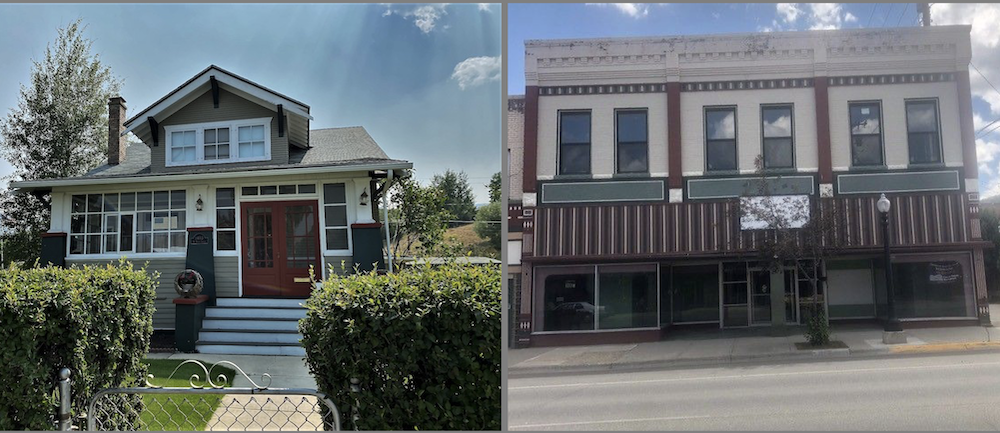
• John Furst was born in Alsace, France in 1852 and moved to America in 1870, where he settled in Kansas City, Missouri. There, he trained as a cobbler.
• In 1878, he relocated to Montana and opened one of the first boot and shoe stores in Butte. By 1881, Mr. Furst had sold his shoe shop and used the profits to buy a small ranch six miles northeast of Anaconda.
• He became a wealthy Deer Lodge Valley dairyman and built this brick store and boardinghouse for $5,000 in 1895 (about $200,000 in today's $)
• For almost thirty years, he ran a dairy and cattle operation from his ranch, along with a milk delivery service in Anaconda.
• In his later years, he worked in the construction industry in Anaconda. He built the Lorraine Apartment House, named after his homeland, as well as the Furst Block at 113 East Park Avenue, and a large home for his daughter at 1403 West Third.
• John Furst died on August 14, 1927.
Marker, “Furst Residence”
1400-1498 W 3rd St, Anaconda, MT 59711
GPS: 46.131467, -112.972267
• Inscription (excerpts):
[...] “Furst came to the United States from Alsace-Lorraine, France, in 1870, learned the trade of shoe cobbling, and came to Butte in 1878. He operated a shoe store there until 1881 when he went into ranching. Furst also had a local contracting business and developed commercial and residential real estate. This residence, initially built as an investment on the west end of the addition, for many years had few neighbors.
After Furst died in 1927, his wife, Theresa, moved into town from the ranch and made her home here until 1949. The beautifully maintained residence is an outstanding example of the Craftsman Bungalow, a style that emerged in California and was widely promoted in the first decades of the twentieth century” [...]
Erected by Montana Historical Society."
Marker, “Furst Block - Anaconda Commercial Historic District”
113 Park Ave, Anaconda, MT 59711
GPS: 46.129083, -112.952133
• Inscription:
“French immigrant and wealthy Deer Lodge Valley dairyman John Furst built this brick store and boardinghouse for $5,000 in 1895. Just steps away from Marcus Daly’s new bank and the fine Montana Hotel, the Furst Block fit in well amongst its high-style neighbors. The original street-level façade was richly decorated with cast-iron pilasters (still visible on the right and left). The well-preserved second story still reflects the type of elaborately patterned brickwork fashionable at the time. The J. T. Carroll Company, lumber manufacturers and dealers, and the Anaconda Business College were early first-floor tenants. Upstairs, Mrs. Radefeld let the rooms to “first-class gentleman.” Around 1900, Furst added a large two-story rear addition. While the first floor continued to house retail businesses, the second floor attracted non-traditional professionals. Tenants between 1900 and 1906 included astrologer Alexis Pfuhl, clairvoyants Madame Bell and Madame Yeteva, magnetic healer John Burtscher, and female osteopath Dr. Adele Allison. One of two licensed female doctors in town, Allison practiced medicine until her death in 1910. Goodfriend’s Clothing Company, a menswear store, occupied both storefronts from 1905 until the early 1930s.
Erected by Montana Historical Society.”
| | |
Alsatians in Texas
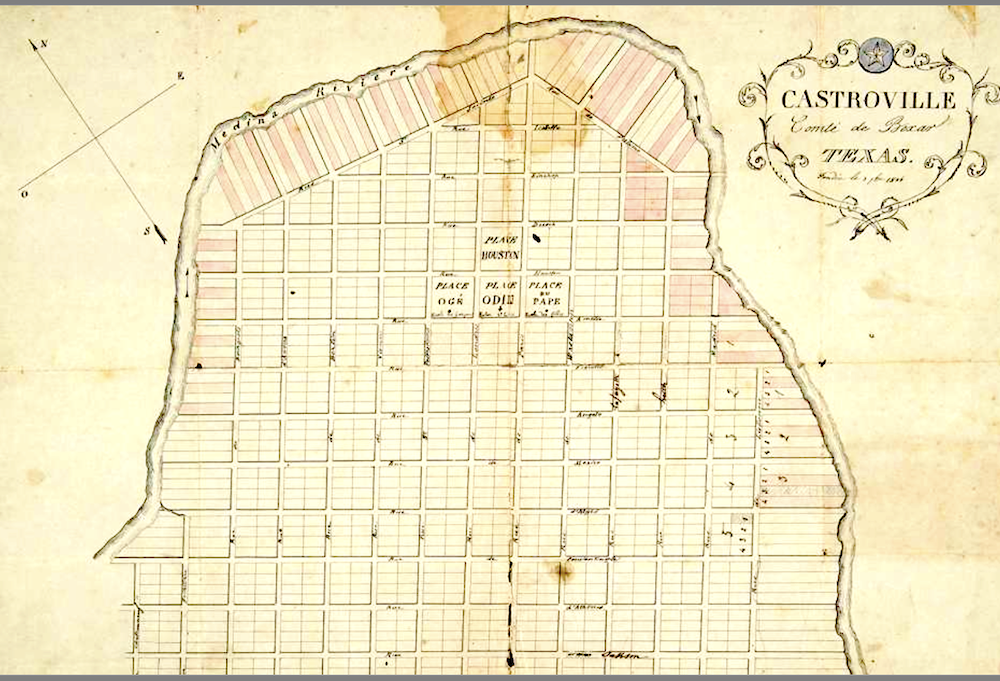
The Castroville Colony
| | |
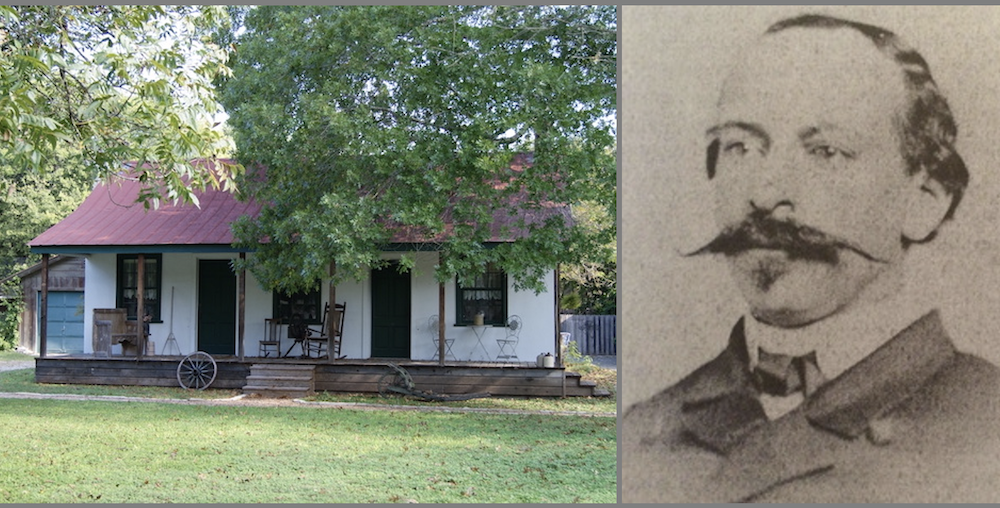
• Henri Castro (born Moïse Henriques de Castro, in Bayonne, France on July 17, 1786 - died in Monterrey, Mexico on November 3, 1865) was a French diplomat and banker, though he recruited many Alsatian colonists to Texas.
• Castro was of Portuguese-Jewish descent. In 1805, he met Napoléon and eventually became a member of the imperial guard.
• In 1813, he married Amelia Mathias, a wealthy heiress, and later moved to the United States in the 1820s, where he was appointed consul of France in Providence, Rhode Island, and became a U.S. citizen in 1827.
• In 1838, he worked as a banker in France and sought to secure a loan for the young Republic of Texas, after which President Sam Houston appointed him as consul general for Texas.
• Castro obtained a land grant of more than a million acres with the condition that he would settle at least 600 families in the area west of San Antonio. As an empresario (a land agent granted the right to settle colonists), he recruited colonists from Alsace starting in 1842 to fulfill the Republic of Texas's stipulations for populating his land grant.
• His first ship loaded with immigrants, L'Ebro, left Le Havre and arrived in Texas on January 1, 1843, followed by six others, transporting a total of 800 people. Single people were given 128 hectares, couples twice that amount. Provided they built a house, cultivated six hectares, and resided there, each became a landowner!
• In the spring of 1847, he established the town of D'Hanis with twenty-nine Alsatian families and he founded other settlements including Castroville, which became known as "Little Alsace of Texas."
• In total, Henri Castro brought nearly 2,100 settlers to Texas, mostly from Alsace, particularly from Oberentzen and Niederentzen, all located in the Haut-Rhin Department, and also some rom nearby Baden, to populate the lands granted to him along the Medina River, 30 km west of San Antonio.
He also founded the towns of Quihi in March 1846, Vandenburg in September 1846, and D'Hanis in the spring of 1847.
• During the first century of Castroville's existence, Alsatian was spoken in homes, shops, and taverns. Today, only half of the city's residents can claim descent from the original settlers from the time of Henri Castro. Still, the Alsatian dialect was transported to Texas through his colonization efforts creating a unique cultural enclave that preserved Alsatian traditions, architecture, and language in Texas that persists to this day.
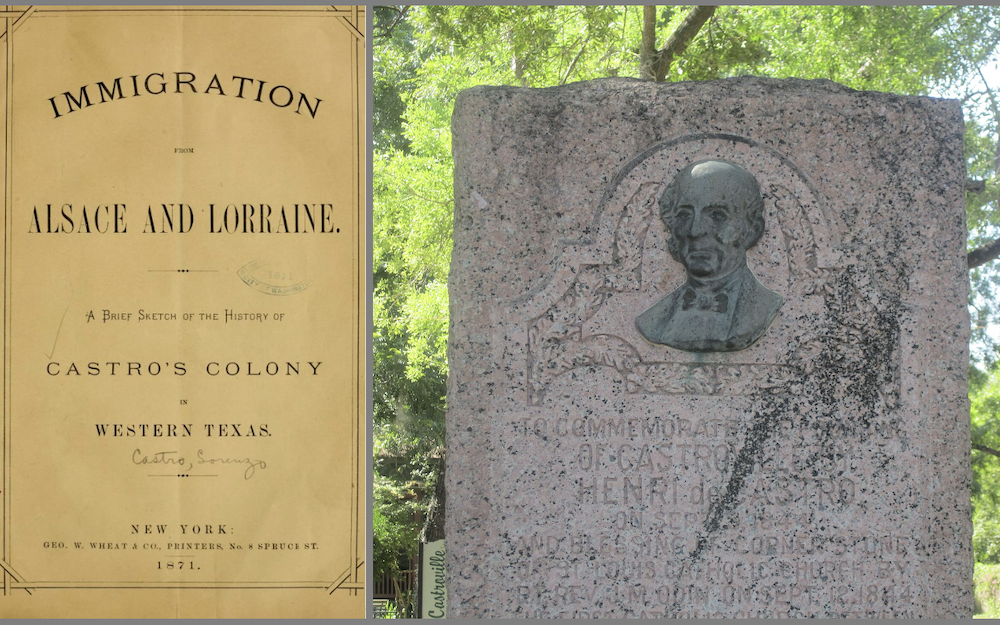
Marker, “Henri Castro (July 17, 1786 - November 3, 1865)”
307 Lafayette Street, Castroville, TX 78009
GPS: 29.355833, -98.875183
• Inscription:
“Henri Castro, a native of Bayonne, France, and the descendant of Portuguese nobility, served briefly in Napoleon's French Army. In 1813 he married Marie Amelia Mathias. He later immigrated to the United States and in 1827 became a naturalized U.S. Citizen. He returned to France in 1838 and joined the banking house of Lafitte and Company. While there he helped negotiate a loan for the Republic of Texas for which a grateful President Sam Houston later appointed him Texas' General Consul in Paris. Between 1843 and 1847 Castro administered, as Empresario, the settlement of at least 2,134 European colonists in this area.
Castro eventually exhausted his own personal wealth to sustain his colonial effort. His extraordinary dedication to his colonists has led many to compare him favorably to the legendary Stephen F. Austin. Henri and Marie lived in Castroville with their four foster children. By 1860, however, the family was living in San Antonio. Henri and his son, Lorenzo, traveled to Eagle Pass to run a family mercantile business.
On his way to France in 1865, Castro was diverted to Monterrey, Mexico, where he became ill and died. He was buried in Monterrey in 1865. In 1876 the newly created Castro County, Texas, was named for Henri Castro.”
Erected 1994 by Texas Historical Commission”
Marker, “Alsatians of Texas”
517 Madrid St, Castroville, TX 78009
GPS: 29.356250, -98.879033
• Inscription:
“In 1842, Empresario Henry Castro brought his first colonists to Texas to settle land west of the Medina River. Most of the immigrants were from the Rhine River area of Europe. Many claimed the province of Alsace, on the border of France and Germany, as their homeland. The Alsatian colonists brought with them their combined French and German heritage, which has left a distinctive mark on this area of the state.
In 1844, Castro laid out a townsite, which the settlers chose to name Castroville. It became the center of Alsatian culture in Texas. The houses, European in style, are primarily single-story dwellings of cut limestone, mortared with adobe, and white-washed. Over the years, farming has been the major occupation of people in the area, as it was in Alsace.
The Alsatian immigrants and their descendants have made a distinct impression on area politics, holiday customs, cuisine, and religion. Winemaking, using grapes grown along the Medina River, is another early tradition that has continued over the years. The history of Alsatians in Texas is a reflection of ethnic and cultural diversity in the state's rich heritage.”
Erected 1985 by Texas Historical Commission. (Marker Number 131.)”
Marker, “Alsatian Immigration through Lavaca Bay”
610 Harbor St, Port Lavaca, TX 77979
GPS: 28.621933, -96.625250
• Inscription:
“Texas land empresario Henri Castro contracted to bring colonists of various European nationalities to Texas beginning in 1842. The first of these were Alsatians, most of whom spoke German and held German sympathies. They arrived at Galveston, their official port of entry, with 114 passengers from France in early 1843; most then sailed for Lavaca (later Port Lavaca). They waited here before beginning their overland journey to what became Medina County, to establish the town of Castroville. Another, largely Alsatian, group of 129 arrived at Galveston January 1, 1844. About 40 continued to Lavaca, landing on the 10th. Conditions were difficult, and many immigrants succumbed to various coastal fevers. Other ships followed in 1845 and 1846. Castro's contract expired in 1847, after he had transported more than 2,000 colonists to Texas, most through Lavaca Bay.”
Erected by Calhoun County Historical Commission George Fred Rhodes, Chairman
Erected 1999 by Texas Historical Commission. (Marker Number 1147.)”
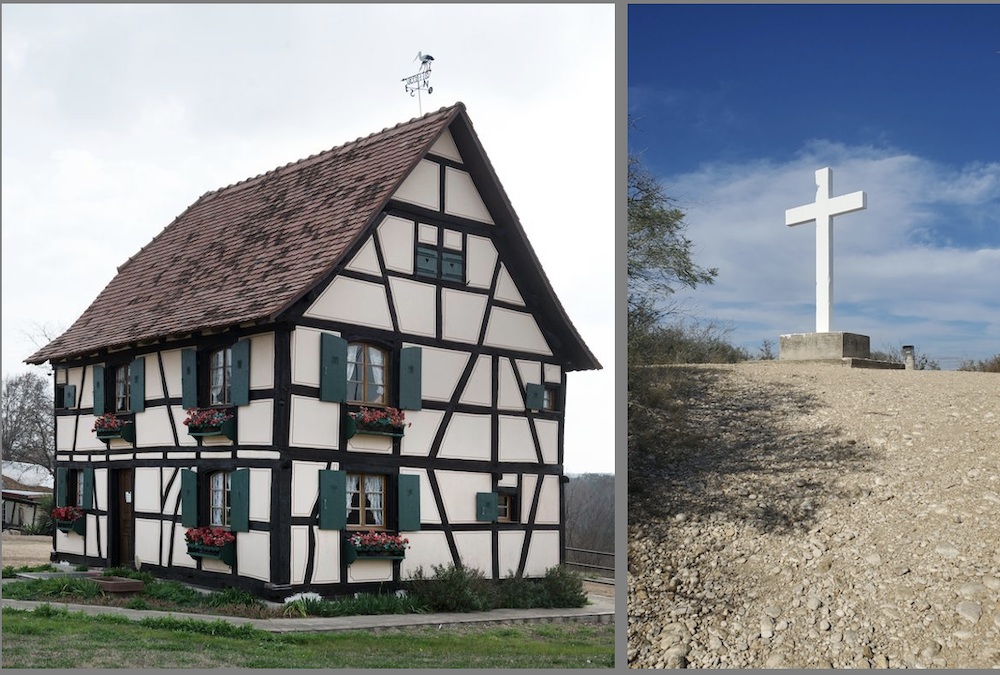
Two landmarks in Castroville
| | |
Above:
Left: Steinbach Hüs, originally built in Wahlbach (today Département du Haut-Rhin), France in 1648 and reassembled in Castroville in 2002, is now the town's Visitors Center. It is the oldest standing building in Texas!
Photo: The Lyda Hill Texas Collection of Photographs in Carol M. Highsmith's America Project, Library of Congress, Prints and Photographs Division. Public Domain
Right: a giant cross has kept watch over Castroville since c. 1850, on top of Mount Gentilz, aka Cross Hill
Photo: https://texastrailrunning.com/castroville-regional-park/
| | |
• The Association Jardin des Racines (Garden of Roots Association) from Rouffach in the Haut-Rhin department of Alsace, France, purchased this ancient house built in 1648, carefully disassembled it, and shipped it to Texas. It landed at Houston and was transported by truck to Castroville in January 1998.
• The doors, windows and shutters, which were made in France and sent to Castroville in February 2002, were installed by 10 volunteer Alsatian craftsmen during the following month. Alsatian furniture and other items were donated by individuals from Alsace and placed inside the house, which opened to the public as a tourism and cultural center following the April 8, 2002 Grand Opening.
Steinbach Hüs: A gift from Alsace and Alsatians to Texas
203 US-90, Castroville, TX 78009
GPS: 29.355316, -98.872291
Marker, “Cross Hill, Castroville, TX.”
Intersection of Jackson Street & Paris Street, Castroville TX 78009
GPS: 29.349600, -98.885550
• Inscription:
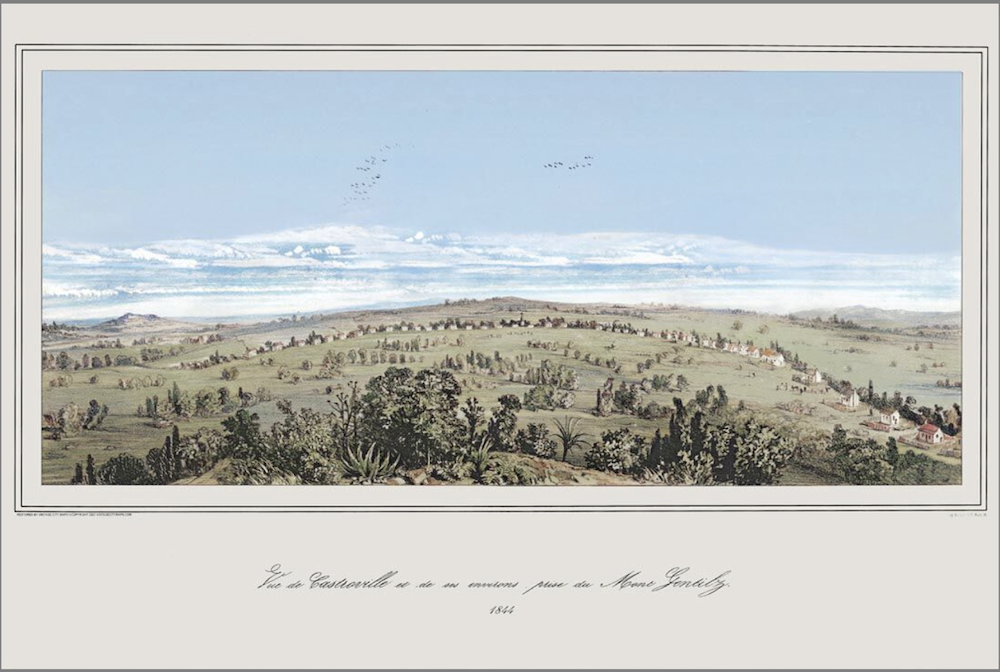
“Castroville was settled in September 1844 by predominately Catholic immigrants, brought to Texas by Empresario Henry Castro from the Alsace region of France along the Rhine River bordering Germany. It is long established European custom for a village to proclaim its faith by erecting a cross on a hill overlooking the community. The Alsatians brought this tradition with them when they founded Castroville.
As early as the 1850s, a cross has overlooked Castroville from its perch on the summit of Mount Gentilz on the west side of town. This was the highest promontory overlooking the village, and was owned by Henri Castro who named the hill, Mount Gentilz in tribute to his artistic friend Theodore Gentilz. Gentilz helped in the early settlement of Castroville, and as a surveyor laid out the towns of D'Hanis and Quihi, as well as Castroville.
The original cross erected shortly after the founding of the community, was consecrated by Father Claude Dubois, the first pastor of St. Louis Catholic Church.
A new cross was erected around 1875 after two miscreants chopped down the first one. In 1900 extremely heavy rains caused the Medina River to flood across Castroville, such that residents took refuge on the higher ground of Cross Hill until the water receded. Shortly thereafter and perhaps in gratitude for their deliverance, the badly weathered cross was replaced with a new 16 foot-high wooden cross and five-foot zinc corpus, forming a complete crucifix. The St. Louis Parish Women's Organization, the St. Ann's Altar Society, was the principal proponent of this impressive upgrade dedicated in 1902. The crucifix cast its protective shadow over Castroville for about 20 years until vandals tore it down. The next cross was made of wood from two telephone poles. Dedicated on Good Friday of 1929 or 1930, it lasted for the next 40 years.
In 1971 it was replaced by the present durable 13 foot-tall concrete cross, skillfully crafted by artisans in Mexico. The cross on Mount Gentilz, overlooking the community of Castroville, stands as a cultural monument to the historically rooted beliefs, customs, and practices of its citizens. Deep faith in God sustained the hardy pioneers in the very difficult task of establishing a colony in the Texas frontier, and they needed only look at the cross on the hill for inspiration as they faced the daunting challenges of life in the wilderness. For over 170 years both residents and visitors to Castroville have admired cross hill and steadfastly kept its tradition alive.
Erected 2018 by Medina County Historical Commission.”
Jean-Jacques Biry & Etienne Arh
shoemaker & blacksmith
| | |
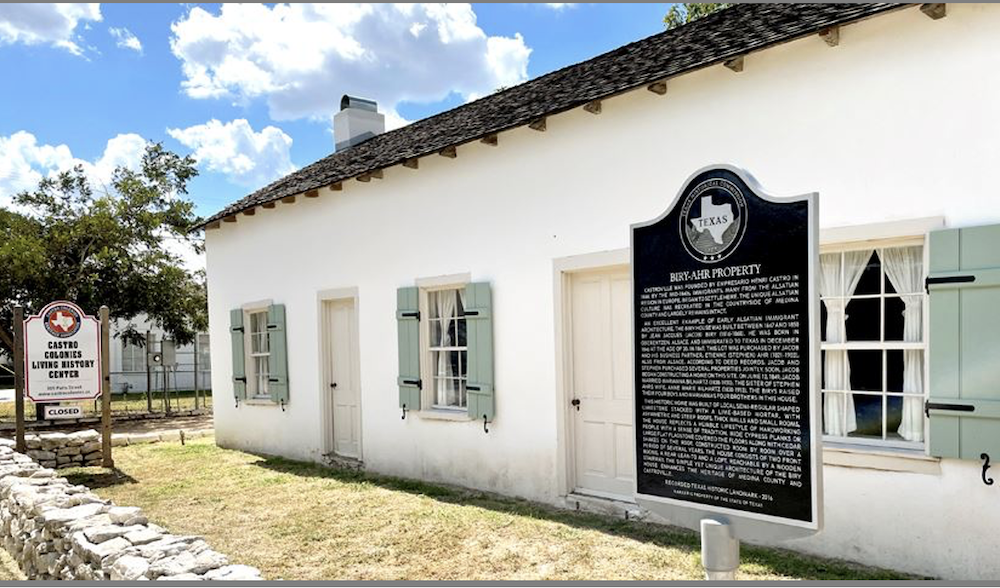
Marker, “Biry-Ahr Property”
309 Paris Street, Castroville TX 78009
GPS: 29.357650, -98.876883
• Inscription (excerpts):
“Castroville was founded by Empresario Henri Castro in 1844. By the mid-1840s, immigrants, many from the Alsatian region in Europe, began to settle here. The unique Alsatian culture was recreated in the countryside of Medina County and largely remains intact.
An excellent example of early Alsatian immigrant architecture, the Biry House was built between 1847 and 1850 by Jean Jacques (Jacob) Biry (1816-1868). He was born in Oberentzen, Alsace, and immigrated to Texas in December 1846 at the age of 30. In 1847, this lot was purchased by Jacob and his business partner, Etienne (Stephen) Ahr (1821-1903), also from Alsace. According to deed records, Jacob and Stephen purchased several properties jointly. Soon, Jacob began constructing a home on this site. On June 12, 1849, Jacob married Marianna Bilhartz (1828-1920), the sister of Stephen Ahr's wife, Anne Marie Bilhartz (1830-1913). The Birys raised their four boys and Marianna's four brothers in this house. [...]”
Erected 2016 by Texas Historical Commission. (Marker Number 18540.)
Jean-Baptiste Cordier, farmer
| | |
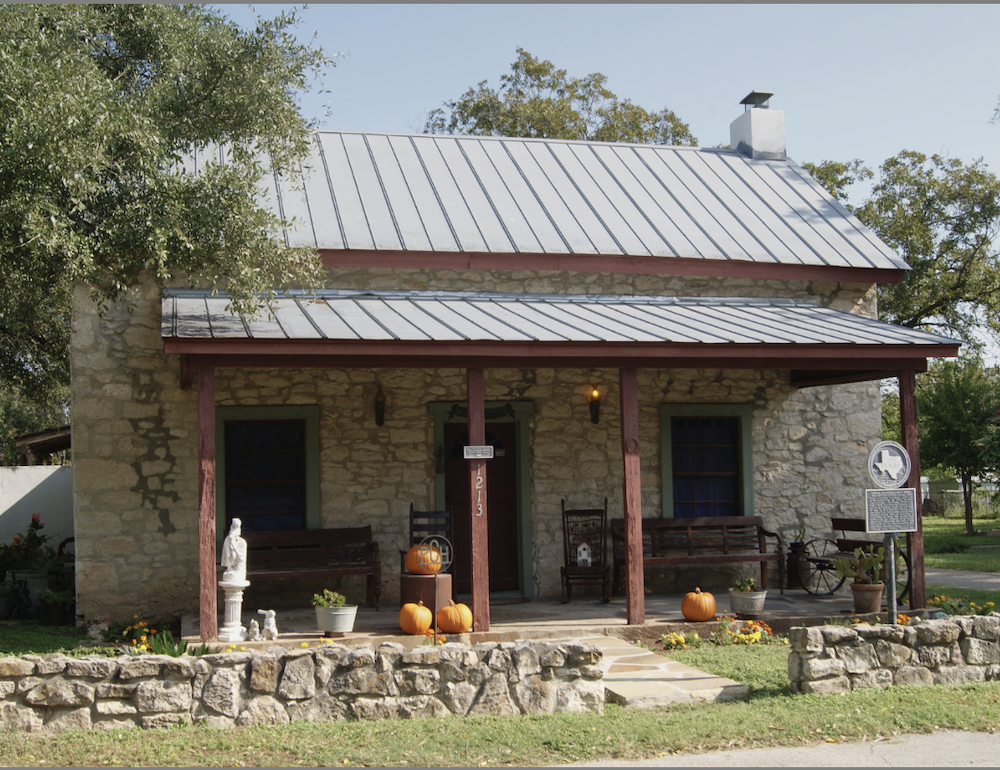
Marker, “Cordier-Tschirhart-Seal House”
1213 Isabelle Street, Castroville TX 78009
GPS: 29.357800, -98.876167
• Inscription:
“Jean Baptiste Cordier (1804-1881) built this Alsatian pioneer dwelling after migrating to Texas in 1844. The native limestone structure had three downstairs rooms and an attic. Cordier sold the cottage in 1847 to blacksmith Stephan Ahr (1821-1903) and shoemaker Jacob Biry (1810-1867), whose families occupied it together. In 1906 the house was purchased by Eugenia Beck (Mrs. Sebastian) Tschirhart (1861-1938). It was restored by her descendants, Mr. and Mrs. Adrian L. Seal.
Recorded Texas Historic Landmark - 1976
Erected 1976 by Texas Historical Commission. (Marker Number 1058.)”
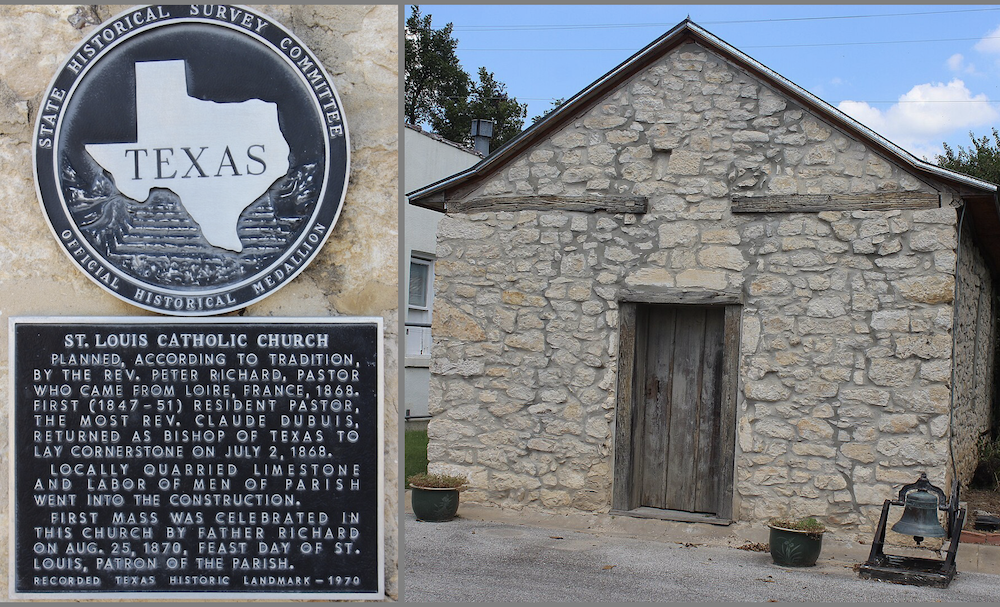
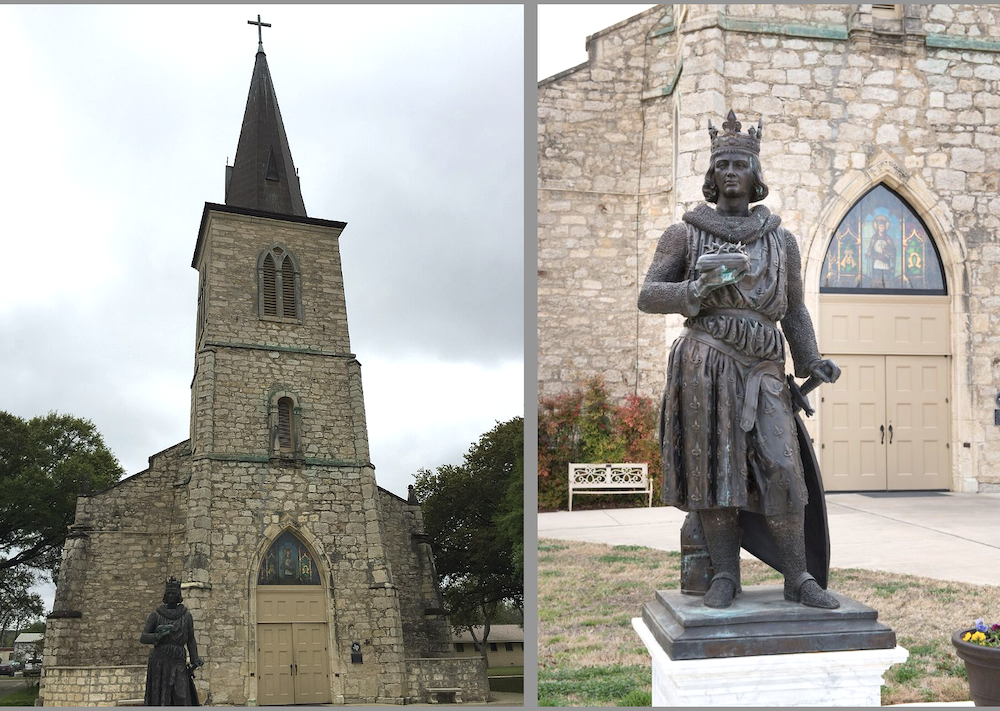
St. Louis Catholic Church
| | |
Above:
Top: original St. Louis Church in Castroville, Tx. Photo by Darrylpearson - Own work, CC BY-SA 4.0, https://commons.wikimedia.org/w/index.php?curid=56285471
Left: The spire of St. Louis the King Catholic Church in Castroville, Texas, viewed from the east, with a statue of St. Louis in the foreground By Bryan Rutherford - Own work, CC BY-SA 4.0, https://commons.wikimedia.org/w/index.php?curid=67684991
Right: Statue of King St. Louis of France, Library of Congress Prints and Photographs Division Washington, D.C., Public Domain, https://lccn.loc.gov/2014631312
| | |
• Jean-Marie Odin, first bishop of Texas, originally from the Loire Département in France, visited just nine days after the first colonists arrived at the site to establish the town of Castroville, celebrated Mass and placed the community under the patronage of St. Louis of France. Father Claude Dubuis, also born in the Loire Department of France, was the first priest.
• The current church was built between 1868 and 1870. Work began in 1868 and with the building complete except for the spire and the floor, the church was dedicated on August 25, 1870, the feast of St. Louis.
Plaque, “St. Louis Catholic Church”
1847 Angelo St, Castroville, TX 78009
GPS: 29.355317, -98.878583
• Inscription:
“Planned, according to tradition, by the Rev. Peter Richard, pastor who came from Loire, France, 1868. First (1847-51) resident pastor, the Most Rev. Claude Dubuis, returned as Bishop of Texas to lay cornerstone on July 2, 1868.
Locally quarried limestone and labor of men of parish went into the construction.
First Mass was celebrated in this church by Father Richard on Aug. 25, 1870, feast day of St. Louis, patron of the parish.
Recorded Texas Historic Landmark - 1970
Erected 1970 by State Historical Survey Committee. (Marker Number 5051.)
• This life sized statue of St. Louis holding a crown of thorns can be found outside of the St. Louis Catholic Church in Castroville, TX.
Marker, “Saint Louis Day”
610 Madrid Street, Castroville TX 78009
GPS: 29.355917, -98.879283
• Inscription:
“Since as early as 1847 residents of Castroville have conducted a community holiday on or about the 25th of August--the Catholic observance of the Feast of St. Louis. Local tradition recalls that early processions escorted clergy from the priests' house adjacent to St. Louis Church, with clanging of anvils and the blare of the community band.
Through the years a picnic became traditional on the church grounds following High Mass. Before the festivities, men smoked sausage and pit-barbecued beef. Women prepared potato salad, cabbage slaw, and desserts. An evening dance in a local establishment ended the day-long celebration.
The St. Louis Society, founded in 1875, traditionally organized the event. Since 1889 the celebration has raised funds for the benefit of the Parish church and school. After the 1920s, the picnic and dance were held at Wernette's Garden. That site (4 blocks NNW) was donated to the parish and renamed Koenig Park in 1949. The dance pavilion there was erected in 1953.
The celebration is now held annually on the Sunday nearest August 25. The procession begins at the church after Mass, and winds through the city to Koenig Park for the picnic lunch and evening dance.
Texas Sesquicentennial 1836-1986
Erected 1986 by Texas Historical Commission. (Marker Number 5054.)”
Marker, “St. Louis Church”
1847 Angelo St, Castroville, TX 78009
GPS: 29.355317, -98.878583
• Inscription:
“Built by Alsatian settlers of Castro Colony, in Republic of Texas dedicated by the Rt. Rev. John Odin, C.M., first Catholic Bishop of Texas, on Nov. 9, 1846. Claude Dubuis, 1847 pastor, was later a Bishop of Texas. Here in 1868 Sisters of Divine Providence opened their first permanent school in Texas. First Mother House of Order in Texas was established in Castroville. Marked on 100th anniversary of founding of the Sisters of Divine Providence in Texas.”
Recorded Texas Historic Landmark - 1966"
2nd Plaque
Presented by
Castroville Garden Club
June 5, 1966
Erected 1966 by State Historical Survey Committee. (Marker Number 5053.)"
Alsatian settlements of Castro colonists
Castroville, Quihi, Vandenburg, d'Hanis
Texas
| | |
• Louis Théodore Jean Gentilz (May 2, 1819 – January 4, 1906) was born in Paris. His father, Pierre Louis Gentilz, was a manufacturer of custom-built carriages in Paris. Gentilz received his training in drawing, painting, and engineering at the Imperial School of Mathematics and Drawing.
• In 1844, Gentilz was hired by the French entrepreneur Henri Castro to work as a surveyor, artist, and promotional agent for Castro's planned colony in Texas.
• Gentilz worked as secretary and surveyor for Castro, guiding settlers to new towns in Castro’s land grant. He helped establish Castroville and likely relocated to San Antonio in the late 1840s.
• In 1849, the same year his father passed away, Gentilz went back to Paris and married Marie Fargeix, bringing her and his younger sister, Henriette Adelaide, to Texas.Three years later, Henriette wed Gentilz’s friend Auguste Fretelliere. From the 1860s until 1894, Gentilz taught art at St. Mary’s College in San Antonio. He also offered art lessons at his home on North Flores Street near Salinas Street and created detailed instructional guides for teaching.
• Today, scholars frequently consult his works, many of which are housed in permanent collections, such as the San Antonio Museum of Art and the Daughters of the Republic of Texas Library at the Alamo. Additionally, collectors eagerly seek out his pieces.
Marker, ”Town of D’Hanis, now known as Old d’Hanis, Tx”
Intersection of County Road 5226 (County Highway 5226) and Highway 5231, Hondo TX 78861
GPS: 29.327650, -99.259350
• Inscription:
“Established in 1847 by 29 families under the leadership of Theodore Gentilz, representing Henri Castro (1781...1861), distinguished pioneer and colonizer of Texas who introduced the early settlers of Medina County. Named in honor of Guillaume (William) D'Hanis manager of the Colonization Society. When the Southern Pacific Railroad missed the town, its citizens moved to present D'Hanis.
Erected by the State of Texas 1936.”
| | Other notable Alsatians in Texas | | |
Above:
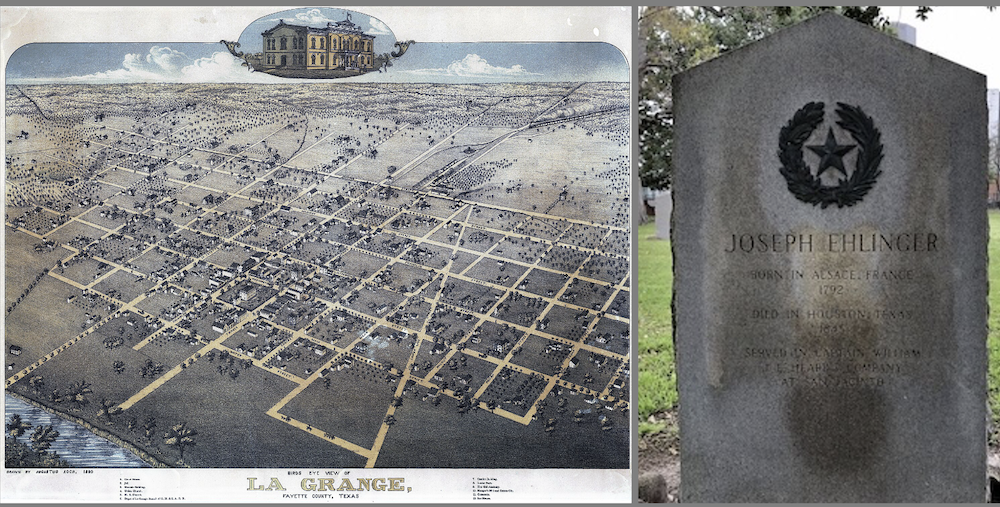
Left: La Grange, TX. named after LaFayette's castle in France, is the county seat of Fayette County, TX, named in honor of the Marquis. It is located about 12 miles southeast of Ellinger, TX., named after Joseph Ehlinger of Alsace. By Augustus Koch (1840-?), Public Domain, https://commons.wikimedia.org/w/index.php?curid=2372125
Right: Joseph Ehlinger's gravestone, Founders Memorial Cemetery, Houston, TX. Photo: https://www.ellingertx.com/ellinger-tx-history-1
| | |
• Joseph Ehlinger was born in Wimmenau, Dept du Bas-Rhin, Alsace, France, and served in Napoleon's army in the Russian campaign.
• He had just married Christine Munsch in March 1834 in her hometown Erckartswiller when they immigrated on board the Pierre Corneille.
• He came to Texas in June of 1835 and served in the Texas Army at San Jacinto in 1836. For his service, he was granted 640 acres, which he chose to be located in present day Fayette and Colorado counties. This extensive acreage included the present site of Ellinger.
• After constructing a house in Fayette County, he went back to Europe to bring his family to their new home. Sadly, he drowned while crossing Buffalo Bayou near Houston. Ehlinger's family moved into the house he built without him being there to witness it.
• Joseph's son, Charles Ehlinger, (born in France 18 Oct 1826 - died 21 Jul 1872 inTexas) became a surveyor and mapped out the original town, which was called Live Oak Hill, just north of what is now Ellinger. This tragic accident prompted Andrea Ondrej, a Czech immigrant, to suggest the town be named in memory of Ehlinger. Charles served as the first postmaster of the town and also became a merchant, farmer, and a Board Member of the First State Bank of Ellinger.
• Charles' son, Joseph "Joe" Ehlinger (born in France 22 Aug 1852 when his parents were visiting family in Alsace - died 15 Jan 1913 (aged 60) La Grange, Fayette County, Texas, USA, was also a U.S. Army veteran.
• In 1873, the Southern Pacific Railroad passed through the area but missed Live Oak Hill by two miles. In 1880, land was given for its current location.
• The name of the town changed from Ehlinger to Ellinger when the railroad arrived, due to a clerical misspelling, according to some, or to facilitate the spelling, according to his descendants.
City of Ellinger, Texas
Grave, “Joseph Ehlinger”
Founders Memorial Cemetery, 1217 West Dallas Street, Houston TX 77019
GPS: 29.757583, -95.379317
• Inscription:
"Born in Alsace, France1792
Died in Houston, Texas1845
Served in Captain William J. E. Heard's companyat San Jacinto
Erected 1936 by the State of Texas. (Marker Number 10655.)"
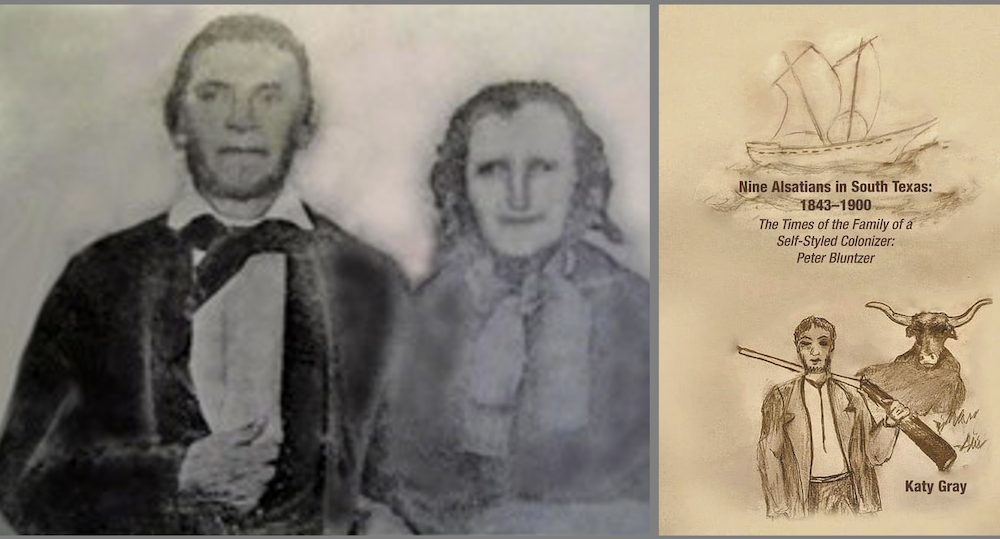
Pierre Bluntzer, rancher
| | |
• Pierre “Peter” Bluntzer (Nov 24, 1805 – July 28, 1872) was born in Oderen, Département du Haut-Rhin, Alsace, married to Theresa Jacobs Bluntzer (born in Kruth, Département du Haut-Rhin, Alsace, on 27 Jan 1805, died Sept. 2, 1869 in Meyersville, TX), were among Henri Castro’s colonists.
They had 7 children, all born in Alsace: Genovefa (1829-1896), Urban (1831-1899), Nicholas (1835-1901), Theresa (1837-1892), Veneranda (1838-1904), Sixtus (1841-1895), Marie-Madeleine (1843-1843).
The latter, born in France in July died in Texas in December, presumably from the hardship of travel.
(https://www.findagrave.com/memorial/34950105/pierre-bluntzer)
• Nicholas Bluntzer (born in Oderen, Département du Haut-Rhin, France - October 29, 1835 – died May 9, 1901 in Hot Springs, Arkansas) emigrated from Alsace when he was 7. His family settled near Victoria, TX, where they faced the constant threat of Indian raids. Over a span of 40 years Bluntzer owned ranches in Coleman, Frio, Nueces and Atascosa counties. He also owned packing houses in Nuecestown and Oso processing beef and vegetables grown on his 1,200 acre farm.
• Bluntzer was a stop on the San Antonio-Brownsville stage line. It was previously called Santa Margarita Crossing before Nicholas Bluntzer settled in the area around 1860. The local school opened in the 1870s and was moved in 1919. Justina Bluntzer, Nicholas's daughter, donated the land for the school. The school operated until it merged with the Banquete Independent School District in 1971.
• Bluntzer, Texas, is a region in Texas that is neither an official town nor a county, named after the Bluntzer family. According to an article on Wikipedia, Eric Bluntzer's children represent the 7th generation of Bluntzers living there. Most residents of Bluntzer, including the Bluntzer family, have been deeply involved in farming and ranching.
Marker, “Peter Bluntzer”
St. Peter & Paul’s Catholic Church, 11220 FM237, Meyersville, TX 77974
GPS: 28.918922, -97.329079
• Inscription:
“Peter Bluntzer. Early German colonizer in this are and donor of land on which this church stands. Migrated with his wife and children from Oderen, Alsace (in Europe), to Texas about 1843. Bound for Castroville with other pioneers, he stayed here after his wagon overturned, injuring his wife. This was the first Catholic family to settle in Coleto (present Meyersville). His enthusiasm for the new home led him to make two return trips to Alsace several years later to bring numerous families to settle here. After his young daughter Theresa was stolen by Indians, she was found some months later, in the woods, unharmed and dressed like an Indian princess; Bluntzer had always been kind to the local tribes. First mass in the community was said in the home of Bluntzer, a devout Catholic, in 1852. Area settlers united to build the first Catholic church in De Witt County -- Sts. Peter and Paul Church -- in 1859 on a 15-acre tract given by Bluntzer. Dedicated in 1860, the small log building was a predecessor to others built 1876, 1892, and the present one of 1939. First priest was the Rev. J. A. Koenig; first resident priest was the Rev. A. Hainke. Many early settlers are buried in the church cemetery. Bluntzer is buried in San Patricio. #3994"
Marker, “Nicholas Bluntzer”
5528 FM3088, Banquete TX 78339
GPS: 27.908217, -97.785333
• Inscription:
“A native of the French province of Alsace, Nicholas Bluntzer came to Texas at age nine with his parents and other Alsatian families led by colonizer Henri Castro. The Bluntzer family settled in DeWitt County, in an area along Coleto Creek which would become the town of Meyersville. In 1856-57 Bluntzer served as a scout in a punitive expedition led by Col. Robert E. Lee against Comanche Indians in West Texas. In 1858 he married Justina Peters. Later, as a member of the Confederate army, he participated in the last battle of the Civil War at Palmito Ranch in May 1865. After the war Bluntzer became an influential rancher, acquiring large tracts of land in Nueces and other counties. He also invested in Corpus Christi real estate. He established a large cotton-growing operation near this site in the 1890s. A settlement grew up in the area and was named Bluntzer. Upon his death in 1901, he was buried in a San Patricio Cemetery. The Bluntzer home not far from this site remained in the family until 1961, when it was bequeathed to the Sisters of the Incarnate Word and Blessed Sacrament. Nicholas Bluntzer was posthumously inducted into the South Texas Cowboy Hall of Fame in 1967.
Erected 1990 by Texas Historical Commission. (Marker Number 6307.)
Joseph Kleiber
Land agent and railroad pioneer
| | |
• Joseph Kleiber, (born May 28, 1833, in Strasbourg, France – died August 13, 1877 in Austin, TX), made his way to America, initially residing in New Orleans before eventually settling in Point Isabel, which is now known as Port Isabel, TX. In 1856, he married Emma Henrietta Butler, and together they had a family of five children. In 1860, Kleiber acquired a drugstore in Brownsville and simultaneously operated it while fulfilling his duties as the Confederate postmaster in the area. When Brownsville was occupied by Union forces, he relocated his family to Matamoros, Tamaulipas. It was there that he engaged in the sale of goods to Confederate troops and participated in the illicit cotton trade. Notably, he played a crucial role in constructing the Rio Grande Railroad connecting Port Isabel and Brownsville. Among his possessions, he left behind a collection of letters written in English, Spanish, and French which provide insights into the life and historical context of South Texas.
Marker, “Joseph Kleiber”
Brownsville Cemetery, E. Madison Street, Brownsville TX 78520
GPS: 25.909550, -97.501350
• Inscription (marker is bilingual English and Spanish):
“Joseph Kleiber was a native of Alsace-Lorraine who owned and operated a pharmacy in Brownsville during the Civil War era. In those years he was also the Confederate Postmaster. His business correspondence was conducted in English, Spanish, and French. He helped establish the Rio Grande Railroad in the 1870s and was linked by marriage with several other pioneer families in the city.
Erected by City of Brownsville, Preserve America, Brownsville Heritage Complex, U.S. Department of the Interior and Brownsville Community Improvement Corporation.”
Mayer Halff, rancher
| | |
Above:
Top Left: Mayer Halff, Photo: https://www.tshaonline.org/handbook/entries/halff-mayer
Top Right: Halff of Texas, Merchant Rancher of the Old West, paperback, 2000 by Patrick Dearen, https://www.amazon.com/Halff-Texas-Merchant-Rancher-West/dp/1571684360
Bottom Left: Marker, photo by Adam Margolis, April 7, 2024, https://www.hmdb.org/m.asp?m=82808
Bottom Right: The Alexander and Alma Oppenheimer Halff House in San Antonio, Texas, United States. The house was designated a Recorded Texas Historic Landmark in 1997. By Larry D. Moore, CC BY 4.0, https://commons.wikimedia.org/w/index.php?curid=39261597
| | |
• "Cowman May, Photo: https://www.tshaonline.org/handbook/entries/halff-mayerer Halff rode a long, busy trail that few men could have followed. It carried him from 1850s France to Texas and across 1,500 miles of wild western country waiting to be tamed. Throughout his life, he was at ease whether dining with a U.S. President at a plush metropolitan banquet or squatting across a campfire from a dirt-streaked cowboy in some forsaken cow camp.Immigrating as a fourteen-year-old, Halff began as a foot peddler. He quickly built the largest dry goods business in the Southwest and by 1861 was pursuing his passion-cattle ranching. He founded several of Texas' famous ranches: the JM Ranch on the Pecos River, the Quien Sabe in the Midland region, the Circle Dot in the Big Bend, the Mallet on the South Plains, and the Schreiner and Halff in South Texas. He eventually controlled almost a million acres..." Excerpts of the book notice of "Halff of Texas" on Amazon.
Marker, ”Halff House”
623 E Nueva St, San Antonio, TX 78205
GPS: 29.420333, -98.487017
• Inscription:
“Mayer Halff (1836-1905) immigrated to Texas from Lauterborg, Alsace Lorraine, France, in 1850. In partnership with his brother Solomon, he opened a mercantile business in Liberty and began a cattle ranching enterprise. They moved to San Antonio in 1864 and established M. Halff & Brother, a wholesale dry goods company. Their ranching interests grew to include over a million acres of land in Texas and other states, and they also became interested in banking.
Mayer Halff purchased land at this site in 1890, and three years later he and his wife Rachel (Hart) had this house built for their family. Exhibiting Eastlake and Richardsonian Romanesque stylistic influences, the Victorian-Era house features a prominent round arch entry, two-story crenellated bay, two-story full-length side porch with eastlake detailing. Originally built on Goliad Street, the house remained on its original site when the street was removed for construction of the Hemisfair facilities in the 1960s.
The Halff family played an important role in the development of San Antonio and the Texas cattle industry. Many of their descendants, some of whom married into the pioneer Oppenheimer family, still reside in the city.”
Erected 1966 by Texas Historical Commission. (Marker Number 2333.)”
Charles A. Schreiner, rancher
"Father of the Hill Country"
| | |
• Charles Armand Schreiner Sr. (born February 22, 1838 in Riquewihr, Département du Haut-Rhin, France – died in Kerrville, TX February 9, 1927), was a cattle and sheep rancher, merchant, banker, politician, and philanthropist from his adopted city of Kerrville in the Texas Hill Country. He is often called the "father of the Hill Country". Schreiner gave away more than a million dollars; his largest gift was to endow Schreiner Institute, since Schreiner University.
Marker “Charles A. Schreiner”
Intersection of State Highway 16 and Main Street, Kerrville TX 78028
GPS: 30.047283, -99.140550
• Inscription:
“Charles A. Schreiner (1838-1927) was born in Riquewihr, France, and moved to San Antonio, Texas, in 1852. He served in the Texas Rangers from 1854-1857 and the Confederate Army from 1861-1865. On this site in 1869, he opened a small store made of cypress planks. From that humble beginning he built a large business empire that included banking, ranching, land holdings, and marketing wool and mohair. Schreiner's was one of the first businesses in the country to recognize the value of mohair and in 1930 Kerrville became known as the Mohair Capital of the World. He was elected Captain of the Kerrville Mounted Rifles in 1875, and carried this title for the remainder of his life. One of his major contributions to the Kerrville community was the founding of Schreiner Institute, now Schreiner University, in 1923.”
| | |
Alsatians in California
Alphonse Weill
Founder of Weill’s Department Stores
| | |
• Alphonse Weill was born on December 20, 1852, in Wolfisheim, Bas-Rhin, Alsace. In 1870, Alphonse Weill immigrated to New York City. From New York City, Weill took the train to San Francisco, intrigued by romance of American mining. Weill headed to Havilah in the San Juaquin Valley, where he worked at his uncle Henry Asher’s hotel for room and board.
• In 1875, he became the the sole owner of the store – known as A. Weill’s, and eventually as Weill’s Department Store. His younger brother, Samuel Weill, was briefly a partner.
• He married Henrietta Levy in 1882 in San Francisco, and were the parents of Blanche, Irma, Adele, and Lawrence. He died on December 31, 1946, at the age of 94.
• Alphonse Weill became also one of the original stockholders of the Southern Hotel, the Bakersfield Water Works, and a principal owners and incorporator of the Jewett Oil Company.
• Their former home at the corner of 17th and H Streets is now at the Kern County Museum in Bakersfield.
Marker, “Alphonse Weill's Department Store”
19th St, Bakersfield, CA 93301
GPS: 35.376333, -119.018283
• Inscription:
“Alphonse Weill came from France to Havilah in 1870 and moved to Bakersfield in 1872, was employed by merchant Jacob Weil (no relation), and became his partner in 1873. Subsequently Weill acquired the business and named it Weill's Department Store. A brick building replaced the wood structure in 1887 and was rebuilt after the fire in 1889. Weill died in 1946 and the firm was sold in 1952, but continued to operate as Weill's until 1963.
Erected 1976 by Lawerence & Helen Weill, Bakerfield Bicentennial Committee.”
Marker, “ Weill House”
3801 Chester Ave, Bakersfield, CA 93301
GPS: 35.392600, -119.021717
• Inscription:
“Built on the southeast corner of 17th and H Streets in Bakersfield in 1882, Alphonse and Henrietta Weill’s house was considered “modern” for its day because of the high ceilings, long hallway, and indoor plumbing.
In 1870, Alphonse Weill migrated from France to Kern County. He originally settled in the mining town of Havilah to pursue a career as a merchant. Two years later, Alphonse moved to Bakersfield and later opened his own general merchandise store. Alphonse was a successful businessman operating his store in Bakersfield for more than 70 years.
Henrietta Levy Weill, a native of San Francisco, came to Bakersfield at the time of her marriage in 1882. Alphonse and Henrietta had four children, Blanche, Irma, Adele and Lawrence. A member of numerous civic organizations, Henrietta worked to improve the lives of Kern County residents through education and social service. The Henrietta Weill Memorial Child Guidance Clinic is named in her honor.
The Weill family donated the house to the Museum in 1950.
Erected by Kern County Museum.”
Fritz Family Homes
Philippe Fritz, carpenter
| | |
• Philippe Fritz (born May 1, 1844 in Preuschdorf, Bas-Rhin, France – died Jan 30, 1932 in L.A.) was among the thousands of Alsatian pioneers emigrating to the United States after the Franco-Prussian War of 1870.
He moved to America in 1873. He worked as a carpenter and later for the Southern Pacific Railroad in the Buildings and Bridges department. His wife, Louise Schaffner, and their children, Philip W. Fritz, George C. Fritz, and Fred Fritz, arrived in the US in 1884.
• During the 1850s to 1860s, French immigration peaked, making the French the fastest-growing immigrant group in L.A. Many of these French immigrants settled to the east and southeast of the Pueblo Plaza. At the same time, the Chinese immigrant community also expanded due to poor conditions in China and the demand for cheap labor in America. The construction of Union Station in the 1930s destroyed the original Chinatown and many French boarding houses and hotels near Alameda and Aliso streets. Many Chinese-Americans then moved into the old French quarter, which eventually became today's Chinatown.
Marker, “The Fritz Family homes”
415 Bernard St, Los Angeles, CA 90012
GPS: 34.067033, -118.236300
• Inscription (excerpts):
“The houses at 411 and 415 Bernard Street — today home to the Chinese Historical Society of Southern California and Chinatown Heritage and Visitors Center — were once part of a three-home complex built by Philip Fritz. An immigrant from Alsace, Fritz worked first as a carpenter then as superintendent of buildings and bridges for the Southern Pacific Railroad” [...] In 1886, Fritz built his first home on the property. As his family grew, he added two more in 1888 and 1892.[...]
Erected by City of Los Angeles.”
Alsatians in Columbia mining town
California
| | |
Above:
Left: Marker Charles Kress, Photo by Syd Whittle, September 21, 2006
https://www.hmdb.org/m.asp?m=12988
Right: Lithograph of Columbia in 1852 by G.H. Goddard. Courtesy Library of Congress/Yale University Library. https://calisphere.org/item/ark:/13030/tf4r29p39d/
| |
• Columbia started as a boomtown in 1850 after gold was discovered during the California Gold Rush, earning the nickname "Gem of the Southern Mines.”
• According to the website https://www.ancestry.com/genealogy/records/felicia-kress-24-1l8hwv6, Charles Crist Kress (1828-1913) was born in Alsace.
Marker, “Charles Crist Kress”
Columbia Cemetery, Columbia CA 95310
GPS: 38.038850, -120.399200
• Inscription:
« Charles Crist Kress died Oct. 10, 1913. Age 84, Native of Alsace-Lorraine. He spoke five languages , a veteran of the Crimean War, married in New York, came around the Horn to San Francisco. He owned a baker shop on Kearny St. In 1863 he bought 160 acres near Columbia for $75. He baked, mined, ranched and served as court interpreter to provide for his six children, Bill, Emma, Ed, Lula, Louis, and Felicia. He was honest, industrious, dependable. Anna his wife died in 1883. The last to go was Louis in 1954, age 84. All Rest here."
• There were many French immigrants in the Gold rush, and are memorialized with markers and plaques. Several, including Prosper Rocher, were likely from Alsace.
Marker, “Prosper Rocher Brewery”
Jackson StreetColumbia CA 95310
GPS: 38.035733, -120.399167
• Inscription:
“In 1856 Prosper Rocher constructed Columbia's second brewery located one-half mile east of town on the north side of Yankee Hill Road. Rocher, a French physician, was first partners with Anton Bixel in the Columbia Brewery on Italian Bar Road. Rocher's brewery business failed and by 1861 the brick building was dismantled, leaving only the basement depression and stone foundation visible today.
Dedicated by
Matuca Chapter 1849
E Clampus Vitus
September 11, 1993 (5998)
Credo Quia Absurdum
Erected 1993 by Matuca Chapter, E Clampus Vitus.”
These are just a few of notable Alsatians remembered with markers and plaques throughout the United States. Many of them are half-forgotten, yet, they contributed greatly to the prosperity and growth of their adopted nation.
We cannot end this tour without including this famous family, also of Alsatian descent!
| |
Alsatians for all the ages...
The Marx Brothers
| |
Above:
Left: The Marx Brothers, on the set of Duck Soup. Top to bottom: Groucho, Gummo, Harpo, Chico, and Zeppo.Photographed by Steve Stoliar, circa 1930s, https://www.alexfilmsociety.org/newsletters/DayAtRaces_web.pdf
Right: The only known photo of the entire surviving Marx family, c. 1915. From left: Groucho, Gummo, Minnie (mother), Zeppo, Samuel (father), Chico, and Harpo, Public Domain, https://commons.wikimedia.org/w/index.php?curid=42851
| |
• Samuel Marx III (born as Simon Marx on October 23, 1859 in Mertzwiller, a small village in the Département du Bas-Rhin, Alsace) came to the U.S. from France in 1880.
• Due to his place of birth, he was known as "Frenchie”. He worked as a tailor, and he met Miene “Minnie “ Schönberg, born in Germany). Minnie came from a family of performers.
• They had six sons together, five of whom became the famous Marx Brothers comedians: in 1887, Chico, 1888, Harpo, 1890, Groucho, 1892, Gummo and 1901, Zeppo.
• Samuel carried his French-Alsatian identity with him to America, as evidenced by his enduring nickname "Frenchie". A biography states: "Simon worked as a tailor, but since he refused to use a measuring tape, his customers were seldom satisfied. His real talents were in cooking". He died in 1933 and is buried in Los Angeles.
Marker, “The Marx Brothers - Chicago Tribute”
4512 South King Drive, Chicago IL 60653
GPS: 41.812517, -87.617067
• Inscription:
“The Marx Brothers Comedy team:
The Marx Brothers lived here at 4512 Grand Boulevard (now King Drive) when they moved to Chicago to tour the vaudeville circuit in the 1910s. Their act, “The Six Musical Mascots,” included all five brothers and their aunt, Hannah. The song and dance routines of the early Marx Brothers evolved into the rapid-fire comedy for which they are best known. After several years in vaudeville, they took their routines to the Broadway stage; and soon after began working in motion pictures. The Cocoanuts, an adaptation of their Broadway routine, was followed by Animal Crackers, Monkey Business, Horse Feathers and Duck Soup in the 1930s. By 1935 Zeppo and Gummo had left the act for other careers, but Groucho, Chico and Harpo continued their madcap partnership. Groucho’s uninhibited wisecracks, Chico’s unorthodox piano technique, and Harpo’s not-so-angelic harpist made movies like A Night at the Opera and A Day at the Races classics of American comedy. When the team broke up in 1949, they continued their idiosyncratic styles in solo careers in television, motion pictures and writing. Erected 1998 by Chicago Tribune, Chicago Department of Cultural Affairs."
Note: When Samuel married Minnie in New York, they lived at 354 E 82nd Street in the Yorkville neighborhood in the Upper East Side. A newer apartment building has been built since. There is no plaque or marker memorializing the place where the Marx brothers grew up.
| |
Epilogue:
L'Union Alsacienne
A vibrant community to this day
| |
Above:
Left: Logo of L'Union Alsacienne, founded in 1871 in New York
https://www.alsace.nyc/about-us
Right: Alsatian-inspired house in San Antonio, TX, by Théodore Gentilz, May 1864, https://www.vintagetexaspaintings.com/texas-art/343-theodore-gentilz-san-antonio-may-1864-watercolor
| Founded in 1871, L’Union Alsacienne is a vibrant organization of Alsatians living in the United States, of Alsatian-Americans, dedicated to upholding their Alsatian heritage, and friends of Alsace. For nearly 150 years L’Union Alsacienne has played an important role in the lives of newly-arrived Alsatian immigrants, providing them with a feeling of community and contact with others from their beloved province. More recently a new generation of Alsatian-Americans has created a wider base of membership. We are not only the native-born immigrants who came to the United States seeking new opportunities. We are also their wives and husbands, their children and grand-children, all holding Alsace close to our hearts, keeping Alsatian culture and heritage alive, and promoting knowledge and understanding of its traditions and products through L’Union Alsacienne. | | |
PART TWO
Tribute to the American Volunteers
who joined the Lafayette Flying Corps:
We continue our series started in October 2023 with individual tributes to members of the Escadrille Lafayette, later part of the Lafayette Flying Corps. To access our Bulletin dedicated to the Escadrille Lafayette, visit:
https://conta.cc/3Qz0Xjl (original version in English)
https://conta.cc/3QCRqYM (version en français)
This month we are paying tribute to another American volunteer who fought for freedom and democracy:
First Lt Carter Landrum Ovington
"Mort Pour la France"
29 mai 1918 (aged 21)
Fère-en-Tardenois, 02 - Aisne, France
Note*: "Mort pour la France" meaning "Died for France," is a legal term in France. It is an honor given to those who lost their lives in conflicts while serving the country. This phrase appears on their death certificates. Both French citizens and foreign volunteers can receive this recognition.
| | |
• Lieutenant Carter L. Ovington was the only son of Edward J. and Georgia Cheatham (Maize) Ovington and was born on May 1, 1897, in Baden-Baden, Germany. His father was one of the heads of the Ovington Brothers Company, a china business out of New York City. Because his father took care of the European end of the family business, Carter spent his first ten years in Germany followed by eight years in France.
• Ovington was only 19 years old when he joined the Escadrille Lafayette, which was an elite group of just 38 pilots headed by French commander Capt. Georges Thenault, and served as its secretary (he was not among the original "Valiant 38" original pilots). After the United States entered the war in April 1917, the Escadrille Lafayette evolved into the Lafayette Flying Corps, and most of its surviving pilots thus joined the U.S. Army Air Service.
• Ovington became a Lieutenant in the U.S. Army but remained attached to the French Air Service.
• Lieut. Carter L. Ovington was killed when, while out on a mission, his plane had a mid-air collision with another plane from his squadron on 29 May 1918. This was during the time of the German offensive toward Chateau-Thierry. He crashed near the village of Lagery in the Marne Department, and his body was never recovered. His name is one of the 1060 listed on the chapel wall at Aisne-Marne American Cemetery and Memorial under the heading "The Names Recorded On These Walls Are Those Of American Soldiers Who Fought In This Region And Who Sleep In Unknown Graves"
• The name of Sergeant Carter L. Ovington (the highest rank he held in the French Army) is one of those honored on the Lafayette Escadrille Memorial in Marnes-la-Coquette right outside of Paris.
• After the War, his mother, Mrs. Georgia M. Ovington, made several trips to the village of Lagery. Eventually she had a bench made to honor her son (see photos below).
• Lieutenant Carter L. Ovington was awarded the French Croix de Guerre, and in 1925, he became a Knight of the French Legion of Honor.
| | |
PART THREE
NEWS, ANNOUNCEMENTS & SAVE THE DATES
| | |
Tribute to 8 French soldiers
buried at Old St. Peter's Church
Cortlandt, NY
September 20, 2025
| | |
On Saturday, September 20, 2025, we had the honor of attending the annual commemoration organized by the Cortlandt Historical Society and W3R. The ceremony pays tribute to eight French soldiers from Rochambeau's army who died of illness and are buried alongside other Revolutionary War patriots. These soldiers perished while Old St. Peter's Church—built in 1766 and remarkably preserved—served as a hospital during the war. Three of them (Paquais, Bonnair and Duguin) died in 1781 on the way to Yorktown, the others died during the return march of 1782, on the way to Boston.
Our Society's President, Thierry Chaunu, accompanied by Bertand Jost, Board Member, delivered remarks before the formal ceremony, which featured period re-enactors firing three musket salutes. The event concluded with a reception where guests enjoyed birthday cake in celebration of the 300th anniversary of Rochambeau's birth. We extend our sincere gratitude to Jeff Canning and all the volunteers, including Anne de neuville, who made this meaningful commemoration possible.
Old St. Peter's Church
Old Hillside Cemetery, Locust Ave & Oregon Rd, Cortlandt, NY 10567
GPS: 41.314134, -73.900233
• Inscription:
“We remember these French soldiers who gave
their lives for our independence
in our old St Peter’s building
years 1781 – 1782”
Lieutenant de Mauvis Jean Bonnair
Jean Joseph Paquais Alexis Labrue
Joseph Duguin Georges Mochl
Claude-Pierre Dumageot Philippe Mortagne
| | |
"The French Army in Westchester County"
1781-1782
A lecture at Scarsdale Public Library
September 24, 2025
| | |
From Michel Perez, President, Alliance Française of Westchester:
"On September 24, 2025, at the public library of Scarsdale, NY, le Souvenir Francais, the Scarsdale Forum and Alliance Francaise of Westchester hosted a joint event on the role of "The French Army in Westchester during theAmerican Revolution". The distinguished lecturer, Thierry Chaunu, president of The American Society of Le Souvenir Français and author of Memories of France, explained to an audience of more than sixty participants the crucial role in the summer of 1781 of the army from France led by count Rochambeau which joined forces in Westchester with the American troops led by General George Washington. They went on to Virginia to secure the siege of Yorktown. The surrender of the British forces of general Cornwallis to generals Washington and Rochambeau on October 19,1781 was the final military episode of the Revolutionary War and secured the independence of the United States of America. The lecturer lively retraced the many challenges faced by the American and French soldiers and captivated the audience by his thorough knowledge."
Photos:
Top row: K. Graytok Middle & Bottom: © courtesy of Lisa VanGundy, Scarsdale Forum Photographer
| | |
Battle of the Hook Commemorative Ceremony 2025
October 3, 2025
| | |
• We unveiled our two historical panels in 2023 and our granite stele in 2024, and recounted the Battle of the Hook in our Bulletin:
September 2023: the Duc de Lauzun and his Legion of hussars
https://conta.cc/460bXLT (original version in English)
https://conta.cc/3tb3hni (version en français)
• This gave rise to a commemoration, initiated by Robert Kelly, which will hopefully become an annual event, held every October 3rd. It was attended by children from Abingdon Elementary School, located on the exact site of the battle, by Nicole Yancey, Board Member and Regional Delegate of our Society, former Honorary Consul of France in Virginia, and by officers from the French Armed Forces stationed at NATO Headquarters in Norfolk.
From Robert Kelly, Jr., Historic Resources Supervisor, Parks, Recreation & Tourism, Gloucester County, Virginia:
"Dear Friends and Supporters of Gloucester County History:
I want to thank you all again for participating in the 3 October 2025 Commemoration of the Battle of the Hook. Please enjoy photos and a full video of the ceremony by clicking the links below. Many thanks to my colleague, Susan Ammons, for documenting the ceremony with her amazing photographic skills!
Photos: https://susanammons.pixieset.com/battleofthehookceremony/
Video: Battle of the Hook Commemorative Ceremony 2025
Huzzah!"
| | News from the "Merci Train" | | |
"Merci train" story: click above or: https://vimeo.com/18495973
• Our November 2022 Bulletin narrated the incredible story and ongoing legacy of the "Train de la Reconnaissance Française", affectionately called "The Merci Train" (November 2022: "The Merci Train, 49 boxcars of French gifts"
https://conta.cc/3OLtgJ3 (original version in English)
https://conta.cc/3VpKzRP (version en français)
• The Merci Train, the 40&8 National Box Car Association and many other local organizations, custodians of the various "Merci train" boxcars in several States are planning various events throughout the year. We invite you to check their respective websites and follow them on social networks. We express our admiration for the fantastic work they are doing and we are honored to help get the word out.
| | News from the New Jersey boxcar | | |
Above: Photos: https://www.facebook.com/groups/TheMerciTrain
"After many decades away from home, New Jersey’s “Merci Train” boxcar is headed back to the Garden State!
Over the past several weeks, URHS volunteers traveled to Kansas City to prepare this very fragile piece of history for the 1200-mile journey home. The car has been indoors since 1993, but much of the roof and floors had deteriorated during its previous time out in the elements. Volunteers sifted through the what was left and conserved every part that could either be reused or utilized for reference in the restoration. That was followed by the removal of decades of dust and removal of any loose components that might shake loose in transit. Finally, the car was placed back on wheels, which are identical to those installed on it in 1949.
We owe a tremendous thanks to Huddleston Machinery Moving, which not only stored the car indoors for more than 30 years, but also donated the transportation of this car back to New Jersey. Four generations of the Huddleston family took care of this car, and we are grateful for their role in its story.
As the car departs Kansas City, it bids farewell to the National WWI Museum and Memorial which saved it from destruction in 1993, protected it, and generously chose to donate it back to its home state once its identity was discovered. We are thrilled to be carrying on its legacy. "
"Some of our team headed out to Kansas City a few weeks ago to prep the boxcar for transport! We cleaned out the car of all rotted wood and fallen roofing, taking care to save anything that might be remotely usable for the restoration.
The big moment was finally putting the car back on wheels. (As a reminder, the wheels are original to 1949, just days after it arrived in the US). Thankfully we were able to get the hubs free, so the car can wheel around on its own. The steering axle is plenty seized, but we can still lift it from one end and cart it around as needed. Now it finally looks like a real boxcar.
The car has been stored at Huddleston Machinery Moving in KC, so they are well equipped to lift and move the car with their massive forklifts. After we left for NJ, they wrapped the car substantially and placed it on the trailer for shipping. They were even generous enough to donate the move back to New Jersey."
"The boxcar is back home! Huddleston delivered the car home to us on Friday morning. And after a few hours of finagling, we rolled the car off the trailer and into our shop in Boonton, NJ. We made sure for it to arrive inside with the proper amount of revelry, and a few big American and French flags.
It arrived in time for our “Railroad Museum [for a day]” event at our yard this past Sunday. More than 1800 guests saw it throughout the day. The Questers, which have donated to a number of these Merci Train restorations, generously contributed the shields, which arrived in time for us to put them on display. These shields are identical to those used on the Utah and Hawaii restorations, so we are lucky to benefit from the research and hard work of others!
We included a segment of the banner on the English side as well. The final product will be hand-painted, but we thought it important give the public a sense of what the boxcar will soon become.
Thanks all for reading, and please consider donating to the project! "
https://www.urhs.org/mercitrain
The 2026 Merci Train calendar is here!
| | |
The 2026 Merci Boxcar Calendars are available!
Proceeds go to the National Box Car Association to help fund activities and programs supported by the NBCA.
Calendars are $15 each, 2 for $25 or 5 for $50.
Please contact Dave Knutson via email at djk3002@yahoo.com if you are interested.
| | |
Update on our restoration of
the Lapérouse Memorial
in Maui, Hawaii
Phase Two
| | |
La Pérouse Memorial, Maui, Hawaii
Off Makena Road, Kihei, HI 96753
GPS: 20.600745, -156.419877
Photo: Image capture Google maps
| | |
• After a couple of years, finally, the restoration of the Lapérouse Memorial is complete! Thanks to the generous support of Marc Onetto, Regional Delegate of Le Souvenir Français in the West Coast and keen admirer of this great explorer, the support of the Consulate General of France in San Francisco, as well as the support of Mr. Sumner Erdman, owner of Ulupalakua Ranch on which the monument is erected, our Society has completed the restoration on June 1st.
• The structure made of lava rocks was crumbling, and the bronze plaque had become illegible over the years.
Phase Two now underway: Interpretative marker
A beautiful interpretive marker is currently being made by a local signage manufacturer (photo above). It will explain to the tourists who was Lapérouse, the scientific and peaceful purpose of his 1786 circumnavigation exploring the Pacific, Alaska and California, and notably his friendly relations with the natives of Maui. This signage, inspired by other Hawaiian historical markers, is made possible by the generosity of Marc Onetto, Regional Delegate of our Society for the West Coast, and board member Jean-Hugues Monier.
The planned rededication on November 12th in the presence of H.E. Mr. Laurent Bili, Ambassador of France to the United States, has just been postponed until next Spring. We will alert you in due time on the new dates!
| | |
Update on our
Projected sculpture of
Antoine de Saint Exupéry & The Little Prince
Phillip & Patricia Frost Museum of Science
Downtown Miami, Florida
| | |
Dear Friends of The Little Prince,
Generations of children -- and with them generations of adults -- have fallen under the spell of Antoine de Saint Exupéry’s The Little Prince since its 1943 publication. Appearing in over 600 languages to date, it is the most translated book of fiction in the world. Dozens of plaques and statues commemorate the Little Prince who touches down from his lonely planet to offer a bouquet of wisdoms to this one.
As an international city, very much a crossroads of the Americas, Miami surely deserves a monument to the Little Prince, that most endearing of cultural ambassadors.
The American Society of Le Souvenir Français, Inc., and the France-Florida Foundation for the Arts, both non-profit 501 (c) 3 organizations, are proposing a bronze sculpture of Saint Exupéry and his most beloved creation for the Phillip and Patricia Frost Museum of Science. The statue would be installed on the esplanade near the museum entrance, in the heart of downtown Miami.
The life-size bronze sculpture designed by renowned artist Jean-Marc de Pas will depict the aviation pioneer, WWII hero, poet, and novelist Antoine de Saint Exupéry in his flight suit, holding the hand of his “petit bonhomme”. Another de Pas sculpture currently sits along a wall opposite Central Park on Fifth Avenue in New York City. It has been an overnight success with the public, who have lined up daily for photos since its 2023 inauguration. We expect the same in Miami, especially at a museum and planetarium frequented by so many families and young children.
This project, a gift to one of Miami’s most vibrant cultural institutions, has received the official endorsement of H.E. Mr. Laurent Bili, Ambassador of France to the United States and Mr. Olivier d'Agay, President of the Antoine de Saint Exupéry Youth Foundation and grand-nephew of the author of The Little Prince. On behalf of our Honorary Committee, we are soliciting your tax-deductible assistance in underwriting the sculptures, along with their transportation and installation.
Any donation of $100 or more will be duly recognized. Names of donors above $1,000 will be engraved on a plaque to be installed inside the Museum, according to the following levels:
Bronze $1,000-$5,000 // Silver $5,000-$10,000 // Gold $10,000-$20,000 Platinum: $20,000 or more.
We gratefully acknowledge a generous donation from Venturi, via Mr. Gildo Pallanca Pastor, the Consul General of Monaco in New York, and from Christian Dior Parfums. Their names will be added to the plaque and we will continue to express our gratitude to them in the coming months and the future inauguration, hopefully in a year from now.
As of today, we have raised close to $70,000, however we still need additional donations in order to have the sculpture completed and sent to the foundry. Individual or corporate donations are actively sought!
Please contribute what you can—and inform us if you know any organizations or individuals who might be able to make significant donations.
Please send your donation (specify: Petit Prince)
by ACH wire to:
The American Society of Le Souvenir Français Inc.
TD BANK - 1031 1st Avenue, New York, NY 10022
Routing # 026013673 - Account# 4326011741
Or by check, made payable to:
The American Society of Le Souvenir Français Inc.
500 East 77th Street #2017, New York, NY 10162
or via PayPal:
https://www.paypal.com/donate/?hosted_button_id=WP5E5SCTBTFMN
| | |
Announcing
The Rochambeau Monument Project
Meadowview Park, Middlebury, CT
2026
| |
Above:
Top: Rendering of the Rochambeau Memorial Statue at Meadowview Park, Middlebury, Connecticut by Tony Falcone.
Middle top: Sculptor Tony Falcone in his studio with a model of the future statue
Middle bottom : French soldiers marching on the aptly-named Breakneck Road, on their way to camp in Middlebury, CT. Illustration by Don Troiani: https://www.middleburyhistoricalsociety.org/rochambeau-project/
Bottom: The field were the French Army camped on June 27-29, 1781 has been left untouched for 244 years, thanks to generations of land owners. Photo: TC © ASSFI, 20225
| | |
The Rochambeau Memorial Project
in Middlebury, Connecticut
Needs Your Help!
Middlebury’s Role in the American Revolution
The Rochambeau Monument Project is a major initiative of the Middlebury Historical Society, commemorating a pivotal moment in our town’s Revolutionary War history.
Timed to coincide with the 250th anniversary of the Declaration of Independence and the start of the Revolutionary War, the monument honors the French troops who marched through Middlebury in 1781 under the leadership of General Jean-Baptiste de Rochambeau. Their presence was part of the critical French-American alliance that helped turn the tide of the war. More than 2,000 of these soldiers died in the fight for American independence.
The monument will be installed at Meadowview Park in 2026.
This monument will honor the encampment of General Rochambeau’s French army in Middlebury on June 27-30, 1781 during their historic march to join General Washington.
As Ms. Alice DeMartino, Board Secretary of the Middlebury Historical Society wrote:
"What makes this monument especially distinctive is that it does not portray a general or statesman— instead, it honors the French foot soldiers themselves: the men who marched, suffered, and in many cases died for American independence. Their courage and sacrifice are too often overlooked. Our project includes a major fundraising effort, a commissioned sculpture by Tony Falcone, and educational materials for the public".
We invite you to visit our dedicated website to learn more:
https://www.middleburyhistoricalsociety.org/
A more detailed article and updates on this very exciting project will be forthcoming in our next bulletins. Stay tuned!
| | |
Fund-raising Appeal to help
a Memorial site
honoring American G.I.'s who died for
the liberation of Brest, Sept. 1944
To be inaugurated November 16, 2025
| | |
A few months ago we were approached by the Municipality of Gouesnou, a suburb of Brest in Brittany, regarding their projected memorial. The overriding concern was to make sure all the American soldiers who died in Gouesnou during the Liberation of Brest in 1944 have their names engraved on the 6 piers of the Memorial, and none would be left behind.
We in turn reached out to our partners and friends Mr. Richard Azzaro, Founder and president, and Mr. J.R. Neubeiser, historian at the Tomb of the Unknown Soldier Foundation. In close coordination with local historians in Brittany, and after combing through hundreds of documents from all U.S. Army units engaged, a total of 229 G.I.'s have been formally identified as having made the ultimate sacrifice during this epic and protracted battle.
The granite pillars were installed this month. Landscaping work will begin shortly, and at the end of October, the life-size bronze sculpture of a G.I. will be installed on site.
Invitations to families, U.S. Army Veterans and active duty personnel will be sent soon, for what promises to be a very moving dedication. Stay tuned!
| | |
Announcement from
Joy Song, Society Member
Publication of the children's book:
"Joy and the Menagerie"
| | |
"Joy and the Menagerie", based on the imagination and Inspiration of Joy Song, by Joseph T. Hoban and Joy Song.
"A global adventure of bears, a bunny, a puppy and a working mom, how they all met, and how they support each other. In particular, Officer Gerard Bear, formerly an officer with the Police Nationale in Paris, France, finds a job at the French Consulate in Chicago to help his mom with the household finances. It becomes a second home for him, and leads him to some interesting adventures, more of which will be forthcoming in book 2."
A great gift idea for the Holidays Season!
Available on Amazon.com
- ASIN : B0FH5H252F
- Publisher : Austin Macauley
- Publication date : August 15, 2025
- Language : English
- Print length : 130 pages
- ISBN-13 : 979-8895432587
- Item Weight : 9 ounces
- Reading age : 9 - 11 years
| | |
The Lower Manhattan Historical Association
Celebration of Saratoga and Yorktown victories
October 18, 2025 2:00PM
| | |
From James S. Kaplan, Chairman, Lower Manhattan Historical Association:
"I invite you all to come to the Lower Manhattan Historical Assocation’s 12 th annual Saratoga Yorktown celebration on October 18 at 2 pm in St Paul’s Chapel.
As in prior years we will be honoring Revolutionary War Generals Horatio Gates, Marinus Willett and Alexander Hamilton who are buried in Trinity Churchyard, and I will be giving my seven minute speech on Marinus Willett the hero of the battle of Fort Stanwix, Mayor in 1807 of New York City, diplomat who negotiated the Treaty of New York with the Creek nation in 1790 and an early leader of the Tammany Society."
Note:
• St. Paul's Chapel of Trinity Church Wall Street, 209 Broadway, New York, NY 10007, is the oldest edifice surviving from the Revolutionary period in New York. George Washington prayed there after his inauguration. Major Pierre l’Enfant designed the altar piece called « Glory » which was installed in 1787.
• Annual celebrations to commemorate the victories of Saratoga and Yorktown are held at St Paul's Chapel Cemetery (Broadway in lower Manhattan). They are organized by the Lower Manhattan Historical Association, with the participation of the Federation of French War Federation, the American Society of Le Souvenir Français, and the Association des Cadres de French Reserve in the United States (ACREFEU).
• Étienne Nicolas Marie Béchet, Sieur de Rochefontaine. (February 20, 1755 – January 30, 1814) was a French military engineer who served in the Continental Army, and later as the Chief of Engineers of the United States Army Corps of Engineers. He came to America in 1778 as a volunteer. For his distinguished services at the siege of Yorktown, Rochefontaine was given the brevet rank of major by Congress, November 16, 1781. He came back to the United States in 1792 and anglicized his first name to Stephen. President Washington appointed him a civilian engineer to fortify the New England coast, in 1794. Rochefontaine started a military school at West Point in 1795, but the building and all his equipment were burned the following year. He left the Army on May 7, 1798, and lived in New York City, where he died January 30, 1814. He is buried in the Churchyard of St. Paul's Chapel in New York. His tomb (photo above) has many bronze plaques, including one which reads:
• Inscription:
Lt. Col. E.M. Bechet
Sieur de Rochefontaine
1755-1814
Revolutionary War Soldier
"A French officer who fought for American independence, Rochefontaine served under the French General Rochambeau during the Revolutionary War. He assisted in the capture of Lord Cornwallis and later commanded the Corps of Artillerists and Engineers at West Point Military Academy.”
| | |
Annual Yorktown commemorations
October 19, 2025
Yorktown battlefield, Virginia
| | |
If the government is still shut down on October 14, the Parade and French Cemetery events will be canceled. The other events listed below will remain intact or be moved to other locations. Specifically, the patriotic exercises would be held at the amphitheater of the ARMY museum (weather permitting).
Sunday, October 19, 2025
(244th anniversary of the allied French-American victory)
10:00 a.m. Commemorative Ceremony at the French Memorial
10:45 a.m. Memorial Wreath-Laying Ceremony at the French Cemetery (may be cancelled)
LUNCH BREAK
1:30 p.m. Yorktown Day Parade, Main Street (may be cancelled)
2:15 p.m. Patriotic Exercises at the Monument to Alliance and Victory
| | |
Announcement from
The Federation of French War Veterans, Inc.
Ceremonies:
Saturday, November 1st, 2025:
The Carré des Anciens Combattants
Flushing Cemetery, 9:30AM
The French Sailors Lot
Cypress Hills Cemetery, 11:30AM
Sunday, November 9, 2025:
Messe du Souvenir
Eglise Notre-Dame, 10:30AM
Tuesday, November 11, 2025
Veterans Day Parade on 5th Avenue
| | |
• On Saturday, November 1st, alongside our friends and partners from the Federation of French War Veterans and the ACREFEU (French Reserve Officers in the USA), our Society will lay a wreath to honor the Veterans who rest at the "Carré des Anciens Combattants" at Flushing Cemetery in Queens. In the presence of a R.O.T.C. Color Guard, we will honor in particular WWI hero Eugene Bullard, who was officially declared the " First African American Fighter Pilot" by the U.S.A.F., and who rests among his French brothers-in-arms.
• Immediately after this ceremony, we will proceed to Cypress Hills National Cemetery in Brooklyn and lay another wreath at the "French Sailors Lot" where 25 WWI French sailors are buried, also in the presence of a R.O.T.C. Color Guard.
• Also, the traditional mass of Armistice Day will be held on Sunday, November 9 at Eglise Notre-Dame in Manhattan and a wreath will be laid in front of the 463 "Morts Pour la France", whose names are inscribed on marble plaques.
• Finally, you are cordially invited to join our three associations for the traditional Veterans Day Parade on Tuesday, November 11, and march with us on 5th Avenue behind our flags. The Assembly point is on 26th Street between 6th & 5th, at 10:00AM.
All are invited to join!
French War Veterans Lot, Flushing Cemetery
163-6 46th Ave, Queens, NY 11358
(Entrance at 46th Avenue and 162nd Street)
GPS: 40.753415, -73.802131
French Navy Sailors Lot, Cypress Hills National Cemetery
625 Jamaica Ave, Brooklyn, NY 11208
GPS: 40.687916, -73.882838
Memorial Plaques, French War Veterans, Église de Notre Dame
405 West 114th Street, New York, NY 10025
GPS: 40.805025, -73.960249
| | |
OUR PAST MONTHLY BULLETINS
OUR AIM: To turn the spotlight on a famous, or less famous, episode or historical figure during the long shared history between France and the United States, with illustrations and anecdotes.
You can have access to our past monthly Bulletins
(in English and French) at: www.SouvenirFrancaisUSA.org
Click on each photo for further access to sources and references.
Images available on the Internet and included in accordance with Title 17 U.S.C. Section 107.
| | |
OUR MISSIONS:
• To preserve the memory of the French soldiers, sailors and airmen who gave their lives for freedom, and who are buried in the United States.
• To honor French Citizens who did great deeds in the United States, or with a strong connection with the United States,
• To promote the appreciation for French culture and heritage in the United States, and the ideals that unite our two nations, in order to pass the torch of memory to younger generations.
• To strengthen the long-standing traditional bonds of friendship between the American and French peoples, and to this end: erect or maintain memorials and monuments and encourage historical research, public presentations and publications in the media.
The American Society of Le Souvenir Français, Inc. is an independent American corporation, apolitical, established in 1993 in NY, with 501 (c) 3 non-profit status.
| | |
Board of Directors
2025 - 2028
Directors:
Françoise Cestac, Honorary President • Gabriel Chalom • Thierry Chaunu, President • Yves de Ternay, General Secretary • Patrick du Tertre, 1st Vice President • Francis Dubois • Alain Dupuis, 2nd Vice President • Daniel Falgerho • Bertrand Jost • Dr. Patti Maclay, MD • Domitille Marchal-Lemoine • Mathias Maisonnier, Treasurer • Clément Mbom, 3rd Vice President • Jean-Hugues Monier, Auditor • Patrick Pagni • Harriet Saxon • Nicole Yancey
Regional Delegates:
Jacques Besnainou, Great Lakes and Midwest • Bruno Cateni, South
Prof. Norman Desmarais, New England • Alain Leca, Washington D.C. •
Marc Onetto, West Coast • Brigitte Van den Hove – Smith, Southeast • Nicole Yancey, Yorktown & Virginia, former Honorary Consul of France in Virginia
| | |
Join us!
Help us implement several historic commemorative projects!
Your contribution is essential to our activities!
- $ 25 for Veterans and Students
- $ 50 for a membership ($80 for a couple)
- $100 for a Supporting Level membership
- $100 for an civic or patriotic association (US only)
- $150 for a Benefactor Level membership
- We are an IRS-qualified 501(c)3 non-profit organization. Donations are tax deductible.
You can send your donation via PayPal by clicking on:
https://souvenirfrancaisusa.org/donate/
(100% secure - no need to have an account with PayPal - major credit cards accepted)
or
By check, payable to "American Society of Le Souvenir Français, Inc"
Mailing address:
Yves de Ternay, General Secretary
5650 Netherland Avenue #4G Bronx NY 10471
A Membership card and a donation receipt will be adressed
| | |
The American Society of Le Souvenir Français, Inc. is a registered NY State non-profit corporation and has full IRS tax exempt 501(c)3 status. All donations are tax deductible.
Copyright © 2025 The American Society of Le Souvenir Français, Inc.
All Rights Reserved
Merci de nous contacter si vous souhaitez recevoir ce bulletin dans sa version traduite en français.
Contact: Thierry Chaunu, President
Email: tchaunu@SouvenirFrancaisUSA.org
| | | | |