Annie Pootoogook (1969-2016) |
|
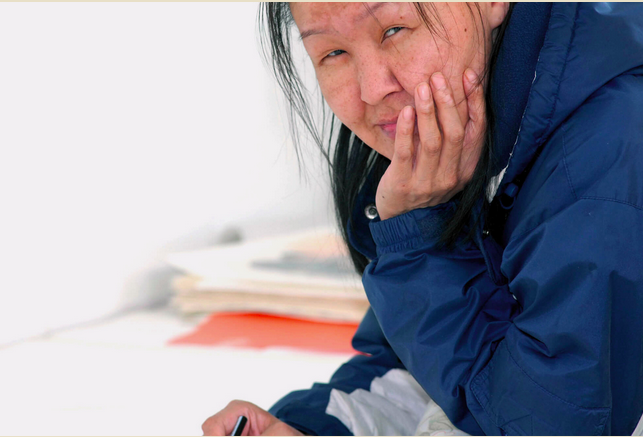
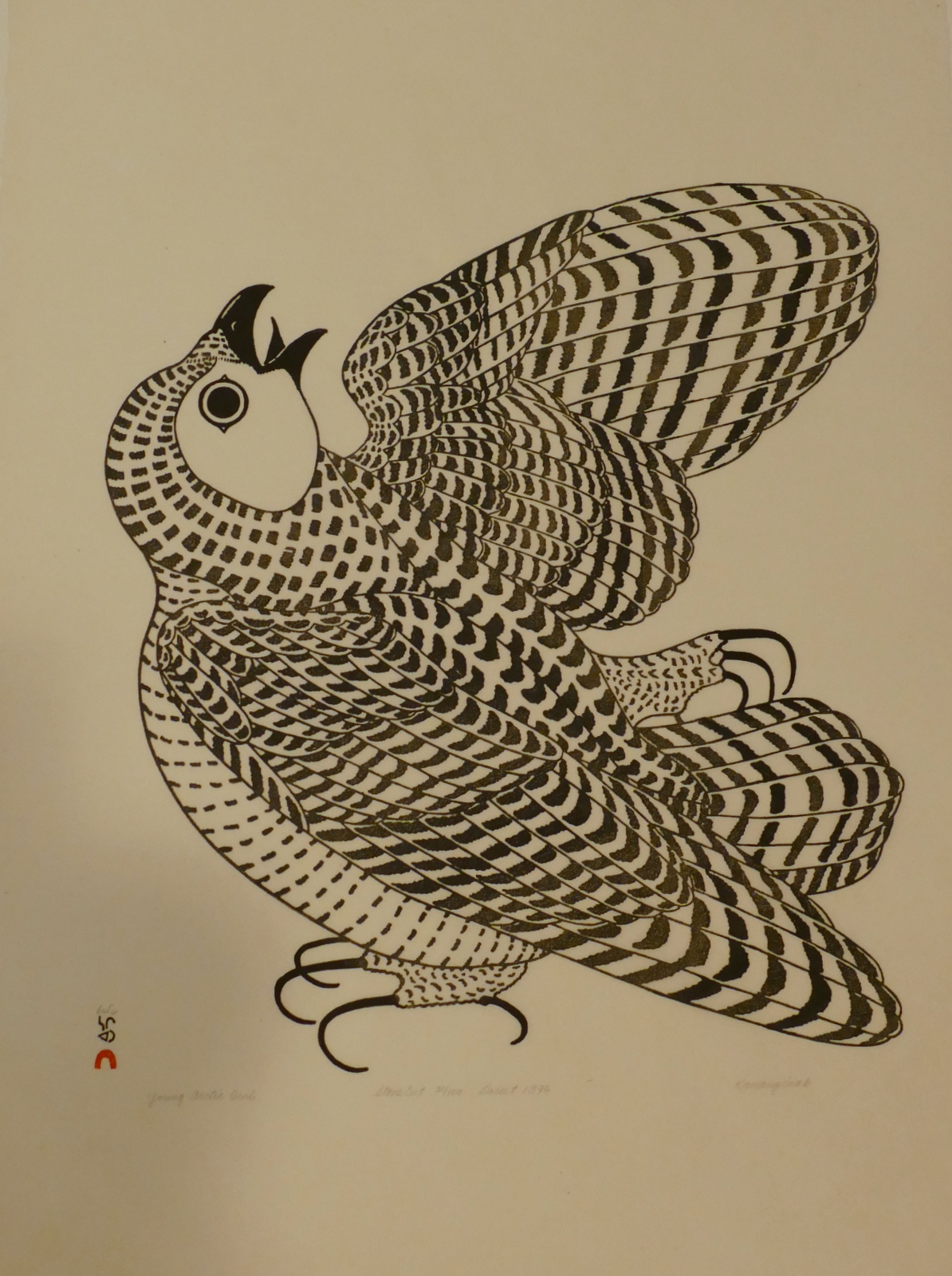
Annie Pootoogook was a member of one of Cape Dorset's most distinguished artistic families. Her parents were Napachie Pootoogook, a graphic artist, and Eegyvudluk Pootoogook, a graphic artist and sculptor. Napachie's mother was Pitseolak Ashoona, a renowned and prolific graphic artist. Annie was also the niece of Kananginak Pootoogook, one of the greatest artists to come from Cape Dorset.
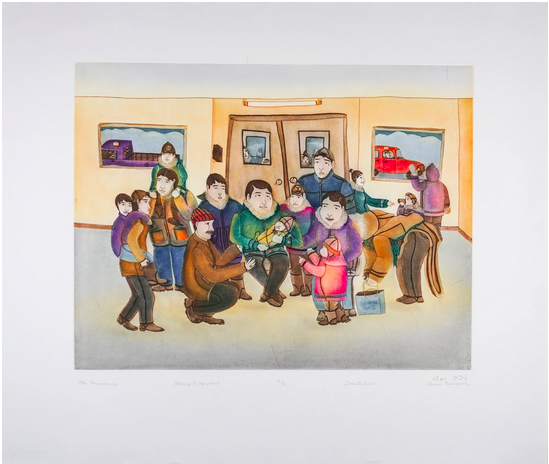
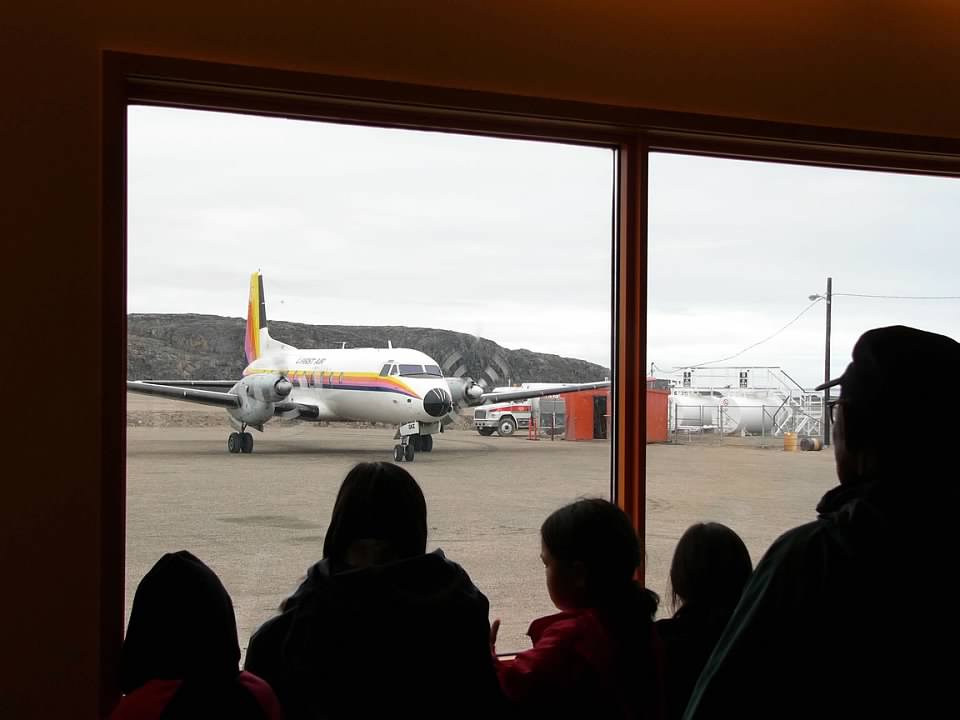
Annie's drawings and prints present an unflinching picture of daily life in the North. Many of her works comment on substance abuse, domestic violence, and the impact of Southern culture and technology on the life of the Inuit. But "The Homecoming" (above) is a picture of unalloyed joy. An extended family is celebrating the return of one of its members, shown filling the one-room Cape Dorset airport. (Travelers deplaning in Cape Dorset are greeted by the sight of residents filling the window facing the runway, waiting to greet the new arrivals,as shown in the photograph below.) Possibly not coincidentally, "The Homecoming" was created in 2006, when Annie was beginning to enjoy national recognition.
|
|
Annie's career as an artist included a meteoric rise, becoming the first Inuk to win the prestigious Sobey Art Award (which describes itself as "the pre-eminent prize for Canadian artists of all ages"). Tragically, the substantial prize money and the recognition that followed the Sobey Award led Annie to move to Ottawa, far from her family and community, and far from the supportive working environment of the West Baffin Eskimo Cooperative. She struggled with substance abuse and abusive personal relationships, and died prematurely, drowned in the Rideau River under what the Canadian Police described as "suspicious circumstances." Click here to read a detailed biography of Annie by Nancy Campbell, an independent curator of contemporary Canadian art.
|
|
How to Decipher Inuktitut Signatures, or
Inuit Art Pinball
|
|
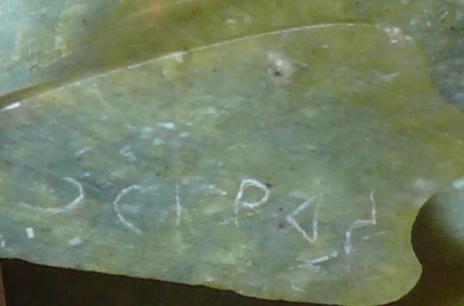
You don’t have to understand Inuktitut in order to learn how to attribute many of your "anonymous" pieces that have markings on the bottom. As with any language skill, it takes some practice, but the time is well spent if you are a serious collector of Inuit art. What follows is a very abbreviated introduction to the subject. Hopefully, it will inspire you to read the complete essay posted here, with step-by-step instructions.
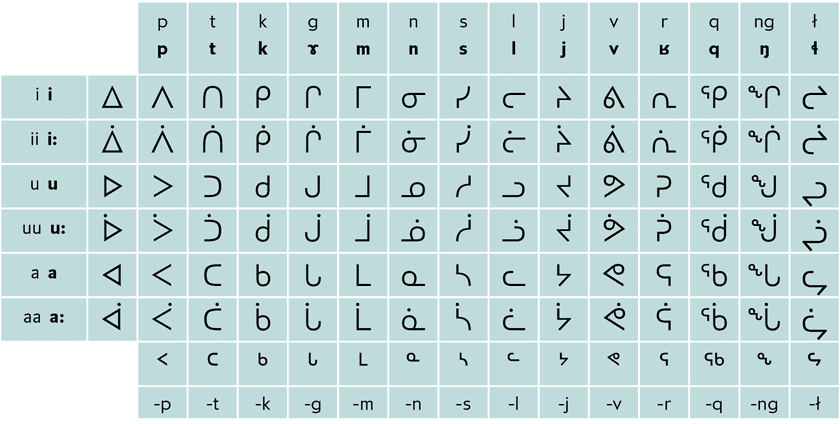
Inuktitut is written using a syllabary -- that is, a system in which each symbol stands for a syllable, not a single letter (unless that letter is a vowel). If you look at the table below, you will see that each syllable is either a single vowel or a consonant followed by a vowel. All of the syllables that begin with the same consonant share the same shape; the vowel sound determines whether the consonant shape will be oriented upright, facing right or facing left. In some cases, a consonant sound will be inserted after a syllable (e.g., mukluk). That can be signified by a superscript for the terminal consonant (see the bottom line in the table).
|
|
The first step is to sound out the syllabics. This is where "pinball" comes into play. First, it is very rare to see terminal consonant superscripts in a signature that's carved in stone. They are frequently dropped, like vowels in Hebrew. Second, many artists were known by several different names. Third, vowel sounds may shift. "a" and "u" were sometimes confused. But this will give you a rough idea of the artist's name.
Second, you can input the syllabics into our artist search tool. This will produce a list of possible matches.
The fourth step is to put the information that you have gleaned together with your knowledge of Inuit art. More pinball. Is the style of the piece consistent with other works by the artist that you have tentatively identified? What does the stone tell you about the origin of your piece? A bright green serpentine carving almost certainly came from Cape Dorset or Kimmirut (Lake Harbour), not from a community west of Hudson's Bay. (There are, of course, exceptions to every rule here. The first piece that I tried to identify was signed in syllabics by a Gjoa Haven artist, but the stone was clearly from Salluit, far from Gjoa Haven. It turns out that in the early days of carving in Gjoa Haven, the government imported stone from Salluit, because Gjoa Haven stone was thought to be too hard to carve.)
If you are still reading this, you can find much more detailed information here, along with photographs of sample signatures for you to practice on. Good luck in identifying undeservedly "anonymous" works. If you get stuck, feel free to send me photographs of the piece and the signature.
|
|
About
Alaska on Madison
In keeping with our self-description as a virtual gallery run by collectors for collectors, we offer a limited number of pieces. Every piece is one that we would be happy to have in our personal collection, and the description of each piece explains why.
We are happy to assist you with inquiries, with searches for particular pieces or artists, with organizing your collections and with buying or selling at auction. Our Inuit artist search tool is available on our website, and we would be delighted to help you use it. If you prefer to puzzle things out for yourself, Deciphering Inuktitut Signatures will help you to identify artists.
We are always pleased to answer questions or just chat. You can contact us by email or by phone at (908) 487-5757.
Our very best wishes to you all.
Ann and Michael Lesk
|
|
|
Alaska on Madison | (908) 487-5757 | alaskaonmadison@gmail.com | www,alaskaonmadison.com |
|
|
|
|
|
|