|
Dependability is one of the most praised traits in education and technology leadership.
We celebrate the people who always get it done, the ones who respond quickly, work late, fill the gaps, and quietly absorb more responsibility without complaint. In many organizations, dependability becomes synonymous with trust.
But there is a cost to being dependable and it’s one we don’t talk about often enough.
Recently, a colleague came to me asking for feedback. She wanted to grow, wanted to contribute more strategically, and wanted to understand how she could stretch beyond her current role. What made the conversation powerful was her honesty.
“I feel like I’m too busy accomplishing tasks,” she said, “and it’s not helping my growth.” She added, “Sometimes I feel stuck in the monotony.”
This is not someone who lacks work ethic. Quite the opposite. She is highly capable, deeply committed, and exceptionally reliable. She works nights. She works weekends. She takes pride in doing high-quality work and being someone others can count on.
And that is precisely where the risk lies.
High performers are often rewarded with more work, not more opportunity. Their competence becomes a magnet for additional tasks, and over time, the role narrows instead of expands. The organization benefits in the short term, but the individual slowly trades growth for throughput.
One of the patterns we discussed was her reluctance to accept help. When I had previously offered to bring in outside support, her response was familiar: “It will take more time to train someone, and I’ll just get further behind.”
That mindset feels practical. It also guarantees that nothing changes.
Over time, this is how capable doers find themselves stuck doing work they have outgrown, efficiently, reliably, and without space to reflect on whether the work itself still makes sense.
Since my early days in the classroom, I’ve tried to approach tasks differently. There are parts of every role that are tedious, repetitive, or simply not energizing. I still do them. But I refuse to do them without asking a follow-up question:
What needs to change so I don’t have to do this the same way again?
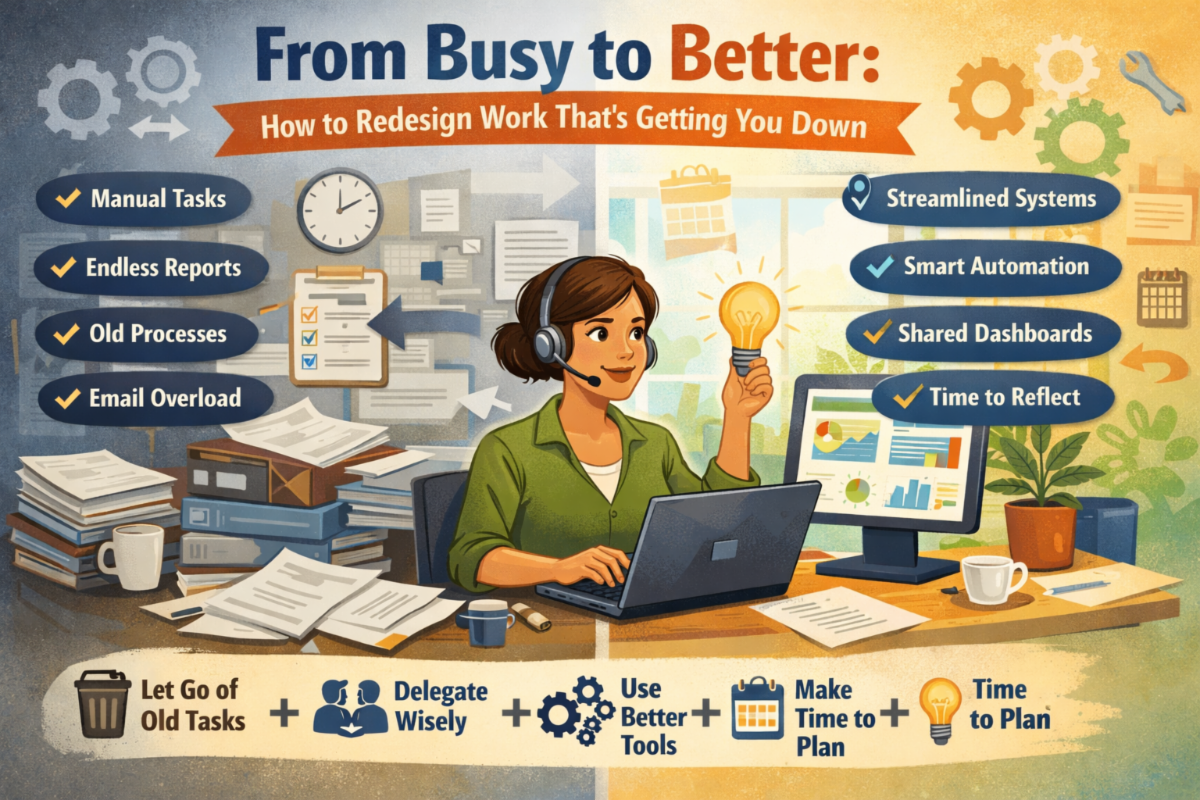
Sometimes the answer is as easy as delegation, bringing in another person, even if it takes time upfront. Sometimes it’s technology, finding ways to streamline or automate without compromising quality. And sometimes the answer is more uncomfortable: redesigning or eliminating the task altogether after asking whether it still adds value.
What I don’t do is assume that monotony is the price of competence.
This habit, stepping back after execution to rethink the work, is what creates space for growth. It’s why I intentionally protect time on my calendar for reading, learning, connecting, and thinking, not as a luxury, but as a leadership responsibility.
There is an important systems-level lesson here. When organizations rely too heavily on their most dependable people to carry the operational load, they unintentionally limit those individuals’ growth. Over time, that leads to burnout, disengagement, or attrition, not because people weren’t capable, but because the system never made room for them to evolve.
Dependability should be a foundation, not a ceiling.
The good news is that redesigning work is a skill that leaders and teams can learn and practice. The next step is moving from awareness to action: identifying the work that drains energy, adds friction, or no longer serves its original purpose and then intentionally reshaping it.
The shift from busy to better is where growth actually begins.
|