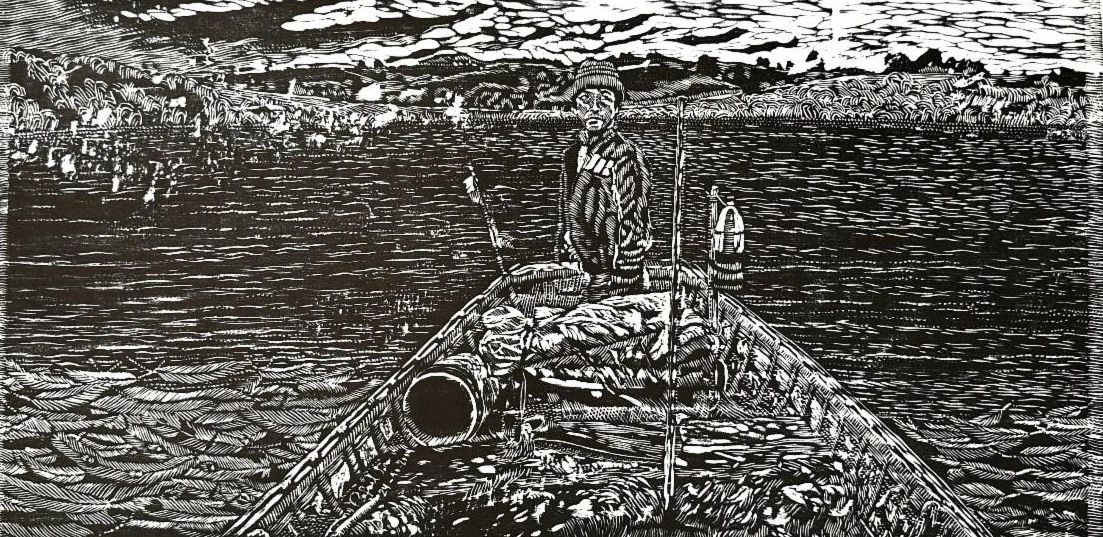
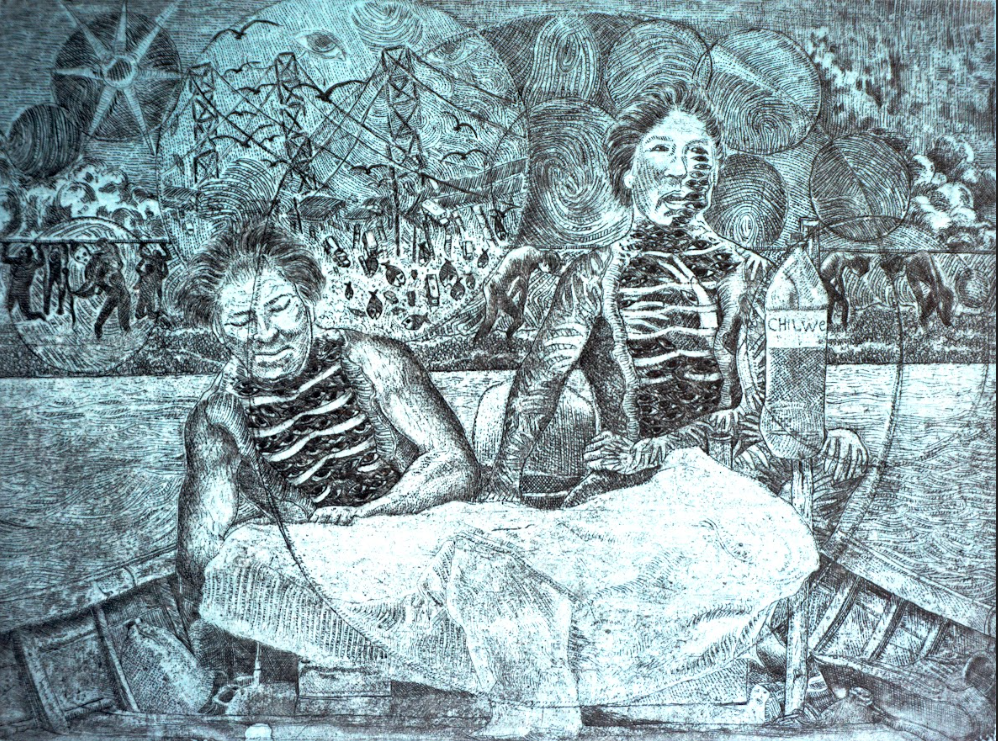
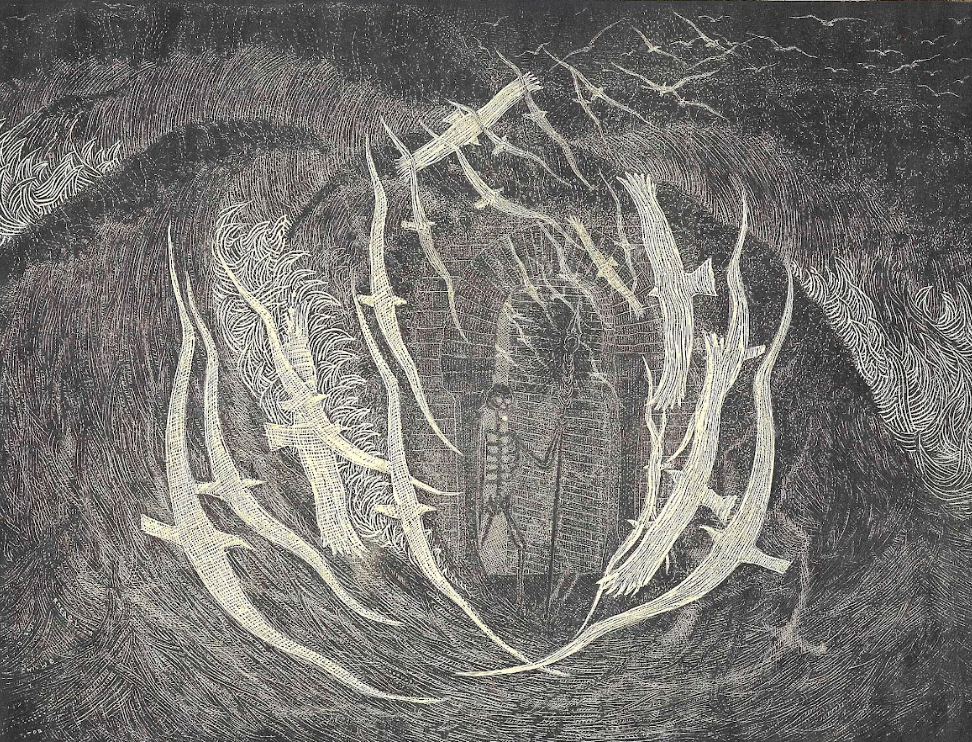
Rafael Lara, Palillo, generosidad del Mar de Chilwe..., woodblock, 2004 | | FREE SPIRIT: CHRONICLE OF AN OPENING | | |
Dear {First Name}
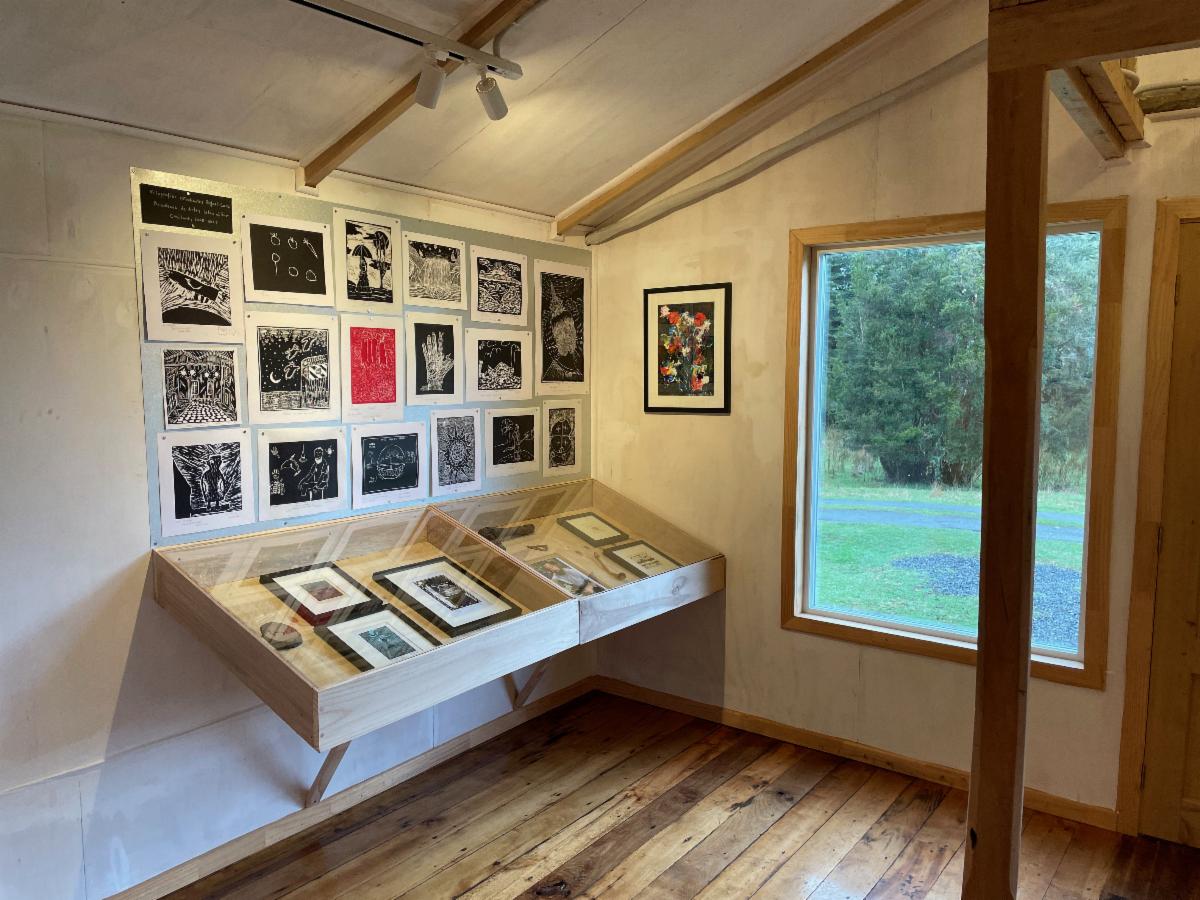
Thanks for spending a few minutes of your day with this new issue of the Capilla Azul newsletter. I’ve been back home in New York for only a few weeks following the highly emotional installation and opening of Rafael Lara: Espíritu Libre/Free Spirit in Chiloé, and I’m happy to report that it was our most meticulous, museum-like exhibition to date, with custom-built glass-covered vitrines for smaller and/or fragile pieces, newly upgraded lighting, and more than a hundred individual works and artifacts on view, including dozens of woodcuts and lithographs produced by Lara’s former students during his eighteen years of giving print-making instruction to children at the Academy of Arts Islas al Sur in Castro, Chiloé’s main city.
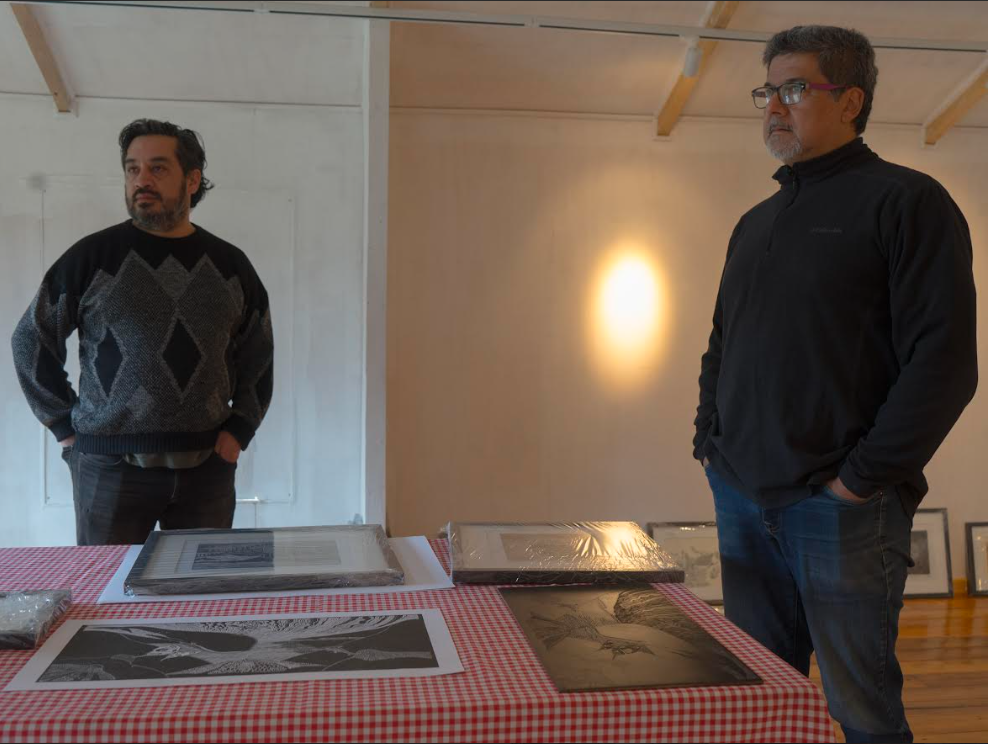
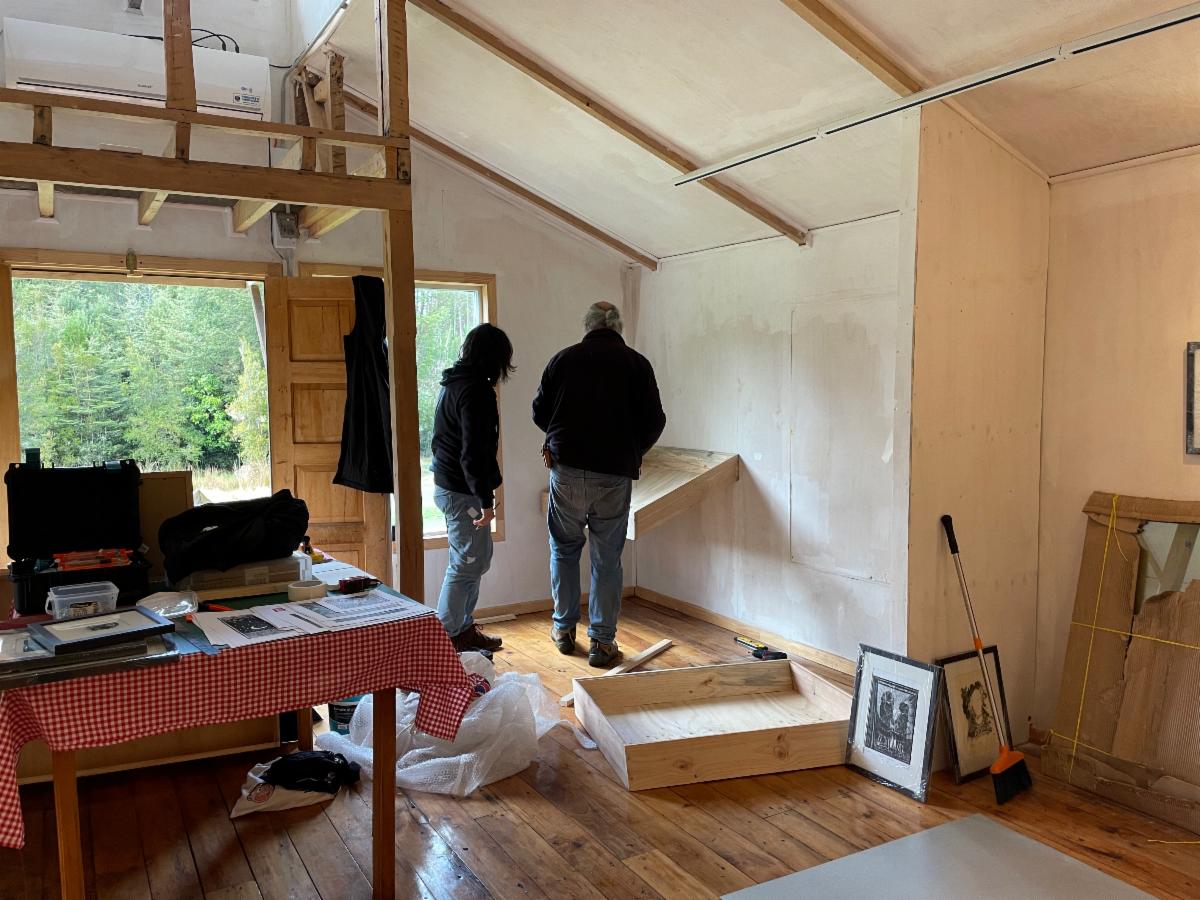
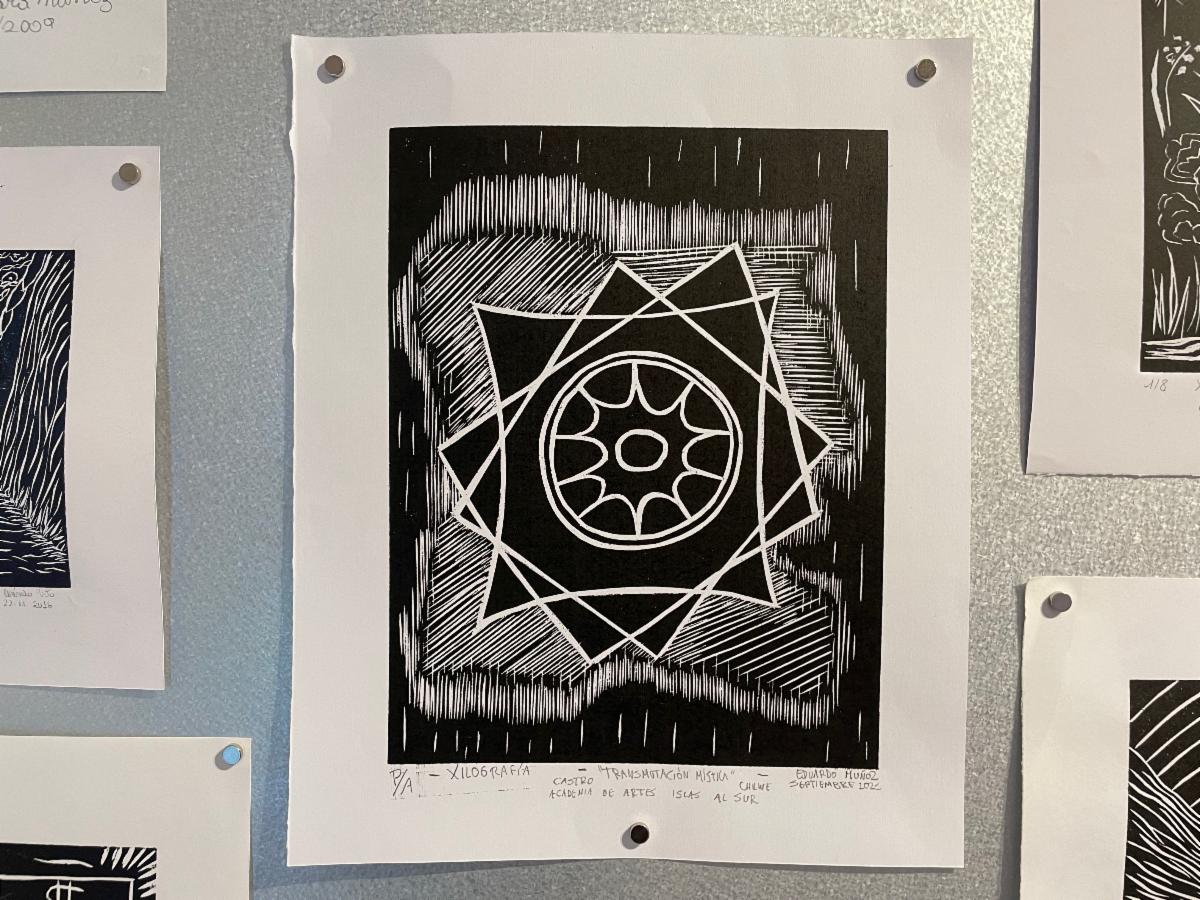
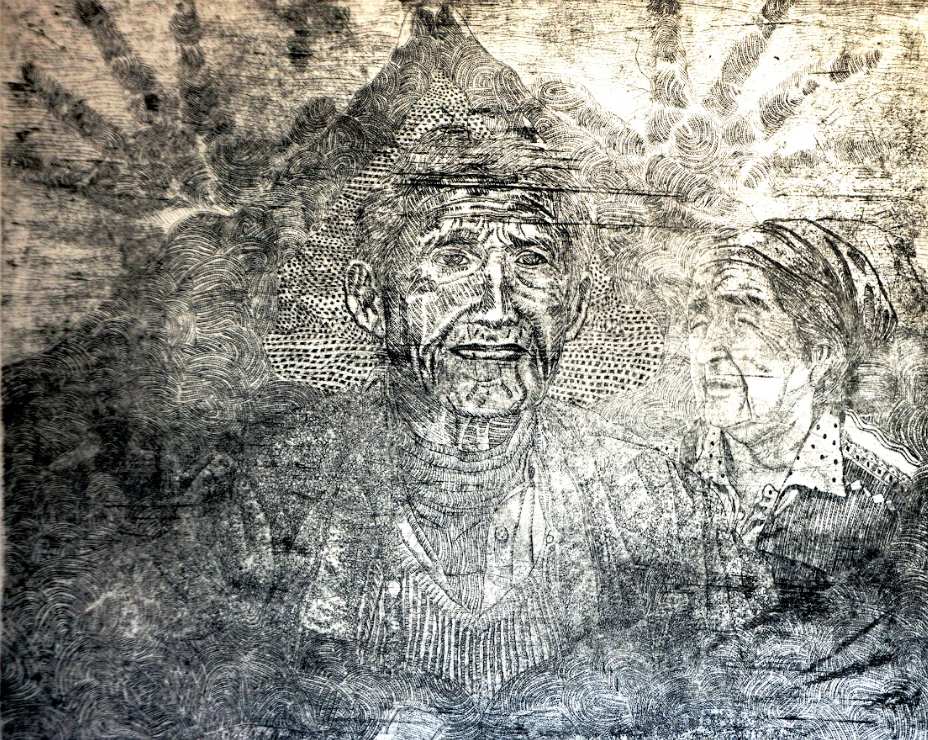
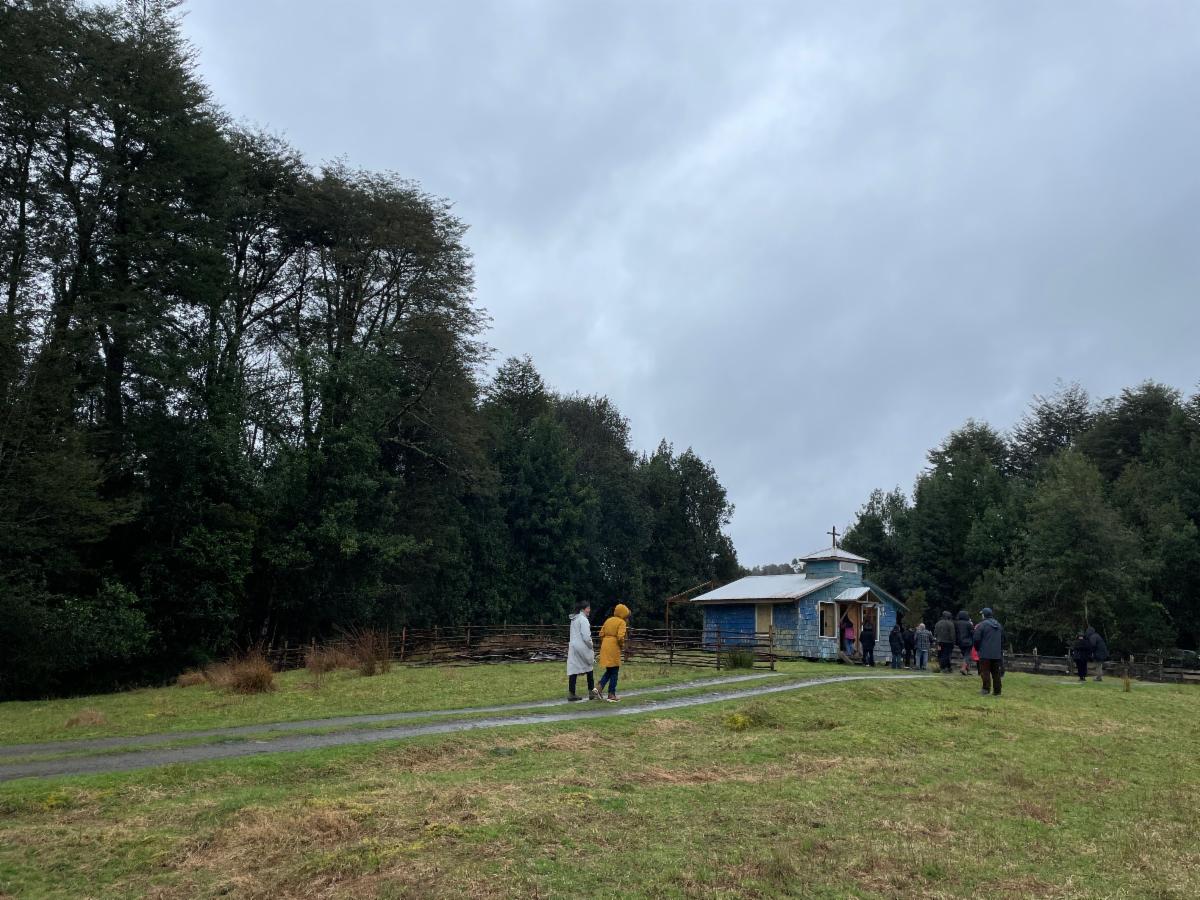
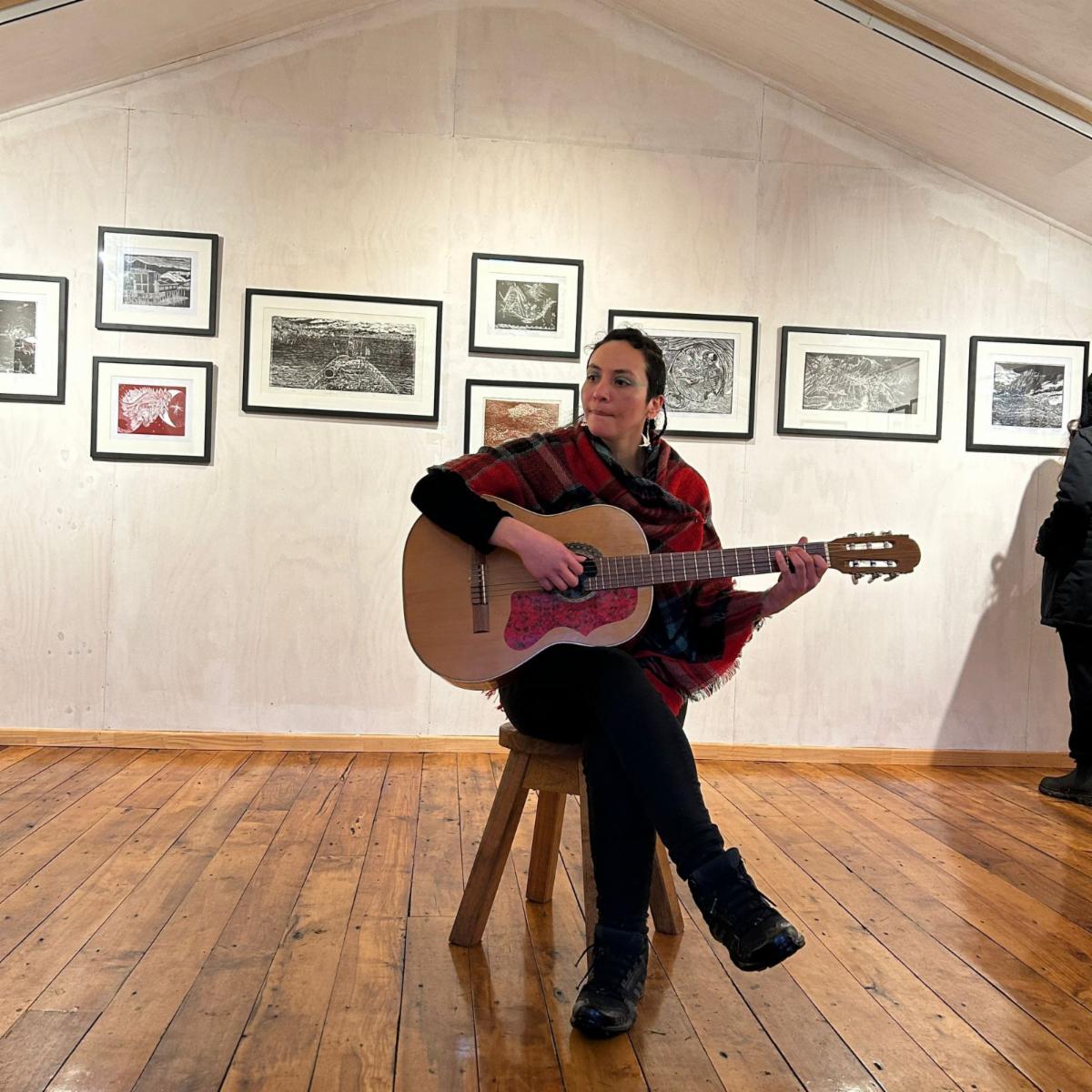
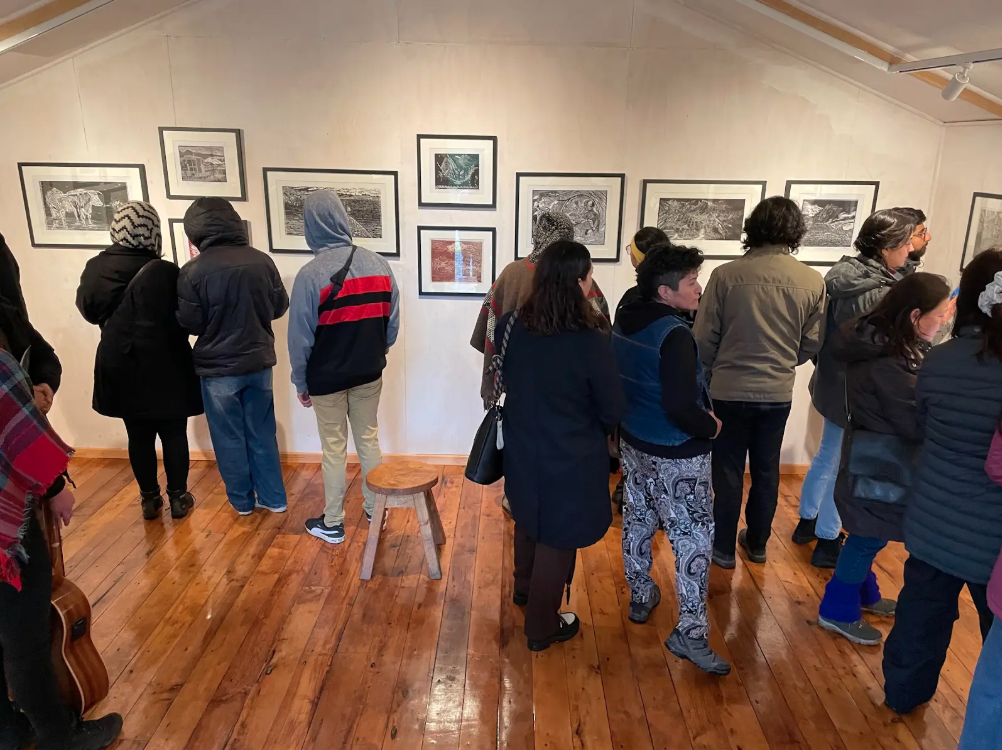
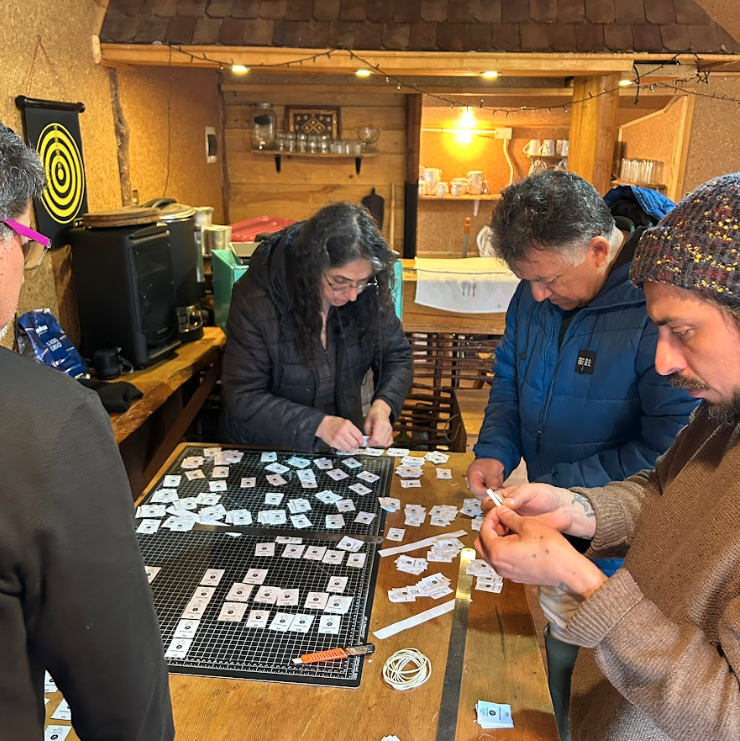
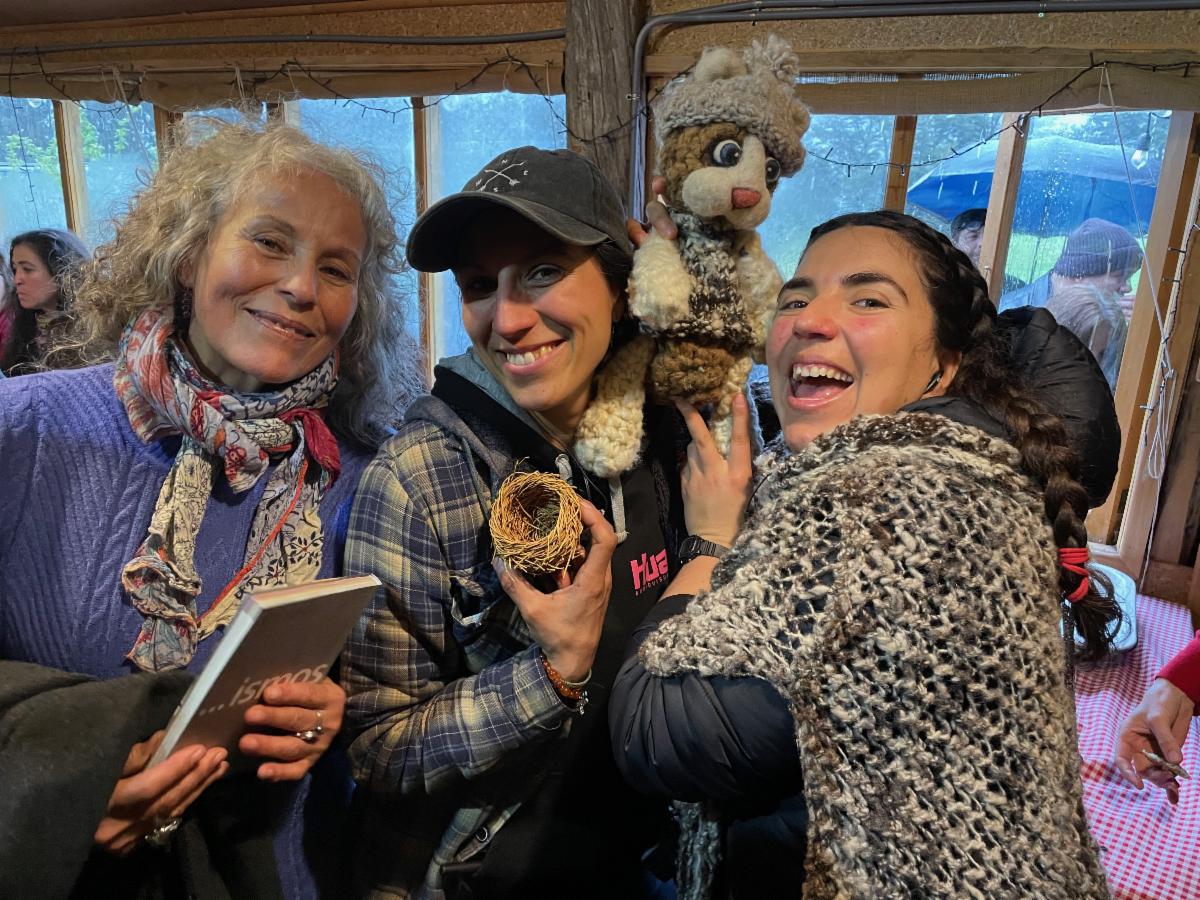
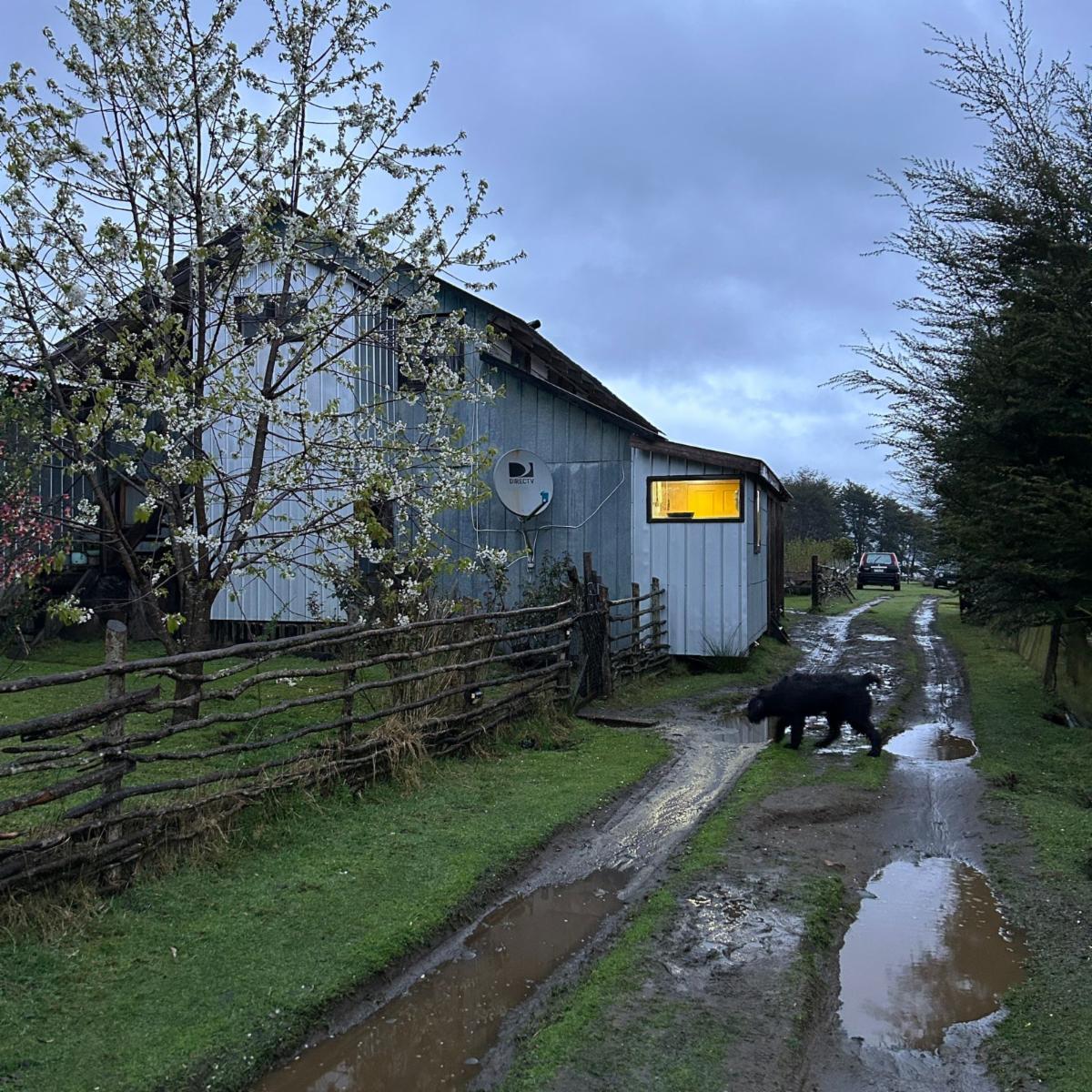
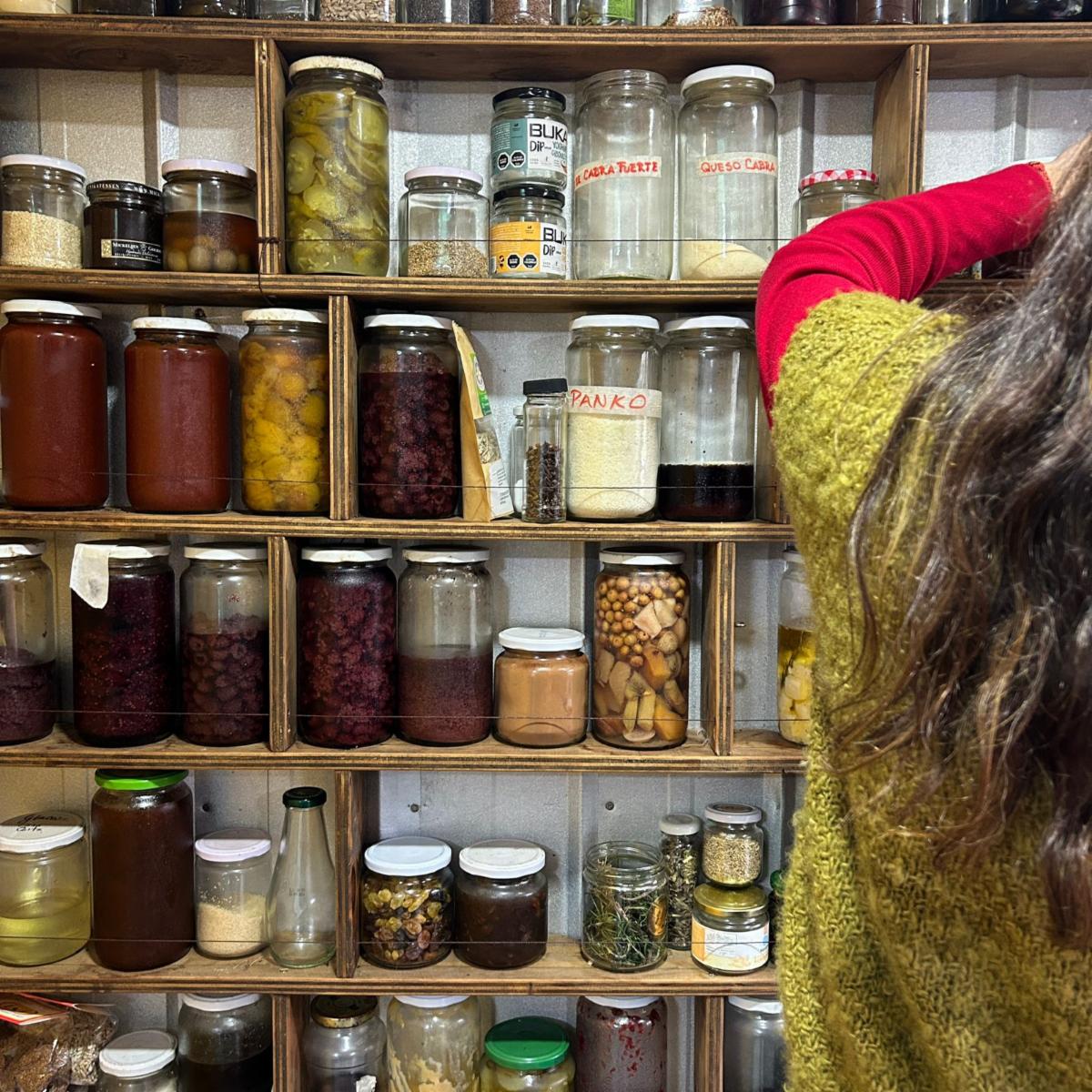
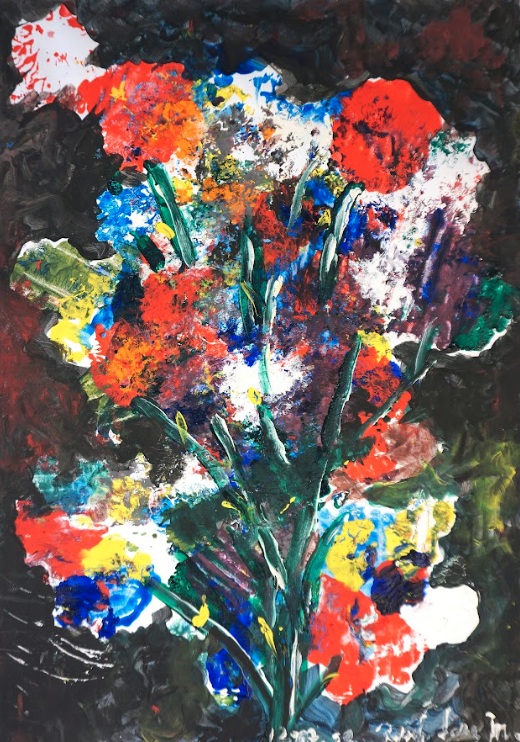
| | Anibal Rocha, Ramon Castilllo installing Espiritu Libre | | Installing the new vitrines | | As for the much-missed Rafael Lara (1969-2024), he was represented by forty newly framed works, including paintings, drawings, etchings and lithographs, along with a dozen exquisite hand-carved planchas used for making tiny woodcuts. The delicate fragility of these carefully worked wooden discs was countered by two floral paintings that bracketed the rest of the installation. I’d learned during my research that Rafael had turned to painting in impasto towards the end, as it was a medium that permitted him to continue working despite his gradual loss of sight making it impossible to maintain the intricately interwoven lines of his etchings and woodcuts. Those delicate, lattice-like patterns in Lara’s finest works, often of natural, mythological or historical subjects closely tied to his spiritual outlook, inspired guests on September 27 to get up very close to the works and inspect his artistry firsthand. | | Just to convey a sense of the way we work together, the checklist and catalog were developed by me in May, the works were framed by local artist Aníbal Rocha in June, Ramón Castillo presented the museography in July, and Pablo Carvacho turned that concept into a working plan in August, using his expertise and sourcing the right materials and tools. Finally, Pablo and Estéban Pérez — fresh off his recent exhibition at Capilla Azul — installed everything to perfection shortly after our arrival in Contuy, as Ramón and I tried our best to be helpful. Clearly, none of our success as a community-based independent art space would be possible without the close teamwork that enables us to maintain high curatorial standards in a fully rural setting, as part of an existing community embraced by the rest of us for its idealistic centering of artistic practice within a natural environment that reflects a quality of life that many aspire to, but few are able to fully realize for themselves. Long after we return to our lives in Santiago and New York to plan the next exhibition, the one we’ve just opened continues to receive visits from local school groups and art educators doing residencies, as well as such esteemed guests as the 2025 recipient of the National Art Prize, Mono Gonzalez, who visited in October. Fittingly, just before the holidays we turn the space over to the students in the Contuy and Apeche schools, who will organize and install an exhibition of their own works. | | Espiritu Libre, vitrine installation at Capilla Azul | | Eduardo Munoz, Transmutacion Mistica, woodcut print, 2025 | | Rafael Lara, Don Serafin Gonzalez, Arqueologo Autodidacta, en Honor a tus Genes | | Espíritu Libre is our first time opening an exhibition of an artist who was not just recently deceased, but a cherished personal friend to many of us, and a sort of underground hero to many more in the Chiloé creative community. Because of his semi-underground reputation, there was a noticeable uptick in local interest about the exhibition, thanks to the posters hung in various cultural hot-spots, and follow-up from nearby teachers and parents. But we truly had no idea how many would make the drive to Contuy for the opening, especially if it rained as predicted. Precipitation was on everyone’s minds because it was an unusually sunny installation week, the first days of spring bringing unexpected warmth and sunshine for all at Comarca Contuy to bask in when we weren’t hard at work getting the exhibition installed and the place ready for the weekend influx of guests. As Saturday approached, there were scattered exchanges to the effect of how Rafael did prefer inclement weather over blue skies, and how we shouldn’t be surprised if it turned out to be one of Chiloe’s legendary wet days. | | Paulina Perez at Espiritu Libre // visitors at the opening, Sept 27, 2025 | | And rain it did on September 27, all day long, in honor of our beloved Rafael, who would have been the first to celebrate the downpour as an expression of nature’s largesse. About an hour before the festivities were to begin, as the largest puddles were transforming into small ponds, an early cluster of guests even took friendly bets on how many would show, with the highest guess being 115 (most were in the double digits). Even so, by late afternoon a hundred people had braved the elements to celebrate Rafael’s work and legacy with us, and the intimacy of the gathering enabled us to use the chapel as a site for an impromptu musical performance. Santiago-based musician Paulina Pérez, who had composed a song in tribute to Rafael Lara, seated herself on a wooden stool in the middle of the space, and when enough neighbors had entered to make a convivial atmosphere, she began performing “Espíritu Libre” with no introduction. Some stopped to listen while others lowered their voices to whispers, keeping their attention mostly on the artwork in front of them. Once the first wave of viewers were replaced by mostly new faces, Paulina performed the song again, and then twice more before the final stragglers gradually made their way back to the fogón for refreshments, foot-stomping Chilote music by the local trio Carnizal, and our signature raffle, where those holding lucky numbers took home art books, a Capilla Azul t-shirt, three small nests made by the estimable Raquel Aguilar, a unique stuffed wool animal created by our own Marcela Contreras, and a print by Rafael’s longtime student, Eduardo Muñoz, who’d spoken earlier about his teacher’s gift for drawing creativity from young people. | | None of this celebration would have been remotely possible without the hands-on support and participation of our unannounced speaker: Rafa’s adult daughter, Angel Paz Lara Rodríguez, who left Chiloé years ago to live and work in the mainland city of Osorno, but in recent months had given her much-needed attention to the numerous details of inventory, documentation, framing and publication of her father’s work. The sole child of a single parent, Paz was still recovering from her loss, but it was clear, as she affirmed in her brief remarks, that having the opportunity to see her father’s works framed and installed as he had never been able to enjoy them, and to read and listen to the words of people whose lives were better off for having known him, gave her immense comfort as she takes on the distinct responsibility that comes with stewarding a parent’s artistic legacy. | | Rafael Lara, Kaeran, Esferas Artificiales, Esfera Ancestrales, Prevaleceran | | At one point during the festivities, a breakaway group of revelers returned to the Capilla, including Ramón, Paulina Perez, the three musicians from Carnizal, and Aníbal Rocha, the Castro-based artist, printmaker and teacher, who took on the lion’s share of coordination and production for the project. Aníbal is also Rafael’s successor at the Art Academy Islas al Sur, and Ramón Castillo took advantage of the occasion to ask him, in his official professor voice, if he might say something to those present about the different techniques Rafael used in his work. What followed was a informed discourse about engraving versus lithography, until Aníbal touched on one of Rafael’s best-known works, Ancestral Mapuche Huilliche. Paulina, whose song had taken that work’s subject matter as its starting point, then cut in to explain that the woodcut’s inscribed date of November 7, 1888 marked the execution of Pedro María Ñancúpel Alarcón, a Mapuche leader who held a controversial role in Chilean history for his multiple acts of piracy and armed rebellion during the long, violent period of “pacification.” She went on to explain that it was only through a rock group in nearby Quellón who’d used the print for an album release, that she’d learned of our exhibition. We could not have planned a more spirited interaction between our visitors and the guests who were all too glad to share why Rafael Lara’s art matters to them. It was a unique fusion of local history, art, politics, and the indomitable human spirit. | | Teamwork cutting out raffle tickets // proud raffle winners! | | In this and many ways large and small, last month’s opening was a milestone for Capilla Azul. First, it seems to have revealed in greater depth how we appear to the local community, and what appears to be a growing acceptance of our project. Not only did a much larger proportion of locals and neighbors come by than at previous openings, but the reality of receiving a hundred visitors in the midst of nonstop precipitation was truly heartening to us, and was received as an expression of solidarity from the greater Chiloé community. Secondly, and perhaps unavoidably, this opening became an unabashed feast for the senses: the savory scones, empanadas, and milcaos were tastier than usual, and the caldo de mariscos was deep, pungent and very rich. Both musical offerings turned out to be exceptional, we had complimentary catalogs circulating freely among the guests, along with art-supply gifts for the few kids whose parents brought them along. | | Perhaps what we accomplished is a little harder to pin down, because it springs from the range of meanings found in Rafael’s art, and his place in the larger scheme of things. We took on this exhibition while he was still alive, but not because he was a major figure in the regional art world. More than anything, Rafael Lara was a leader within his community, and because of that, plus the multitude of revelations and insights that he packed into his art, he continues to mean a great deal to many people in Chiloé. If by producing the Espiritu Libre exhibition and catalog, and touring the project to different institutions throughout Chile, we'll have contributed to whatever groundswell of interest might arise for Rafael Lara’s work in the future, then we can take satisfaction knowing our work has benefited both Chiloé and Chile in the longer term. | | Rafael Lara, Ngen Koi Koiveln, Te Komvocamos | | Dusk with busy kitchen // pantry at Comarca Contuy | | |
Although both Ramón and I are passionate about projecting our laboratory of curatorial ideas outward to the rest of Chile, what most sparks our passion is having an opportunity to take our measure of what the Chiloé community appears to feels deeply, and transform that investigation into a program, which we hope can then become a working formula for convincing more people to take active part in what we do, even if they’re thousands of miles away and might never come to visit.
That’s why the human side to the Espiritu Libre opening was a powerful affirmation, and when questions arise, as they do, about the more far-reaching implications of the work we’re doing at Capilla Azul, the answer always entails going back to the meaning of “community.” Ours is a small, rural community of working families, nearly all engaged in sustainable agriculture, for whom visual art’s most frequently encountered form is as a handmade object produced for the use of one’s own family or community, or a product made for the commercial market in artisanal goods. As a result, many of Comarca Contuy’s neighbors are experiencing contemporary art for the first time when they visit Capilla Azul, which is a special responsibility for us as curators. These neighbors, who at times are also the purveyors of lettuce or farm eggs, have in many cases been here for many generations, and are deeply knowledgeable about the land on which these three hundred families sustains themselves.
| | If we succeed in making a convincing case to our neighbors regarding the value of art in everyone’s lives, and can accomplish this at a human scale, with curatorial choices that can be easily shared, then perhaps we don’t need to worry about how our program might appear to the larger art world. If art can generate a dynamic, positive circuit of ideas, impulses and inspirations in Contuy, is’t it possible for such a program to flourish anywhere? The main reason we chose this specific location — or did it choose us? — is because it best communicates the closely entwined relationship that art and nature can have for people who live close to both. Precisely due to its remoteness from urban priorities, the countryside can reveal essential truths about Chiloé as a living territory, a land which has been regenerated through millennia of indigenous knowledge and applied practices. | | Rafael Lara, Flores rojo, amarillo, azul y blanco | | Despite opening our eighth exhibition in less than two and a half years, La Capilla Azul still feels very much like an experiment for us, a working template for developing curatorial practice in the hamlet of Contuy, which is sparsely populated and closely-knit. Part of our rationale stems from recognizing that what Comarca Contuy had already found long before we showed up on the scene provides the framework for a quality of life that offers different kinds of fulfillment than our ongoing lives in very large cities. The art world also bears its share of blame for continually inventing and sharing idealistic formats by which its habituees imagine their lives lived better, even it’s only a weekend escape to our remote corner of the Gran Isla de Chiloé, just a few miles off the coast of Chilean Patagonia. | | | | |
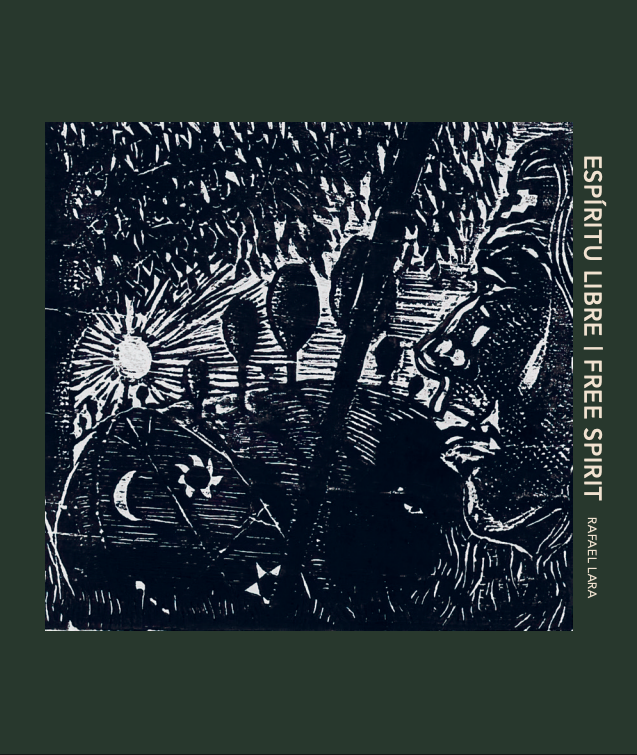
We are proud of our publication last month of a 44-page catalog for Rafael Lara: Espiritu Libre, which contains 24 color reproductions alongside essays written by Dan Cameron, Ramón Castillo, Aníbal Rochas, Anelys Wolf, Camila Zaccarelli, Angel Paz Lara Rodríguez, Silvia Rivera and Eduardo Muñoz. The book’s design is by Claudia Guerra, and although our run was for 500 copies, half are designated for museums and galleries that will present the exhibition in the future.
A very limited number of catalogs are currently available for sale in the U.S. for $15, plus $5 shipping & handling. If interested, please write to dan@capillaazul.com.
You can also see it here.
| | DEPT OF CORRECTIONS & ADDENDA | | | |
In earlier communications, we erroneously announced the closing date for Rafael Lara: Espíritu Libre as January 10, instead of the correct date of Saturday, December 6. We regret the error and apologize for any inconvenience caused by it.
On the bright side, we are delighted to announce that Rafael Lara: Espíritu Libre will open at Centro Cultural Bosque Nativo in Puerto Varas on Saturday, January 17, 2026, where it will remain on view through the end of February. This is planned as the first in a series of venues that brings his work to galleries, art centers and museums throughout Chile.
| | Karina Aguilera Skvirsky and Maria-Inés Galecio // Anex Ahumador | | |
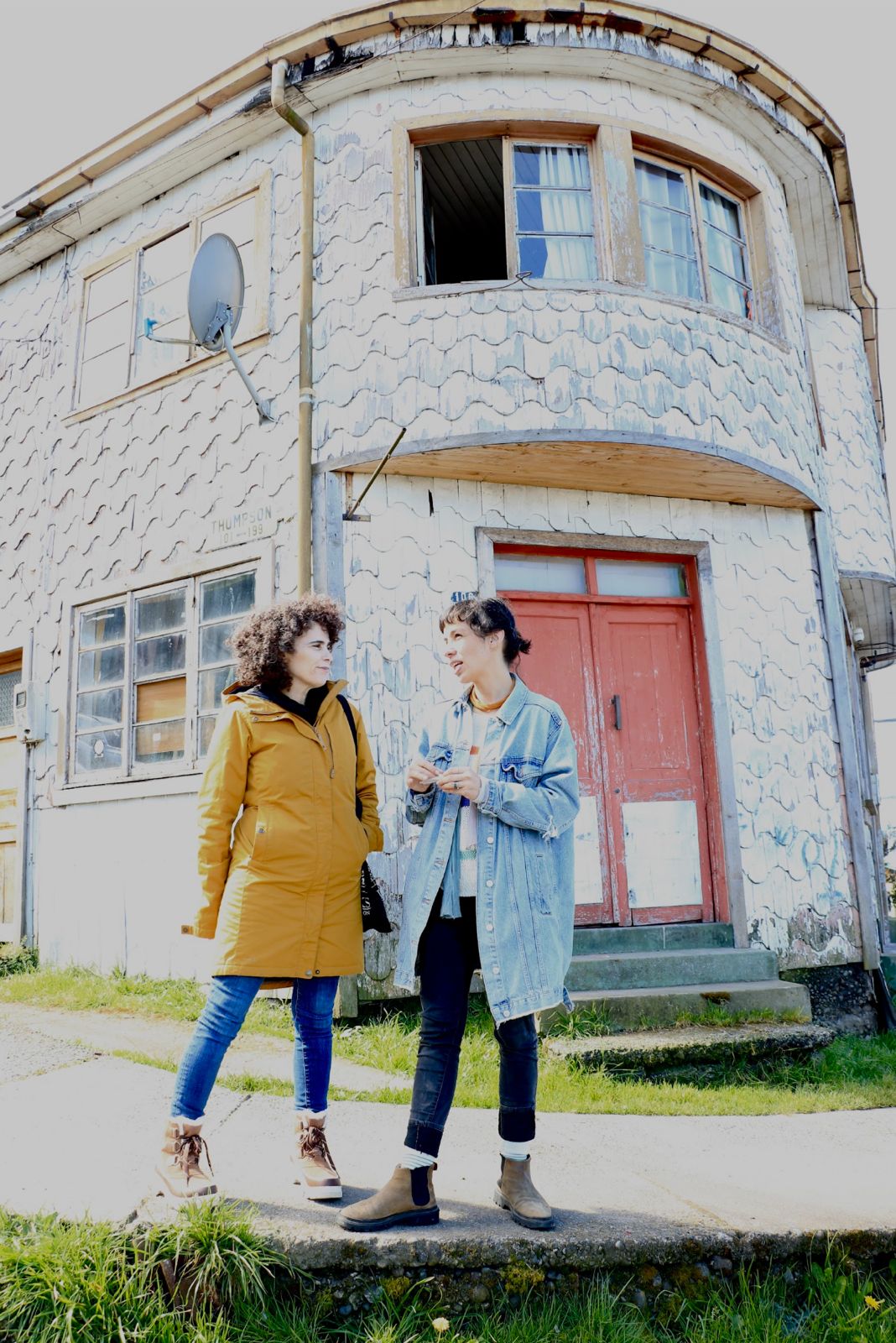
Capilla Azul is especially happy to announce our January exhibition, whose title we’ll share in the next newsletter, opening January 24. The project is centered on a collaborative dialogue that began some months ago between artists María-Inés Galecio and Karina Aguilera Skvirsky. After teleconferencing a few times, the two met in person in Dalcahue last month to further their joint exhibition. Aguilera, an Ecuadoran-American artist based in New York, works in a range of media but in particular video and photography. It was her first visit to the archipelago, whereas Galecio, who frequently incorporates woven and knitted wool constructions into her sculptural installations, is a native of Chiloé who has been exhibiting her work regularly throughout the region, most recently with Bloque Erático, a 2024 solo exhibition at CAMM in Puerto Varas that addressed the growing presence of styrofoam waste from local salmon farms scattered along Chiloé’s shores.
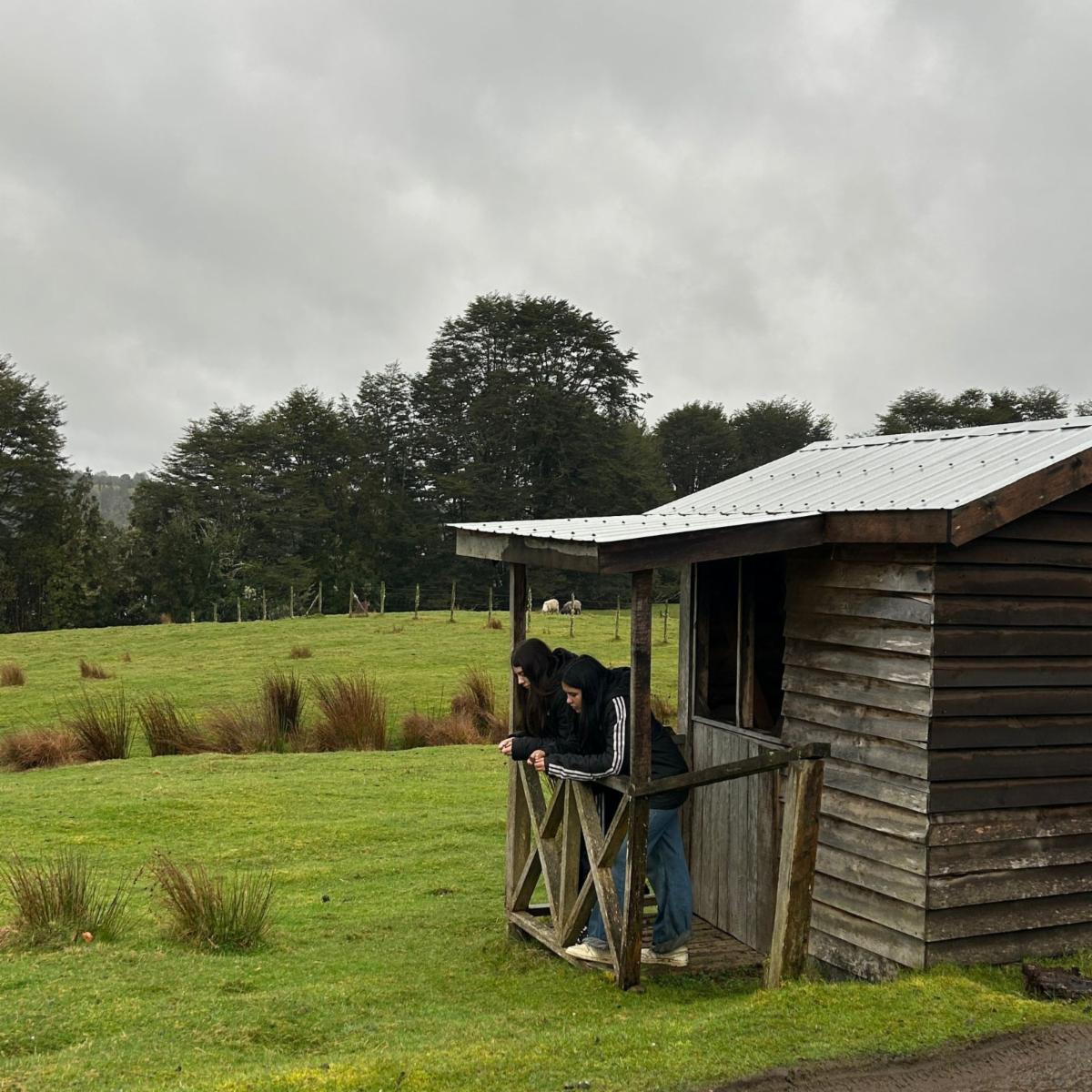
If things continue according to plan, January will also include the soft opening of a new exhibition space at Comarca Contuy. Set directly in front of the fogón, the wooden structure was conceived of and created during the Covid-19 lockdown as a communal smokehouse, but never saw the level of use originally envisioned. Instead it became a curiously artful shed with a tiny interior that makes Capilla Azul seem enormous by comparison. The idea isn’t to invite visitors to physically enter the space, but to peer instead inside through the wooden slats that frame the top half of the Dutch door. A 55-inch video screen fits snugly on the far wall, and seating will be built for viewers on the porch, but only two at a time.
| | |
As of this month, La Capilla Azul, Inc., reached its one-year mark as a U.S.-based public charity based in upstate NY. What this first anniversary highlight is that it’s time for our periodic reminder to you that more than nine-tenths of our support comes from individual donors in the U.S. When we first began raising funds through GoFundMe in early 2022, our average donation was about $40, and nobody (including ourselves) thought we’d get this far in such a short period of time. Fortunately, thanks to the generosity of more than a hundred and forty persons like yourself, we’ve managed to meet or surpass our annual budget of US $18,000 ever since our opening exhibition in May 2023, including this year But we plan to open a library in 2026, as well as begin inviting artists from outside Chile. Once you fold in the costs of our slightly expanded publications, Capilla Azul's budget for 2026 is expected to increase by nearly one-fourth, which is why it’s incumbent on us to turn to you today to ask for your support. If you’ve already donated to Capilla Azul in the past, thank you once more for your generosity. If not, please consider a charitable gift to one of the most uniquely independent, community-based exhibition spaces in the world.
Thank you,
Dan
| | | | Capilla Azul is part of Comarca Contuy, Queilen, Chiloé, Region Los Lagos, Chile | | | | |