|
Water Rights Watch:
Updates for Farmers
| |
SEPTEMBER 2025 UPDATE
- The Court Process
- State Budget Woes Affects the Process
- Local Efforts to Prepare
- Collaborative Discussions
| | | "We will be making the case to the state that suing our county and then forcing local water users to cover the costs is grossly unfair." | | |
The Court Process
It’s now been over a year since the adjudication was officially filed, and yet the process is still winding its way very, very slowly through Whatcom Superior Court. Hearings are happening once a month in front of Judge David Freeman. It is the opinion of those who have been watching that this Judge is very meticulous and very deliberate in his approach. There will be no quick decisions in this case!
The court has taken considerable time, so far, in working to lay out the ground rules of how this admittedly very complicated and far-reaching court case is going to operate. Recent discussions have centered around the court docket (the calendar of trial proceedings). The docket is what the court will use to let the various parties know which cases the court will be working on next. How will it look? Will it be sent out in a way that all parties can be fairly notified of which upcoming cases will be looked at? The Judge and the Steering Committee have been passing various ideas around. It appears they are getting close to approving how this will look, hopefully at the next hearing in October.
Ecology realizes that it needs to notify water users on a regular basis about how and when legal issues will be handled. The idea is to use the court’s docket and keep the docket up to date and online. Then all parties will be required to look at the docket for notice of what things are happening next at the adjudication court. To ensure adequate notice to all water users, Ecology plans to mail a postcard giving all the parties notice about how the docket system will work. The Judge has yet to approve the language in the postcard and hopes to do so before or at the next hearing.
Another key item has been the question of how to serve the remaining parties who haven’t yet been served. According to recent Ecology statements, they have 6,000 water users yet to serve out of the now 35,000 water users who were supposed to receive summons. Ecology plans on serving them via public notice in a newspaper of record. Because state law requires that claims are to be filed one year after service, this means there could be different deadlines for different water users to file their claims based on the timing of notice.
A quick word here about the fuzzy math we keep getting, which leads those of us following the adjudication to doubt the “facts” from Ecology. At the beginning of the entire adjudication discussion Ecology noted that only 15-20,000 would be served, and now we are up to 35,000. We were also told that 12,000 notices had been returned. Now we are told 6,000 have yet to be served. We also know of a group who weren’t served the first time around. We were told the entire adjudication process would only take 10-15 years.
Yet, it’s been over a year and we really haven’t even set the guidelines for the case, much less any of the issues surrounding the water rights of the 35,000 who have been or eventually will be served. And there will definitely be many issues to resolve! We have heard there will be multiple pre-trial motions that will almost certainly cause more delays. Judge Freeman noted in the hearing that over 35,000 people will be served in the adjudication, but in a typical year prior to the adjudication, all four Whatcom Superior Court judges have usually served only about 6,000. We’ve also seen some ridiculously low quotes on how much Ecology has estimated this adjudication would cost (apparently, they must think attorneys, engineers and consultants make minimum wage?)
So, we now have one Judge working on this admittedly very complicated case who follows a very deliberate path. Whatcom County’s funding has been drastically cut. Over time we keep getting reports of numbers and timelines that don’t match reality. It has become increasingly clear that Ecology still lacks an understanding of just how complicated an adjudication is going to be.
| | State Budget Woes Affect the Process | | "While the state (Department of Ecology and the Attorney General’s Office) received its full funding request, Whatcom County, who is running an adjudication that the state has pressed on its residents, asked for $4.7 million to support the process, and it only received $1.4 million." | | | |
Washington state, through the Department of Ecology, is the plaintiff, the one suing water users – from tribes to farmers to cities to individual homeowners. However, the process of the adjudication goes through Whatcom Superior Court, and therefore Whatcom County funds some of the costs. As you can imagine, this is a very expensive process, and because of this the state has promised to provide funds to run the adjudication.
But, the state is in a budget crisis and is looking for places to cut. The result: Whatcom County did not receive even close to the amount of money it needs to run the adjudication.
Cascadia Daily News did a great job of laying it out, so we will summarize the issues here:
-
Whatcom County asked for $2.9 million for facility, staffing, and technology upgrades. It received $1.2 million.
-
Whatcom County asked for $600,000 for technical assistance for the community. It received $200,000.
-
Whatcom County asked for $200,000 to help facilitate collaborative discussions leading to settlement. It received $0.
-
Whatcom County asked for $1 million for technical studies to support the Watershed Management Board in technical studies connected to water supply issues. It received $0.
Bottom line: While the state (Department of Ecology and the Attorney General’s Office) received its full funding request, Whatcom County, who is running an adjudication that the state has pressed on its residents, asked for $4.7 million to support the process, and it only received $1.4 million.
What will be the result? Three things are most likely to occur: the first is an even greater slowdown of the process, the second will be additional costs hoisted on Whatcom County and its residents, and the third will be residents less prepared to manage their claims. The county can go back and ask for more funding next year, but given the budget crisis, the chances of success are not good. We will be making the case to the state that suing our county and then forcing local water users to cover the costs is grossly unfair.
| | |
Last year, the Watershed Improvement Districts provided technical support to our farmers, holding multiple day-long events where our farmers were invited in to meet with experts from Associated Earth Sciences (AESI), who could help with an initial evaluation of their water rights situation. The costs for these events were shared with the county, which picked up 40% of the tab with dollars it received from the state. It was assumed that the need for this technical assistance will ramp up the closer we get to the deadline (currently May 1, 2026 for those who have received service by May 1, 2025) for filing claims. However, the cut in funds to the county has the Watershed Improvement Districts evaluating how much can be done.
Outside of the court process, the Ag Water Board has also been increasing its efforts to create possible solutions. Recently it hired the well-respected lobbying firm, the Ferguson Group to help ramp up discussions at the federal level on what possible settlement talks could look like. Ferguson has been successful in securing funds to implement the Yakima Basin Integrated Plan, which was developed by major parties to the Yakima adjudication. They have already provided invaluable expertise. This is in addition to AWB federal attorney Ramsey Kropf, who has been helping guide our discussions. Ramsey also has a lot of experience at the federal level on settlement talks.
| | "The opinion of most private legal experts is to prepare now but hold on filing until the date is much closer. There don’t appear to be any benefits to filing early. Likewise, there are enough variables in this case that caution at this point is probably warranted." | | | |
We often get asked: Do I need to file, and if so, should I be filing this form right now? While there are different opinions on the timing of filing, it is still vitally important to file to protect your water rights. Ecology and Whatcom County are encouraging filing as soon as possible. Others have a different opinion on this subject.
We are not legal experts, but we do speak to many who are. The opinion of most private legal experts is to prepare now but hold on filing until the date is much closer. There don’t appear to be any benefits to filing early. Likewise, there are enough variables in this case that caution at this point is probably warranted. We have been told there will be multiple pre-trial motions that may affect how the adjudication proceeds.
One public example: A group from Sumas known as Sumas Out is expected to ask the Court to exclude the Sumas Basin from the adjudication under the premise that all their water, both surface and groundwater, flows toward Canada and not to the Nooksack watershed. At this point, it is unclear if filing in the Sumas area will be necessary if this group is successful. We imagine there are other, more private efforts going on that may affect the adjudication as well.
| | Collaborative Discussions | | "We see collaboration and settlement as the only path forward for the community to create durable and thoughtful approaches to water management on the Nooksack River." | | | |
There have been continued discussions and outreach from the Ag Water Board to other parties, including the State and federal Governments, as well as Lummi Nation and the Nooksack Tribe. It is important to note that tribal governments are sovereign nations and prefer only government to government discussions. Therefore, the Ag Water Board, which represents our Watershed Improvement Districts, is our lead on communication with the tribes.
Creating relationships and broaching discussions is an important part of any larger effort such as the adjudication, and that is no different in this situation. A key effort is underway to engage a “champion” from state or federal political leaders to help the parties engage with each other to discuss solutions and a potential for long term settlement that can occur under the adjudication umbrella. The Ag Water Board has reached out to the state with requests for leadership to help jumpstart discussions. In addition, AWB board and staff are heading to Washington, D.C. this fall to meet and build relationships with elected and appointed officials in the federal government, with an eye to gain further support for moving negotiations forward.
Locally, the AWB has reached out to the tribes to request we begin meeting to discuss solutions. The AWB also has an ex-officio (non-voting) position on the Watershed Management Board. While the WMB is supposed to be the place where discussions about water resource issues occur, currently no discussions surrounding adjudication are happening. A disagreement earlier this year over instream flow studies led the WMB to stop discussing how this important issue will be addressed. Additionally, the drop in funding from the state had left the WMB with very little funding to pursue any possible studies or projects that may be helpful.
We see collaboration and settlement as the only path forward for the community to create durable and thoughtful approaches to water management on the Nooksack River. There are at least three different efforts to encourage discussions among wide-ranging groups of people.
| | |
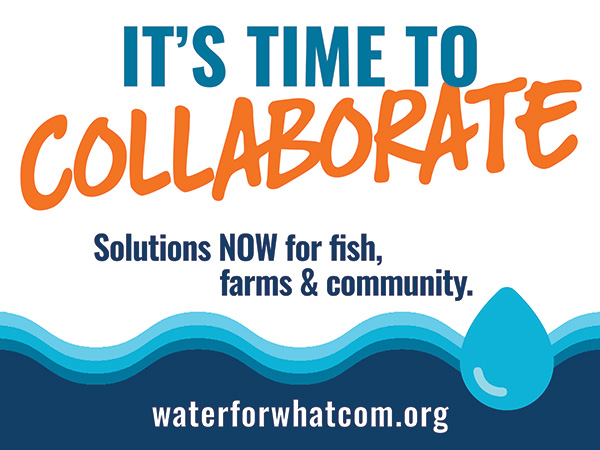
First, Whatcom Family Farmers, along with the Whatcom County Association of Realtors and the Whatcom Farm Bureau, started a group called ‘Water For Whatcom.’ This group is trying to push the community toward collaborative discussions. You may have seen signs that say “It’s Time To Negotiate” or “It’s Time to Collaborate,” which are from this group.
Water For Whatcom has also been focusing its outreach recently on how the collaborative process in Yakima was developed to provide outcomes that the adjudication could not. Recently, we were joined by a couple of voices from the local environmental community who are also giving their perspective on a path forward.
| |
| |
Second, a small group of farmers and environmentalists have recently started meeting to discuss the need to find common ground. This was spurred by the multiple op-eds by Fred Likkel and Eric Hirst in local news outlets. A recognition that we may not agree on all things, but that we agree the current path isn’t sustainable–and that we can agree on 90% of what the solutions need to be–is what is driving these discussions.
Third, a local film producer with a passion for finding common ground has started getting local groups together for discussions. He is hoping to make a film on how finding common ground can lead to solutions.
As the water rights adjudication continues to unfold, we are committed to following it very closely and speaking up for the Whatcom farming community regarding its impacts. We will continue to share information and educate the public about the process, as well as its huge significance not only for the future of local agriculture, but also for the community as a whole. Please subscribe to receive our newsletter updates, and follow us on social media to hear the latest information as we share what we’re hearing. Also, you can sign up to show support and receive alerts on the Water For Whatcom campaign here.
| | | | |