ALTERNATIVE FINANCIAL SERVICE PROVIDERS ASSOCIATION | | Industry News, Regulatory Updates & Market Insights | Edition: October 22, 2026 | | |
Many Americans Are Struggling to Afford Basic Necessities
As the 2026 midterms approach, economic issues are top of mind for voters. Many specifically mention prices and affordability as key concerns, according to a Pew Research Center survey conducted this fall.
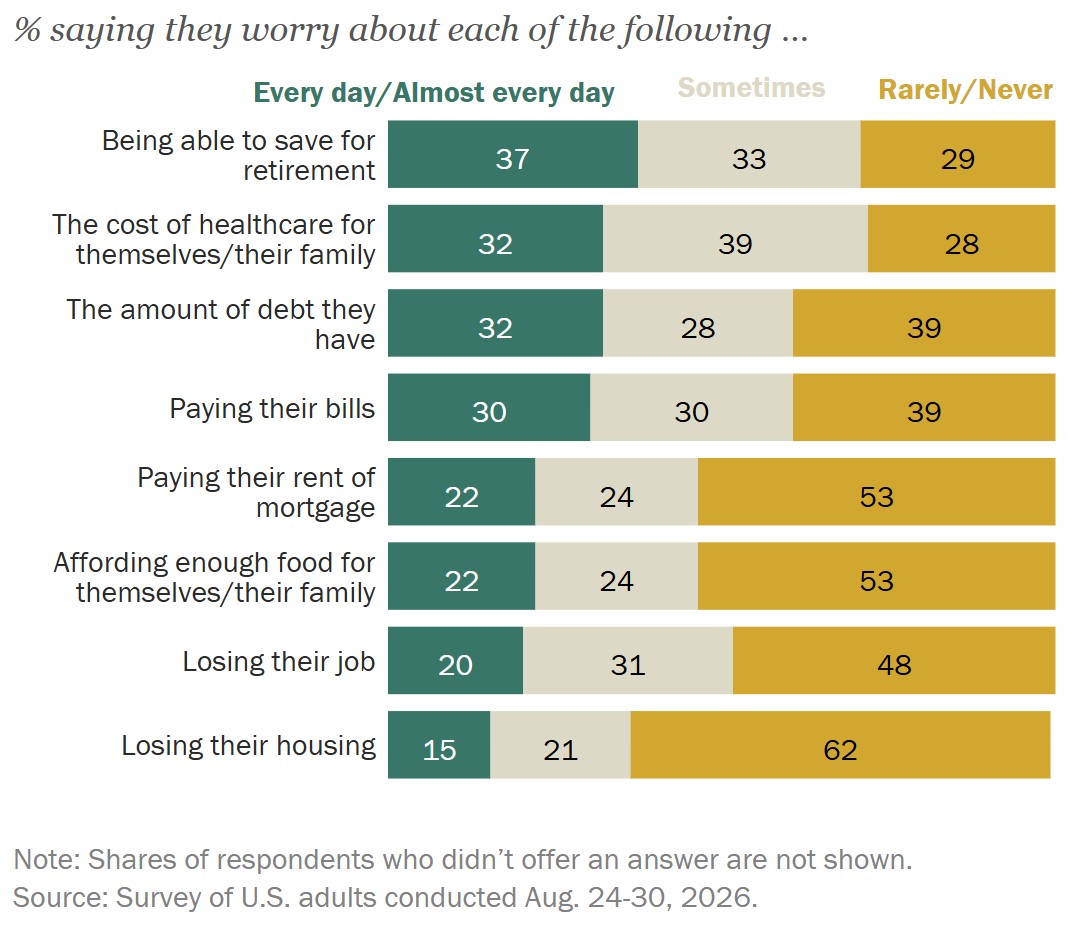
As part of our ongoing work to understand how these issues are affecting people in their day-to-day lives, we asked Americans a series of questions about their financial stability and security, their ability to afford basic necessities, and their general outlook on their personal financial situation.
The survey, conducted in August, finds that many Americans are not on solid financial footing:
Read more at PEW
| | |
What does the Consumer Financial Protection Bureau (CFPB) do?
The Consumer Financial Protection Bureau (CFPB) is an independent agency responsible for consumer protection in the financial sector. The bureau's primary mission is to ensure that markets for consumer financial products and services work for Americans. The CFPB enforces federal consumer financial laws, supervises financial institutions, and educates consumers to make informed financial decisions. It was established in 2010 as part of the Dodd-Frank Wall Street Reform and Consumer Protection Act.
How much does the Consumer Financial Protection Bureau spend?
CFPB spent $2.74 billion in fiscal year (FY) 2025. This was 0.039% of the $7.04 trillion in overall federal spending. The agency ranked 27th among federal agencies in total spending.
Read more at USA Facts
| | |
Optimize Lending Decisions with Real-Time Financial Data.
Enhance lead purchasing, underwriting, and product line
assignment with ValidiFI’s data-driven solutions
| |
|
7.5% mortgages have been the norm since the 1970s. Here's why they feel
less affordable today.
Median incomes have grown since then. But median home prices have grown faster.
The housing industry got a whole heap of bad news on Tuesday. Housing starts, which are a measure of new construction, plunged in September and were down 7.4% year-on-year. Meanwhile, pending home sales dropped to their lowest level since 2001.
Higher mortgage interest rates are to blame for the cratering numbers. The average rate for a 30-year fixed-rate loan is just shy of 7.5%. But that happens to be lower than the average mortgage rate since 1971, which is about 7.67%.
Yet those rates, high by today's standards, didn't lead to a housing affordability crisis like today's. What gives?
Read more at MARKETPLACE
| | |
Struggling consumers are increasingly turning to high-cost credit for basic needs
New research found consumers struggling to afford basic necessities are far more likely to turn to high-cost borrowing like payday loans and buy now, pay later services.
Inflation — like the higher gas prices we’re paying because of ongoing geopolitical conflict — eats away at everyone’s budget. But for people already struggling to make ends meet, higher prices can force them to turn to debt to bridge a budget gap, which can become yet another financial burden.
New reports from the Kansas City Federal Reserve and Pew Research show struggling consumers are a lot more likely to turn to debt than those who aren’t struggling.
“Fifty percent of those who had trouble affording a basic necessity said that they borrowed money from friends and family,” said Juliana Horowitz, senior associate director at Pew Research Center. “About 30% of them said they took out a payday loan, compared to 4% of those who didn't have those challenges.”
Read more at MARKETPLACE
| |
Majorities of Americans say key financial milestones are harder for today’s young adults to reach
Amid reports of a tough job market and rising costs of living, a new Pew Research Center survey finds that majorities of Americans say young adults have it harder today financially than their parents’ generation did.
The shares of U.S. adults who say it’s harder for young adults now to achieve several financial milestones have gone up since 2021. The biggest jump is in the share saying it’s harder to find a job.
Most adults (64%) say it’s harder for young people to find a job today, up from 39% who said the same in 2021. Just 15% say it’s easier, down from 40% five years ago. Another 20% say it’s about the same for young people today as it was for their parents.
Read more at PEW
| | Don't let access to capital be an obstacle. Call us. | | |
Sitting on the Sidelines Until After the Midterms?
You’re not alone. Many business owners and executives are waiting for greater clarity from the November elections before committing to their
next phase of growth.
But waiting to make the decision doesn’t mean you
should wait to prepare for it.
If additional capital will be part of your growth strategy once the political
and economic environment becomes clearer, now may be the right time
to begin the conversation.
| | |
FinTech Five
Lowenstein's FinTech, Crypto, Trading & Markets Newsletter
1. CFTC Seeks Public Comment on Notice of Proposed Rulemaking Concerning the Inclusion of Certain Event Contracts in the Definition of ‘Swap’
On October 9, the Commodity Futures Trading Commission (CFTC) published a proposed rule adding new paragraph (2)(i)(G) to the definition of “swap” in 17 CFR § 1.3 to expressly include “event contracts, including those based on sports, politics, cultural, and weather-related events.” The CFTC notes that its authority under Dodd-Frank allows it to “further define” the term “swap” and argues that event contracts already qualify as swaps under several prongs of the statutory definition. The CFTC’s proposed rule follows a developing circuit split (KalshiEX v. Assad (9th Cir.) and KalshiEX v. Schuler (6th Cir.)) and conflicting state actions, including Minnesota’s criminalization of prediction markets; Arizona’s criminal charges against a designated contract market (DCM); and court-ordered geofencing in Michigan,
Read more at Lowenstein Sandler LLP
| | |
What are the biggest drivers of inflation in the past year?
Housing was the main driver of inflation from September 2025 to September 2026. As of September 2026, overall prices increased 3.7% over the previous year. Of this, 1.5 percentage points came from price increases in housing, or about two-fifths of it.
The inflation rate is calculated using the Consumer Price Index (CPI), which tracks the price changes of a consistent basket of goods and services over time. Each item in this basket is given a weight that reflects how much the average urban household spends on it. Items with higher weights, like shelter, tend to have a larger impact on the overall inflation rate than categories with lower weights. By examining the price changes across different categories, we can better understand the factors contributing to the current inflation rate.
Read more at USA Facts
| | |
Our Vision is to become the leading
PAYDAY + ALTERNATIVE LENDER
in NORTH AMERICA
| | |
Home repair costs jump 76% in a decade
Home improvement and repair costs have escalated in price in the last decade, adding to the strain of tight budgets for Americans, a new analysis finds.
The median cost of a home improvement project has risen 76.1% from 2015 to 2025, from $1,200 to an inflation-adjusted $2,113, according to a LendingTree analysis.
"Home improvement costs are increasing so much in part because the price of most anything is going up. The cost of labor and building is likely playing a big role," Matt Schulz, LendingTree chief consumer finance analyst, told USA TODAY.
Read more at USA TODAY
| |
What does the Department of Labor (DOL) do?
The Department of Labor (DOL) is an executive branch agency responsible for overseeing the American labor force and working conditions. Its functions include enforcing wage and hour standards and union law, regulating workplace safety, administering unemployment benefits and workers’ compensation, collecting labor market data, and promoting workforce development. It was established in 1913.
How much does the Department of Labor spend?
The Department of Labor spent $54.6 billion in fiscal year (FY) 2025. This was 0.8% of the $7.04 trillion in overall federal spending. The department ranked 10 among federal agencies in total spending.
Read more at USA Facts
| |
Maximize Your Call Center
E-Complish, LLC Launches: IntellAgent™, a 24/7
AI Companion for Customer Account Management &
Payment Processing
| |
How Travel Co-Brand Cards Are Competing for Everyday Wallet Share
Card marketers understand that consumers typically open travel co-brand credit cards because they already have an affinity for a particular airline or hotel brand. Perhaps they’ve had a few great experiences flying with a specific airline or staying at a favorite hotel chain and want to unlock additional rewards, perks, and status opportunities in the future.
Historically, card marketers have faced a common challenge: Travel co-brand cardholders don’t always use those cards regularly.
According to eMarketer, 17% of U.S. adults have airline co-brand cards, but only 7% use one as their top-of-wallet card. Instead, travel co-brand cards are often reserved for booking flights or hotel stays, while day-to-day purchases flow to other rewards cards that offer stronger value on everyday spending categories.
Read more at The Financial Brand
| LEND360 was a Great Success! | |
Our 2026 LEND360 Conference was a Great Success!
We had a record number of attendees, including record numbers of CEOs and lenders. Networking was king with a record number of meetings booked through our LEND360 platform combined with numerous additional opportunities for participants to make that next connection. The content was incredible, too.
Highlight speakers included Wade Arnold of Moov, Naftali Harris of SentiLink, Sherrie Rees of First Electronic Bank, Jer Woods of Block, Rodney Williams of SoLo Funds, Manoj Verma of TabaPay, Sarah Hartung of Old National Bank, Meredith Winegar of
Old National Bank, and famed political commentator
Karl Rove.
We had over 20 focused content sessions that addressed key issues facing our industry using the expertise of our 100+ speakers to give participants concrete takeaways.
We extend a special thank you to the 90+ sponsors (including a sold-out exhibit floor)
that made this show possible. We are already working to make next year’s show even better and look forward to seeing everyone at the
2027 LEND360 event in Chicago on October 4-6.
| |
What does the Department of Housing and Urban Development (HUD) do?
The Department of Housing and Urban Development (HUD) is an executive branch agency responsible for national housing policy and community development. Its functions include providing affordable housing assistance, enforcing fair housing laws, supporting homeownership programs, and administering grants for urban development and disaster recovery. It was established in 1965.
How much does the Department of Housing and Urban Development spend?
HUD spent $50.5 billion in fiscal year (FY) 2025. This was 0.7% of the $7.04 trillion in overall federal spending. The department ranked 12th among federal agencies in total spending.
Read more at USA Facts
| | |
PayYield lifts net portfolio yield on every consumer repayment: clearing available funds on debits that
decline today, and cutting what you pay to accept
the dollars that do clear.
| | |
What is poverty?
October 14, 2025 · Everyone talks about the American dream, but not everyone has access to it. Welcome to “Just the Facts: Do You Qualify?” In this six-part series, USAFacts founder Steve Ballmer walks through government programs that give people support with food, housing, healthcare, and more. You’ll learn how these programs work, who they help, and what they cost. Do we do too much? Too little? Or just the right amount?
Just the Facts: Do You Qualify?
This is how we all start: cute little blobs. And there's a basic hope in America that everyone has a shot at living the American dream.
Read more at USA Facts
| | |
What does the Department of Commerce (DOC) do?
The Department of Commerce (DOC) is an executive branch agency responsible for supporting economic growth within the US. Its functions include promoting job creation, sustainable business development, and ensuring economic competitiveness. It was established in 1903.
How much does the Department of Commerce spend?
The DOC spent $29.7 billion in fiscal year (FY) 2025. This was 0.4% of the $7.04 trillion in overall federal spending. The department ranked 16th among federal agencies in total spending.
Read more at USA Facts
| | |
Start your FREE trial TODAY.
We'll use this to build free listings and create a
growth strategy for your business.
| |
JPMorgan CEO warns of trouble ahead for corporate America, and your job could be affected
Jamie Dimon has spent 2026 warning that companies may be enjoying calmer conditions than they should expect to last. The JPMorgan Chase CEO is not predicting an immediate recession, and the economy has shown resilience. But his latest message lands differently because it is aimed directly at businesses deciding how much to borrow, spend and hire. The question is not whether money is available today. It is what happens when companies need it tomorrow
Companies routinely borrow to expand, refinance old debt, build facilities, buy equipment and fund everyday operations. When financing becomes more expensive, those plans get harder to justify. Dimon recently asked whether companies are prepared for higher credit spreads when they need to borrow or refinance. That sounds like Wall Street jargon. For employees, it can become very real, very fast. Because when corporate budgets get squeezed, borrowing costs are rarely the only thing executives reconsider.
Read more at MSN
| |
What is this year’s Social Security cost of living increase?
Social Security payments will go up an average of $75 a month in 2027 — a 3.6% increase.
In 2027, Social Security benefit payments will increase by 3.6%, averaging $75 a month. The Social Security Administration adjusts benefit payments annually to account for inflation — a change known as the cost-of-living adjustment, or COLA.
What is COLA and how is it calculated?
The COLA is based on the Consumer Price Index for Urban Wage Earners and Clerical Workers (CPI-W), a measure tracked by the Bureau of Labor Statistics. SSA compares CPI-W data from the third quarter of the current year to the third quarter of the last year a COLA was applied. The percentage difference becomes the next year's COLA. If there's no increase, there's no adjustment
Read more at USA Facts
| | |
Choose a logo for your website to show you
SUPPORT AFSPA.
| | ALTERNATIVE FINANCIAL SERVICE PROVIDERS ASSOCIATION | | |
Alternative Financial Service Providers Association
757.737.4088
315 Tuscarora St., Lewiston, NY 14092
dan@afspassociation.com
www.afspassociation.com
Copyright © AFSPA 2007-2026
| | | | |