Rail & Labor News from RWU
| | Weekly Digest Number 47 - November 18, 2025 | | Welcome to the RWU Rail & Labor News! This news bulletin is produced and emailed out each Tuesday morning. We hope you find each week's news and information useful. If so, please share with co-workers, friends, and colleagues. If you like, you can sign them up to get all the news from RWU HERE. Or forward them the link. Got a hot tip? Please forward the article and a link to raillabornews@gmail.com. Note: If you read over this news bulletin each week, you will be sure to never miss the important news of what is going on in the railroad world from a worker's perspective! | | THIS WEEK'S RAIL AND LABOR NEWS | | Editor's Note: This merger is another chapter in the old story of capital seeking a throne. When corporations unite on this scale, it is never to lighten the burdens of the men and women who labor, but to deepen them. Rail workers know too well that every consolidation is followed by cuts, danger, and silence in the places where accountability once lived. A transcontinental colossus would not serve the people.. it would command them. Labor stands in opposition because someone must, lest the nation’s commerce be surrendered wholly to the whims of private empire. | |
| |
American Economic Liberties Project / October 2025
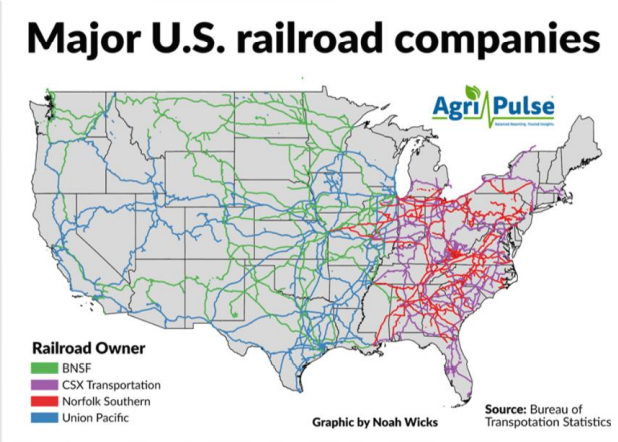
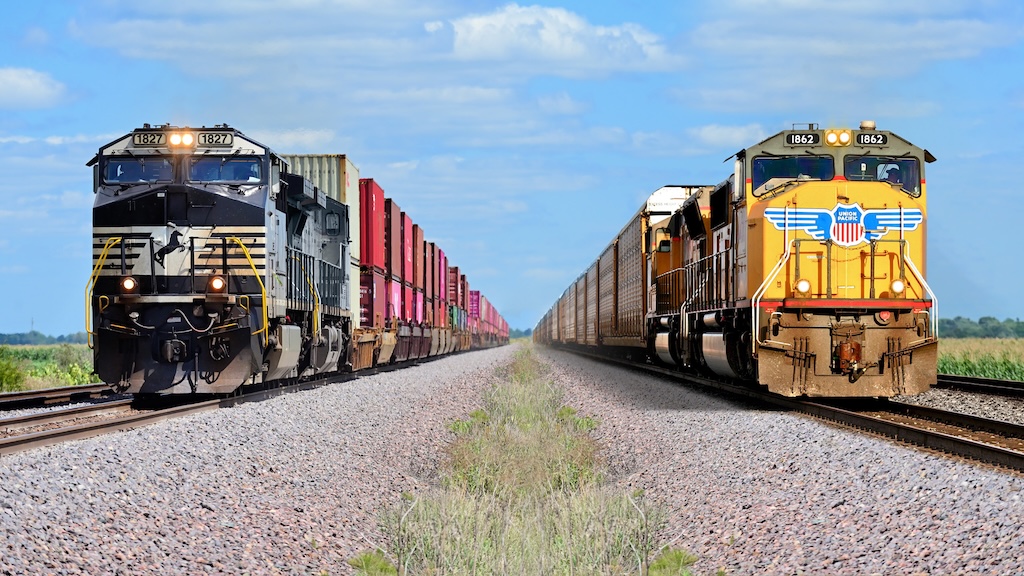
On July 29, 2025, Union Pacific Railroad announced plans to acquire Norfolk Southern Railway in a $72 billion transaction. As two of the four largest railroads in the United States, the combined $250 billion company would become the country’s first consolidated transcontinental railroad system, and the largest ever railroad company in the United States. Because of the clear harms to competition and anticipated regulatory reaction, no transcontinental merger of this kind has ever been attempted — until now.
As recent history with rail mergers illustrates, this merger would reduce competition in the rail industry, create service and shipping delays, increase prices for shippers, hurt workers, and threaten the viability of many independent businesses. Several major labor unions have opposed the merger, which would increase safety risks for American rail workers, while shipping associations have expressed concerns about possible price increases and more limited service should the merger be permitted.
| |
| Editor's Note: No surprise here of course. The impetus for the merger has been driven all along by Wall Street. As a general rule, stockholders large and small support corporate mergers because the know it gives the corporation more financial clout, elimination of "redundancies" (read, workers and infrastructure), bigger dividends and higher stock prices. | | |
Trains Magazine / November 14
Union Pacific and Norfolk Southern today cleared their first merger hurdle as shareholders overwhelmingly backed their deal to create the first transcontinental railroad.
In separate votes, nearly 99% of NS shareholders and 99.5% of UP shareholders approved UP’s proposed $85 billion acquisition of NS.
“The approval of our shareholders marks a key milestone in our journey to create America’s first coast-to-coast transcontinental railroad, combining complementary networks and capabilities to unlock a multiplier effect for benefits to all stakeholders,” NS CEO Mark George said in a statement.
NS investors will receive one Union Pacific common share and $88.82 in cash for each share of Norfolk Southern owned.
| | Editor's Note: So pathetic to see the dominoes start to fall. Now that a few unions have agreed to publicly support the UP-NS merger, it adds more and more pressure upon those craft unions that might otherwise take a principled position and oppose the merger, to bow down and kiss the ring as well. This is not trade unionism in our book, but simply grovelling for crumbs, currying favor with the giant powerful Class One carriers when they all should be standing together in solidarity and calling the proposed merger what it is - not good for railroad workers, period! | |
Progressive Railroading / November 11
Union Pacific Railroad and the National Conference of Firemen and Oilers (NCFO) yesterday announced they've reached an agreement that calls for job security for hundreds of the union's members under the proposed merger between UP and Norfolk Southern Railway.
The agreement commits to NCFO members who are employed at the time of the merger having a job for the length of their careers after the proposed merger, according to a UP-issued press release. The agreement is subject to the usual requirements for continued employment.
"The NCFO recognizes this merger presents an opportunity to strengthen long-term stability, expand opportunities for our members, and protect quality jobs for the future,” said NCFO President Michael Pistone. “We believe that by combining resources and expertise, this merger will enhance job security, create pathways for member growth, and improve working conditions through sustainable investment and innovation.”
|
| Editor's Note: A tentative agreement is always welcome, but workers know the truth behind the polished declarations of corporate goodwill. Wage gains and “flexibility” mean little if they are not rooted in dignity, security, and a voice strong enough to be heard above the boardroom chorus. Rail labor has long understood that progress is won at the bargaining table, not bestowed by executives eager to praise themselves for harmony. Three hundred engineers on the Soo Line carry a nation’s commerce on their backs, and any agreement worth celebrating must honor that reality in full. Let the company speak of growth and efficiency; labor’s measure is whether the men and women in the cab stand safer, stronger, and more sovereign than the day before. | |
|
Progressive Railroading / November 14
Canadian Pacific Kansas City yesterday announced it has reached a new tentative five-year collective agreement with the Brotherhood of Locomotive Engineers and Trainmen (BLET).
The tentative agreement providing increased wages and more flexible work rules covers 300 locomotive engineers on the Soo Line property operating trains in Illinois, Indiana, Minnesota, North Dakota and Wisconsin, CPKC officials said in a press release.
"We are very pleased to have reached this latest tentative collective agreement benefiting approximately 300 of our railroaders in the United States," said CPKC President and CEO Keith Creel. "With this agreement and 13 others reached at the bargaining table with our unions across the United States in recent days, CPKC will continue to safely and efficiently deliver for our customers for years to come in support of American business and economic growth."
| |
|
Progressive Railroading / November 13
U.S. freight railroads hauled 493,493 carloads and intermodal units in the week ending Nov. 8, down 4.9% compared with the same week in 2024, according to Association of American Railroads data.
Carloads hauled rose 0.1% to 224,651 and while intermodal volume fell 8.7% to 68,842 containers and trailers.
Four of the 10 carload commodity groups tracked by the AAR each week posted an increase in traffic compared to the same week last year. They included nonmetallic minerals, up 12.9% to 32,939 carloads; grain, up 3.4% to 24,291; and miscellaneous, up 8.4% to 8,469.
Commodity groups that posted decreases during the week included motor vehicles and parts, down 9.4% to 13,840 carloads; metallic ores and metals, down 6.6% to 19,056; and coal, down 2.1% to 57,352.
| |
|
The Vindicator / November 10
The five residents appealing the East Palestine train derailment class-action settlement were a day late and $850,000 short, the U.S. Court of Appeals for the 6th Circuit ruled last week.
The appellate court in Cincinnati dismissed appeals filed by attorney David Graham on behalf of Zsuzsa Troyan, Tamara Freeze, Sharon Lynch, Joseph Sheely and Carly Tunno, citing jurisdictional issues and failure to pay the appeal bond.
“A set of objectors to a class-action settlement are over eight months late in paying an $850,000 appeal bond. Instead of paying up, they moved to extend the time to appeal the bond order — one day late,” Wednesday’s ruling by a three-judge panel read. “Because they’re a day late, we can’t hear their reasons for being $850,000 short. We dismiss their appeal of the motion to extend for lack of jurisdiction, and we dismiss their appeals of the settlement for failure to pay the bond.”
| |
Solutionary Rail / November 7
Thursday’s Senate Commerce Committee confirmation hearing should have never happened. The National Transportation Safety Board (NTSB) nominee that appeared is meant to replace the illegally fired vice chair Alvin Brown, who is fighting his removal in the courts. On the same day Chair Ted Cruz (R-TX) announced the hearing, Senate Democrats on the Commerce Committee asked that the hearing not take place. This may also explain the poor attendance.
But it wasn’t the NTSB nomination that dominated the questioning. It was the rising sense of alarm about whether the Surface Transportation Board (STB), an independent adjudicatory body, retains the independence necessary to defend public, shipper, and national interests in deciding whether the proposed Union Pacific/Norfolk Southern merger will be allowed to be consummated. Or, will this once-independent body be taking their cues from a pay-to-play White House to which UP CEO Vena visits to flatter Trump and UP makes donations toward the new White House ballroom?
| | Editor's Note: It is phenomenal that Mexico is forging ahead with the reintroduction of passenger rail. Prior to the privatization of the national railway system in the mid 1990s, Mexico had an extensive passenger train network, but that all was dismantled 30 years ago. Great to see the foresight and progressive nature of a government that understands the need for passenger rail development! | |
Trains Magazine / November 8
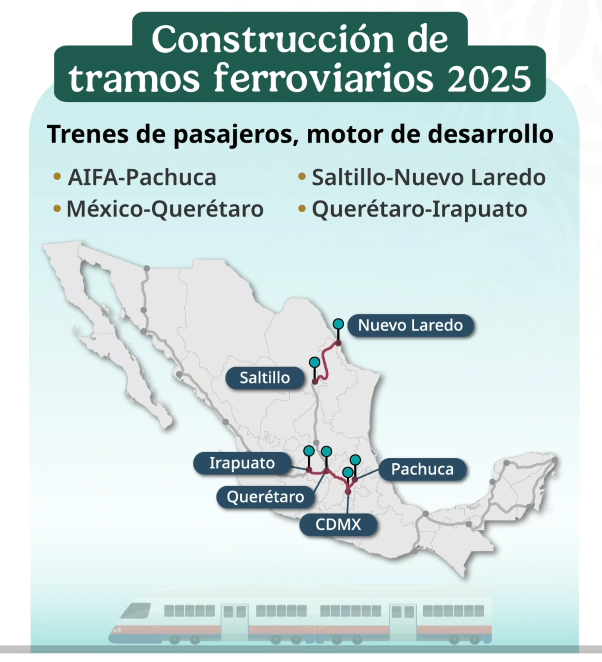
Mexican President Claudia Sheinbaum on Friday (Nov. 7) announced the start of the country’s latest major rail project, the Gulf of Mexico Train, a planned passenger route linking Nuevo Laredo at the U.S. border to the cities of Saltillo and Monterrey.
Groundbreaking was held Friday in Nuevo Laredo for the first phase of the project, a 137-kilometer (85-mile) single-track route to Arroyo El Sauz. That segment, the first of five, will require the construction of 52 bridges and 42 grade crossings, according a government press release. The new passenger line will be built next to an existing freight line. The federal ministry of infrastructure, communications and transportation, SICT, says 71% of the right-of-way has already been cleared, and contracts have been put out to bid, according to a BNamericas report.
The full Nuevo Laredo-Saltillo route will cover 396 kilometers (246 miles) with operating speeds of 160 to 200 kilometers per hour (99-124 mph). The government projects the complete Saltillo-Nuevo Laredo route will carry 7.5 million passengers annually.
| | Editor's Note: Despite equipment shortages, limited capacity, train consolidations and skyrocketing prices, Amtrak set yet another ridership record. The public demand is there. Two new routes (Chicago to Twin cities and New Orleans to Mobile) have exceeded all expectations. It is time for the federal government to make a firm long-term commitment to Amtrak in the form of an extended operating budget and a capital budget that will ensure acquire adequate new equipment ASAP to both replace aging cars and locomotives and allow for extended train consists, frequencies and new routes. | |
Trains Magazine / November 16
Amtrak ridership grew 5% in the fiscal year ending Sept. 30, 2025, and revenue surged 11%, as robust Northeast Regional gains offset fewer Acela frequencies on the Northeast Corridor. The railroad carried nearly 34.5 million passengers, while ticket revenue was $2.764 billion.
The results from the company’s monthly performance reports for 2025 are now posted on the Amtrak website. Compared with fiscal 2024, they show ticket revenue growing more than ridership in each category of service — Northeast Corridor, Long Distance, and State-Supported. This confirms what ticket buyers have experienced all year: fares are raised exponentially as coach seats and sleeping car space fill up. The higher fares allow the company to cash in on last-minute customers.
This strategy was recently criticized by New York Gov. Kathy Hochul, who secured a $99 price cap on fares between New York City and Albany-Rensselaer as part of an agreement to expand that route’s service.
| |
High Speed Rail Alliance / November 14
On Dec. 31, 1978, the Rock Island Line ran its last passenger train from Chicago to Rock Island, Illinois. The Quad Cities of Illinois and Iowa have not had passenger rail service since.
This is due to change. The transit legislation that the Illinois General Assembly passed on Halloween calls for a one-time appropriation for “intercity passenger rail capital startup” of $300 million. Almost all of that will go toward establishing rail service between Chicago and Moline. The remainder will go to study and plan the embryonic Chicago-to-Peoria route.
The Illinois Department of Transportation estimated the cost of implementing the service at $750 million; $475 million had already been amassed from a variety of sources, so this allocation puts the project, in the works since early this century, over the top.
| | NEWS FROM AROUND THE LABOR MOVEMENT | | Each week, RWU includes a few articles about advances and developments in the larger labor movement that are of interest to railroad workers. Got an artcile to submit for possible inclusion next week? Email it along to raillabornews@gmail.com. Thank you! | | Editor's Note: Three years ago, Railroad Workers United decided that the way forward for the railroad industry in North America was public ownership. The rail network is just too central and important to be left to the whims of Wall Street hedge funds. Freight traffic has declined dramatically the past 20 years and passenger rail is stagnant. Meanwhile, vast fortunes are being made by stockholders. This is no way to run a railroad. We need expansion, not contraction. | |
Jacobin / November 9
Zohran Mamdani’s historic victory in New York’s Democratic Party primary for mayor in June 2025 and victory in the general election on Tuesday has provided a dose of hope to a Left seeking a path forward amid a dire political landscape. His campaign succeeded by offering real solutions to working-class concerns — including on climate policy and its connection to New Yorkers’ material conditions.
The climate crisis is heightening the cost-of-living crisis. As a political issue, climate has become less of a priority with voters, with the economy surpassing it in poll after poll since 2019. But this does not mean that people have stopped caring about the climate crisis. The pressing affordability crisis is front of mind for most. People need to believe and see the climate crisis not as an economic burden but as an opportunity to make their lives more affordable. Mamdani’s campaign did this with a laser focus on material improvements in working-class people’s daily lives through climate action via promises like fast and free public buses.
| | |
In These Times / November 13
As hundreds of Starbucks workers go on strike across the US to protest the company’s unfair labor practices, its union is telling customers to boycott the company in hopes of pressuring it to return to the bargaining table to negotiate its first union contract.
“As of today, Starbucks workers across the country are officially ON STRIKE,” said Starbucks Workers United, the union representing nearly 10,000 baristas, on social media Thursday. “We’re prepared for this to become the biggest and longest [unfair labor practices] strike in Starbucks history.”
The union implored customers: “DON’T BUY STARBUCKS for the duration of our open-ended ULP strike!”
The strike comes after negotiations between the union and the company stalled out in April. Last week, 92% of union baristas voted to authorize a strike as the company’s lucrative holiday season began. They are hoping to turn the company’s annual “Red Cup Day,” during which it gives out free reusable cups to customers, into a “Red Cup Rebellion.”
| | WEEKLY DERAILMENT DEPARTMENT | | Each Tuesday in this news bulletin, RWU does our best to present a picture of what has been happening over the course of the previous week in terms of derailments in North America, and investigation determinations of previous accidents. NOTE: This list is by no means comprehensive. Smaller and less consequential mishaps are generally not reported here. If the wreck results in injury or fatality, or is especially damaging/extreme, a full article will appear as a feature in the dozen or so rail articles above. Know of a train wreck? Please feel free to forward a link to raillabornews@gmail.com for possible inclusion next week. Thanks! |
| | | |