|
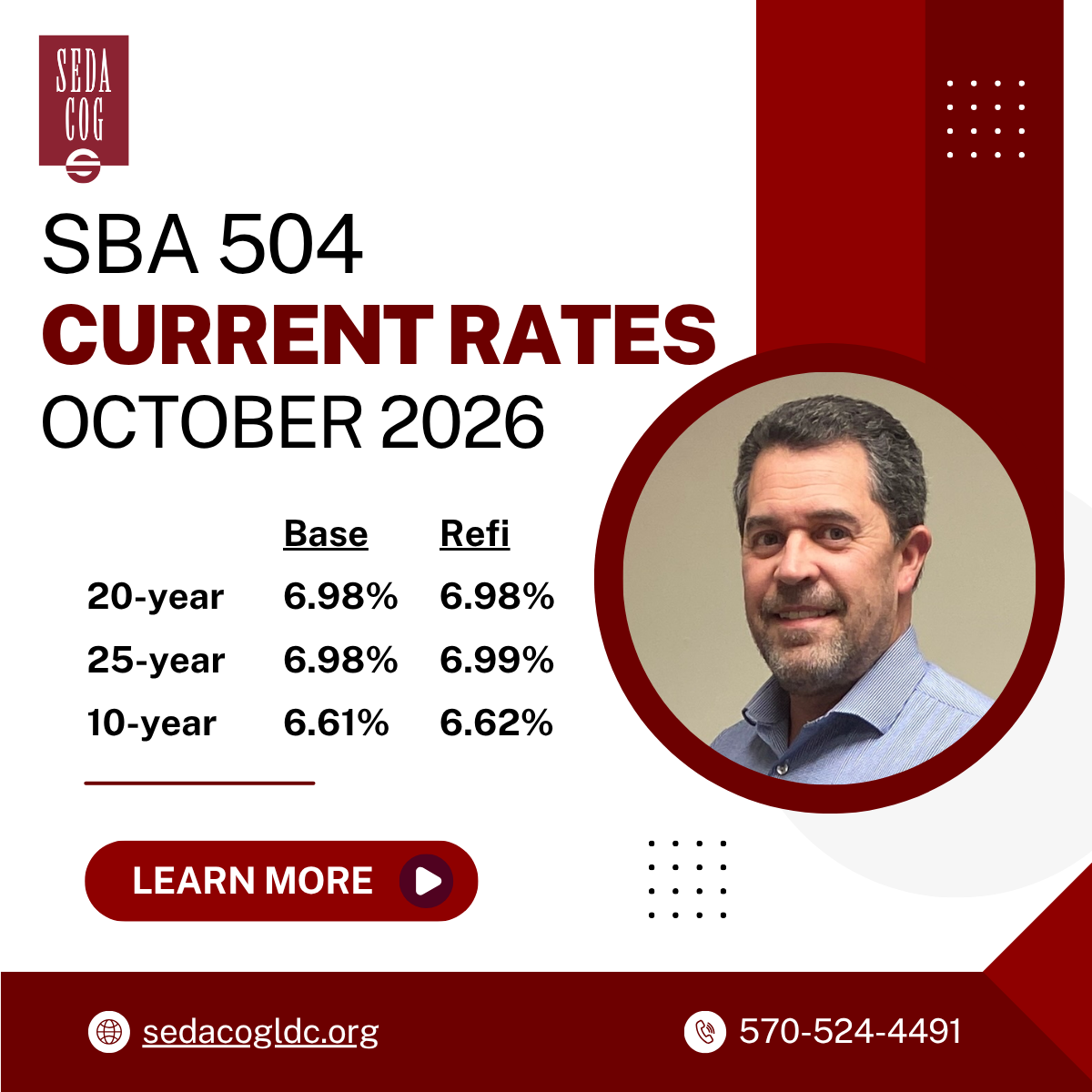
NADCO, the trade association for the nation's Certified Development Companies (CDCs), has released the SBA 504 fixed interest rates for October 2026. Eagle Compliance, the Fiscal Agent for the SBA 504 Loan Program, responsible for the marketing, pricing, and selling of the debentures sold to investors to fund the SBA 504 Loan Program, stated that October saw SBA interest rates rise sharply amid continued concern for inflation and the rise in Federal debt.
According to Eagle Compliance, a week before the SBA bond sales:
Inflation Flat, Hiring Slows
Those are the takeaways from a week that was loaded with key economic reports that provided more insight into the economy. 2Q2026 GDP increased to 2.2% from the previously reported 1.5%; Non-Farm Payroll of 29,000 came in below consensus and weaker than the downward revision to 133,000 for July; unemployment rose to 4.2%, and Personal Consumption Expenditures were interesting:
-
Personal Income declined 0.1% to 0.2%.
-
Personal Consumption increased sharply to 0.9% from 0.2%, a reflection of consumer demand that is a major part of our economy.
-
Average hourly earnings declined 0.2 % to 0.1%, and the y/y rate declined to 3% from 3.1%.
-
Core PCE m/m rose to 0.2% from a downwardly revised rate of 0.1% in July.
-
Core PCE y/y at 3% was flat to the July rate, which was revised down from 3.3%.
Increased consumption combined with lower income and reduced earnings is not a good mix for consumers who identify the cost of living as their primary concern.
Turn Back Time
A WSJ article identified how surging bond yields are bringing the bond market back to the turn of the century as a reminder that these current rates are not abnormal. Following the dot.com bubble of the 90s, rates took a jagged journey that culminated on 6/20/2020 with a low rate of 0.65% for the 10-Year Treasury Note during the pandemic. With the end of Quantitative Easing, rates have risen and are expected to move even higher. The question for now is whether or not the work the market is doing for the Fed is sufficient, as even the futures market has reduced the probability of another 25 bps rate hike on September 28 to 22%, while the December 9 meeting holds a 67% probability rate. Recent comments from two Vice Chairs of the FOMC helped to calm the markets. John Williams, President of the NY Fed, said “there is no urgency” for raising rates, while Philip Jefferson noted rates have risen since the September meeting as investors reassess the economy.
For the week, the 10-Year benchmark Treasury rose 12 bps to 5.28% while the slope of the 2-Year/10-Year curve steepened from +33 bps to +48 bps, a move that inspired the FedWatch probability of a September rate increase to decline.
From a historical perspective for the SBA 504 loan program, the average rate for the 10-Year Treasury dating back to the program’s first debenture sale in November 1986 is 4.58%.
Market Activity
The rates market was split, as short-term rates were unchanged with longer rates rising by 12 bps in a bear market steepener, an indication that the market does not expect the Fed to act this month. The benchmark 10-Year Note closed 37 bps higher than when the 504 program priced its September debentures, with credit spreads widening.
Sovereign debt is tracking US rates higher, as is our domestic Corporate market, where Paramount sold a $52 billion package of investment-grade and junk-rated bonds with rates as high as 9.1%, with the securities three times oversubscribed.
DJIA and S&P 500 were flat, with the Nasdaq gaining 4% thanks to hyperscaler activity. Oil prices settled back after G7 nations agreed to release 100MM barrels from their reserves.
Following the bond sales, Eagle Compliance reported:
Riding the U.S. Treasury Elevator: Last Floor 4%, This Floor 5%, Next Floor…
As we approached last week’s October SBAP sale, the market’s “risk-off” tone had gained momentum. The FOMC raised interest rates by 25 bps in September, and the probability of an additional rate increase in December hovered near 90%. Worrisome inflation levels continued, driven by elevated energy prices, driven by the conflict in Iran, which continued with little sign of meaningful progress toward resolution. Additionally, fiscal policy issues were becoming ever more concerning. The level of Federal debt outstanding had recently topped $40 trillion, Federal debt relative to GDP had reached 123% and continued to climb, and finally, Federal debt interest expense had risen by 12% in 2026. Economic releases for the week were expected to be light, with the FOMC meeting minutes release on Wednesday and the U.S. Treasury completing its quarterly refunding of 3-Year, 10-Year, and 30-Year notes/bonds throughout the week.
From the prior month, U.S. Treasuries had continued their relentless increase in yields. The 10-Year UST yield was 5.22%, up 31 bps month over month. The U.S. Treasury curve had retained its relatively steep shape. As measured by the MOVE Index, UST volatility had increased a massive 48% from 73.1 to 108.1 month over month. Comparable ACMBS issues had widened 7 to 8 bps month over month in addition to the 3 bps of widening experienced the prior month. The MBS to UST basis had also widened 12 bps, and the 30-Year residential mortgage rate was now 7.28%, up 57 bps month over month. With these factors in mind, it was decided that the suggested initial pricing spread on the 20-Year debenture would be +50 bps and for the 25-Year debenture it would be +57 bps, each to the 10-Yr. U.S. Treasury Note; each 7 bps wider than the September pricing.
Investor response to the SBAP $11.364 million 20-Year was positive; for the SBAP $457.367 million 25-Year it was also good, though it took a bit longer to distribute. Given the very negative market tone and positive, though not exceptional, investor reception on the SBAP issues, it was decided that the pricing spread on each would not be changed from the initial pricing spreads suggested. The 20-Year debenture was priced at a spread of +50 bps; the 25-Year debenture was priced at a spread of +57 bps. The October debenture rate for the 20-Year was 5.78%, and for the 25-Year it was 5.85%; each 44 bps higher than the September pricing. The 25-Year rate is 50 bps over the program life average of 5.35%, and the +51 bps spread over Treasury was 21 bps below its program life average of T+78.
Wednesday’s release of the latest FOMC meeting minutes showed a modestly hawkish Committee unanimously supporting September’s rate hike. The minutes, furthermore, showed broad-based support for a potential second-round increase by year-end amid a surprisingly resilient economy. That said, some officials continue to champion the position of patience, noting that the central bank should take time to assess the evolution of the data and the broader economy before further adjusting policy. Curiously, based upon their statements, the FOMC seems committed to reducing inflation back to its 2% PCE target. However, and perhaps contradictorily, based upon their projections for the Federal Funds rate, no further rate increases are projected beyond 4.25%; rate declines are expected in 2028 and beyond, and the PCE itself is not expected to reach their goal until 2029.
While this flexible approach to monetary policy is understandable given changing conditions, a sense of trepidation to raise rates in a clearly inflationary environment may undermine the FOMC’s commitment to actually achieving price stability.
_________________________________________________________________
Despite the recent rise in rates, SBA 504 loans remain very attractive, as they reduce the down payment on commercial real estate projects to as low as 10% and provide a 20- or 25-year fixed rate for up to 40% of the borrower's financing need.
For more information about the SBA 504 loan program, visit sedacogldc.org.
|