Rail & Labor News from RWU
| | Weekly Digest Number 48 - November 25, 2025 | | Welcome to the RWU Rail & Labor News! This news bulletin is produced and emailed out each Tuesday morning. We hope you find each week's news and information useful. If so, please share with co-workers, friends, and colleagues. If you like, you can sign them up to get all the news from RWU HERE. Or forward them the link. Got a hot tip? Please forward the article and a link to raillabornews@gmail.com. Note: If you read over this news bulletin each week, you will be sure to never miss the important news of what is going on in the railroad world from a worker's perspective! | | THIS WEEK'S RAIL AND LABOR NEWS | | Editor's Note: The legislators have sounded a warning the whole country ought to heed: when two rail barons join hands to command nearly half the nation’s freight, it is not progress but a tightening of chains upon the people. The UP–NS merger is hailed as “efficiency,” but we know that efficiency in the kingdom of monopoly means higher prices, poorer service, and the steady impoverishment of those who make this nation run. Such a consolidation would place the cost of food, steel, autos.. the staples of American life, at the mercy of a private power answerable to no community and no conscience. If this scheme is allowed to proceed, it will not strengthen our nation against foreign rivals; it will surrender the people’s commerce to a corporate colossus whose only loyalty is to its own enrichment. | |
|
Freight Waves / November 18th
Dozens of Republican state legislators warned regulators that the proposed rail mega-merger of Union Pacific and Norfolk Southern threatens to raise the cost of products on everything from steel and autos to food, and hinder the ability of U.S. companies to compete on the world market.
While stating that they were committed to economic opportunity, free enterprise, and fair competition, “[T]his merger raises serious questions about its long-term impact on competition, service reliability, and the cost of doing business in America,” said legislators in the letter addressed to Surface Transportation Board Chairman Patrick Fuchs, Vice Chair Michelle Schultz and member Karen Hedlund. “If approved, the combined UP (NYSE: UNP)-NS (NYSE: NSC) system would control nearly 45% of all U.S. rail tonnage and hold dominant market share in critical commodity sectors. These commodities directly affect the cost of consumer goods, housing, energy, and food – core expenses for American families and small businesses.
“Reduced competition in these areas will inevitably lead to higher prices and fewer choices. This merger could negatively affect America’s ability to compete with China, and it has the potential to pose significant risks for the industrial and agricultural production that powers state economies and the broader American manufacturing base.”
| |
| Editor's Note: More than a dozen members of Railroad Workers United (RWU) attended an event in Terre Haute, IN at the end of October, where each year an outstanding dignitary wins the Eugene V Debs Award. When candidate Zohran Mamdani won the election and will soon be seated as the new mayor of New York, he invoked the name of Eugene Debs in the first line of his victory speech. So just who is this man whose name keeps cropping up lately? And why is his name revered to this day among railroad workers? | |
Counter Punch / November 14th
Zohran Mamdani’s quoting of Eugene Debs in his recent victory speech (for mayor of New York City) should awaken interest in the man who gained a name for himself as “Mr. Socialism.”
For seventeen years Debs was the Brotherhood of Locomotive Firemen, starving himself of sleep to bone up on politics, economics, and history. With painstaking effort he made himself into a manager’s worst nightmare: an educated union man who could unravel the knots of capitalist contradiction, making the need for revolution plain for all to see.
Unable to ignore workers’ constant pleas for help, he went everywhere he was called, never managing to get his suitcase unpacked. In bad years he donated up to $900 of his $1500 salary to keeping the union and its magazine afloat, steering the workers through strikes, depression, and looming bankruptcy.
| | Editor's Note: When nine state attorneys general warn that a rail merger threatens not only the nation’s economy but its very security, the country ought to stop and listen. Their message is plain: when two great carriers fuse into one dominant power, competition withers, prices rise, and the people pay the bill. An “America First” economy cannot stand when its own railroads make it too costly for American industry and agriculture to survive. To kneecap our manufacturers and farmers in the name of corporate consolidation is not patriotism; it is surrender. If this merger proceeds, it will not strengthen the nation, but place its commerce.. and its security, at the mercy of a private empire whose interests run no farther than its own profit. | |
|
Railway Age / November 17th
Attorneys General Jonathan Skrmetti (Tennessee ), Kris Kobach (Kansas), James Uthmeier (Florida), Lynn Fitch (Mississippi), Brenna Bird (Iowa), Austin Knudsen (Montana), Drew Wrigley (North Dakota), Marty Jackley (South Dakota) and Dave Yost (Ohio) on Nov. 14 wrote to the STB asking the agency “to conduct a thorough review of the proposed merger and prioritize the need for a competitive and innovative freight rail system.” Following is the full text:
“We write to express our concerns that the proposed merger between Union Pacific and Norfolk Southern will result in undue market concentration that stifles competition and therefore creates higher prices, lower reliability, and less innovation at the expense of America’s manufacturers and, ultimately, America’s consumers. An America First economy will not work if high internal shipping costs kneecap American companies’ ability to compete with foreign manufacturers. The downstream impact of the merger poses significant risk not just for our industrial base but also our agricultural producers. Ultimately, then, this merger could compromise our national security."
| |
| Editor's Note: It is interesting to watch the continued cracks in the Republican Party on the issue of the UP-NS Merger. Earlier this month, 9 Attorneys General - all Republicans - condemned the merger as an impediment to free enterprise and competition. Now, 3 more AGs - again all Republicans - weigh in in favor of the proposed merger, siding with capitalist amalgamation. | |
Progressive Railroading / November 21st
State attorneys general from Georgia, Nebraska and West Virginia yesterday called on the Surface Transportation Board to approve the proposed merger of Union Pacific Railroad and Norfolk Southern Railway.
In a filing with the board, the three attorneys general tout both the key role that freight railroads serve in powering the U.S. economy, and the environmental benefits of rail transportation.
"The merger of Union Pacific and Norfolk Southern will only further strengthen the efficiency, reliability, and effectiveness of our freight rail system," they wrote, and added that the newly formed transcontinental railroad would directly connect 100 North American ports and expand operational access to 43 states.
| | Editor's Note: For decades, Amtrak has been a political football, with at least two past presidents - Bush and Trump - attempting to defund it completely, and at least one recent Amtrak CEO himself - Richard Anderson - attempting to kill off the long-distance network. In this environment, new equipment was not exactly on the agenda, despite the fact that the company has had limited rolling stock for years, and that so much of this rolling stock has been past its prime for decades. Now with unprecedented demand for accomodations, trains are selling out left and right. The time to do a mass purchase of new equipment was years ago. Let's not wait another day! | |
High Speed Rail Alliance / November 20th
Amtrak has a problem: There’s more demand than it can handle. Trains regularly sell out, year round.
In fact, Amtrak just reported its best year ever, with two million more passengers than the previous record-setting year.
This is great news, but it should have been even better. We can only imagine what Amtrak’s ridership would be if it weren’t turning so many people away because of limited capacity.
There’s a relatively simple fix for this problem: Buy more trainsets.
Bizarrely, though, Amtrak and the Federal Railroad Administration are slow-walking an order to replace the oldest trains. And Amtrak appears to have no plans to expand its fleet.
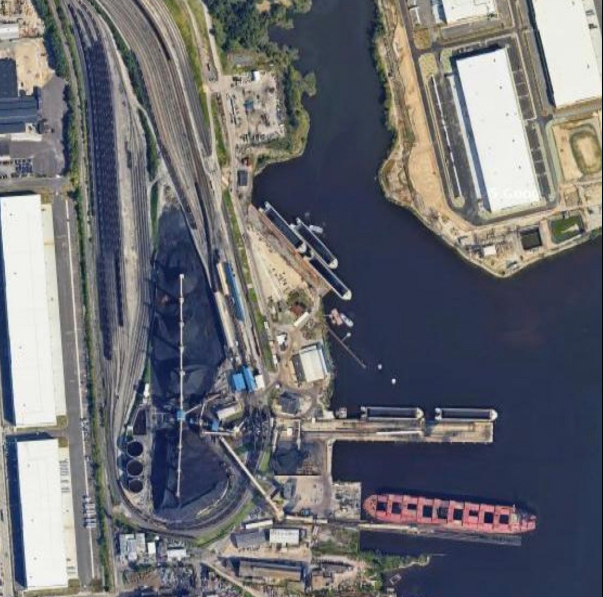
| | Editor's Note: On December 30, 2022 a coal silo exploded and destroyed property in the community. The explosion resulted in a $1.75 million class-action law settlement and fines from the state. However, residents report of ongoing coal dust pollution in their community. More recently Maryland Department of the Environment (as part of the new permit) is requiring CSX to enclose its coal terminal operations in Curtis Bay with a physical barrier to prevent the black dust from blowing into the neighborhood, they refuse. CSX states that the enclosure would be too expensive. For a company worth 63.83 billion; and a CEO who has an annual base salary of $1.5 million; residents find it hard to believe the corporation cannot invest in infrastructure to ensure the safety of the community. | |
Trains Magazine / November 21st
CSX Transportation is asking the Surface Transportation Board to block parts of the state of Maryland’s new operating permit for the railroad’s Curtis Bay coal terminal in Baltimore, saying they constitute an impermissible attempt for the state to regulate rail transportation.
The railroad, in a Nov. 19 filing, is asking the board for a declaratory order finding those conditions are preempted by the ICC Termination Act, which establishes regulation of the rail industry as a federal matter.
CSX’s primary concern is a requirement that it build a windscreen surrounding the terminal, a rail-to-ship transload facility, to control coal dust. The state permit would require these windscreens to be taller than the maximum height of the coal piles at the facility, which the railroad says would require screens more than 100 feet tall.
| | Editor's Note: CSX’s protest over the rush to approve the UP–NS merger lays bare an old truth: when corporations seek to consolidate power, they prefer speed over scrutiny. UP and NS now demand a 345-day sprint through a process designed for careful judgment, as if the fate of half the nation’s freight can be settled like a routine timetable adjustment. CSX, no friend of labor itself, at least recognizes the danger in treating an unprecedented consolidation as mere administrative housekeeping. The Surface Transportation Board has every right.. and every obligation, to use the full statutory period, for what stands before it is not paperwork but the potential remaking of the national rail map. A merger of this scale must be examined with the patience and rigor worthy of the public it will affect, not hurried along to satisfy those who stand to profit most from haste. | |
|
Trains Magazine / November 20th
CSX Transportation has objected to the accelerated schedule Union Pacific and Norfolk Southern have proposed for Surface Transportation Board consideration of the UP-NS merger, with CSX offering its own proposal for a slightly longer schedule than an STB proposal that largely follows an earlier UP-NS proposal.
CSX says the proposed shorter timeline “imposes unnecessary burdens on other parties.”
UP and NS have proposed a 345-day schedule after previously outlining plan for a 390-day timeline [see “UP and NS seek faster merger review …,” Trains.com, Oct. 30, 2025]. An STB proposal largely followed the initial UP-NS plan [see “STB proposes schedule …,” Trains.com, Sept. 26, 2025], but left open the possibility to use the full 485 days allowed by statute. But in a Nov. 19 filing, CSX says the board is “faced with an unprecedented proposal where many highly complex issues could arise under never-applied standards” and should use “the full statutory period provided.”
| |
| Editor's Note: The latest “job security” pact between the Brotherhood of Railway Carmen and Union Pacific arrives with all the familiar fanfare of corporate benevolence.. and all the familiar limits. These guarantees, offered only to those on the property at the moment of merger, are less a shield for workers than a public relations salve meant to ease the path toward consolidation. UP has struck similar deals with other crafts, but no promise tied to a merger has ever outweighed the iron law of monopoly: fewer competitors mean fewer jobs, less voice, and more power concentrated in the hands of the carrier. Workers deserve security rooted in strong contracts and real competition, not assurances granted at the convenience of a corporation seeking approval for empire-building. The unions may accept these terms out of caution, but the public should not mistake them for the long-term protections that only a truly competitive rail system can provide. | |
|
Progressive Railroading / November 18
The Brotherhood of Railway Carmen (BRC) and Union Pacific Railroad reached an agreement that provides a job security commitment for hundreds of union employees if the proposed merger between UP and Norfolk Southern Railway goes through.
The BRC is the latest union to reach an agreement with UP that ensures members employed at both UP and NS at the time of the merger will have job security for life, subject to the usual requirements for continued employment, UP officials said in a press release.
The other two unions are International Association of Sheet Metal, Air, Rail and Transportation Workers–Transportation Division and the National Conference of Firemen and Oilers.
| |
|
The Rift / November 16th
[Interview ] with Ron Kaminkow and Nick Wurst of Railroad Workers United about cross-union organizing, the fight against mega-mergers in rail, and what a worker-lead rail industry might mean for the fight against climate change.
| |
Ellis Simon / November 17th
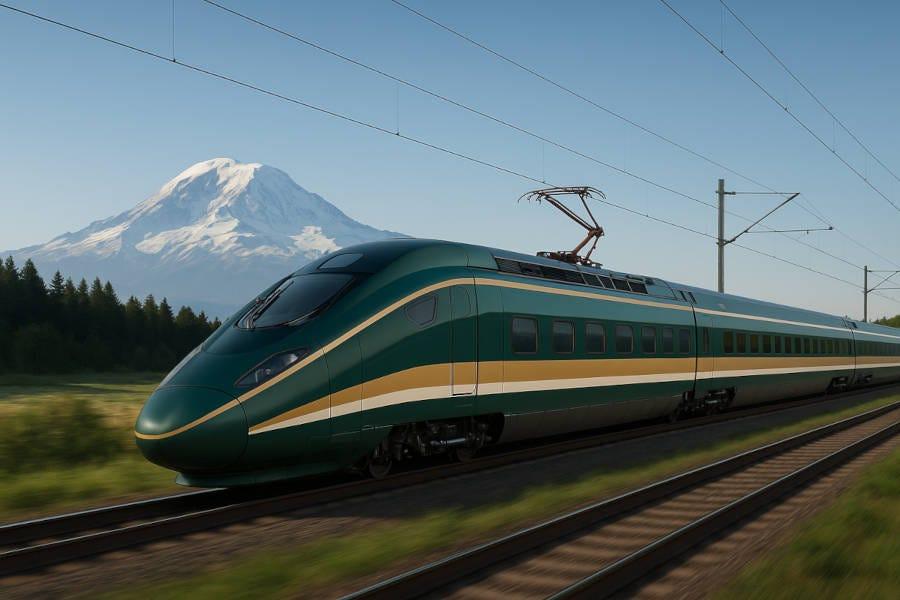
While the nation’s attention has been focused on high-speed rail (HSR) in California and Florida, another HSR project has been building steam in the Pacific Northwest. The Cascadia Corridor route would serve an eponymous mega-region that is home to ten million people. It includes Portland, OR, Seattle, WA, and Vancouver, BC. High-speed trains capable of 250 mph top speeds could cover the 315-mile corridor in as little as two hours.
Cascadia is the first HSR proposal to receive a Federal Railroad Administration Step Two Corridor Identification and Development funding. The $47.9 million grant, awarded last December, and matched by $5.6 million from the Washington Department of Transportation (WashDOT), will enable the agency to produce a service development plan. The plan is scheduled for completion in 2028.
A service development plan is a prerequisite for additional federal aid for environmental studies and, later, design, engineering, and construction. “We are currently in project planning,” Chelsea Levy, Cascadia Corridor project manager, told a gathering of business leaders last month in Seattle. “We’ll need not only approvals but additional funding to advance the environmental review process both in the US and Canada.”
| | Editor's Note: Another week of falling intermodal traffic tells a story deeper than a set of percentages. When volume slips for six straight weeks in an economy that is supposedly “strong,” it signals a system straining under its own consolidation.. a rail network optimized for shareholder return rather than national service. Intermodal, the very lifeline of consumer goods and domestic manufacturing, continues to sag because the carriers long ago chose precision scheduling over resilience, cost-cutting over capacity, and monopoly comfort over competition. Yes, year-to-date totals remain slightly ahead of last year, but that only shows how much freight the railroads shed in 2024, not how well they are serving the nation today. A healthy rail system does not repeatedly falter under routine demand; it adapts, expands, and carries the commerce of a people with confidence. These declines are not the fault of the shippers or the workers.. they are the predictable harvest of a business model that treats the American economy as something to be skimmed, not served. | |
|
Trains Magazine / November 20th
Slumping intermodal traffic continues to keep weekly U.S. rail traffic below 2024 levels.
For the week ending Nov. 15, 2025, U.S. volume was 493,880 carloads and intermodal units, a 4.5% decline from the same week a year ago. The total included 223,101 carloads, down 0.2%, and 270,779 containers and trailers, down 7.7%.
It was the sixth straight week traffic had shown a decline compared to the same week a year earlier.
Through 46 weeks of 2025, U.S. traffic totals 22,709,819 carloads and intermodal units, a 2% increase over the same period in 2024. That includes 20,227,762 carloads, up 1.8%, and 12,592,057 intermodal units, up 2.2%.
| |
|
Progressive Railroading / November 19th
North Carolina's state-sponsored intercity passenger-rail service, NC By Train, set a new monthly ridership record in October.
NC By Train carried 74,400 passengers in the month, a nearly 10% increase over ridership in October 2024, North Carolina Department of Transportation (NCDOT) officials said in a press release. It was the highest month of ridership in the service's 35 years of operation.
Total ridership between January and October increased 4% over the same period last year, from 584,600 in 2024 to 608,300 this year. NC By Train ridership has consistently grown since 2022, and is on track to break its ridership record again in 2025, NCDOT officials said.
| | NEWS FROM AROUND THE LABOR MOVEMENT | | Each week, RWU includes a few articles about advances and developments in the larger labor movement that are of interest to railroad workers. Got an artcile to submit for possible inclusion next week? Email it along to raillabornews@gmail.com. Thank you! | |
Pay Day Report / November 19th
“We will physically take the plant,” said Unifor Local 88 plant chair Mike Van Boekel after GM missed a deadline from the Canadian Government to present its plan to keep the factory open.
The GM CAMI plant had 1,200 workers before a shut down earlier in April, and production was supposed to resume last month. However, instead GM said they would be pulling production, laying off all of the workers.
GM says this is because of low demand, but Unifor says it’s also Trump’s tariffs.
"The reality is that CAMI was hit from both directions by Trump as he aggressively acted to undo EV support and hit Canadian auto assembly plants with a 25 per-cent tariff," said Unifor President Lana Payne.
| |
Labor Notes / November 18th
The Mexican government is failing to prosecute violent retaliation and threats against workers who organize, says a new report, putting Mexico out of compliance with its trade agreement with the U.S. and Canada.
The report lists nine separate organizing campaigns in which threats were made against workers: in each instance, the authors found “little evidence of investigation or prosecution by the authorities.”
The report was authored by the Independent Mexico Labor Expert Board (IMLEB), set up by the U.S. Congress under the United States-Mexico-Canada Agreement and tasked with reviewing the implementation of Mexico’s labor reforms.
The USMCA, signed into law in 2020, was modeled on and replaced the North American Free Trade Agreement, which had gutted wages and pitted workers against each other while employers made out like bandits.
| | |
Portside / November 20th
There is a military axiom that if your positions are encircled by far superior forces, you will inevitably be annihilated, unless you break out. I have been a member of our labor movement and left wing since I got out of high school in 1979. For every one of those 46 years our labor movement has been under heavy attack, and at the end of every year we were smaller and more exhausted than when it began. This year will be no exception.
With only a few scant exceptions the U.S. labor movement continues to avoid the key question of new organizing. The call to “Organize the Unorganized!” is no longer heard. Embattled unions must draw to their support the masses of unorganized – or face destruction. As the left, we had better face up to the fact that unorganized workers do not get organized by themselves. That’s our job. William Z. Foster taught us the simple fact that, “The left wing must do the work.”
New union organizing today continues to dwindle in scale and in degree of success, with only a few contrary examples. Much of today’s labor journalism – what little remains – tries mostly to rally the faithful by extolling mythic breakthroughs and upsurges.
| | WEEKLY DERAILMENT DEPARTMENT | | Each Tuesday in this news bulletin, RWU does our best to present a picture of what has been happening over the course of the previous week in terms of derailments in North America, and investigation determinations of previous accidents. NOTE: This list is by no means comprehensive. Smaller and less consequential mishaps are generally not reported here. If the wreck results in injury or fatality, or is especially damaging/extreme, a full article will appear as a feature in the dozen or so rail articles above. Know of a train wreck? Please feel free to forward a link to raillabornews@gmail.com for possible inclusion next week. Thanks! |
| | | |