Summary of Monthly Situation Update for September 2026 | | | 1. Info-graphs of BHRN's Report | | 2. News Summary and Analysis | | 3. Political, Legal, and International Developments Affecting Myanmar | | 4. Resistance Updates | | 5. On the Ground: Escalating Violence and Human Rights Violations | | I. Attacks on Civilians and Civilian Property | | II. Attacks on Schools, Religious Buildings and Sites Sheltering Displaced Civilians | | III. Religious and Ethnic Discrimination | | IV. Arbitrary Detention, Abductions and Coercive Military Recruitment | | V. Deaths and Ill-treatment in Custody | | 6. Policy Recommendations | | | Every month BHRN provides a summary of situation update for the previous month’s important event in Burma. More detailed information for each paragraph contained in the update is available in more details upon request. | | |
Methodology
This report is based on primary and secondary sources, including on-the-ground documentation by BHRN and other human rights groups and media reports from trusted national and international outlets. It provides a detailed analysis of key events during the month, situating them within international legal frameworks and offering policy recommendations to guide international responses, humanitarian action, and justice efforts.
For more information about any of the incidents documented in this report, or to request interviews or supporting materials, please contact Kyaw Win, Executive Director of BHRN, at kyawwin@bhrn.org.uk.
| | Short Video for Summary of Situation Update - September 2026 | | 1.Info-graphs of BHRN’s Report | | This Month in Myanmar – September 2026 | | 2. News Summary and Analysis | | |
Myanmar’s military junta continued to carry out deadly attacks on civilians throughout September 2026, bombing villages, markets, schools and areas sheltering displaced people. On September 28, military aircraft struck a crowded market in Kyauktaw Township, Rakhine State, killing at least 50 people and injuring 58 others. Across the country, civilians faced arbitrary arrests, forced military recruitment, extortion, ill-treatment in detention and restrictions on access to essential services.
In Mandalay, junta authorities sealed Muslim prayer spaces following pressure from Buddhist ultranationalist monks and continued to block repairs to mosques damaged in the 2025 earthquake. In Rakhine State, Rohingya residents in areas controlled by the Arakan Army and United League of Arakan reported discriminatory registration requirements, unequal taxation, threats of expulsion and abuses linked to military recruitment. Resistance authorities also faced allegations of arbitrary detention and misconduct, raising concerns about their willingness and ability to hold personnel accountable.
On September 29, Malaysia returned 1,476 Myanmar nationals without allowing UNHCR to assess their protection needs or establish whether their decisions to return were voluntary. Those returned faced potential persecution, detention, and forced military recruitment in Myanmar. Bangladesh continued to restrict Rohingya refugees’ freedom of movement and access to education, while international calls for repatriation continued despite the absence of conditions for safe and voluntary returns. International legal proceedings and investigations into atrocities and related abuses continued, but meaningful accountability remains elusive.
| |
1. AA/ULA Administrative Restrictions on Rohingya
The United League of Arakan (ULA), the political wing of the Arakan Army (AA), has begun imposing discriminatory administrative restrictions on Rohingya communities in areas under its control in Rakhine State, according to accounts documented by BHRN in September 2026. In Pauktaw Township, residents said ULA officials issuing new household registration documents prohibited them from identifying as “Rohingya” and instructed them to use another ethnic designation. In Maungdaw Township, Rohingya traders reported that ULA authorities imposed higher import and export taxes on them than on traders from other ethnic communities conducting comparable business activities.
ULA authorities have also reportedly taken steps affecting Rohingya housing and imposed compulsory financial contributions backed by threats of expulsion. Beginning September 25, ULA officials reportedly ordered village administrators in Maungdaw Township to compile lists of vacant homes belonging to Rohingya families who had fled to Bangladesh. In Myo Ma Ka Nyin Tan, also known as Shiddar Para, administrators reportedly recorded 163 vacant households, prompting fears that the properties could be demolished or confiscated. On September 30, residents of Mangla Gyi village in northern Maungdaw reported that ULA authorities ordered households to pay 5,000 kyat monthly into a “national fund” beginning in October, warning that those who failed to pay could be expelled from the village. These reported practices threaten Rohingya residents' ability to retain their homes and property and remain in their communities without discrimination or coercion.
2. Junta Restricts Muslim Worship and Mosque Reconstruction
On 13 September, junta-controlled authorities in Mandalay issued Order No. 1/2026 under Section 144 of the Code of Criminal Procedure, sealing two structures within the Miba Zay Mosque compound and prohibiting prayer, access, and construction work. The order followed objections to mosque renovations by monks linked to the Buddhist ultranationalist Ma Ba Tha movement.
The junta also continued to restrict repairs to mosques damaged in the March 2025 earthquake. In mid-September, township authorities blocked the reconstruction of Sit Tat Mosque in Taungoo. BHRN's Blocked from Rebuilding report, published on 7 October, documented 180 earthquake-affected Islamic religious buildings across 29 townships. A Mandalay mosque trustee told BHRN that more than 70 mosques known to him had sought repair permission, but only four had received approval. The restrictions have prevented Muslim communities from reopening damaged places of worship, while junta officials have acted on demands from Buddhist ultranationalist groups to restrict Muslim religious activities.
3. Passport Restrictions Affect Former Political Prisoners
A 22 September Human Rights Watch investigation documented how the junta's March 2026 passport law restricts former political prisoners' ability to leave Myanmar. The law permits authorities to deny passports to people released conditionally or deemed threats to national security, and allows courts and other authorities to recommend travel bans against people who have faced criminal proceedings. Combined with biometric registration and surveillance systems, these measures expose former detainees to further monitoring and prevent some from leaving the country legally.
4. Junta Removes Opposition Lawmakers
On 7 September, the junta-controlled Union Election Commission removed two People's Party lawmakers representing Myeik and Launglon townships in Tanintharyi Region. The commission awarded both seats to candidates from the military-backed Union Solidarity and Development Party following electoral challenges. The decision further reduced opposition representation in the legislature formed after the junta’s illegitimate 2025–26 elections process.
5. Malaysia Returns Myanmar Nationals Without UNHCR Protection Assessments
On 29 September, Malaysia returned 1,476 Myanmar nationals as part of a proposed arrangement involving 5,000 people. Malaysian authorities described the returns as voluntary, although those returned had been held in immigration detention. On 30 September, UNHCR said Malaysia had denied it access to assess individual protection needs or determine whether the decisions to return were free and informed. Returnees risk persecution, detention and forced military recruitment in Myanmar. Available information did not establish how many of those who returned belonged to each ethnicity.
6. Rohingya Refugee Protection and the ICJ Genocide Case
On 20 September, the Organisation of Islamic Cooperation called for Rohingya citizenship rights, protection in Rakhine State and refugee repatriation. Its Secretary-General reiterated support for voluntary, safe and dignified returns and accountability on 22 September. At a UN meeting on 23 September, Bangladesh's Prime Minister Tarique Rahman proposed measures on refugee returns, humanitarian assistance and accountability.
Bangladesh nevertheless continued to restrict Rohingya refugees' movement in mainland camps and on Bhasan Char, while Rohingya children remained excluded from accredited education outside the camps.
The International Court of Justice is set to issue its judgment on the merits in The Gambia v Myanmar. Its January 2020 provisional measures requiring Myanmar to prevent genocidal acts against the Rohingya and preserve evidence remain binding. In a 12 October opinion article, BHRN Executive Director Kyaw Win called on OIC governments supporting the case to protect Rohingya refugees rather than press for returns without adequate safeguards.
7. Norway Opens Criminal Investigations into Telenor
On 15 September, Norwegian police opened two criminal investigations and brought charges against Telenor ASA relating to its former Myanmar operations. One investigation concerns alleged complicity in crimes against humanity after Telenor Myanmar repeatedly supplied historical customer traffic data to the military junta between February 2021 and March 2022. The second concerns suspected sanctions violations involving the transfer of surveillance equipment. Telenor said its employees faced serious threats if they refused orders from the military junta. The company has not been found guilty, and no individuals had been charged as of 15 September.
8. EU Proceedings Examine Aircraft Exports to the Military Junta
On 24 September, an Advocate General of the Court of Justice of the European Union issued a non-binding opinion concerning aircraft and equipment intended for the military junta's air force. The case arose after Austria refused an export application for aircraft-related goods that could support military pilot training or reconnaissance. The opinion found that equipment marketed for civilian use could still fall under EU controls on dual-use goods because of its technical capabilities. The Court had not issued a final judgment by the end of September.
9. US Court Allows Challenge to ICC Sanctions to Proceed
On 28 September, a US federal court allowed a lawsuit challenging US sanctions on cooperation with the International Criminal Court to proceed. Human rights defenders Matthew Smith and Akila Radhakrishnan challenged restrictions introduced in February 2025 that threatened penalties for certain communications and evidence-sharing with the ICC Prosecutor. A July 2025 preliminary injunction continued to protect the two plaintiffs while the case proceeded. The court has not reached a final ruling, and the injunction did not protect other investigators documenting international crimes in Myanmar.
| |
|
1. Federal Resistance Coalition Adds Three Members
On 8 September, the Steering Council for the Emergence of a Federal Democratic Union (SCEF) admitted the Sagaing Federal Unit, Mandalay Region, and Magway Federal Unit, increasing its membership from six to nine organisations. The coalition includes the National Unity Government (NUG), parliamentary representatives and major ethnic armed organisations, including the Karen National Union and Kachin Independence Organisation.
2. Chin Resistance Authorities Develop Defence and Military Service Laws
On 2 September, the Chinland Council announced plans to draft a Chinland Defence Law to bring the Chin National Army and separate Chinland Defence Force units under unified civilian command. The council had circulated interim guidelines in August and planned to consult the armed groups before adopting the law.
On 17–18 September, the Mara Territorial Administration Council approved a draft military service law and amendments to existing defence and administration rules. Mara authorities had already announced compulsory military service for adults in April. The council did not disclose when the September legislation would take effect or clarify eligibility, exemptions and implementation.
3. NUG Reports More Than 100 Complaints Against Resistance Personnel
On 14 September, the NUG said it had received more than 100 complaints against resistance security personnel and local administrators, including allegations of extortion, arbitrary detention, abuse of authority and sexual misconduct. The NUG said it had resolved more than 60 cases, was examining more than 30 others and had suspended some personnel during investigations.
The deputy minister for home affairs acknowledged that investigators could not access certain areas or arrest some armed personnel accused of misconduct. The NUG did not disclose the outcomes of individual cases or the remedies provided to complainants.
4. RCSS and MNDAA Meet Junta as Other Armed Groups Reject Talks
On 15 September, the Restoration Council of Shan State (RCSS) met the military junta's negotiating committee in Naypyidaw to discuss the return of displaced civilians and local services. The RCSS signed the 2015 Nationwide Ceasefire Agreement and has maintained contact with the junta. Other major ethnic armed organisations, including the Kachin Independence Organisation, Karen National Union, Chin National Front and Karenni National Progressive Party, rejected the junta's invitations.
On 23 September, a Myanmar National Democratic Alliance Army (MNDAA) delegation arrived in Naypyidaw for its first negotiations with the junta in the capital. Talks began the following day. A source familiar with the negotiations said Chinese pressure prompted the visit after junta reconnaissance flights over MNDAA-controlled towns threatened to derail the meeting. Reopening China–Myanmar border trade routes was a principal issue.
5. Arakan Army Captures Four Junta Outposts Near Sittwe
On 15–16 September, the Arakan Army (AA) captured four junta outposts along the Sittwe–Ponnagyun front in Rakhine State, according to Development Media Group, citing military sources. The positions included areas near Minchaung Bridge and the villages of Khamaungtaw and Aungmyaygon. The gains followed a junta offensive towards Ponnagyun that began on 4 September with naval and air support.
6. KIA Captures Military Positions in Kachin and Northern Shan States
On 2 September, the Kachin Independence Army (KIA) and allied forces attacked a 15-vessel junta flotilla travelling towards Bhamo along the Ayeyarwady River. One vessel surrendered with military personnel, police, civil servants and military families aboard. The Kachin Independence Organisation subsequently said it was screening civilians among those taken into custody.
On 28 September, KIA and allied resistance forces reportedly captured a junta hilltop position near Shwemyintin Pagoda outside Momeik, northern Shan State. Resistance sources reported seizing weapons and ammunition. Junta forces responded with airstrikes and artillery fire.
7. Resistance Drone Attack Forces Closure of Mandalay Airport
On 10 September, resistance forces launched a drone attack against Tada-U Air Force Base beside Mandalay International Airport. The junta closed the airport from 10 to 12 September, and airlines cancelled passenger flights. Resistance groups claimed to have destroyed two military aircraft, but the damage was not independently verified. Accounts of civilian injuries also conflicted.
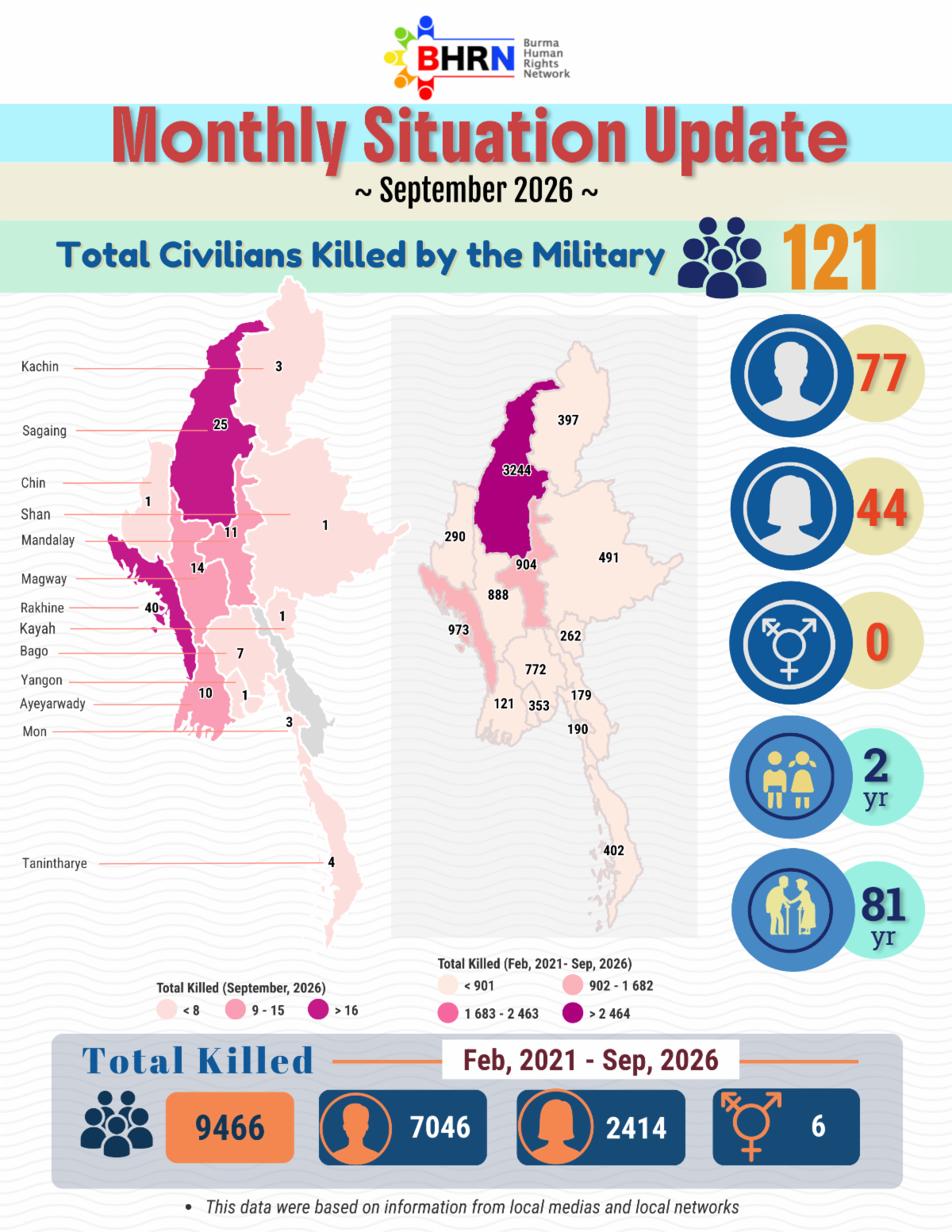
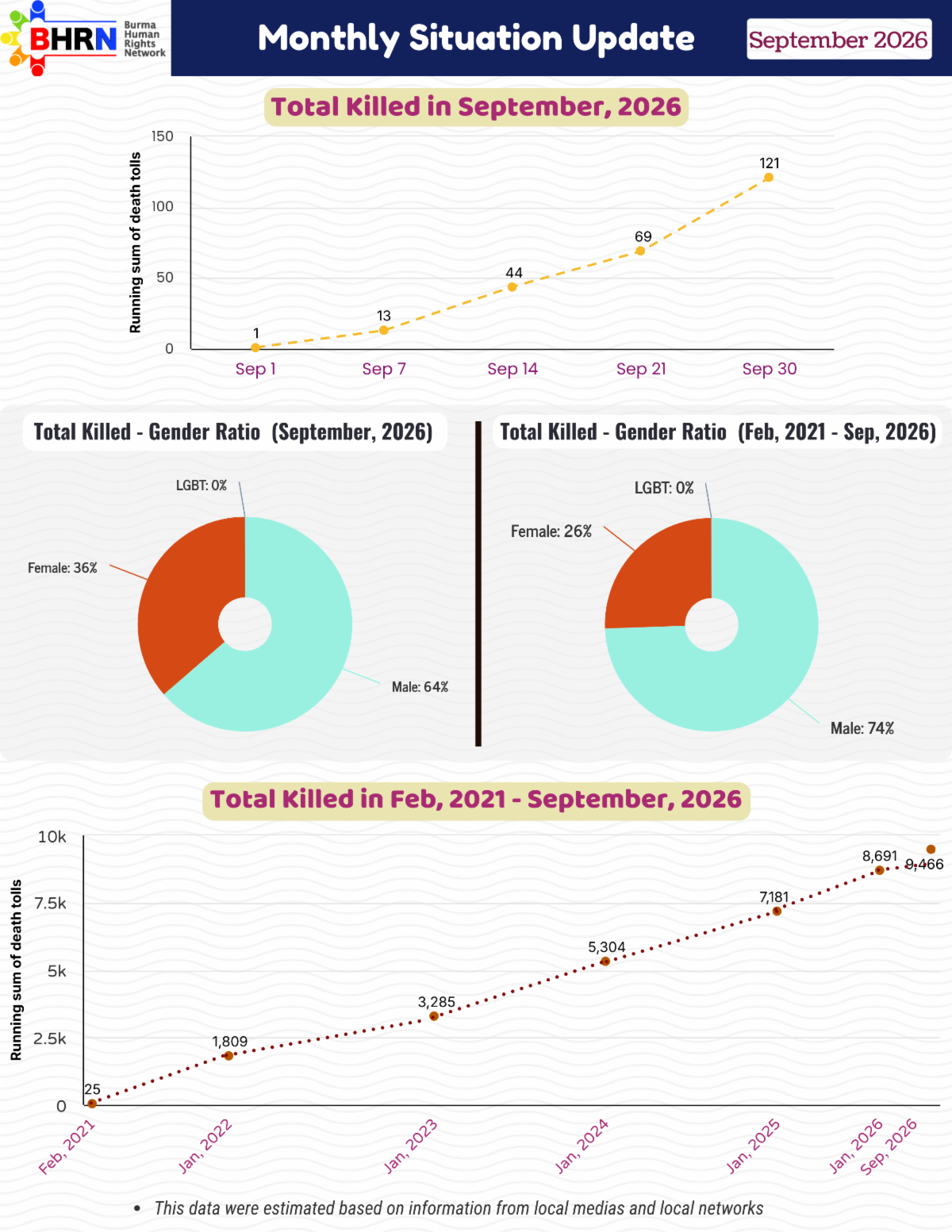
| | 5. On the Ground: Escalating Violence and Human Rights Violations | | The military junta carried out aerial attacks, shelling and ground operations that killed and injured civilians during September. Civilians also faced detentions, forced participation in military movements and interference with religious worship. Monitoring identified 97 people killed by the junta from 1 to 30 September, including 12 children, and attributed 82 of those deaths to airstrikes. The same monitoring separately recorded 107 reported deaths for which the victims had not been identified. Separate monitoring documented 58 women killed and 65 injured during September. These are source-specific monitoring figures and are not combined with the incident entries below. | | |
International humanitarian law prohibits attacks directed at civilians and civilian objects, indiscriminate attacks, and attacks expected to cause excessive incidental civilian harm. Reporting an attack and civilian casualties does not, by itself, establish a war crime. The incidents below identify attacks and alleged deliberate killing or destruction that require scrutiny under these rules.
· 1 September - Hpasawng Township, Karenni State: At least five civilians, including children, were killed when military aircraft bombed the Mawchi area.
· 2 September - Mahlaing Township, Mandalay Region: A military drone exploded beside a house in Se Kwe village. A civilian man injured by fragments died the following morning, and his wife was also wounded.
· 4 September - Myawaddy Township, Karen State: A military drone struck Kyun Taw village in the Phalu area, killing a child and injuring three other civilians.
· 5 September - Laymyethna Township, Ayeyarwady Region: A military airstrike on Pan Taw Gyi village killed a displaced father and son who had fled fighting in Rakhine State and damaged civilian homes.
· 5 September - Shadaw Township, Karenni State: Five civilians were killed by a military airstrike, including children.
· 6 September - Bilin Township, Mon State: Junta artillery struck Nyaung Daught village, killing a ten-year-old child and injuring the child's mother.
· 10 September - Launglon Township, Tanintharyi Region: Junta troops entering Kone Za Yet village killed U Phay Aye, who was over 90. A man and a woman in their twenties were also killed in nearby Mae Maw.
· 13 September - Ponnagyun Township, Rakhine State: Bombs struck the Seti Yin and U Raz Taung area, killing two civilians and injuring three.
· 14 September - Nanmekhon area, Karenni State: One civilian was killed by a military drone strike around Nanmekhon.
· 15 September - Pale Township, Sagaing Region: Gyrocopter attacks on Kanpauk village killed at least three people.
· 16 September - Myingyan Township, Mandalay Region: Military artillery struck Pyo Kan village, killing a woman and injuring two others.
· 17 to 18 September - Pakokku Township, Magway Region: Air attacks on residential wards in Myit Chay killed four civilians and severely injured another. The attacks began on 13 September and displaced thousands of residents.
· 19 September - Kanpetlet Township, Chin State: Two military aircraft made three bombing runs over a village in Kanpetlet Township, damaging civilian houses.
· 21 September - Khin-U Township, Sagaing Region: Two military airstrikes struck minutes apart on Ywar Sin and Kone Gyi villages. Two civilians were injured.
· 21 September - Laymyethna Township, Ayeyarwady Region: A military airstrike hit Daunt Gyi village early in the morning, killing a displaced woman and injuring a man.
· 21 September - Laymyethna Township, Ayeyarwady Region: A junta column shot and killed Kyaw Thet Oo near Pan Taw Gyi village while he was returning with medicines and supplies for his mother. The shooting occurred as the column entered neighbouring villages.
· 21 September - Mobye area, southern Shan State: Military artillery killed a displaced woman who had returned to Warisuplai village to collect firewood.
· 21 September - Pauktaw Township, Rakhine State: A military aircraft bombed Taung Phoo village, killing one woman. -BHRN Documentation
· 22 September - Hpruso Township, Karenni State: A military drone bombed a village in eastern Hpruso, seriously injuring a man. Drone attacks disrupted farming and left households afraid to tend their fields.
· 22 September - Natogyi Township, Mandalay Region: An airstrike hit Man Lel village, killing two older women and injuring five other civilians.
· 23 September - Indaw Township, Sagaing Region: A military air attack struck a road junction between Indaw and Meza, setting a fuel tanker and a lorry ablaze. Two transport workers were killed in the vehicle strike.
· 24 September - Bawlakhe Township, Karenni State: Military aircraft carried out two bombing runs, followed by artillery fire, in a residential area. Two men were reported killed and four people injured, including a young child. Several homes were damaged.
· 26 September - Kanpetlet Township, Chin State: Military aircraft bombed a village, destroying approximately five civilian houses and injuring one person.
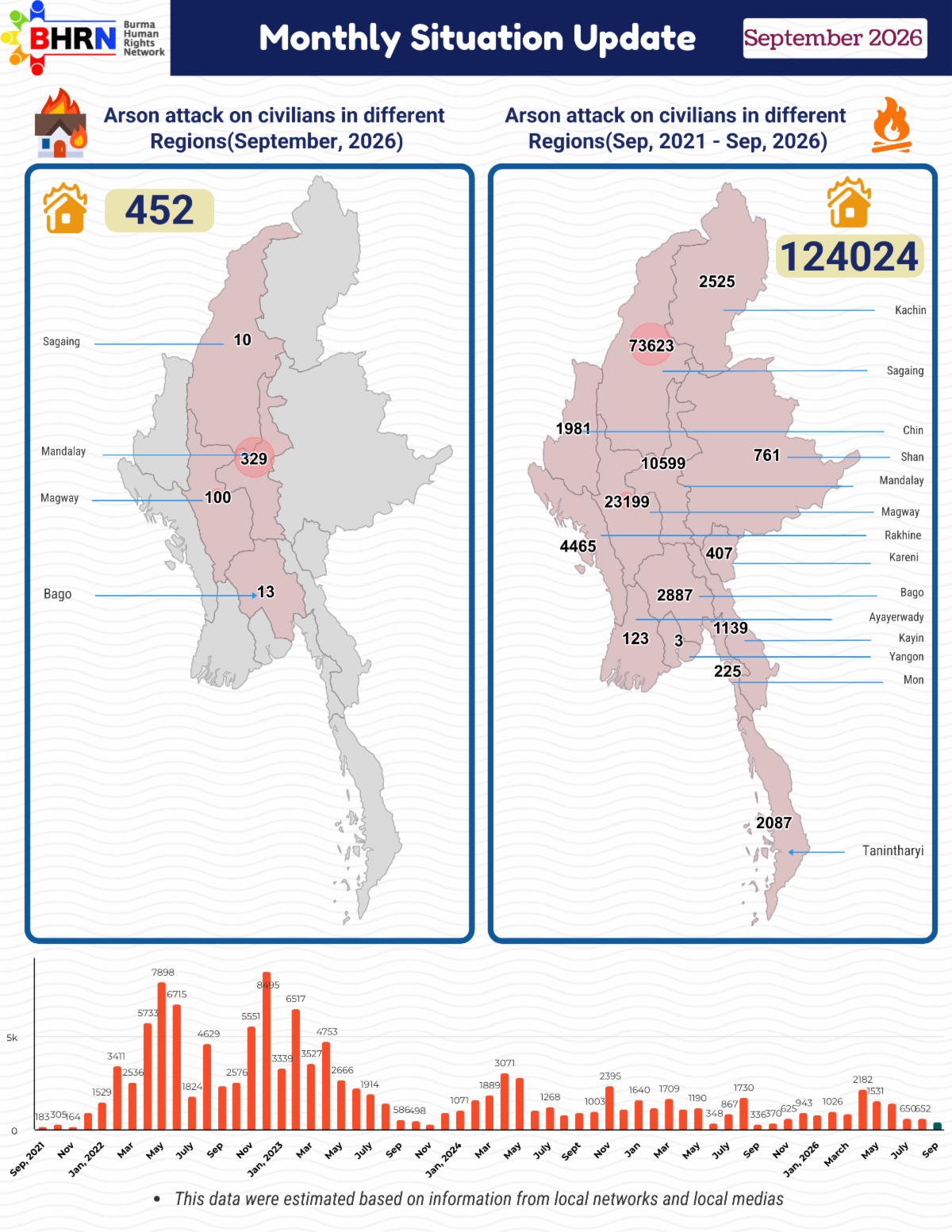
· 26 September - Saw Township, Magway Region: Junta troops set fire to houses near the monastery in Thee Kone village, destroying at least three. The military junta maintained a position in the village and independent assessment of the wider damage was not possible.
· 28 September - Demoso Township, Karenni State: An air attack struck three villages sheltering displaced families west of Demoso. One civilian was killed and eight injured. Children were sheltering beneath houses while adults worked in nearby fields.
· 28 September - Kanbalu Township, Sagaing Region: A military aircraft bombed Inlaegyi village and struck homes. Four civilians were killed, including children. Nine people were injured during three attack runs, including rockets, over Inn Lel Gyi village. -BHRN Documentation
· 28 September - Kyauktaw Township, Rakhine State: Military aircraft bombed the Indian Market during trading hours, damaging the adjacent Kissapanadi Bridge. At least 50 people were killed and 58 injured, including traders, customers, and transport workers from several communities. The strikes occurred at approximately 12:10 pm and 12:14 pm. -BHRN Documentation
· 28 September - Thabaung Township, Ayeyarwady Region: Soldiers entering Thit Phyu village shot and killed farmer U Kyi Win, a man in his forties, while he was working in a field and trying to flee. Three other civilian men were detained during the operation. Their whereabouts and reasons for their detention are unknown.
· 28 September - Minbya and Thandwe townships, Rakhine State: Military aircraft bombed Sun Ye village in Minbya Township and Ngapali Beach in Thandwe Township. Nine people were injured across the two locations. -BHRN Documentation
· 30 September - Ponnagyun Township, Rakhine State: Military aircraft bombed Kyaukseik village, which was sheltering displaced families. Two displaced civilians, including a child, were injured shortly after 9 pm.
· 30 September - Rathedaung Township, Rakhine State: A military bomb struck a home in Kutaung village on Mosel Island, killing a man and injuring his wife.
| | II. Attacks on Schools, Religious Buildings and Sites Sheltering Displaced Civilians | | |
Schools, places of worship and sites sheltering displaced civilians receive civilian protection under international humanitarian law unless their actual use makes them military objectives. Medical, religious and educational facilities may have additional protections. The available reporting does not establish the target selection or precautions taken in every attack.
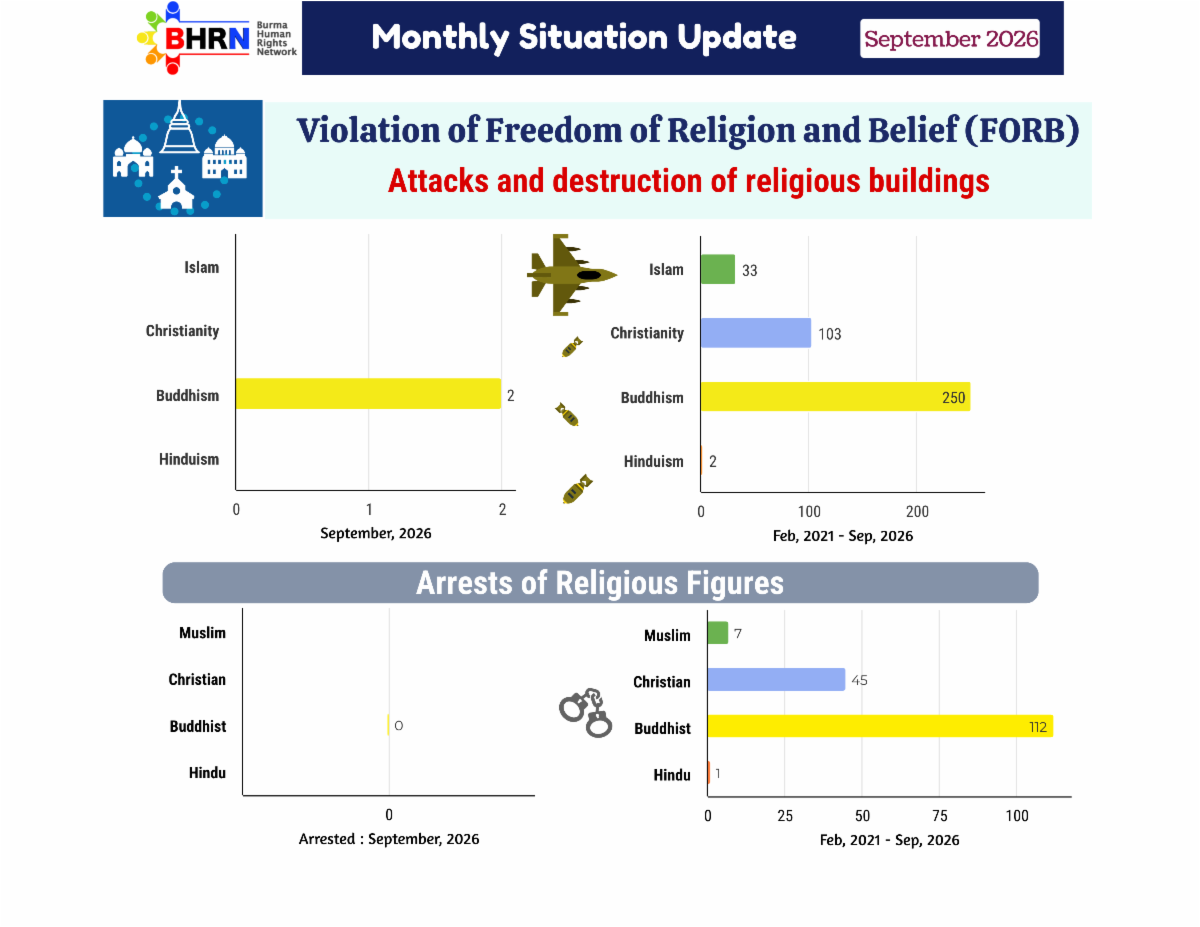
· 6 September - Ngazun Township, Mandalay Region: Military drones struck Ywar Thit Taw monastery, which sheltered displaced people, killing three people, including a monk and two women.
· 16 September - Demoso Township, Karenni State: A military explosive drone hit an orphanage in western Demoso and killed a child.
· 16 September - Kanpetlet Township, Chin State: A military fighter jet bombed Maw Chaung village, damaging homes and a school. More than 290 civilians, including children, fled the village.
· 16 September - Shwebo Township, Sagaing Region: Artillery struck a monastery in Nama Sayit village, killing a monk and injuring five civilians; subsequent airstrikes injured at least seven others at a temporary shelter for displaced people.
· 19 September - Bilin Township, Mon State: An airstrike on Yoa Klah village at around 11 pm destroyed Yoa Klah West Middle School and causing minor damage to Yoa Klah East Primary School; a monastery was also damaged.
· 23 September - Katha Township, Sagaing Region: Military aircraft bombed Naung Pein and Nyaung Che Htauk villages. A woman died after being wounded near a school in Naung Pein and a Buddhist nun was injured in the other village. The school building was also damaged.
· 23 September - Myingyan Township, Mandalay Region: Artillery shells struck Da Kyun village's monastic school near the end of the school day, killing a primary-school pupil and injuring two children.
· 26 September - Gwa Township, Rakhine State: Military aircraft struck Kyeintali town and Yaykyaw village at about 1 am. Two people were injured in Kyeintali, and a Buddhist monastery was damaged in Yaykyaw. Civilian casualties at the monastery were not established.
| | III. Religious and Ethnic Discrimination | | |
International human rights law protects freedom of religion or belief and prohibits discrimination based on religion or ethnicity. The incidents below concern restrictions on Muslim worship and administrative measures affecting Rohingya ethnic identity, property, and residence.
· 1 September - Pauktaw Township, Rakhine State: The United League of Arakan issued new household registration lists and instructed Rohingya residents not to enter “Rohingya” as their ethnicity on the forms. Copies of the forms and the written basis for the restriction were not available. -BHRN Documentation
· 13 September - Aungmyethazan Township, Mandalay Region: The junta-controlled Township General Administration Department issued Order No. 1/2026, purporting to act under Section 144 of the Code of Criminal Procedure. It sealed two structures within the Miba Zay Mosque compound and prohibited prayer, access, and repair work. The order followed an intervention by Ma Ba Tha-linked monks opposing mosque renovations.
· From 25 September - Maungdaw Township, Rakhine State: ULA administrators instructed Rohingya village leaders to compile lists of vacant houses belonging to families who fled to Bangladesh. By 26 September, a list of 163 vacant households was prepared in Myo Ma Ka Nyin Tan (Shiddar Para). Residents feared the properties could be demolished, but no demolition order or demolition was independently verified. -BHRN Documentation
· 30 September - Maungdaw Township, Rakhine State: The ULA administration ordered Mangla Gyi village households to contribute 5,000 kyat per month to a “national fund” from October and established a five-member collection committee. Non-payment could result in expulsion from the village. No expulsions had been established. -BHRN Documentation
| | IV. Arbitrary Detention, Abductions and Coercive Military Recruitment | | |
The right to liberty prohibits arbitrary arrest and detention. International humanitarian law protects civilians from coercion, involuntary participation in military operations, and cruel treatment. The reporting below distinguishes documented seizures and coercion from unverified allegations about the purpose of recruitment or the ultimate fate of detainees.
· 4 September - Thanbyuzayat Township, Mon State: Junta personnel detained a married couple from Wae Win Kara village, accusing them of supplying information to resistance forces. The two worked on rubber plantations. Their whereabouts remain unknown.
· 5 September - Thaton Township, Mon State: Soldiers, police and allied militia detained 18 people in separate raids on Auk Kyin ward and the area near Shwesayan Pagoda. The arrests were linked to military recruitment.
· 6 September - Kyaikto Township, Mon State: About 12 young people were taken from several wards. The identity of the arresting personnel and whether the detainees were taken for military service had not been established.
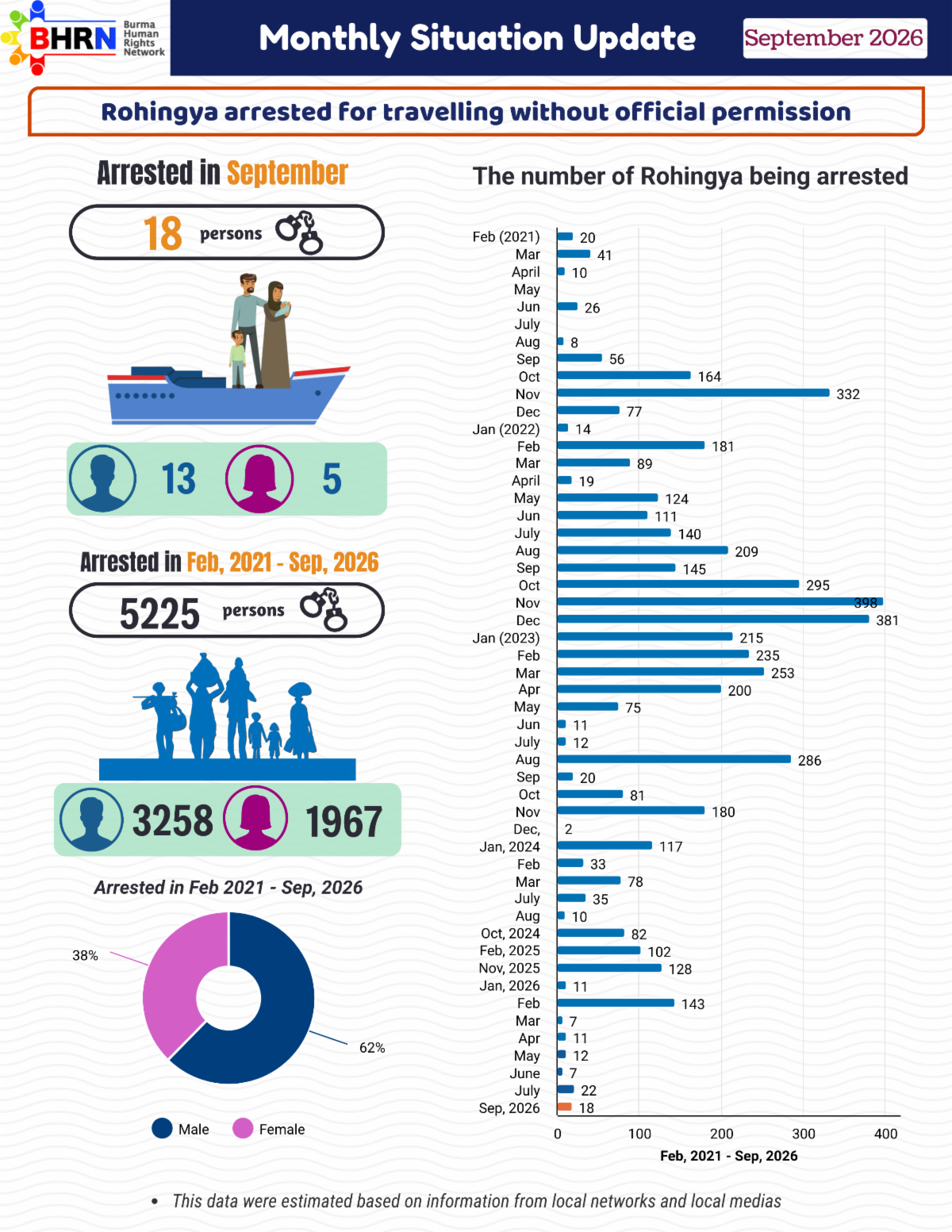
· 6 September - Kyankhin Township, Ayeyarwady Region: Five Rohingya who had entered the township from Rakhine State were arrested. The arresting authorities, grounds for detention, and subsequent whereabouts were not established. -BHRN Documentation
· 7 September - Mawlamyine Township, Mon State: Young men were seized by suspected military recruitment teams near the highway bus terminal, on the bypass road and outside a school. Substantial payments were demanded to secure releases.
· 7 September - Thaton Township, Mon State: Junta forces detained eight people in Leik Inn ward during recruitment-related raids. Some people detained during the township raids had serious health conditions or disabilities. Their treatment and whereabouts had not been confirmed.
· 8 September - Pauktaw Township, Rakhine State: ULA authorities detained four people in Anaukyee village over allegations of unauthorised transport or trade of cattle and medicine towards Sittwe. One detainee’s family said he was working on a fishing boat. Three others were detained subsequently, and all four were taken to Minbya Court. -BHRN Documentation
· From 10 September - Putao and Machanbaw townships, Kachin State: Junta troops and an allied Rawang militia conducted nighttime sweeps, with men taken from neighbourhoods, villages and mining areas.
· 10 September - Kawthaung Township, Tanintharyi Region: Thailand returned 97 Myanmar nationals, 80 men and 17 women, through the Ranong–Kawthaung crossing after they had served prison sentences. In other cases, men returned by this route had been taken for military recruitment by the junta. -BHRN Documentation
· 11 September - Mawlamyine Township, Mon State: Junta personnel stopped and detained students wearing school uniforms in Thiri Myaing ward. Families secured their release.
· 11 September - Thabaung Township, Ayeyarwady Region: Junta troops detained six Rohingya, including two women, near Thae Phyu village after they travelled from Sittwe by boat. Their subsequent detention location was unknown. -BHRN Documentation
· 11 September - Maungdaw Township, Rakhine State: Around 100 Rohingya from central Maungdaw were called to undertake work at the town’s football stadium before a planned match. The labour was compulsory, while Rakhine residents were not required to perform comparable work. -BHRN Documentation
· 13 September - Mawlamyine Township, Mon State: Ward and local administrative teams demanded payments from households in several Mawlamyine neighbourhoods, describing them as contributions towards military recruits or substitutes. The collections were compulsory and ranged from 10,000 kyat to much larger amounts.
· 13 September - Buthidaung Township, Rakhine State: Arakan Army personnel arrested Swayod Nur, 47, of Bo Gyi Chaung village, one day after his return from Bangladesh, where he had received medical treatment for a stomach condition.
-BHRN Documentation
· 14 September - Thayetchaung Township, Tanintharyi Region: Armed men stopped and abducted Daw Khaine Zin Htwe, a worker at the township law office, near the Titutpyin junction. Her whereabouts are still unknown.
· Since 15 September - Thandwe Township, Rakhine State: The Arakan Army was selecting men aged 18 to 35 for its NDEP military service programme by lottery, with some taken immediately for training and denied visits home. Relatives of selected men were allegedly detained when they failed to report, with approximately four such cases reported. A young mosque imam from Zati Pyin village was allegedly taken despite a reported exemption for religious teachers. The selection figures and detention allegations were not independently verified. -BHRN Documentation
· 17 September - Yebyu Township, Tanintharyi Region: Soldiers stopped a villager near Kywe Talin village and forced him and other civilians to accompany a military column. Some carried military supplies, while he and another man were made to walk in front of the troops. He was released later that night. The other villagers’ fate is unknown.
· 18 September - Dawei Township, Tanintharyi Region: At least four young men were seized in two operations, including at Ka Myaw King Bridge and on Ka Myaw King Road in San Chi ward. Suspected junta recruitment personnel forced men into vehicles and seized their motorcycles.
· 17 to 18 September - Pauktaw Township, Rakhine State: A military naval vessel fired on two fishing boats carrying 16 Muslim men from Sin Tet Maw village on 17 September and detained eight of them. Troops allegedly questioned the men about possible Arakan Army links, destroyed their boats, and on 18 September abandoned the detainees at sea with plastic containers. The men were rescued by another fishing boat. -BHRN Documentation
· 20 to 21 September - Saw Township, Magway Region: Military personnel detained young men in Laung Shwe from the night of 20 September. At least five more were taken from surrounding villages on 21 September.
· 24 September - Pauktaw Township, Rakhine State: Arakan Army personnel detained Rohingya residents at Anaukyee village after accusing them of preparing to transport cattle illegally to Sittwe and seized five cattle. The detainees’ relatives denied the allegation and said the group had gathered for a picnic near the shore.
-BHRN Documentation
· 27 September - Yegyi Township, Ayeyarwady Region: Junta soldiers and police detained seven Rohingya, including three women, at Yenanthar checkpoint near Ngathaingchaung. The detainees were seen being placed in a military vehicle and were later held at an artillery battalion. The reported detention site was Artillery Battalion No. 344. -BHRN Documentation
· 27 September - Pauktaw Township, Rakhine State: ULA authorities searched 15 Rohingya homes in Siakkpin village and five in Kundine village, then arrested five residents of Siakkpin and two of Kundine on alleged drug-smuggling grounds. -BHRN Documentation
| | V. Deaths and Ill-treatment in Custody | | |
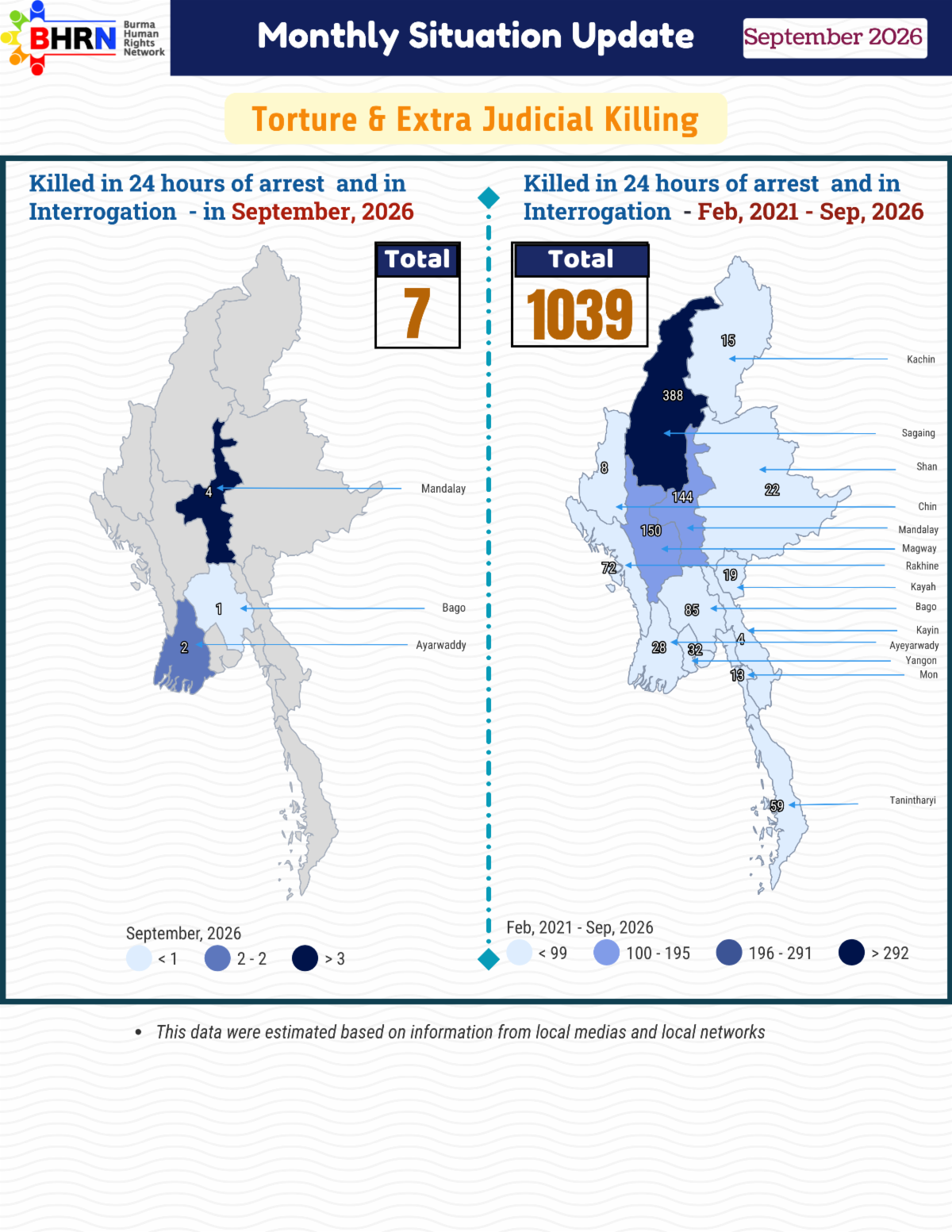
People in custody must be treated humanely and provided with adequate medical care. An unexplained death in detention requires an effective investigation. Claims of torture, unlawful killing or deliberate medical neglect require evidence beyond the fact of death.
· 1 September - Thanbyuzayat Township, Mon State: A monastery driver from Wae Win Kara village died while held by junta troops after he and his wife were detained in late August. His wife had been released.
· 9 to 10 September - Kyaikmayaw Township, Mon State: Six prisoners, four men and two women, died during a dengue outbreak at Kyaikmayaw Central Prison. Emergency medical transfers were allegedly delayed by administrative approval and shackling arrangements.
· 13 September - Hlaingthaya East Township, Yangon Region: Ward officials detained and beat a young man during an operation linked to forced recruitment. The man died after the assault. Junta-controlled police arrested ward personnel afterward.
· 15 September - Myingyan Township, Mandalay Region: Political prisoner Soe Moe Naing, also known as Dein Daung, died in Myingyan Prison. He had coronary artery disease and did not receive adequate medical treatment before his condition deteriorated.
· 18 September - Shwebo Township, Sagaing Region: Soldiers at a checkpoint in Seikkhun village detained and beat three boys aged 14, 15 and 17 after they passed on one motorcycle. Troops took their phones, demanded 200,000 kyat for each boy's release and threatened to shoot them if they returned. The boys were released and received medical treatment.
| | 6. Policy Recommendations | | |
· Restrict the Military Junta’s Access to Aircraft, Aviation Fuel and Military Technology: The United Kingdom, European Union, United States and other governments should impose coordinated restrictions on aviation fuel, aircraft components, maintenance services and dual-use equipment that could support the military junta’s attacks on civilians. The 28 September airstrike on Kyauktaw’s market, which killed at least 50 people, demonstrates the urgency of disrupting these supply chains. Governments should strengthen end-user verification, investigate intermediary companies and enforce sanctions against businesses and individuals knowingly facilitating prohibited military procurement.
· Demand an End to Arbitrary Detention, Forced Recruitment and Abuses in Custody: UN member states and ASEAN governments should press the military junta to disclose the whereabouts of people detained during recruitment operations, release those held arbitrarily and end the coercion of civilians into military service or participation in military operations. Independent humanitarian organisations must be granted access to detention facilities, including prisons where medical neglect and preventable deaths have been reported.
· Challenge Restrictions on Muslim Worship and Discriminatory Reconstruction Policies: The UN Special Rapporteurs on Myanmar and freedom of religion or belief, OHCHR and the Independent Investigative Mechanism for Myanmar should investigate and publicly report on discriminatory permit restrictions, land-registration barriers, mosque closures, unofficial-payment demands and retaliation, and preserve evidence for future accountability proceedings.
· Prevent Forced Returns and Protect Rohingya Rights: Malaysia should immediately halt forced returns to Myanmar and ensure UNHCR has unrestricted access to immigration detainees before any deportation or removal. Bangladesh should lift discriminatory restrictions on Rohingya freedom of movement and access to education, and ensure adequate protection and essential services. Member states of the Organization of Islamic Cooperation (OIC) should back their commitments with increased humanitarian funding, sustained diplomatic pressure, and concrete support for accountability.
· Ensure Civilian Protection and Accountability in Resistance-Controlled Areas: The National Unity Government (NUG), ethnic resistance organisations, and other authorities exercising territorial control should establish effective, independent mechanisms to investigate abuses by their forces, hold those responsible accountable, and provide remedies to victims. The NUG should publicly report on the findings and outcomes of misconduct investigations while protecting complainants and witnesses from retaliation. All resistance authorities should ensure that security operations and detention practices comply with international human rights and humanitarian law and are subject to independent oversight.
| | |
Background on the Burma Human Rights Network (BHRN)
Burma Human Rights Network (BHRN) is based in London, operates across Burma/Myanmar and works for human rights, minority rights and religious freedom in Burma. BHRN has played a crucial role in advocating for human rights and religious freedom with politicians and world leaders.
Media Enquiries
Please contact:
Kyaw Win
Executive Director
Burma Human Rights Network (BHRN)
E: kyawwin@bhrn.org.uk
T: +44(0) 740 345 2378
Ye Min
Editor
Burma Human Rights Network (BHRN)
E: ye.min@bhrn.org.uk
T: +66(0) 994 942 358
| | | | |