March 3, 2025

Top stories

■ Voice of America journalists face investigations for Trump comments (New York Times) / ‘MAGA candidate and former local TV anchor Kari Lake … is now stationed as a senior Trump administration advisor at the US Agency for Global Media. ...’ (David Folkenflik) 


■ Washington Post loses 75K subscribers after Bezos-ordered op-ed pivot (The Hill) / Where Jeff Bezos went wrong with The Washington Post (The Atlantic) / Marty Baron on Jeff Bezos, The Washington Post, and Trump’s crackdown on the press (Mediaite) 


■ A Russian state media reporter gained entry to the Oval Office for Trump-Zelensky sit-down (CNN) / Tracking Trump: Press pool takeover, Zelensky and the Musk effect (Axios)


■ ‘Inside a tense off-the-record meeting, the Pentagon’s new press chief confronted reporters and indicated they will do away with the regular travel pool, doubling down on Pete Hegseth's anti-media approach.’ (Status)


■ MSNBC's post-Joy Reid era begins with hiring of POLITICO veteran Eugene Daniels (Los Angeles Times) / He’s the face of a White House press corps under attack by Trump (New York Times)


■ The story behind FCC Chairman Brendan Carr’s role in Project 2025 (Bloomberg)  


■ Fox CEO puts Fox Nation subscriber totals at 2 million to 2.5 million (Variety) / Pete Distad joins Fox Corporation as CEO of upcoming FOX direct-to-consumer service (Fox Corporation) 


■ L.A. Times' De Los editor resigns, accuses leadership of dismissing HR complaints against managing editor (The Wrap) / Los Angeles Times to display AI-generated political rating on opinion pieces (The Guardian) 


■ NYT v. Sullivan: Will the landmark defamation ruling survive? (New York Times Magazine)


■ Ransomware group takes credit for Lee Enterprises attack (SecurityWeek)


■ Tracy Connor joins Business Insider as standards editor (Business Insider) / Caroline Kitchener joins The New York Times (New York Times) / David Leonhardt returns to Opinion (New York Times) / Dallas Mornings News taps Ferguson to cover energy (Talking Biz News) / Rest of World hires Ghosh as Middle East and Africa editor (Talking Biz News) 


■ After he ran a cartoon on the war in Gaza, Gannett fired him (New York Times)


■ I Vaticanisti: Meet the reporters covering Pope Francis (Columbia Journalism Review) 


■ Hulu hit by outage during Oscars livestream (Entertainment Weekly) / Hulu prematurely ended its Oscars stream right before the final awards (The Verge) / The Oscars consider move from Disney to Netflix, other networks (Bloomberg) 


■ How NPR’s newsroom reinvented itself on 9/11 in real time: ‘Get on the Air’ (Vanity Fair)

CRAFT

Digital Security: How journalists can reclaim power and control


From online harassment to doxxing, journalists face increasing digital security threats as a direct result of their work. 


The Institute reached out to PEN America for a primer on digital safety. Viktorya Vilk, director, digital safety and free expression, and Tat Bellamy-Walker, program manager, digital safety training and resources (media), shared the following tips and resources.

What are the biggest safety concerns you are hearing from journalists right now?


PEN America: It’s hard to know where to start. The Trump administration is unpredictable and extremely hostile to a free press, which means that U.S. journalists are facing heightened safety risks. 


In terms of offline risks, journalists and newsrooms are concerned about legal attacks, particularly libel lawsuits, and the weaponization of federal agencies — from the FCC and the IRS to the FBI — in retaliation against the press. Journalists are also increasingly worried about threats to their physical safety, including intimidation and violence in the field. 


In terms of online risks, journalists — particularly women journalists, journalists of color, and LGBTQ+ journalists — say they’re facing a surge in hateful and harassing content on social media platforms. As technology companies gut their trust and safety teams, loosen their anti-harassment policies, and abdicate responsibility for content moderation, online abuse and threats are exacerbated. There’s also a growing concern about digital surveillance from both the federal government and private corporations. 


It’s important to keep in mind that journalists are targeted not only because of their profession and their coverage areas, but because of who they are and how they look. We’ve increasingly been hearing from newsrooms staffed by and covering Black communities, trans communities, and immigrant communities that they are encountering heightened hostility and safety challenges.


Despite these risks, we want journalists and newsrooms to understand that there are multiple non-profit organizations that will have their backs. If you’re a U.S.-based journalist or news outlet concerned about your safety or under attack for your work, reach out to the Journalist Safety Urgent Care Helpline, and we’ll connect you to individualized, trauma-informed support from PEN America, Committee to Protect Journalists (CPJ), International Women’s Media Foundation (IWMF), Reporters Committee for a Free Press (RCFP), Freedom of the Press Foundation (FPF), and Aegis Safety Alliance (Aegis). 


What is the first line of defense when a journalist faces online harassment?


PEN America: Online abuse can be profoundly isolating, exhausting, frightening, and even traumatizing. Remember: you’re not alone. Find your support network and don’t be afraid to ask for help. Draw on your fellow reporters, trusted managers, close family and friends, and your wider online community of fans and followers. 


Allies can help you monitor your mentions, report abuse, take screenshots, amplify your work, lock down your accounts, and tighten your privacy and security settings on social media. They can also help you document abuse by taking screenshots, saving hyperlinks, and storing abusive emails and voicemails. Documentation can be critically important if you’re seeking support from an employer, law enforcement, or a lawyer. 


Where journalists can receive hands-on personalized support:


We will continue to share digital safety tips from PEN America in the upcoming days.


Watch: Bellamy-Walker recently joined an Institute webinar on how to handle (and prevent) online threats as a journalist.

CAREER
 
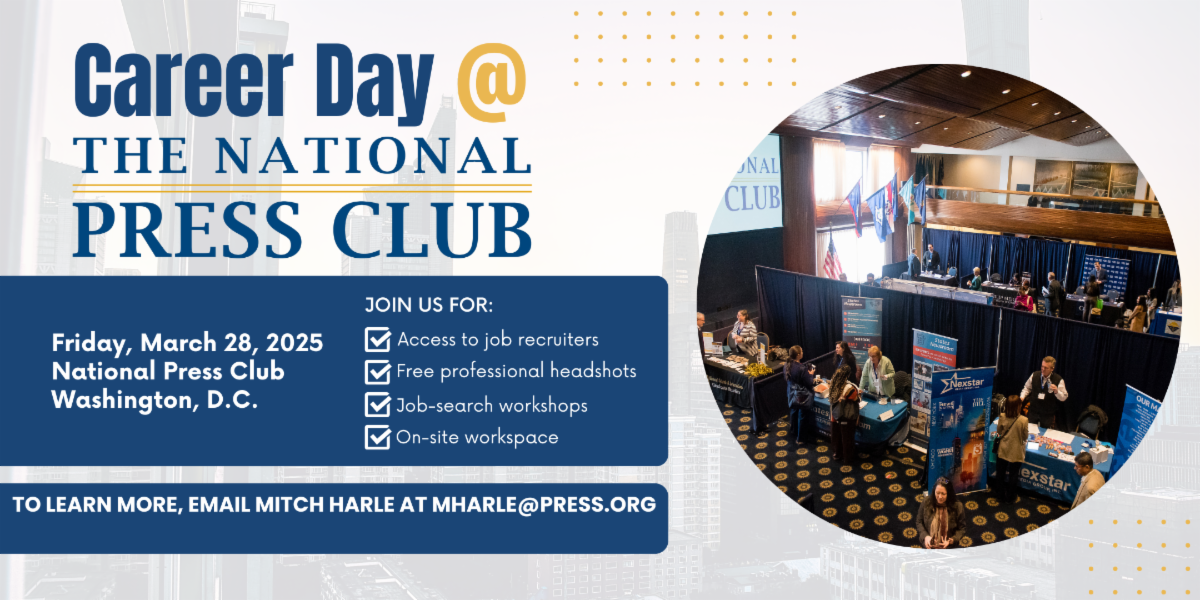
Career Day at the National Press Club is Friday, March 28, from 9 am to 4 pm ET. Join us for: Access to job recruiters; Free professional headshots; Job-search workshops; On-site workspace. Tickets on sale now.

Career Day at the National Press Club is March 28


Join us for a unique opportunity at the National Press Club to grow your professional network and explore your next career move. Participants will receive:


Tickets:


GET TICKETS

Who should attend:


  • Anyone interested in a journalism career
  • Mid-career professionals looking for a move up — or over to a new field
  • Early-career professionals looking for their next shop
  • Freelancers hoping to connect with new potential clients
  • Journalism and communication students
 
COMMUNITY

Resources


This newsletter is written & edited by the National Press Club Journalism Institute staff: Beth Francesco, Holly Butcher Grant, Elliot C. Williams, and Mitch Harle. Send us your questions and suggestions for topics to cover.


Get this from a friend? Subscribe, and view the archives.

Facebook  X  Linkedin  Youtube  

DONATE TO THE INSTITUTE


The National Press Club Journalism Institute promotes an engaged global citizenry through an independent and free press, and equips journalists with skills and standards to inform the public in ways that inspire a more representative democracy. As the non-profit affiliate of the National Press Club, the Institute powers journalism in the public interest. The Institute's tax ID number is 52-1750908.