Complete Government Contract Solutions from Certified Professionals


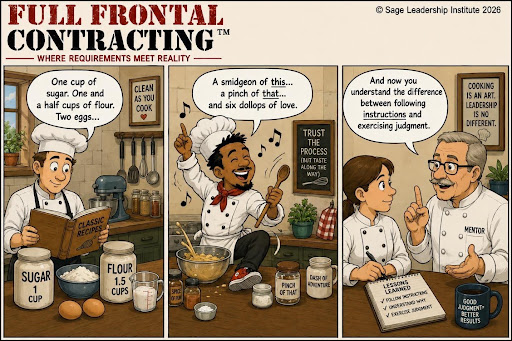
More Discretion Requires Better Judgment


Reasonable judgment combines a set of considerations and educated approaches to specific issues and problems. For professionals, these include discretion, knowledge, discernment, judgment, and wisdom. 


Discretion is one essential thought pattern, allowing professionals to translate general legal requirements and public objectives into a defensible decision about a particular acquisition. The FAR already explicitly calls for discretion and sound business judgment—not merely compliance with instructions. In this context, discretion is latitude to decide, rather than discretion as confidentiality or tact.


Discretion is the authorized space within which a person chooses what to do, how to do it, or whether to act at all. It might be described as having four purposes: 

  1. Adapt general rules to particular circumstances; 
  2. Reconcile legitimate but competing objectives; 
  3. Manage risk rather than merely avoiding it; and 
  4. Make responsibility real - Delegating responsibility without meaningful choice risks making accountability ceremonial: the individual is answerable for results but cannot materially influence them.


Discretion is not permission to disregard requirements, however. Acting contrary to legal, ethical, regulatory, or other limits is, by definition, an abuse of discretion. The FAR, in both its current and proposed overhaul version, connects individual initiative with best value, public trust, public policy, and the limits of a team member’s authority.


All five of these concepts appear in the Sustained Leadership construct under the concepts of critical, systemic, and strategic thinking. All of these exist under a veil of creative thinking that is most active at the borders of each one. Given the FAR Overhaul initiative of separating statutory requirements from discretionary processes and procedures, I thought it best to offer the definition of some key terms. This table helps to frame the various mental processes that will require more discipline and justification of reasonable action for acquisition decisions.

Concept

Its role in contracting

The question it helps answer

Knowledge

Supplies understanding of governing requirements, facts, markets, technical issues, and contractual obligations. Its accuracy, currency, and completeness must be examined. What you think you “know” might not be accurate!

What do we know, what do we know we lack, and how will we test for gaps or false positives we have not yet recognized?

Discernment

Distinguishes evidence from assumptions, appearances, and unsupported claims; identifies relevant differences, interests, and uncertainties.

What is really going on here?

Judgment

Weighs evidence, options, obligations, and consequences to reach a reasoned decision. Combines consideration of ultimate objectives amidst governing principles

What should we do in these circumstances?

Discretion

Provides the authorized latitude within which a decision can be made and acted upon; within which a particular action might responsibly be taken. Professionals must identify that latitude and its limits accurately.

What may I decide, and within what boundaries?

Wisdom

Places the decision in a larger perspective: public purpose, proportionality, long-term consequences, experience, and humility.

Is this a fitting use of our authority and resources?

These are related, but they are not interchangeable.

How does one develop better judgment?


Primarily through education and continued practice -learning from the mistakes made by ourselves and others.


  • Knowledge is necessary, but does not select the answer by itself
  • Discernment identifies differences that matter
  • Judgment turns understanding into a decision
  • Discretion is the space for judgment, not proof of its quality
  • Wisdom governs the use of capability and authority


It’s not the purpose here to delve into deep philosophy or psychology, but as we expand the realm of judgment under the new regulatory schema, these five words are worth considering and applying in our day-to-day activities and in how we document our use of each of them in making decisions that are in the best interests of the government and reflect the necessary professionalism of our craft. 


P.S. Professional Challenge 


Take one recent acquisition decision. Identify the knowledge you relied upon, the assumptions you examined, the judgment you exercised, and the authority that permitted your choice. Then ask: what would a wiser review of its consequences add?

If you missed the prior newsletters, you can find them here.

Free Journal Article


Have you ever wondered why parts of the FAR seem to point in different directions?


Download Tom Reid's Journal of Contract Management article, How Jurisprudence Informs Ethical Business Judgment in Acquisition, and discover how legal reasoning can improve acquisition decision-making.

X  Linkedin  

New to this newsletter? We gather contact information from many channels where people have interacted with either our contracting or leadership platforms. We also receive many referrals from your co-workers and provide you with a complimentary copy of one or both newsletters. Not interested? No problem! We don’t want to clutter your inbox with things that are not helpful to you. Simply click on the “Unsubscribe” button below to be removed. Want to be added to the other newsletter, or to both? Simply click on the “Update Profile” button below and let us know. We hope you will stick with us, gain from the short information we provide, and engage with us on topics of interest.