|
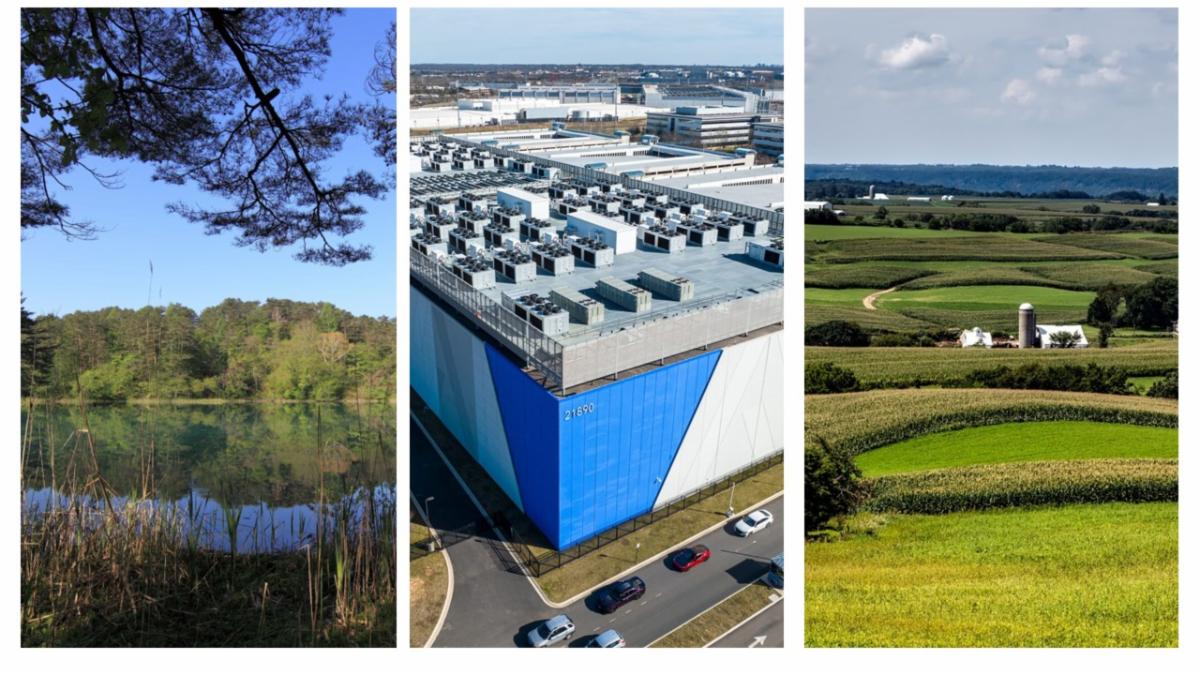
There is mounting concern about the explosion of growth in data centers around the US and world and how it may lead to a backpedaling on climate emission goals. Data centers require computer power from tens of thousands of servers, to even even millions of servers in top-tier data centers. These complexes need massive amounts of electricity to operate.
Virginia is “distinguished” with having the most centers – at 665-plus. Northern Virginia is the largest hub, Texas follows with 519, California has 321. Tech companies are racing to build more and more.
COMMUNITIES AND IMPACTS
While data centers are proposed as potential drivers of economic benefits for localities, concerns are also growing as they increasingly occupy vast amounts of land, gobble up electricity/power, and “drink up” billions of gallons of water.
Citizens are beginning to question the presence of data centers: including farmers and consumers who are footing much higher power costs; the risk of personal and environmental harms, many yet unknown; plus harm to wildlife/nature habitats from these data center “neighbors.” And how about that buzzing sound if you live near one? Data Centers are often approved before members of the community can even have a voice in the matter.
Large data centers can consume 1 to 5 million gallons of water daily, comparable to the usage of a town with 10,000 to 50,000 residents – straining local resources in drought-prone areas and are often placed in locales with existing water crises.The Lincoln Institute of Land Policy, a private global nonprofit founded in 1946, has produced a comprehensive overview of data center impacts – their economics, effects on populations, water and land use.
Some communities are beginning to push back. Projects have been paused or reconsidered in some places. In Prince William County, Virginia, plans were recently abandoned for one of the country’s largest and most controversial data center projects. Voters in Maine passed a yearlong freeze on AI data centers. However, it was vetoed by the governor who said it would "hurt economic growth."
GROWING ENERGY DEMAND
Data centers used about 4.6% of total U.S. electricity in 2024 – a share that could nearly triple by 2028. Some analysts project overall U.S. electricity demand could rise by up to 20% in the next decade, driven in large part by data centers. AI already accounts for an estimated 10-20% of data center energy use and is expected to drive 50-70% of computing demand by 2030, even as traditional and cloud workloads continue to make up the majority of current usage. (Sources: Congressional Research Service report, AP News article, and Bain & Company and McKinsey)
The primary source of power for these complexes comes from the electrical grid with various backup power supplies, often powered by diesel generators. Some data centers are also turning to renewable energy sources to power their operations. However, In late 2025, about 56% of total data center energy came from fossil fuels, with renewables accounting for roughly 22-24%. (Pew Research Center) There is concern that a backlog of proposed renewable energy projects awaiting permission to connect to power grids may affect tech companies’ already failing climate commitments by prolonging the reliance on fossil fuels. (AP news article).
Why do data centers lead to higher energy costs for everyone? Surging demand increases electricity rates. Electricity markets operate on a supply-and-demand basis. When large data centers--which can use as much electricity as 100,000 households--rapidly increase, it outpaces the speed at which new power supplies can be built. When demand is high, utilities must buy more expensive energy to keep the grid stable, driving up the supply charge on your bill.
CLIMATE IMPACTS
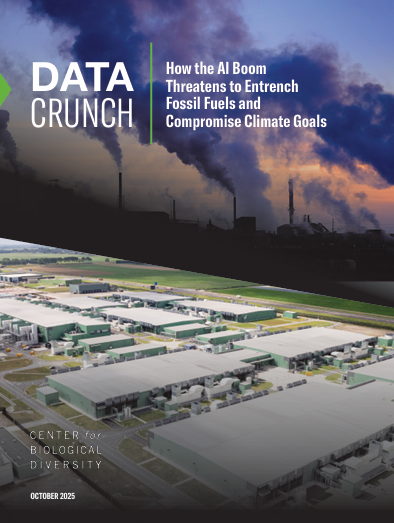
The increasing energy and environmental impact of these centers, and their impact on climate goals, is warned about in the report, Data Crunch: How the AI Boom Threatens to Entrench Fossil Fuels and Compromise Climate Goals: “The U.S. disproportionately holds the planet’s highest concentration of data centers and is the greatest contributor of AI climate pollution. Without significant changes, U.S. data center expansion is completely incompatible with the 2035 U.S. climate goal." The report’s co-author, Jean Su, Energy Justice director at the Center for Biological Diversity, is featured in this interview by Democracy Now.
WHAT ABOUT RESPONSIBLE DEVELOPMENT?
The Data Crunch report contains a series of policy recommendations for establishing domestic and global guardrails on the development of AI data centers. These include the responsible siting of data centers and the use of on-site renewable energy, storage, and micro-grids. These recommendations may help communities as they determine the best methods for moving forward on AI data center development.
WHAT ABOUT ME?
Beyond this, we also need to look at the impact of our personal consumption!
We’ve become conspicuous consumers with the Cloud! Our daily use of our PCs to store data, to incessantly query AI with myriad searches, etc., adds significantly to data center’s consumption of water and energy. Ironically – an AI search will turn up lots of information on this topic, while simultaneously consuming a big drink of water at the data center.
Here is one such resource on how we can make a difference.
|