|
|
Horses and the Science of Harmony | |
|
|
|
|
Investigation into the effect of EQ Bands on rider symmetry on a mechanical horse
by Isabelle Hudson
| | | |
|
Rider asymmetry has been shown to have a significant influence on the horse’s biomechanics, restricting movement, contributing to muscle asymmetries and causing sensitivity under the saddle (Von Peinen et al., 2010; Engell et al., 2016; MacKechnie-Guire et al., 2020). If not addressed, rider asymmetry can lead to a repetitive cycle of equine back pain and dynamic instability, predisposing the horse to the early onset of degenerative changes (Stubbs et al., 2010) and negatively impacting the horse’s welfare and performance (Zimmerman et al., 2011; 2012; Greve and Dyson, 2013). Despite this, there is a lack of research on training methods that attempt to improve rider symmetry and help the rider evaluate their perception of their position in the dynamic environment. Through advancements in knowledge and understanding, we can positively impact horse welfare.
Rider asymmetry affects weight distribution and increases pressures under the saddle (Fruehwirth et al., 2004), determining whether the horse can move easily and freely through the back (De Cocq et al., 2009; Martin et al., 2016). Increased loading of the contralateral forelimb and hindlimb fetlock extension influence movement of the spine and increase the risk of injury to the soft tissue structures of the distal limb (Clayton et al., 1999; MacKechnie- Guire et al., 2020). Additionally, rider asymmetry can cause uneven rein tension, affecting the position of the head and neck, further impacting kinematics and vertical ground reaction forces. The position of the neck has a marked effect on the whole movement pattern of the horse (Zsoldos and Licka, 2015).
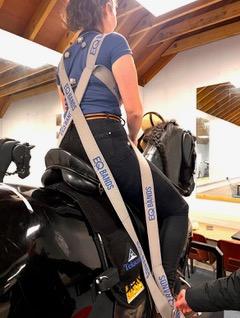
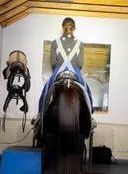
EQ Bands claim to correct and optimise rider position via proprioception and kinesthetic awareness, enhancing the rider’s understanding of their body position and highlighting asymmetry. By challenging motor control and promoting activation of the key postural muscles, the EQ Bands aim to optimise the rider’s body position and aids, thereby enhancing the performance of the horse-rider combination (Dynamic Performance Hub, 2023). This study aimed to test an element of these claims by comparing a group of riders wearing the bands on a mechanical horse with a control group who did not wear the bands.
| |
|
The results of this study revealed that rider asymmetry was generally reduced with the use of EQ Bands, suggesting that they had a positive effect. The results re-affirmed that a rider- specific training programme is required to see significant changes in posture (Lee et al., 2015). This has been found in resistance band training in other sports (Rogers et al., 2002; Jakobsen et al., 2013, Kocaoglu and Erkmen, 2021). It is believed that training adaptation takes time to occur and depends on the rider's usual posture. Therefore, putting the bands on once may not be enough to generate a significant change.
The rider’s capacity to maintain a proper position, balance, and connection with the horse hinges on the rider’s ability to maintain isometric muscular contractions for an extended period of time (Lee et al., 2015). This requires training to stimulate muscular adaptation and increase muscular strength and endurance (Lee et al., 2015). The connection between rider asymmetry and postural stability are closely interlinked because of the connection between the pelvis, trunk and shoulders via the axial skeleton (Engell et al., 2016). In sitting trot, the rider has to work the hardest to maintain dynamic postural stability against the force generated by the diagonal limb pairs (Bystrom et al., 2015; Martin et al., 2016; Clayton and Hobbs, 2017). Implementing exercises that challenge a rider’s isometric strength stimulates adaptations to occur in the muscle. The muscle becomes more reliant on oxidative energy sources, delaying the onset of metabolite accumulation associated with fatigue. This improves muscular endurance and the rider’s ability to maintain their posture in the saddle, ensuring overall higher test scores and performance (Lee et al., 2015). This improves the rider’s ability to demonstrate harmony with the mechanics of each gait (Schils et al., 1993; Hobbs et al., 2023), whilst also increasing the effectiveness of their aids (Lee et al., 2015).
These preliminary results support the use of EQ Bands. This research should now be extended to study riders on the horse in motion.
| |
|
References
- Byström, A., Roepstroff, L., Geser-von Peinen, K., Weishaupt, M.A., Rhodin, M. (2015) Differences in rider movement pattern between different degrees of collection at the trot in high-level dressage horses ridden on a treadmill. Human Movement Science. 41, 1–8.
- Clayton, H.M., Lanovaz, J.L., Schamhardt, H.C., Van Wessum, R. (1999) The effects of a rider’s mass on ground reaction forces and fetlock kinematics at the trot. Equine Veterinary Journal. 31(S30), 218–221
- Clayton, H.M., Hobbs, S.-J. (2017) The role of biomechanical analysis of horse and rider in equitation science. Applied Animal Behaviour Science. 190, 123–132.
- de Cocq, P., Clayton, H.M., Terada, K., Muller, M., van Leeuwen, J.L. (2009) Usability of normal force distribution measurements to evaluate asymmetrical loading of the back of the horse and different rider positions on a standing horse. The Veterinary Journal. 181(3), 266–273.
- Dynamic Performance Hub Dynamic Performance Hub Shop. Dynamic Performance Hub Shop. [online]. Available from: https://eqbands.com/ [Accessed October 14, 2023].
- Engell, M.T., Clayton, H.M., Egenvall, A., Weishaupt, M.A., Roepstorff, L. (2016) Postural changes and their effects in elite riders when actively influencing the horse versus sitting passively at trot. Comparative Exercise Physiology. 12(1), 27–33.
- Fruehwirth, B., Peham, C., Scheidl, M., Schobesberger, H. (2004) Evaluation of pressure distribution under an English saddle at walk, trot and canter. Equine Veterinary Journal. 36(8), 754–757.
- Greve, L., Dyson, S. (2013) The horse–saddle–rider interaction. The Veterinary Journal. 195(3), 275–281.
- Hobbs, S.J., Serra Braganca, F.M., Rhodin, M., Hernlund, E., Peterson, M., Clayton, H.M. (2023) Evaluating Overall Performance in High-Level Dressage Horse–Rider Combinations by Comparing Measurements from Inertial Sensors with General Impression Scores Awarded by Judges. Animals. 13(15), 2496.
- Jakobsen, M.D., Sundstrup, E., Andersen, C.H., Aagaard, P., Andersen, L.L. (2013) Muscle activity during leg strengthening exercise using free weights and elastic resistance: Effects of ballistic vs controlled contractions. Human Movement Science. 32(1), 65–78.
- Kocaoğlu, Y., Erkmen, N. (2021) The Effect of Elastic Resistance Band Training on Postural Control and Body Composition in Sedentary Women. Spor Bilimleri Araştırmaları Dergisi. 6(1), 233–245.
- Lee, J. T., Soboleswki, E. J., Story, C. E., Shields, E. W., Battaglini, C. l. (2015) The feasibility of an 8-week, home-based isometric strength-training program for improving dressage test performance in equestrian athletes. Comparative Exercise Physiology. 11(4), 223–230.
- MacKechnie-Guire, R., MacKechnie-Guire, E., Fairfax, V., Fisher, M., Hargreaves, S., Pfau,
- T. (2020) The Effect That Induced Rider Asymmetry Has on Equine Locomotion and the Range of Motion of the Thoracolumbar Spine When Ridden in Rising Trot. Journal of Equine Veterinary Science. 88, 102946.
- Martin, P., Cheze, L., Pourcelot, P., Desquilbet, L., Duray, L., Chateau, H. (2016) Effect of the rider position during rising trot on the horse׳s biomechanics (back and trunk kinematics and pressure under the saddle). Journal of Biomechanics. 49(7), 1027–1033.
- Rogers, M.E., Sherwood, H., Rogers, N., Bohlken, R. (2002) Effects of Dumbbell and Elastic Band Training on Physical Function in Older Inner-City African-American Women. Women & health. 36, 33–41.
- Schils, S.J., Greer, N.L., Stoner, L.J., Kobluk, C.N. (1993) Kinematic analysis of the equestrian — Walk, posting trot and sitting trot. Human Movement Science. 12(6), 693–712.
- Stubbs, N.C., Riggs, C.M., Hodges, P.W., Jeffcott, L.B., Hodgson, D.R., Clayton, H.M., Mc Gowan, C.M. (2010) Osseous spinal pathology and epaxial muscle ultrasonography in Thoroughbred racehorses. Equine Veterinary Journal. 42(s38), 654–661.
- Von Peinen, K., Wiestner, T., Von Rechenberg, B., Weishaupt, M.A. (2010) Relationship between saddle pressure measurements and clinical signs of saddle soreness at the withers. Equine Veterinary Journal. 42(s38), 650–653.
- Zimmerman, M., Dyson, S., Murray, R. (2012) Close, impinging and overriding spinous processes in the thoracolumbar spine: The relationship between radiological and scintigraphic findings and clinical signs. Equine Veterinary Journal. 44(2), 178–184.
- Zimmerman, M., Dyson, S., Murray, R. (2011) Comparison of Radiographic and Scintigraphic Findings of the Spinous Processes in the Equine Thoracolumbar Region. Veterinary Radiology & Ultrasound. 52(6), 661–671.
- Zsoldos, R.R., Licka, T.F. (2015) The equine neck and its function during movement and locomotion. Zoology. 118(5), 364–376.
| |
Horses and the Science of Harmony | |
A documentary has been released recently, “Horses and the Science of Harmony”. Though telling a story, the content does contain several good scientists setting out useful, evidence-based information for the horse owner and rider. Watch out for these golden nuggets.
There is also some product placement and brand endorsement in the film. There are many other brands and products available. The SRT does not endorse or recommend any of the mentioned products or services in the film.
| |
|
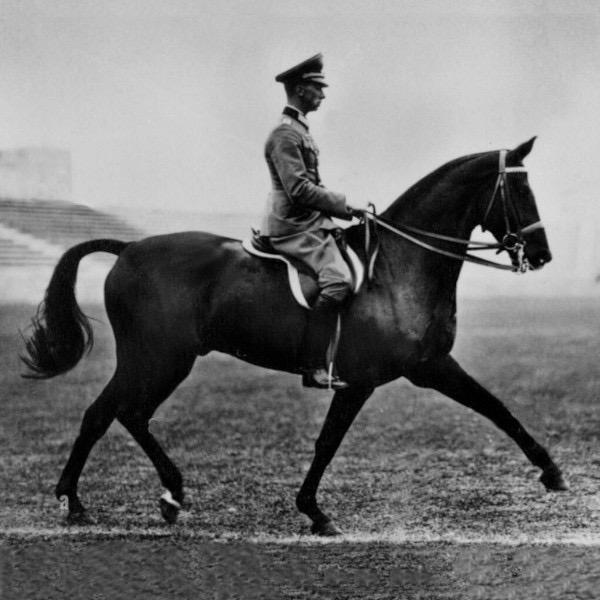
Here we have another classic example from the archives: Lieutenant Colonel Heinz Pollay on Kronos, 1936 Berlin Olympic Gold Medalists. There is a lot to like about this snapshot, showing a light and harmonious partnership with the horse moving well through his body in an open and uphill frame and happy expression.
Don't forget, we'd love to share your examples. Simply use the link below:
| | | | |