Paris Agreement

Crediting Mechanism

Newsletter

08 August 2025

In this issue


  • Supervisory Body Adopts Standard to Support Climate Efforts in Communities Lacking Basic Needs
  • Supervisory Body Approves five Designated Operational Entities
  • Recap: Webinar on PACM Standards With MEP Co-Chairs and Panel Members
  • Climate Week Event - Carbon Markets for Climate Action: Accelerating NDC Implementation in Africa


Supervisory Body Adopts Standard to Support Climate Efforts in Communities Lacking Basic Needs

The Article 6.4 Supervisory Body has adopted a new standard on suppressed demand, opening the door for more inclusive climate action in regions with limited access to basic services such as water and sanitation. 


Suppressed demand refers to situations where people use very little energy or services, not because they don't need them, but because they can't afford them or the infrastructure doesn’t exist. The new standard allows climate projects that help meet these basic human needs to earn carbon credits, even if emissions would naturally rise as a result of improved access. 


This approach helps ensure that people in low-income communities can benefit from climate finance, by recognising the emissions that would occur if their basic needs were met and supporting projects that meet those needs in the cleanest way possible. 


The decision allows suppressed demand to be recognized in mechanism baselines to credit projects that provide essential services. These baselines reflect the expected emissions if communities had normal access to those services and enable fairer crediting for development-focused projects. 


“We’ve recognized that baselines can be established with reference to basic human needs where they aren’t being met. This approach allows the mechanism to support real development benefits, particularly in communities where access is currently limited,” said Martin Hession, Chair of the Supervisory Body.  


Read the full article on the outcomes of SBM017 and the meeting report on the UN Climate Change website.


Supervisory Body Approves five Designated Operational Entities


The Supervisory Body has accredited the five independent entities tasked with validating and verifying Article 6.4 activities and programmes of activities  - also known as Designated Operational Entities (DOEs).


This marks an important step in operationalizing the PACM, as it is essential to have DOEs in place in order for future Article 6.4 activities to be validated and verified by a third party. The accreditation of the five entities for five years will allow them to validate, verify, and certify Article 6.4 activities across a range of sectors.


View the list of the accredited DOEs (currently six in total) and applicant entities seeking accreditation as DOEs (currently twelve in total) on the UN Climate Change website.


Recap: Webinar on PACM Standards With MEP Co-Chairs and Panel Members

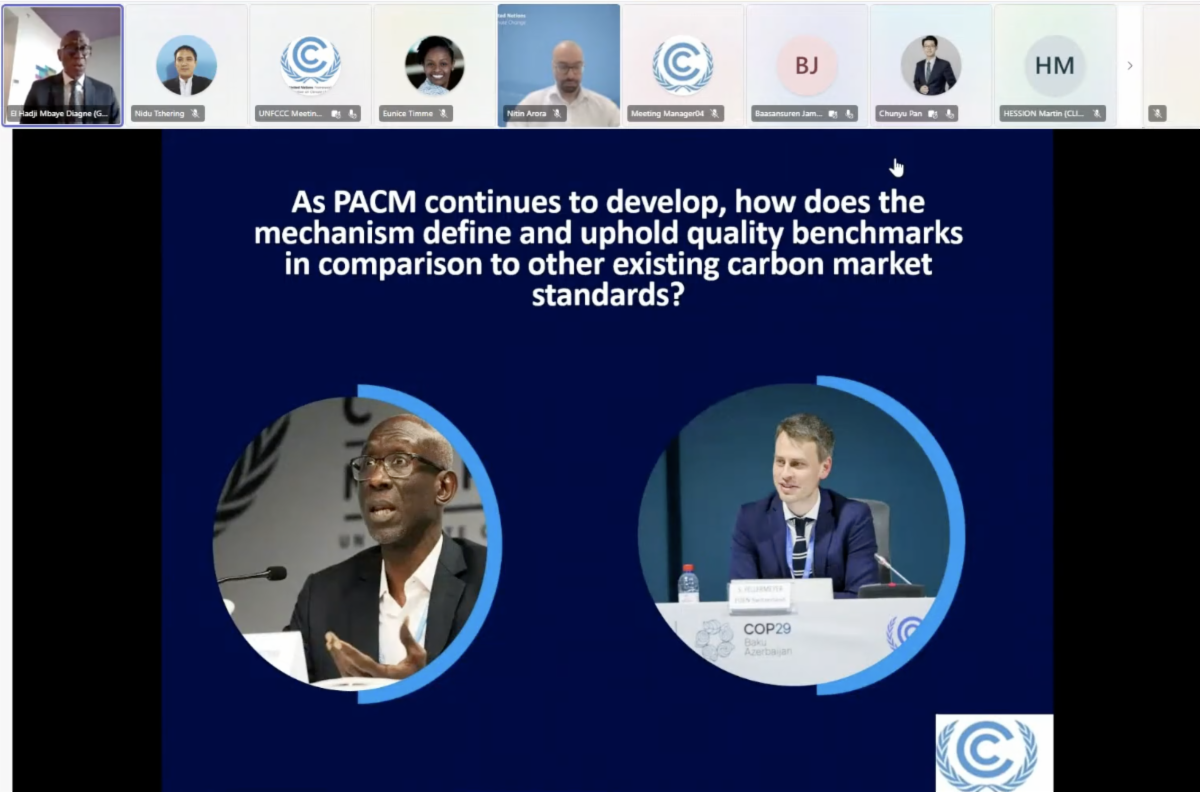
On 22 July 2025, over 250 stakeholders took part in a webinar with the Methodological Expert Panel (MEP) Co‑Chairs, El Hadji Mbaye Diagne and Simon Fellermeyer, alongside MEP members to gain deeper insights into the methodological standards that underpin the integrity of the Paris Agreement Crediting Mechanism.


The session opened with remarks by Martin Hession, Chair of the Article 6.4 Supervisory Body, and focused on key methodological elements, including the application of the methodological standard, the demonstration of additionality, the setting of robust and dynamic baselines, and the identification and mitigation of leakage risks.


Panelists included:


  • El Hadji Mbaye Diagne, Co‑Chair, MEP
  • Simon Fellermeyer, Co‑Chair, MEP
  • Lambert Schneider, MEP member
  • Martha Ntabadde Kasozi, MEP member
  • Perumal Arumugam, UNFCCC Secretariat


Missed it?


Climate Week Event - Carbon Markets for Climate Action: Accelerating NDC Implementation in Africa

As part of Climate Week 2 in Addis Ababa, the UNFCCC secretariat will host a two-day, action-oriented workshop focused on accelerating climate finance and NDC implementation across Africa via high-integrity carbon markets, especially under Article 6.4 of the Paris Agreement.


The event will bring together governments, the private sector, regional and multilateral bodies, and technical experts for a mix of information sessions, interactive discussions, and peer learning.


Key Objectives:


  • Examine the current state of climate and development finance in Africa, identifying gaps and opportunities for leveraging carbon markets.  
  • Explore how African countries are embedding carbon markets and pricing into their NDCs, and what institutional frameworks are emerging.  
  • Build a shared understanding of carbon market mechanisms, particularly the Paris Agreement Crediting Mechanism. 
  • Highlight case studies of African countries that have undertaken carbon market transactions, and the institutional innovations enabling them.  
  • Facilitate experience sharing between countries, regional bodies, and multilateral organizations to accelerate learning and action.


Find out more about Climate Week 2.

Have you been forwarded this newsletter? Sign up for the latest news on the Paris Agreement Crediting Mechanism.

A6.4mechanism-info@unfccc.int | unfccc.int

STAY CONNECTED

Facebook  Twitter  Instagram  Linkedin  Youtube  TikTok  Web