Weekly Digest Number 2 - January 11, 2022 |
|
Welcome to another year of the RWU Rail & Labor News! This news bulletin is produced and emailed out each Tuesday morning. We hope you find each week's news and information useful. If so, please share with co-workers, friends, and colleagues. If you like, you can sign them up to get all the news from RWU HERE. Or forward them the link. Note: If you read over this news bulletin each week, you will be sure to never miss the important news of what is going on in the railroad world from a worker's perspective!
|
|
(Editor's Note: In response to the Class One carriers' stonewalling at the bargaining table, the lack of action by the rail unions, and the favorable conditions for workers in the U.S currently, Railroad Workers United (RWU) has drafted a Resolution that calls for action, up to and including a national strike to win back some of what we have lost, to say nothing of our pride, dignity, and self respect as a body of essential union workers! ) |
|
RWU Resolution on National Rail Strike |
|
Whereas, the major freight rail carriers continue to refuse to bargain in good faith, leaving national negotiations with the unions at a standstill; and
Whereas, these same carriers – represented by the National Carriers Conference Committee (NCCC) - have been making record profits for years, including all through the pandemic; and
Whereas, Precision Scheduled Railroading, firings and furloughs; increased discipline and harassment; massive job cuts, short-staffing, and chronic fatigue; together with unpaid claims and wholesale abrogation of the union contract has left railroad workers frustrated, angry, and ready to fightback; and
Whereas, Countless workers in an array of industries nationwide are fighting back, organizing, striking, and winning; and
Whereas, current conditions appear to be ripe for railroad workers to mount a successful national strike, including but not limited to:
-- A general labor shortage where the rail carriers are unable to recruit and retain employees in
the various crafts, including train and engine service.
-- Supply chains in crisis, as goods in transit are hampered at every turn.
-- Public opinion that has sided with striking workers throughout 2021.
-- The record profits generated by the carriers, together with their alienation of shippers, passengers
and communities, which suggest that railroad strikers would enjoy vast public support.
-- Rail unions of late that have been largely standing together.
-- The fact that the carriers have attacked ALL rail workers, solidifying workers from all crafts, unions,
and carriers.
-- The existence of a sitting President who claims to be “the most pro-labor President you have ever
had.,” and
Whereas, such favorable conditions for rail workers outlined above have not existed for decades - if ever - and will not continue indefinitely;
Therefore, Be it Resolved that RWU urges all railroad workers to consider the strike option, and to prepare for such a strike; and
Be it further Resolved that RWU urge the rail unions to educate their respective memberships on:
-- the Railway Labor Act (RLA) under which our actions are governed;
-- the history of rail strikes;
-- the benefits and risks of taking such action with webinars, printed materials, presentations at local
union meetings, and other means of communication; and
Be it further Resolved that RWU urge the rail unions to poll their respective members for a strike vote so as to ascertain the willingness of the respective memberships to take such action; and
Be it Further Resolved that RWU urge the rail unions to undertake informational picketing, “practice” strikes, and other high-profile activities to mobilize the membership, put the carriers on notice that we mean business; to educate the public as to our cause; and to mobilize our allies; and
Be it Finally Resolved, that the rail craft unions put aside their petty differences and take this opportunity to consummate a single bargaining coalition of all rail labor in order to achieve the greatest possible solidarity, unity, and power.
Adopted by the RWU Steering Committee 1/5/2022
|
|
Seven Themes that Defined US Freight Rail in 2021 |
|
While 2020 was a roller coaster year for all modes of freight transportation because of how the COVID-19 pandemic upended day-to-day life in North America, 2021 had its share of ups and downs as well. The year started off with queues of ocean vessels waiting to dock at U.S. coastal ports … and ended with queues of ocean vessels waiting to dock at U.S. coastal ports.
Here are seven themes that dominated the freight rail industry in 2021, some of which were direct results of the COVID-19 pandemic and supply chain congestion:
Mergers and acquisitions remained relevant
One of the arguments for an acquisition of Kansas City Southern (NYSE: KSU) by a fellow Class I railroad is that North American manufacturers will be looking for more nearshoring opportunities after seeing how the COVID-19 pandemic disrupted efforts to import goods from far-flung origins. By having a Canadian railway acquire KCS, customers would have single-line access between Canada, the U.S. and Mexico.
Canadian Pacific (NYSE: CP) is now awaiting federal approval to acquire KCS after rival CN (NYSE: CNI) also sought, and failed, to merge with KCS. CN encountered a roadblock in the form of the Surface Transportation Board’s rejection of CN’s proposed voting trust, which would’ve been used in the process of acquiring KCS.
Meanwhile, U.S. Eastern carrier CSX (NASDAQ: CSX) is seeking to acquire New England short line Pan Am Railways in a bid to solidify its position up and down the East Coast.
Both proposed acquisitions are pending before the STB.
All aboard: Amtrak renews calls for more passenger rail service
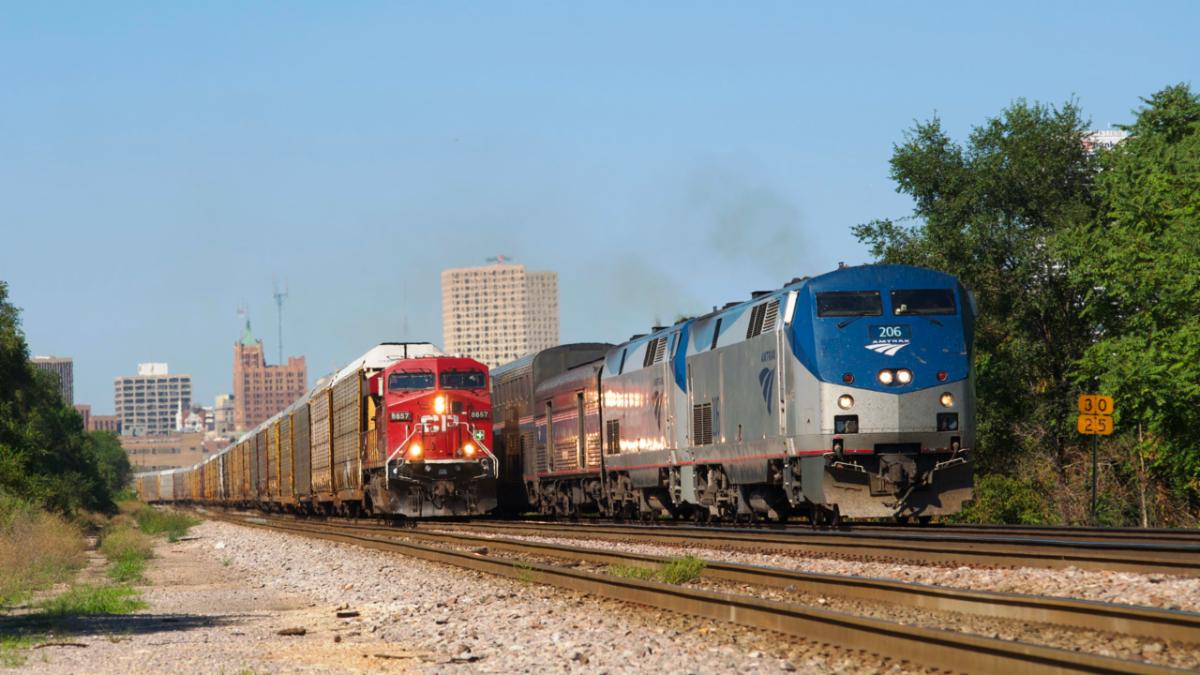
The infrastructure package (see below) signed into law by President Joe Biden calls for renewed efforts to invest in existing and potentially new intercity passenger rail routes and infrastructure. This is significant because Amtrak runs on track owned by the freight railroads, including in densely populated areas such as the Northeast corridor and around Chicago.
|
|
(Editor's Note: In November, the Teamsters United slate swept the Teamsters union International leadership elections with the support of Teamsters for a Democratic Union (TDU), a group that Railroad Workers United has close ties with. Below is a letter from our Steering Committee to the newly elected leadership.) |
|
An Open Letter to Newly Elected Teamsters National Leadership |
|
Dear Teamster’s Union Leadership-Elect:
Railroad Workers United (RWU) would like to take this opportunity to offer our heartfelt congratulations upon your victory in the recent IBT elections.
Many of us in rail are optimistic that the Teamsters United triumph can move the union forward on a new path, ushering in a new era of rank-and-file action, internal union democracy and participation, member-to-member solidarity, and a unified labor organization, one committed to organizing new members, building rank & file power, mobilizing the membership, and winning better contracts.
As you are aware, railroad workers of the Teamsters Rail Conference across the board voted in favor of change in the IBT elections five years ago, unhappy with the Hoffa leadership. While that was a heart-breaking loss, the resounding victory this time around was worth the wait!
RWU offers to work with the new IBT leadership upon assuming office. While the membership of our organization is drawn from the ranks of all rail labor and all rail unions, a substantial number of our activists are Teamster members. But all our members – and all railroad workers – have a keen interest in a strong and united Teamster Rail Conference and Teamsters union.
Please do not hesitate to call on our organization at any point you think we might be of assistance in your efforts to build Teamster power and move the union in a new direction.
All the best to all of you!
In solidarity,
Ron Kaminkow, General Secretary
for the RWU Steering Committee
|
|
(Editor's Note: This is a step in the right direction for the Teamsters union. Railroad Workers United adopted a Resolution in Support of a Paid Holiday for All Railroaders on MLK Day in 2019. Click HERE to have a look.)
|
|
Teamsters Uniting to Make UPS Deliver on the Dream |
|
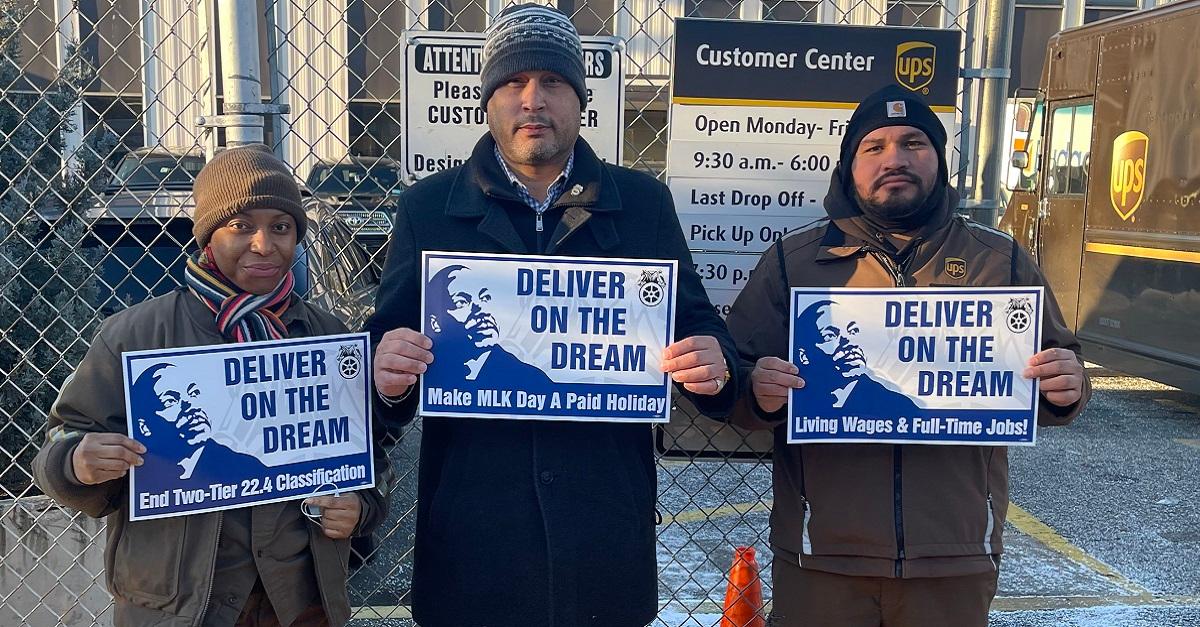
On January 17, UPS Teamsters are organizing a national day of action to tell UPS to deliver on the dream by respecting the holiday, ending two-tier pay for 22.4s, and providing living wages and full-time jobs for part-timers.
The Teamster Convention approved a resolution to fight to win Martin Luther King Day as a paid holiday in all Teamster contracts.
The national Day of Action on MLK Day was announced by Sean O’Brien and the newly-elected O’Brien-Zuckerman Teamsters United leadership team.
Teamsters and their local unions will be passing out leaflets, collecting petition signatures, and holding parking lot meetings and rallies in dozens of cities.
A toolkit is available for members and local unions that want to participate, including a leaflet, a petition, and rally signs.
|
|
(Editor's Note: RWU wishes the Attorneys General success in their efforts. We drafted a letter to PHMSA in August 2019 with our official position on the issue. You can read it HERE. )
|
|
Attorneys General Call on PHMSA to Suspend LNG-by-Rail Rule |
|
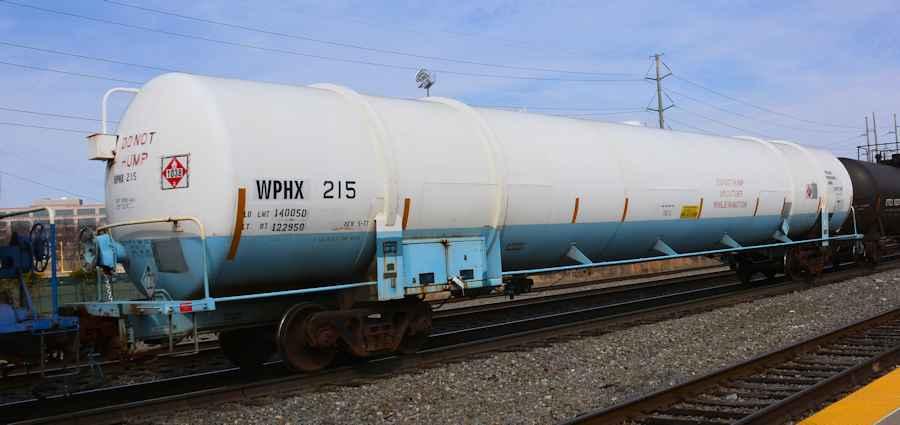
A coalition of 15 attorneys general representing 14 states and the District of Columbia has filed comments in support of the Pipeline and Hazardous Materials Safety Administration’s (PHMSA) proposal to suspend authorization of the bulk transport of refrigerated liquid methane, more commonly known as liquefied natural gas (LNG), by rail nationwide.
Led by Maryland Attorney General Brian Frosh and New York Attorney General Letitia James, the coalition filed the comments last month after PHMSA officials announced plans to suspend a rule made during President Donald Trump’s administration that would have authorized rail transportation of LNG.
"Suspending the Trump administration’s misguided LNG-by-rail rule is a step in the right direction," Frosh said in a press release. "Allowing these dangerous trains to travel along our freight-rail network, much of which passes through minority and disadvantaged communities, would put millions of our states’ residents at risk while further fueling the climate crisis."
According to Frosh, the attorneys general support suspending the rule because it:
• was based on a flawed and incomplete safety assessment;
• did not adequately consider the rule’s upstream and downstream effects on greenhouse gas emissions; and
• lacked an adequate discussion of the rule’s impact on low-income, minority, underserved and disadvantaged communities.
In addition to Frosh and James, attorneys general participating in the coalition are from Connecticut, Delaware, the District of Columbia, Illinois, Massachusetts, Michigan, Minnesota, New Jersey, Oregon, Pennsylvania, Rhode Island, Vermont and Washington.
|
|
(Editor's Note: Great to see the engineers & trainmen union - BLET - and the trackworkers union - BMWED - both joining the TTD. Now if they could only join together in the same rail bargaining coalition where it counts, and stop the destructive infighting between them!) |
|
America’s Largest Transportation Labor Coalition Gains 3 More Unions, Unifies Rail Labor |
|
The Transportation Trades Department, AFL-CIO (TTD), America’s largest coalition of transportation labor unions, today announced the affiliation of three more unions, bringing the coalition’s total membership to 36 affiliated unions. TTD proudly welcomes the Brotherhood of Locomotive Engineers and Trainmen (BLET) and Brotherhood of Maintenance of Way Employes (BMWED), both divisions of the Rail Conference of the International Brotherhood of Teamsters, and the International Union of Painters and Allied Trades (IUPAT) to its membership.
Significantly, the re-affiliation of BLET and BMWED means all of America’s rail labor unions have a unified voice. In addition to BLET and BMWED, the Rail Labor Division includes the American Train Dispatchers Association (ATDA); Brotherhood of Railroad Signalmen (BRS); International Association of Machinists and Aerospace Workers (IAMAW); International Association of Sheet Metal, Air, Rail and Transportation Workers (SMART); International Brotherhood of Boilermakers, Iron Ship Builders, Blacksmiths, Forgers and Helpers (IBB); International Brotherhood of Electrical Workers (IBEW); National Conference of Firemen & Oilers, SEIU (NCFO); Transportation Communications Union/IAM (TCU); Transport Workers Union of America (TWU); and UNITE HERE.
The BLET represents more than 57,000 active and retired members, including Locomotive Engineers, Conductors, Brakemen, Firemen, Switchmen, Hostlers and other Train Service Employees on U.S. railroads. “Our re-affiliation with TTD and its Rail Labor Division (RLD) once again unites all rail labor unions in one common Organization. We look forward to working with all of TTD’s officers, staff and affiliated unions; we are always stronger, and our members are best represented when we are working together,” said BLET President Dennis Pierce.
The BMWED represents nearly 26,000 workers who build and maintain the tracks, bridges, buildings and other structures on railroads across the nation. “I am excited for the prospect of advancements for all railroad workers that could come through all of rail labor uniting under TTD. I look forward to working with TTD President Greg Regan, Secretary-Treasurer Shari Semelsberger and the very capable TTD Staff. Rail Labor is always strongest and prospers most when we stand united against the railroads, and TTD will certainly help with our fight,” said BMWED President Freddie Simpson.
|
|
(Editor's Note: It is not everyday that you see a major Class One freight rail carrier cooperating with Amtrak, especially when it comes to operating more trains. Perhaps CPKC smells government money. Whatever the case, this is good news for passenger rail and rail workers.) |
|
CPKC Secures Amtrak Support |
|
Amtrak is backing Canadian Pacific and Kansas City Southern’s proposed combination, Canadian Pacific Kansas City (CPKC), and CP is committing to support Amtrak’s service expansion in two U.S. regions, the railroads reported on Jan. 6.
“CP has been an excellent host of Amtrak intercity passenger service year after year and has established itself as a leader in the railroad industry,” Amtrak President Stephen J. Gardner said during the announcement. “We welcome CP’s commitment to our efforts with states and others to expand Amtrak service and are pleased to have reached an agreement formalizing CP’s support of Amtrak expansion in the Midwest and the South.
Amtrak President Stephen J. Gardner
“Given CP’s consistent record as an Amtrak host, we support CP’s proposal to expand its network. This is exactly what Congress and the [Biden] Administration are seeking: Amtrak and the freight railroads working together to benefit freight customers, Amtrak passengers, our state/regional partners and the general public.”
According to Amtrak, CP has consistently received an A rating in Amtrak’s annual host railroad report card, “recognizing its industry-leading on-time performance record,” and CP is the first Class I railroad to “complete 100% certification of its Amtrak schedules” to the STB.
CP has committed to cooperating with Amtrak to:
• Increase frequency of the Hiawatha Service between Chicago and Milwaukee.
• Extend Hiawatha Service from Milwaukee to St. Paul, Minn., creating a second round-trip on the Twin Cities-Milwaukee-Chicago corridor.
• Provide passenger service through the Detroit River Tunnel between Michigan and Ontario to Windsor and Toronto (with connections to VIA Rail Canada).
|
|
(Editor's Note: This is important stuff, because it is saying that if YOU the rail worker honestly believe that you are reporting an unsafe condition at work, then there is no onus on your part to be held to an "objective" standard.) |
|
Another Circuit Holds Subjective Belief Alone Is Enough |
|
The FRSA protects employees from retaliation for “reporting, in good faith, a hazardous safety condition.” In a recent landmark decision, the 2nd Circuit Court of Appeals held that such good faith only requires proof of a subjective belief, and rail workers do not have to prove both a subjective and objective basis for believing a condition is hazardous. Ziparo v. CSX Transp. Inc.
The 8th Circuit now endorses and follows that standard. In Monohon v. BNSF Ry. Co., the 8th Circuit holds “good faith as used in the FRSA requires only that the reporting employee honestly believes that what she reports constitutes a hazardous safety condition.”
The 8th Circuit goes on to note that the refusal-to-work provision of the FRSA has a higher standard and does require proof of objective reasonableness. However, the FRSA’s refusal-to-work provision is rarely invoked, while there is a multitude of hazardous condition reporting cases.
Regarding damages, the 8th Circuit Monohon decision also addresses reinstatement versus front pay. The FRSA states that an employee who prevails in a FRSA action “shall be entitled to all relief necessary to make the employee whole.” The 8th Circuit notes the FRSA goes on to state such relief “shall include” reinstatement, and so “unambiguously requires reinstatement.” However, the Circuit Court also recognizes “this requirement is not absolute” and that courts have the discretion to award front pay when reinstatement is not possible. But there is no question reinstatement is the default FRSA remedy, and can be replaced by front pay only under limited circumstances, or by agreement of the parties.
|
|
WEBINAR: The FRA's Midwest Regional Rail Plan |
|
Please join us for another look at the FRA's Midwest Regional Rail Plan, which lays out a compelling vision for a network of high-speed trains that would transform travel across the Midwest.
We will be joined by FRA Project Manager, Peter Schwartz. Peter was a Study Administrator for the Midwest Regional Rail Plan, which makes him uniquely qualified to provide us a detailed account of the report.
The plan envisions a network that consists of four “pillar corridors” radiating out from Chicago, with endpoints in Minneapolis-St. Paul, St. Louis, Indianapolis and Detroit. These high-speed lines form the backbone of the system and would be integrated with transit systems and regional lines. This would make connections much faster and easier between hundreds of cities throughout the Midwest.
We're excited to be joined by an expert on this topic and hope you are as well. Please come with questions as there will be time for a Q+A after the presentation.
|
|
(Editor's Note: Just last month the rail industry was engaged in an orgy of self-congratulatory BS about its amazing performance in keeping employees safe while keeping the freight moving throughout the pandemic.) |
|
Railroad Employee COVID-19 Infections Hit Pandemic High |
|
Railroads have not been immune to the skyrocketing number of COVID-19 cases across the U.S. as the more contagious Omicron variant spreads nationwide.
Click to enlarge.
Overall, 2,171 railroad employees had contracted COVID-19 in the week ending Jan. 1, while 2,551 were quarantined after being exposed to the virus. Some 824 railroaders tested positive at Class I railroads in the East, along with 746 in the West, 205 at Amtrak, 313 at commuter railroads, and 83 people at short lines and regionals.
Quarantine levels remained below the pandemic peak recorded in the week ending Nov. 21, 2020, which has helped lessen the impact on employee availability industrywide, the FRA data show.
But the total number of infections and quarantines in the rail industry jumped 47% in the week ending Jan. 1 and is up 74% since the week ending Dec. 18. Those railroad numbers are likely to climb: In the two-week period ending Jan. 6, new COVID-19 cases rose 227% nationwide.
The rising infection and quarantine rates come as Norfolk Southern and CSX Transportation already face shortages of train crews in some locations.
|
|
(Editor's Note: Do not be misled by these statistics. The RWU Rail & Labor News has reported on the decline in freight traffic these last 6 months. This article might lead one to assume that this trend has reversed. It has not. The stats below represent a YEAR-OVER-YEAR increase, and if you remember, the year in question was 2020, when the pandemic had ravaged commerce and industry and saw a major decline in freight traffic, including rail freight. One would expect of course, that the 2021 totals would exceed the 2020 totals. And they did ... by just a lousy 6%.) |
|
AAR: North American Freight-rail Traffic Rose in 2021 |
|
U.S. freight-rail traffic rose 5.7% to 26,152,716 carloads and intermodal units in 2021 compared with 2020 levels, according to Association of American Railroads (AAR) data.
Year over year, total carload traffic climbed 6.6% to 12,010,274 units, while intermodal volume increased 4.9% to 14,142,442 containers and trailers.
Rail traffic in 2021 was "substantially higher" in most commodity categories, said AAR Senior Vice President John Gray in a press release.
"On the carload side, chemicals set a new annual record and grain had its best year since 2008," Gray said. "Coal carloads were up substantially because of sharply higher natural gas prices, while carloads of motor vehicles suffered as microchip shortages forced automakers to cut output."
For intermodal traffic, the first half of the year set a record, while the year’s second half gave way to lower volume due to supply-chain challenges, he said.
"Still, 2021 was the second-best U.S. intermodal year ever, behind only 2018," Gray added.
In December 2021, U.S. railroads originated 1,135,835 carloads, a 3.1% increase from the same month in 2020. On the intermodal side, U.S. railroads originated 1,224,780 containers and trailers
|
|
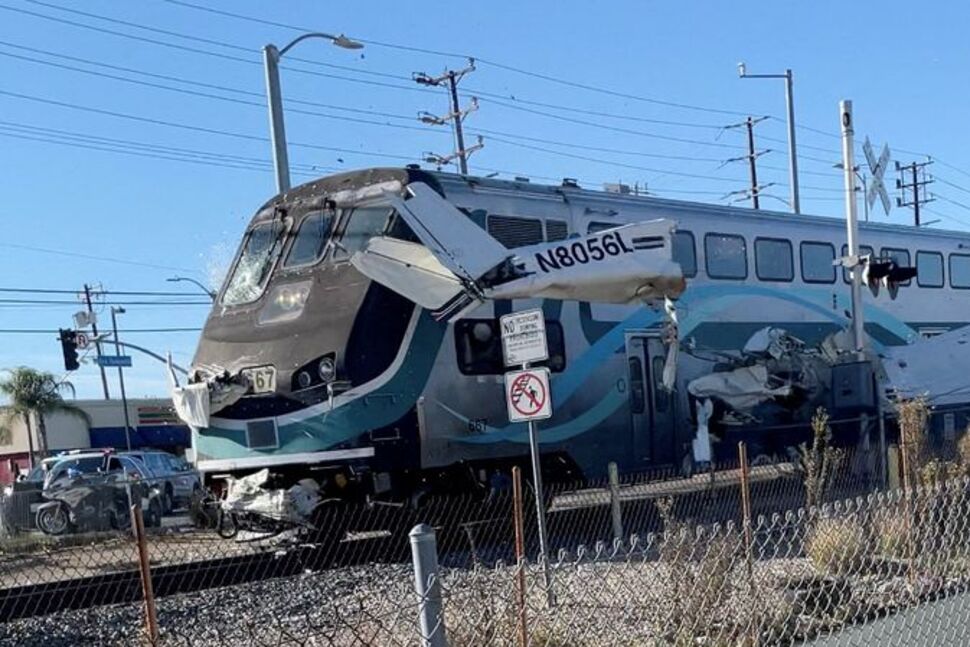
Plane Hit by Train After Crashing on Train Tracks in California |
|
Police in Los Angeles, California, pulled the pilot from a crash-landed Cessna seconds before the aircraft was hit by a train on Sunday, sending debris flying in all directions.
Dramatic video obtained by Reuters shows several officers freeing the man from the downed plane, which had crashed shortly after takeoff in the Pacoima neighborhood, according to local media. The officers and pilot are just a few feet away from the tracks when the passing train destroys the plane.
"The plane had a failed takeoff and landed on the train tracks at a popular intersection," said Luis Jimenez, the 21-year-old music composer who filmed the video. "Just seconds before impact police officers saved the pilot, and a piece of debris almost hit me."
The pilot was treated for cuts and bruises and is in a stable condition, according to local media. No one on the train was injured, local media reported.
|
|
|
|
|
|
|