Colorado and Gunderson Newsletter: December 2023


The Colorado/Gunderson Rd fiber-to-the-home (FTTH) project has been in the works for over a year now, and the lack of regular status updates and concrete timelines has left residents wondering, where is my internet?


Going forward, both SandyNet and CBX want to ensure that we are keeping everyone informed about latest developments and any changes or delays. We hope these newsletters are informative and help communicate our efforts to bring internet to you.


Rest assured, the project is still underway, and making progress every day. Most people do not know what goes on behind the scenes, and what makes this project so unique. To take a glimpse into the inner workings of a rural FTTH deployment, we must first define the parties involved, and understand their roles.


The Colorado/Gunderson Rd FTTH project has two pieces moving as one. Clackamas Broadband eXchange (CBX), a department of Clackamas County, entered into an IGA with SandyNet, a department of the City of Sandy back in 2019, to begin providing FTTH to underserved areas outside of Sandy city limits. The partnership focused on splitting the responsibilities of CBX and SandyNet, where CBX would build and maintain the fiber optic network, and SandyNet would be the service provider and deliver broadband to the home.


In January of 2023, the IGA was revised to include the Colorado and Gunderson roads west of 362nd. The other major revision was the introduction of CBX using an open access model for service providers to deliver broadband. An Open Access Network is a fiber buildout that allows several service providers to deliver services alongside other ISPs. This kind of model removes barriers for other ISPs wishing to service an area, should the ISP desire to utilize the network. SandyNet is an ISP that will deliver those broadband services across the CBX fiber network.


Since the signing of the IGA between SandyNet and CBX, funding was secured by CBX under the American Rescue Plan Act (ARPA) to design and construct the fiber network. Under the ARPA guidelines for broadband projects, minimum broadband speeds of 100 Megabits Per Second (Mbps) download and 100Mbps upload are required. Both CBX and SandyNet agreed to offer symmetrical 500Mbps and 1Gbps (gigabit) services, where the download and upload speeds are the same speed. Plans and prices can be found here.


Fiber Deployments - In a Nutshell


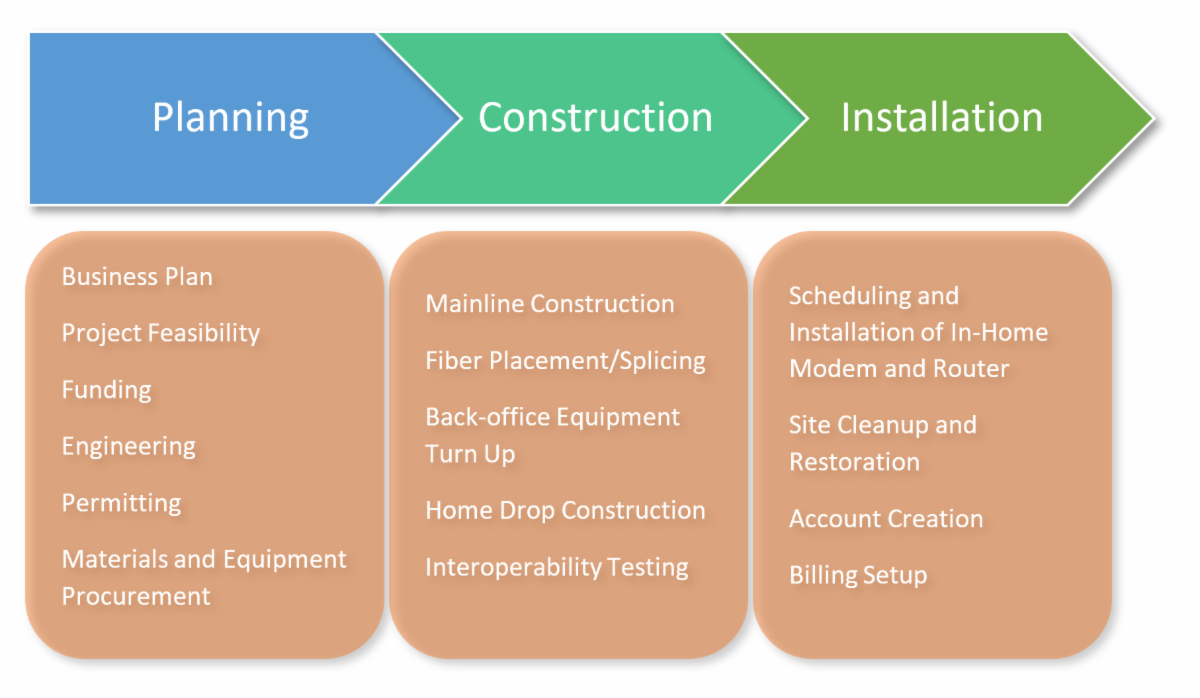
There are three main phases to any fiber deployment. First, a location must be identified to construct, and funding must be secured before any plans or construction can occur. During this phase, a feasibility assessment is performed for the service footprint. At the end of the first phase, all permits are granted, a solid business plan is formed, and a buildable set of plans are delivered from a design/engineering firm for construction.


Second, the construction phase begins, usually starting with the fiber backbone. The backbone ties into an existing fiber network and connects to the serving project location. From there, fiber is distributed to mainlines, which runs down major roads, connecting paths. That mainline is then distributed to each home via a service drop. During this process, the electronics on the other end of the backbone are turned up. This equipment typically sits in a hut or central office and provides light to the in-home modems. When configuring the back-office systems in an open access network, there is an additional step where CBX and SandyNet must connect and test the interoperability between each of the systems.

The third and final step is getting the home connected with fiber. At this point, fiber is lit and ready for connections, and the fiber optic cable can been installed at the side of the home. An installer must take that fiber and then run it along the house and bring the fiber inside to connect to the modem. The modem is installed to convert the fiber to ethernet and must connect to a router, which will provide internet over Wi-Fi and wired devices. After the installation, service is active, and all available wired and wireless devices are connected. After the install is completed, billing is set up and the connection is now active.

After the initial project deployment is completed, all construction and service orders are installed and operational. Any final cleanup is performed, and the project is officially completed. Any additional requests for service are placed on a standard installation schedule to have the fiber drop brought up to the home and an indoor installation scheduled. After a project is completed, all sites should be restored to a condition that is equal or better than when the project started.

Current Project Status


The Colorado/Gunderson Rd project is currently in the second phase, where the mainline is constructed and drops are being built out and installed. CBX has two contractors that are installing drops from the poles to the home. Fiber is being delivered either overhead or underground. In most cases, the fiber drop will be installed the same way the other utilities are brought to the home. An overhead power service will most likely result in an overhead fiber drop, whereas an underground power service will most likely require a boring machine to bring the fiber to the home. Exceptions do exist, and some driveways are longer than normal and harder to construct, so before any construction is performed to the home, a representative from CBX will reach out to discuss and determine the best path for the fiber drop.


On the backend side, the datacenter equipment has been received and CBX is working with the fiber equipment vendor to turn up the electronics. Once the electronics are lit and active, SandyNet will perform its interoperability tests in a lab to ensure that broadband service are being delivered at the expected speeds. After interoperability testing, the modem and in-home installation will begin. Once that stage is reached, SandyNet will schedule an indoor installation with the homeowner to install the modem and Wi-Fi router. Details regarding the indoor installation will be provided in upcoming newsletters. 

Project Timeframe and Projections


Both CBX and SandyNet have a goal to start the in-home installations after the first of the new year. While drops are beginning to be constructed, the back-office equipment is scheduled to begin its turnup in the next few weeks. The interoperability testing between SandyNet and CBX is expected to take no more than two weeks after that. The timeline is subject to change if challenges arise, however, there is optimism between CBX and SandyNet that the project will be on schedule within a week or two of the projected timeframes. Individual service connections are subject to the drop completion date, and the availability of the install schedule. The next newsletter update will provide a more precise timeline, as the back-office equipment turn-up will have begun and interoperability testing will be in its planning stages.