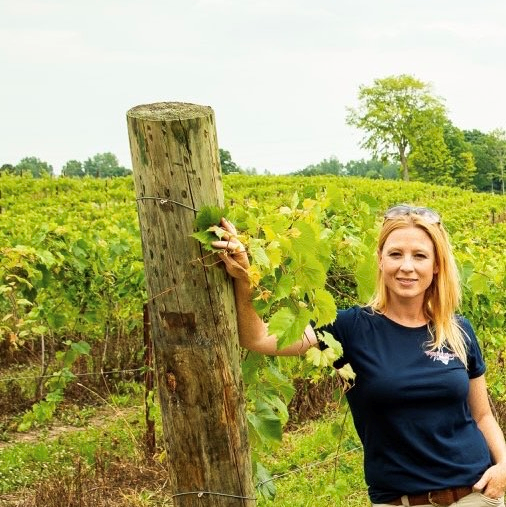
Jessica Youngblood in her block of Petite Pearl, a cold-hardy red wine variety |
|
I’ve been a member of the National Grape Research Alliance for five years, and am honored to now serve as the Board Chairwoman for an organization that personally means so much to me. Why do I believe in the importance of research as a mechanism to support the grape and wine industry? Because my family business is made possible by research. I see its results every day in my own vineyard.
I own a 25-acre cold-hardy wine grape vineyard in metro Detroit. Growing wine grapes in the Midwest is not for the faint of heart, and the grapes that I grow did not even exist a few decades ago, some not even one decade ago. I once read an interview with a Midwest winemaker who commented that a “Midwest Burgundy” was “the dream.” Imagine that: a cold-hardy wine grape that could rival the dry red Pinot Noirs made in the most renowned wine region of the world.
Well, thanks to exactly the kind of research NGRA supports, we have our Midwest Burgundy; it’s called Marquette. It was developed by the University of Minnesota and commercially released in 2006, just nine years before we planted it on our farm. As the genetic grandchild of those same Pinot Noir grapes from a half a world away, it has not only won numerous awards for its wine quality, but is also now being grown far outside the Midwest, due to considerations driven by climate change.
And it’s not just new grape varieties that can create the potential for entirely new wine regions. In the Midwest, we have a whole lot of three things that make having a vineyard more challenging: lots of humidity, lots of weeds, and lots of bugs! The research that supports vine management, pesticide applications, as well as vineyard mechanization are all crucial to supporting the entire industry, and literally make it possible to have vineyards in places most might not consider “grape country.”
But by far the best thing about the NGRA is the strong collaborative attitude that supports all grapes. Juice grapes, raisin grapes, wine grapes and table grapes sit on equal footing and are fully supported by millions of dollars of research. The NGRA helps steer that research and grow the industry through the development of knowledge to make growing grapes not just possible, but more productive, sustainable and competitive.
NGRA’s work doesn’t focus on just one specific state or region, but benefits the grape and wine industry throughout the United States. Hot climates, cold climates and everything in between have more grape-growing potential than ever before. Whether you are on the East Coast or West Coast, Midwest or Southwest, or you’re growing 30 acres or 30,000, research is literally redrawing the grape-growing map.
So, bring on the cold and damp, the bugs, and weeds. I know that, whatever issue I encounter while growing my grapes, I have a direct line to a receptive group of science-minded industry colleagues and smart, energetic scientists focused on fixing our common problems. It’s unbelievably exciting—and comforting—to be part of NGRA’s mission. We support the research that matters most, and all to support the most amazing of fruits—the GRAPE!
|
|
|
Jessica Youngblood
NGRA Board Chairwoman
Owner, Youngblood Vineyard
|
|
President’s Budget Boosts Research |
|
This month, the Biden Administration released the President’s Fiscal Year 2023 Budget, which would be effective October 1, 2023 through September 30, 2024, if passed. As stated by Agriculture Secretary Vilsack, the proposed budget “is a clear message of what President Biden values,” signaling his funding priorities, including climate-smart “effective, innovative science-based public policy leadership at home and around the world.” But as our colleague and NGRA Board member Jim Trezise of WineAmerica explains, Congress is under no obligation to enact the President’s Budget...and typically doesn’t. Jim also notes that the President’s FY 2024 Budget includes an increase of 14% to $30.1 billion for the USDA to support increased research and implementation of the Farm Bill, once it passes. More broadly, it provides $210 billion for federal research and development, a “ historic level of investment in American science, technology and innovation.” See the complete President’s FY 2024 Budget.
|
|
At the B.E.V. (Business, Enology and Viticulture) NY conference in Syracuse, NY, this month, a new white wine grape was introduced. Aravelle, the newest commercial release from renowned Cornell grape breeder and NGRA Science Advisory Council member Bruce Reisch, was developed by crossing Cayuga white and Riesling grapes in 1981, at the start of Bruce’s career. The cross yielded a vine with improved cold hardiness, much better rot and fungal disease resistance and similarly high wine quality. Now, with 15 grape varieties to his credit and retirement coming later this year, Bruce was on hand to release the new variety and reveal its name (previously known only by its research ID, NY-81-315-17). In a video shot just before the announcement, Bruce says with a smile, “The name of the grape will be Aravelle. It means, ‘Maybe this is the answer to your prayers.’” |
|
NRCS Releases Framework for Western Water Conservation |
|
Last month, t he USDA’s Natural Resources Conservation Service (NRCS) released its Western Water and Working Lands Framework for Conservation Action to address key water and land management challenges across 17 Western states representing the nation’s most arid landscapes. It provides direction, support and coordination to address resource concerns and threats across state boundaries, including climate-change impacts, such as droughts, wildfires and floods. And it leverages new scientific tools to guide program implementation on the ground. It also includes guidelines for identifying vulnerable agricultural landscapes and 13 strategies to help NRCS state leaders, water resource managers and producers respond to six priority challenges resulting from threats to water supply in the West.
|
|
Unity Awards Recognize Leaders in New York |
|
On March 1, the New York Wine & Grape Foundation announced its Unity Awards. Created in 1990, the awards “recognize, encourage and celebrate cooperation among grape growers, wineries, researchers, retailers and others to advance the entire industry.” Among the winners are two academic colleagues who have been instrumental in grape research. Congrats to Jan Nyrop, the retired director of Cornell AgriTech, who won the Foundation’s Jim Finkle Industry Award, and Jason Londo, associate professor at Cornell University, who was recognized with the Research Award. They and the other deserving industry leaders and champions received their Unity Awards at the B.E.V. NY conference this month.
|
|
Academic Colleagues Win ASEV Awards |
|
Congratulations to these outstanding academic colleagues for their well-earned recognition from the American Society for Enology and Viticulture (ASEV)! Join them for their celebratory talks at the 74th ASEV National Conference in Napa, CA, in June, where they will officially receive their awards.
- A leader and collaborator in grape extension and research at Cornell University, Dr. Timothy Martinson is this year’s recipient for the organization’s highest honor, the ASEV Merit Award. A senior extension associate emeritus, Tim retired from Cornell in January 2022, having led New York’s sustainability initiatives in wine throughout his 30-plus-year career. His Merit Award presentation is titled, “An Insect Ecologist’s ‘Random Walk’ through the Viticultural Landscape.”
-
Dr. Anna Katharine Mansfield, associate director of Cornell AgriTech and associate professor of enology at Cornell University, is the 2023 ASEV Extension Distinction Award recipient. She will be presenting, “Would You Rather Be Right or Kind? The Ideal vs. the Real in Enology Extension.”
This month, ASEV also announced its 2023 Best Enology and Best Viticulture Papers. Both papers are freely available in the American Journal of Enology and Viticulture (see links below) and will be presented at the National Conference.
- The 2023 Best Viticulture Paper, “Electrical Stimulation as a Potential Technique for Enlarging Table Grape Size by Enhancing Cell Division,” is authored by Daisuke Mori, Norimichi Hanya, Yoshinao Aoki and Shunji Suzuki from the University of Yamanashi, Japan; and Hiroshi Kanamaru and Yoshiyuki Masamura of NIHON SHINKO Co., Ltd., Japan.
- The 2023 Best Enology Paper is “Fertilize or Supplement: The Impact of Nitrogen on Vine Productivity and Wine Sensory Properties in Chardonnay,” by Tian Tian of the University of California Cooperative Extension, Kern County; R. Paul Schreiner of USDA-ARS, Corvallis, OR; and Meghan Ruppel, James Osborne and Elizabeth Tomasino of Oregon State University.
|
|
New Pest Control Coordinators, Coast to Coast |
|
New York State’s first Grape IPM Coordinator, entomologist Dr. Germán Vargas, begins his new role June 20, 2023. Based at the Cornell Lake Erie Research and Extension Laboratory in Portland, NY, Germán will help grow and sustain the state’s grape industry—nearly 35,000 acres, producing 128,000 tons of juice grapes, 57,000 tons of wine grapes, and 2,000 tons of table grapes each year—by working with Cornell colleagues and industry stakeholders to develop, demonstrate and guide IPM implementation efforts.
On the other side of the country, in November 2022, Joseph Damiano joined the California Department of Food and Agriculture Pierce’s Disease Control Program as the Pierce’s Disease Control Program Statewide Coordinator. He has a six-acre family vineyard of his own and extensive experience in both the wine industry and government agencies that serve the agriculture community. “Having a perspective of both industry and government, and being able to engage in meaningful discussions with the PD/GWSS Board and other stakeholders will help move the program forward in a positive manner,” he said. |
|
Cornell to Host GiESCO Meeting; Professional Day Added |
|
Cornell University will host the 2023 GiESCO Meeting at its Ithaca, NY, campus July 17-21, 2023. (GiESCO is short for Group of International Experts for Cooperation on Vitivinicultural Systems.) This year, the prestigious international academic conference will include an industry-focused Professional Day on July 20, offered in person and via livestream, featuring applied viticulture topics presented by international speakers. Professional Day keynote speakers (and their topics) are: NGRA Research Chair Dr. Nick Dokoozlian, E. & J. Gallo Winery (The Vineyard of the Future); Dr. Kaitlin Gold, Cornell (Remote Sensing for Disease Detection); Dr. Michela Centinari, Penn State (The Threat of the Invasive Spotted Lanternfly). Other topics include managing grapevine diseases with UV radiation, new fumigation alternatives, vineyard nutrient budget and sampling protocols, response of vineyard soils to biochar, and other timely topics that address grower challenges. Learn more.
|
|
DIALING IN WATER STRESS INDICATORS TO BETTER REFLECT HOLISTIC STRESS RESPONSES
By Abby Hammermeister
|
|
Even as more and better technologies emerge to help simplify water management, knowing when, where and how much to irrigate vineyards is a complex question. Commonly, farmers rely on point measures like leaf water potential to help guide management decisions. But it’s not that simple. These measures are destructive and time- and labor-intensive. Plus, spatial variation commonly found in vineyards can be missed with single point measurements. With support from my colleagues in the McElrone Lab at UC Davis, I intend to help find a better way.
Under water stress, the leaves and canopies of grapevines exhibit biological and physical changes that aren’t visible to the naked eye. Whether done via towers, drones, planes, or satellites, remote sensing can elucidate these changes. Remote sensing-aided technologies for irrigation management currently use light reflectance and energy balance modeling to estimate water use and stress. However, these approaches still require work to better understand how detected changes relate to meaningful physiological events.
Taking a biophysical perspective on this problem, I’m working from the leaf level first to understand physical and biological changes under drought stress before applying this knowledge to the large scale. I’m tracking physiological responses to drought stress and mapping how these relate to changes seen using ground-based and remote sensing systems. By answering the question of “how well do stress measures via remote sensing match actual physiology?” I hope to improve irrigation management and water use efficiency in vineyards.
To better understand leaf-level changes under water stress, I’ll be performing two sets of experiments. The first will be a series of short-term dry downs to evaluate spectral and structural effects of quick water loss, and the second will be longer term drought experiments to evaluate the biochemical component of water loss and its effect on spectral data. Thus far, in the rapid dry down studies, by making pressure-volume curves to identify turgor loss points (an indicator of stomatal closure and general drought tolerance of the tissue), we’ve found that the turgor loss point becomes more negative over the course of a season. This finding suggests that grapevines become more drought-resistant over time and confirms that methods for monitoring water stress need to be calibrated with the time of the season, leaf age and by integrating the canopy as a whole. During these pressure-volume curve experiments, we were also collecting spectral data, which we hope to correlate with canopy-level spectral measurements.
How will this help? Spectral data is a measure of how light interacts with a surface. As sunlight hits leaves, some of it is reflected back, some is absorbed and some is transmitted. What’s measured with spectrometers and hyperspectral cameras is the reflected values. The reason spectral data works as an indicator of water stress is because, when the structure and chemical content of leaves change, it affects the amount of reflected light the sensor receives. Certain wavelengths are more sensitive to water content changes than others. More than 100 spectral indicators for water stress exist today, in the form of ratios or the normalized difference of two wavelengths. My goal is to find the best indicators of tissue dehydration by using current indices and looking for new ones, as well.
My next steps will be to compare the pressure-volume curve data to a long-term drought study to see how my water stress indicators perform, since the biochemical interactions occurring under longer drought conditions may affect spectral readings. One way of learning what kind of changes happen may include looking at chlorophyll fluorescence in these drought-stressed leaves to see how photosynthesis is affected by long-term water stress.
By building a full picture of what is happening physiologically, we can better inform models used for satellite and other remote sensing imagery. To test this theory, I will use the large-scale, long-term GRAPEX project field sites and existing datasets to perform experiments under field conditions that could cause similar rapid changes in water content, as in the short-term dry downs. The GRAPEX project will also help to integrate broad-scale measurements, such as drone, plane and satellite data.
While my project is mostly focused on water stress, remote sensing has other useful applications like disease management and monitoring for nutrient deficiencies. The goal of applying remote sensing to vineyard management is to ultimately make the output of any one plot as uniform as possible, and to maximize total yield without sacrificing quality. I hope my project will lead to improvements to make this tool more accessible and accurate for growers.
Abby Hammermeister is the inaugural NGRA Fellow. She is a Ph.D. student at UC Davis, working in the McElrone Lab. Her research leverages the USDA-ARS GRAPEX project, in which Abby’s academic advisor, Dr. Andrew McElrone, is a primary investigator. Additional authors on her project are Nico Bambach, Mimar Alsina, Bill Kustas, Nick Daman, Robin Nguyen, Ian Wright, Peter Tolentino, Troy Williams, Mina Momayyezi, Morgan Furze and Sebastian Castro Bustamante and Dr. McElrone.
|
|
ASEV Journals Have Merged |
|
Earlier this year, ASEV merged its journal, Catalyst: Discovery into Practice, with its American Journal of Enology and Viticulture (AJEV). Effective January 2023, Catalyst, as a single entity, was dissolved and AJEV introduced new features, including new article types, online-only publication with a print-on-demand option, and a shift from an issue-based to a continual publishing format. Get more information, including AJEV’s new publishing guidelines and a link to submit your articles. |
|
The IAB funds research to promote the production of fruit tree, nut tree and grapevines resulting in improved nursery stock. Funded projects commonly include research of diseases and genetic disorders, variety identification, education and outreach, alternative treatment methods, and rootstock advancements as it relates to the production of high-quality tree and grapevine nursery stock. Deadline to apply is April 3, 2023.
The North Central Region of Sustainable Agriculture Research and Education (SARE) gives grants for professional development projects that provide sustainable agriculture training to agricultural professionals and educators in the Cooperative Extension Service, Natural Resources Conservation Service and other governmental agencies, and educators in the profit and non-profit sectors serving the food and fiber system in its 12-state region. Projects can be up to three years and up to $120,000. Proposals are due on April 6, 2023.
The Foundation for Food and Agriculture Research (FFAR) is accepting applications for its 2023-2026 FFAR Fellows cohort. The deadline for professional development ($10,000 award) is April 15, 2023.
Open to researchers from Western institutions, these grants support projects that bring together teams of researchers, students, agriculture professionals and producers to advance sustainable agriculture at local and regional levels. Projects must integrate rigorous research and education targeting the three components of sustainable agriculture—environmental, economic and social—and use innovative outreach to disseminate new knowledge. Project budget is a maximum of $350,000, with a project length of 1-3 years. Deadline is May 23, 2023.
|
|
Applying for a grant? Request a letter of support!
NGRA is pleased to provide letters of support for research projects that directly address our industry-set research priorities. Request a letter by completing our online request form at least two weeks prior to the grant deadline (or any internal deadline you may have). Requests are reviewed and approved by NGRA Research Committee leadership, so processing times may vary. |
|
March 24, 2023 | National Science Foundation
First-of-its-kind research at Mcity 2.0, a University of Michigan vehicle testing facility powered by the National Science Foundation and U.S. Department of Transportation-funded Center for Connected and Automated Transportation, is using AI to train autonomous vehicles. From naturalistic driving data, the AI learns what adversarial maneuver to execute through a dense deep-reinforcement-learning approach. It could reduce the amount of required testing miles by 99.99%, researchers said.
March 23, 2023 | Western Farm Press
In this wide-ranging interview with Western Farm Press columnist Lee Allen, NGRA President Donnell Brown talks about the threats of spotted lanternfly and grapevine red blotch, the organization’s “big ideas” for grape research to be identified this year and the idea that growers “have a role in science.”
March 20, 2023 | Lodi Winegrowers
In this excellent post on the Lodi Winegrowers blog, Randy Caparoso explains the rarity of Mediterranean climates around the world, though prevalent in wine-growing regions. But what makes Lodi’s Mediterranean climate different from other regions in Northern California? “The Sacramento-San Joaquin River Delta is the only part of California’s entire coast where there are no coastal mountains—the Lodi appellation’s summer growing season does not see any of the coastal fog or morning cloud cover typical of regions located closer to the coast.”
March 16, 2023 | Good Fruit Grower
Washington State University’s industry-supported AgWeatherNet applies machine learning, data from both weather stations and grower reports, and 101 years of recorded weather observations to make microscale frost forecasts freely available to local growers. It took years to develop the climatology of frost risks, particularly getting to know how cold air behaves across the landscape. Today, computer models learn those patterns rapidly to predict frost events. It’s one piece of a “field-specific, weather-driven, automated frost mitigation” USDA-funded project targeted to cherry and blueberry crops.
March 14, 2023 | USDA Agricultural Research Service
USDA-ARS researchers in the Mississippi Delta are studying ways to minimize crop-damaging off-target drift in ground-based pre-emergent herbicide applications for corn, soybean and cotton. They found that, by applying the materials using a hooded sprayer, pesticide drift was reduced by as much as 63% compared to a conventional sprayer. They acknowledge that mitigating drift is still possible by avoiding high wind speeds and high temperatures during spraying; using a longer sprayer boom also helps.
March 13, 2023 | SevenFiftyDaily
An Italian geologist has developed an analytical framework he calls Vineyard Geological Identity (VGI) to pinpoint “terroir” and how it affects grape production. It uses a variety of environmental data—geology and geochemistry, soil chemistry, climate (and its change), vineyard practices and other human impacts—and analyses to ascertain specific features of vineyards that could impact winemaking. For one Vermont grapegrower who tested VGI on two local vineyards, it seems to offer some order to the chaos of vineyard site variables…and surprising results.
March 9, 2023 | The New York Times
La Niña, the climate pattern that helped fuel hurricanes in the east and drought in the southwest over the past two and a half years, has ended, according to the National Oceanic and Atmospheric Administration. Forecasters believe that by the fall, there’s a 62% chance El Niño will form, bringing with it another spike in global temperatures that had been kept at bay by La Niña’s cooling effect.
March 8, 2023 | RochesterFirst.com
Cornell University’s Jason Londo explains the grapevine physiology that makes them especially vulnerable this year. “When we have a winter like this (in New York), the vines don’t acquire as much defense as they might in a cold year and respond much faster to warm temperatures in the spring,” he says. “That puts them at risk when we have big changes in temperature.” On a trajectory toward budbreak, vines have been stepping down their defenses, he adds. If another steep drop in temperature hits, “they would suffer damage.”
March 7, 2023 | HiRes Vineyard Nutrition Podcast
Tune in to this podcast from the NGRA-initiated HiRes Vineyard Nutrition project to hear UC Davis’ Matthew Fidelibus discuss how classic petiole testing methods compare to new leaf sampling and testing at the individual and whole-canopy level in California table grapes. Learn how viticulture and sensor research developments could leverage longstanding vineyard nutrition standards to inform future nutrient monitoring and management. “We feel like there's utility in those old recommendations," he says. "But the quantity of mineral nutrients that are needed to achieve [today’s] targets is higher because the vines are bigger and more productive. More fruit is leaving the vineyard and that fruit has a lot of nutrition in it.”
March 6, 2023 | Oregon Wine Board
If you’re growing grapes on the West Coast, you’ll value these predictions from climatologist (and winemaker) Dr. Greg Jones. He notes that drought conditions are forecast to continue to improve into spring, as temperatures remain relatively cool.
#graperesearch https://bit.ly/3Kgngaw
March 6, 2023 | CBC
One of the most promising tools in viticulture’s fight against climate change is CRISPR/Cas9. The “precise, quick and simple gene editing technology” is especially helpful for removing individual genes that, for example, make Chardonnay susceptible to diseases that are becoming a bigger problem in a warmer world. Unlike traditional grape breeding, which risks introducing off-target traits, gene editing could make disease-resistant Chardonnay grapes while otherwise leaving the variety completely intact. ”Unlike with hybridizing, it’s still 100% Chardonnay.”
March 2, 2023 | Science
In the largest ever genetic analysis of grapevine varieties incorporating the effects of glacial changes, researchers have discovered that the domestication of grape, via its progenitor Vitis sylvestris, took two distinct paths. One was associated with winemaking, but the other involved crossing varieties of wild and domesticated grapes, the latter for fresh consumption. The world’s first hybrids?
March 2023 | The Crush
California’s Lodi and Clarksburg AVAs experienced damaging freeze events in 2020 that prompted discussions of site selection and development, variety selection, vine management and more. “With lower areas, consider planting with later budding varieties, or pruning to delay budbreak,” says UCCE Viticulture Farm Advisor Justin Tanner, or use higher trellis systems to elevate young shoots from the cold ground. As two growers are quoted here, though, if freezes are rare, investing in mitigating its effects may not make financial sense.
March 2023 | Wine Business Monthly
Public and private grape breeders will soon have access to new powdery mildew-resistant grapevines produced by the NGRA-supported, SCRI-funded VitisGen2 project. Eight “Renstack” vines with four to six powdery mildew resistance genes have been released to Foundation Plant Services. They aren’t commercial varieties for growers to plant, but rather resources for breeders to use in developing grape varieties with durable resistance to powdery mildew. In other words, they “offer a solution to an intractable issue with traditional European grape varieties—their extreme susceptibility to that disease,” the authors write. (Find the story on p. 52)
February 24, 2023 | Water Talk
In this water-focused podcast UCCE Viticulture Advisor Chris Chen (Sonoma, Lake, Mendocino Counties) and UC Davis soil scientist Noelymar Gonzalez-Maldonado discuss the effects of heat and drought, and the benefits of rich, resilient soils on grape growing and winemaking. They also weigh in on the definition of and knowledge gaps around regenerative viticulture. As Noely says, “I see it as a group of practices that are sustainable, but focused on the soil—especially on protecting and building soil health. How do these practices impact grape quality? How expensive are they? How will they affect my production? These are questions we’re working on.”
February 9, 2023 | Western Farm Press
University of California researchers are studying whether hydrogel beads—used in diapers to keep babies dry—can be infused with trace amounts of pesticides (e.g., 1% of label rates) to control ants in orchards and vineyards. Ants are a factor in vine mealybug movement, so the research could have implications for the grapevine diseases they vector.
February 1, 2023 | American Journal of Enology and Viticulture
A Cornell-based team sought to tackle the longstanding question, what’s the ideal tissue type or phenological stage for sampling for grapevine mineral nutrients? They concluded that nutrient recommendations should be developed based on leaf blade samples. And although veraison-period samples have lower variability, having sufficient time to address deficiencies within the growing season may be of greater importance to growers. The results, they said, may be region- and/or cultivar-specific.
February 1, 2023 | Good Fruit Grower
As a research issue, the effects of wildfire smoke on grapes “has proved to be quite complicated,” the Washington State Wine Commission’s Melissa Hansen (an NGRA Board member) writes in a Good Fruit Grower guest column. “Australia has yet to fully solve the problem after supporting smoke research for more than two decades.” But with early and continuing support from Washington’s wine industry, the collective efforts of the West Coast Smoke Exposure Task Force and new funding for staff and research at USDA-ARS, major progress has been made.
January 31, 2023 | Fruit and Vegetable
Canada is interested in adopting or developing new varieties to grow its table grape industry. But the path to finding varieties adapted to the northern climate is complex. New vines come in soil-free and must be virus-tested for three or four years. Once planted in experimental test blocks, they must pass basic quality parameters and survive multiple winters—a moving target now with climate change. Jupiter, a blue, seedless grape from the University of Arkansas first planted in Ontario in 2014, has shown excellent winter hardiness. It is just now being planted commercially and 11 other varieties are under evaluation.
May 5, 2022 | Plants
Research led by UC Davis’ Matt Fidelibus focused on abscission, or the harvest of table grapes as single berries (popular in food service and culinary environments) without ripping the flesh when detaching fruit from the stem. The team found that, especially when paired with 1-aminocyclopropane-1-carboxylic acid (ACC), jasmonic acid effectively reduces the force needed to destem berries and yields a dry stem scar when doing so. But it works so well that JA-ACC treated grapes must be harvested within 24 to 48 hours!
|
|
Find these stories and more, published every weekday, on our Facebook and Twitter feeds. Use #graperesearch to join and grow the conversation!
|
|
April 4, 2023
Corvallis, OR
April 20, 2023
ASEV Webinar:
Virtual event
April 28, 2023
Plains, TX
May 8-10, 2023
Washington, DC
May 9-10, 2023
Washington, DC
June 7-9, 2023
Austin, TX
June 26, 2023
NGRA Mid-Year Board Meeting
Napa, CA
June 26-29, 2023
Willamette Valley, OR
June 26-29, 2023
Napa, CA
July 17-21, 2023
Ithaca, NY
|
|
The monthly NGRA Update is provided as a service to the U.S. grape and wine industry.
|
|
|
|
|
|
|