|
Community Update
February 2025
| | |
|
|
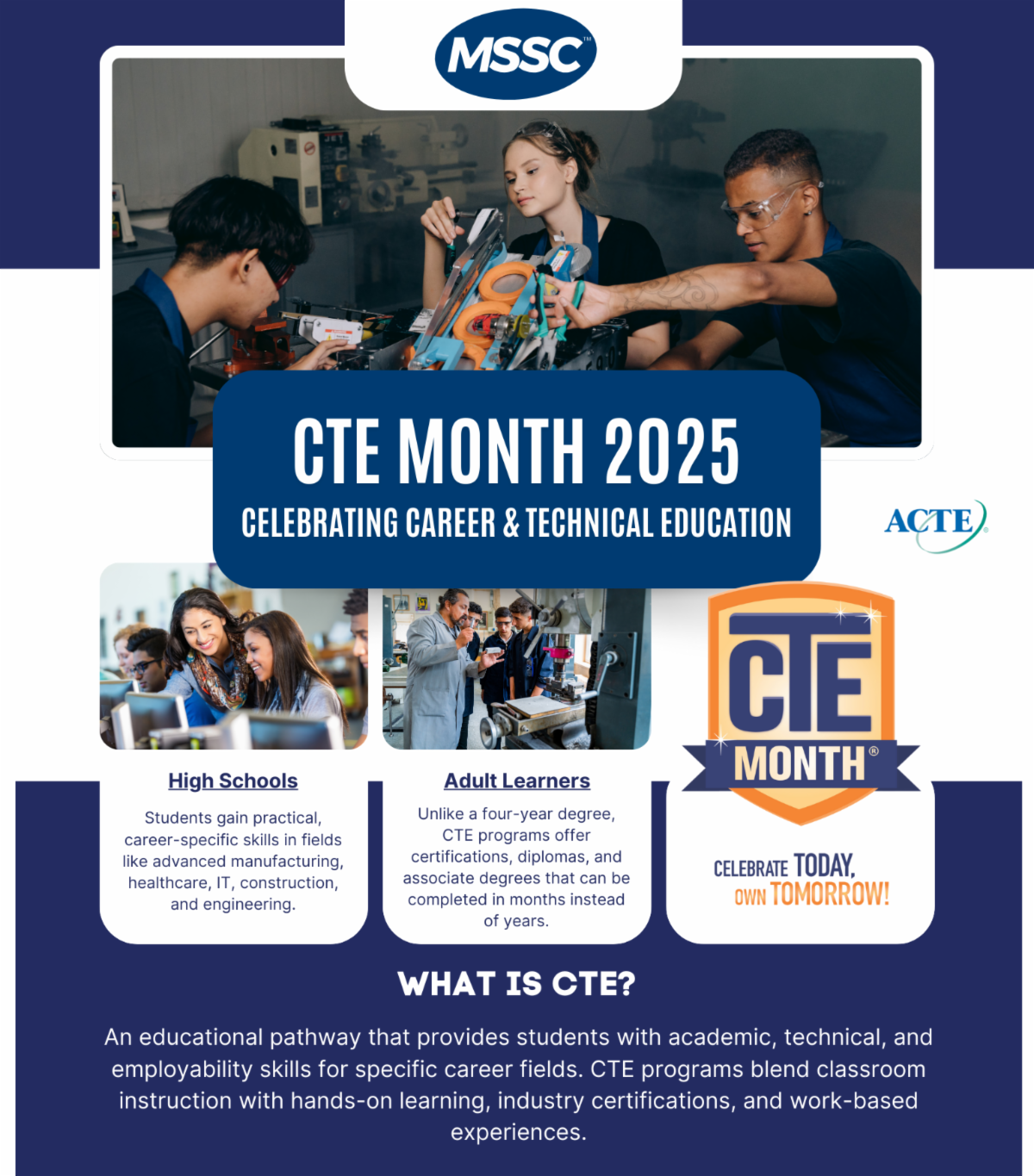
Celebrating CTE Month
With February being Career and Technical Education (CTE) Month, we at the Manufacturing Skill Standards Council recognize the critical role CTE plays in preparing students and workers for high-demand careers in advanced manufacturing, logistics, and beyond.
CTE is more than just education— it's a launchpad for success, equipping individuals with the technical skills, certifications, and hands-on experience needed to thrive in today's workforce.
This CTE Month and beyond, let's celebrate the educators, industry partners, and learners who are shaping the future of work. Together, we can build a stronger, skilled workforce for the modern economy.
| |
|
Earn, Share, and Connect: MSSC’s Credly Digital Badges
MSSC has partnered with Credly, the largest online network and delivery platform of digital badges. With electronic badges for all our credentials, certificants can directly access, control and share their verified credentials in both electronic and print format.
Benefits to Credly Badges:
- Match candidate’s skills to job opportunities with employers in their community or state. Search, access and apply to those relevant job postings pulled from specific employer sites and major job aggregator sites, i.e., Indeed, Monster, Careerbuilder, etc.
- Have direct access and control to share credentialed skills easily with employers through multiple delivery modes, i.e., e-mail, LinkedIn, Facebook, etc.
- Allow for employers to view candidate’s skills, competencies and knowledge earned with and verified by MSSC.
| |
|
Department of Education Announces OCTAE Nominee
The U.S. Department of Education has nominated Kevin O’Farrell as the next Assistant Secretary for Career and Technical Education. O’Farrell, currently serving as Chancellor for the Division of Career and Adult Education in Florida’s Department of Education, brings extensive experience in CTE and education policy.
The Office of Career and Technical Education (OCTAE) plays a critical leadership role in helping promote high-quality career and technical education (CTE) programs around the country and overseeing the implementation of key federal policies supporting these programs. More on the announcement here.
| |
|
Budget Reconciliation and FY25 Continue to Take Shape
Congressional Republicans continued internal deliberations and discussions regarding a forthcoming legislative package intended to address a number of President Trump’s priorities related to tax, energy, immigration, trade, and more. Republicans intend to advance this package via the Congressional budget reconciliation process, which allows certain policies to be passed by a simple majority, thus circumventing a likely Democratic filibuster in the Senate.
These discussions are still ongoing and could include a wide range of potential legislative proposals to offset some of the potential costs associated with this effort. Congressional appropriations leaders are also reportedly negotiating an agreement on new topline figures for the federal fiscal year 2025 (FY25) funding bill – a critical first step before lawmakers can negotiate a full-year FY25 package for individual programs like the Carl D. Perkins Career and Technical Education Act (Perkins V). As a reminder, current federal funding was recently extended through March 14, 2025, via a short-term extension of federal funding, known as a continuing resolution (CR).
| |
|
House Education & Workforce Committee Members
The House Education and Workforce Chair Tim Walberg announced new Republican subcommittee leaders and members as the committee continues to organize for the new 119th Congress. Five new Republican members are set to join the committee this Congress, including Reps. Robert Onder (R-MO), Ryan Mackenzie (R-PA), Michael Baumgartner (R-WA), Mark Harris (R-NC), and Mark Messmer (R-IN). Subcommittee assignments were also published and can be accessed here. Similarly, House Education and Workforce Committee Ranking Member Bobby Scott (D-VA) announced new subcommittee Democratic leadership and members. Reps. Greg Casar (D-TX), Summer Lee (D-PA), and John Mannion (D-NY) will join the committee this Congress. Following these announcements, the committee formally met for the first time this year to adopt a new rules package and outline some of the committee’s early agenda, including an oversight plan for the year. Notably, the plan includes a list of 21 major federal laws with lapsed authorizations, including WIOA. Access the hearing here.
| |
|
Education Department Appointees
The Administration has announced 10 new Education Department appointees, four of whom have previously worked with the America First Policy Institute, a think tank formed in 2021. Education secretary nominee Linda McMahon was a co-founder of AFPI and served as the group’s president and CEO until she was selected to head the department. The newest cohort of appointees includes:
- Rachel Oglesby, a former AFPI chief state action officer, as chief of staff.
- Jonathan Pidluzny, AFPI’s former director of higher education reform, as deputy chief of staff for policy and programs.
- Virginia “Chase” Forrester, former AFPI chief events officer, as deputy chief of staff for operations.
- Craig Trainor, a former congressional senior special counsel and AFPI senior litigation counsel, as deputy assistant secretary for policy in the Office for Civil Rights. (During his time at AFPI, Trainor worked under new Attorney General Pam Bondi.
- Steve Warzoha as White House liaison.
- Tom Wheeler as principal deputy general counsel.
- Madi Biedermann as deputy assistant secretary for the Office of Communications and Outreach.
- Candice Jackson, who served in the first Trump administration, as deputy general counsel.
- Joshua Kleinfeld as deputy general counsel.
- Hannah Ruth Earl as director of the Center for Faith-Based and Neighborhood Partnerships.
Until McMahon and Deputy Secretary–designate Penny Schwinn are confirmed by the Senate, a veteran agency official, Denise Carter, will serve as acting secretary.
| |
|
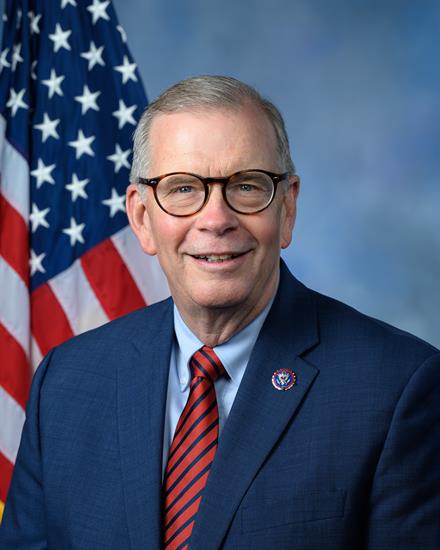
Thompson Introduces Skills Investment Act
Reps. Thompson, Bonamici, Fitzpatrick and Schneider introduced the bipartisan Skills Investment Act. The bill aims to expand tax-advantaged savings opportunities for learners pursuing CTE and workforce training programs through Coverdell education savings accounts (ESAs). Workers would be eligible to use Coverdell accounts to pay for skills training, apprenticeships and professional development. Information on the proposed legislation can be found here.
| |
|
National Landscape of Credit for Prior Learning
The American Council on Education released a report analyzing trends in state and system policy regarding credit for prior learning (CPL) and experiences attained outside of a formal college setting. CPL policies are critical as states and institutions consider how to accelerate credential completion to reduce gaps in educational attainment. Researchers tracked 362 CPL policies nationally and found that 49 states had policies on methods of assessment to test outside learning, 46 provided credit for military experience, and 42 required postsecondary institutions to establish a CPL policy. Policies evaluating the effectiveness of CPL were least common (20 states), followed by 30 states with policies on data tracking and 30 with cost/affordability policies. Based on these findings, the report outlines some next steps that policymakers in states should consider. This includes making data collection and reporting a priority; integrating CPL data into equity and workforce initiatives; and addressing the costs and fees often associated with CPL services, such as exams. Access the report.
| |
|
Projections of High School Graduates
The Western Interstate Commission for Higher Education published a report with extensive disaggregated projections of high school graduation rates in the United States. Analyses were done by race/ethnicity, region and urban/rural locality. Some of the most critical findings are:
- The total number of high school graduates is expected to peak in 2025, followed by a steady decline through 2041.
- The share of graduates who are from underrepresented racial and ethnic groups, particularly Hispanic and multiracial students, is expected to keep rising.
- By 2041, 38 states are projected to see a decline in the total number of graduates.
COVID-19 is also expected to remain impactful in the years that follow, with the researchers noting a decline in enrollment in earlier grades of schooling. These projections indicate that more work needs to be done by policymakers to address the needs of students who may face obstacles in pursuing their high school diploma, such as chronic absenteeism. View the report here.
| |
|
Future of Jobs Report 2025
The World Economic Forum recently published their Future of Jobs Report, a biannual report that examines evolving global technological, societal and economic trends to understand workforce opportunities and disruptions for the jobs of the future. This iteration of the report identifies trends expected in the future global workforce, including:
- 60% of employers expect expanding digital access to transform their business, with recent advancements being made in generative AI, robotics, and information processing expected to dramatically alter the workforce. Correspondingly, the need for AI and big data skills is expected to grow fastest, followed by networks and cybersecurity skills.
- The aging population is also expected to alter the workforce, paving the way for CTE and work-based learning programs to prepare young workers to meet shortages.
- Employers consider the biggest hurdle to business transformation to be the skills gap in workers, with 85% of employers intending to prioritize upskilling their workforce.
See more information here.
| |
|
Rethinking High School Graduation Requirements - A Strategic Imperative for State Policy Leaders
High school graduation requirements serve as both a signal of readiness and a lever for opening access and opportunity to social and economic mobility. This brief lays out principles for state policymakers to consider when revising their high school graduation requirements, examines the current landscape, lifts up trailblazing states, and offers considerations for supporting the shift from policy to implementation. Read more here.
| |
|
Hosted by the Southeastern Employment & Training Association
March 16-19, 2025
Myrtle Beach, SC
The Forum 2025
Hosted by the National Association of Workforce Boards
March 29-April 1, 2025
Washington, DC
Advance CTE Spring Meeting
Hosted by Advance CTE
April 23-25, 2025
MGM National Harbor, Oxon Hill, MD
National Skills Summit
Hosted by National Skills Coalition
May 5, 2025
Washington, DC
| | | |
Manufacturing Skill Standards Council (MSSC) Website
| |
| | | |