|
With much of the corn, soybean, and sunflower harvest nearing completion across southwest North Dakota, the 2025 harvest season is almost officially over. As fields empty, many growers start looking ahead and planning for the next cropping season. With tightening profit margins and fluctuating input costs, making cost-efficient fertility decisions can make a real difference to the bottom line.
At this time of year, soil fertility is a key topic as growers prepare and apply their fall fertilizers. The first step toward sound fertilizer management is soil sampling—it truly makes dollars and sense. However, the accuracy of your results depends on proper sampling techniques and sample handling. Soil samples contain active chemical and biological components that can change quickly when exposed to air or warm temperatures. For instance, nitrogen levels can drop rapidly if a moist soil sample is left at or above room temperature. If samples cannot be shipped immediately, air-dry or refrigerate them to preserve accuracy.
Another important reminder: with the closure of NDSU’s Soil Testing Lab, AGVISE Laboratories is currently the only lab in North Dakota equipped to process soil samples accurately. When submitting samples, make sure to select the Olsen method for phosphorus (P) analysis, as it is better suited for soils derived from calcitic (lime-rich) parent materials, which are common across North Dakota..
Once your soil test results are in, calculating fall nitrogen (N) fertilizer rates becomes easier. Remember, N fertilization decisions should be based on economics, not yield goals. NDSU’s Crop Nitrogen Calculator is a great tool to help identify the most economical rate for your operation.
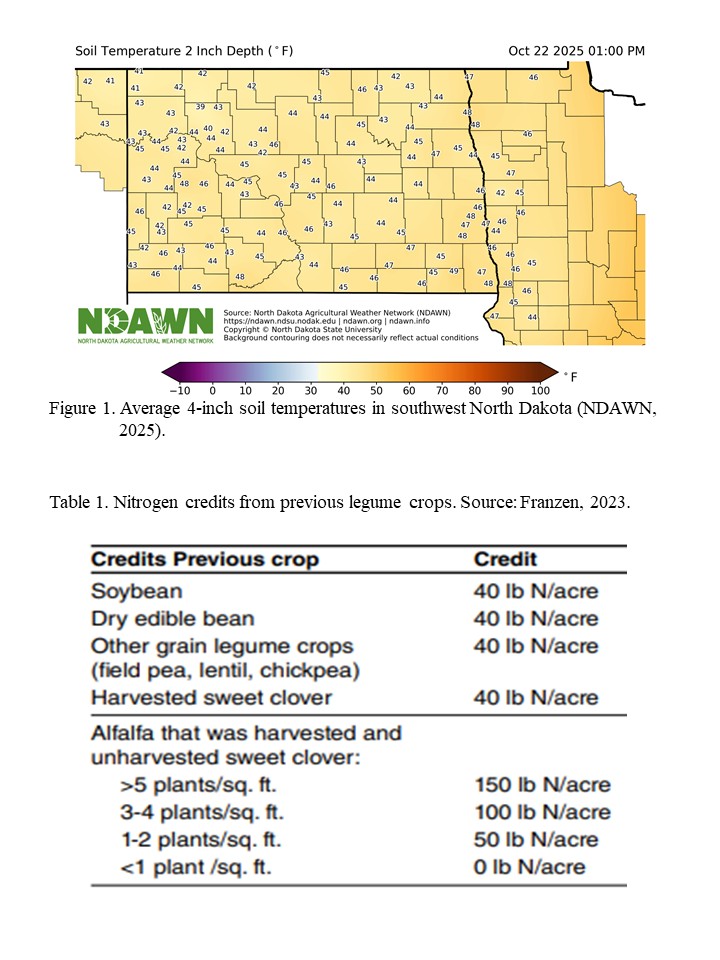
Before applying N fertilizer in the fall, check soil temperature. Wait until soil temperatures are 50°F or lower at the four-inch depth. As of last week, soil temperatures in southwest North Dakota have been averaging around 40°F (Figure 1), meaning conditions are now suitable for fall N applications. For surface-applied urea, wait about two weeks after soils drop below 50°F to reduce volatilization losses. If you don’t have a weather station on your farm, the NDAWN website is a great resource for local soil temperature data.
When planning nitrogen fertilization, don’t forget to account for nitrogen credits from previous legume crops. NDSU recommends a 40 lbs N/acre credit following legumes such as soybean, field pea, lentil, or edible bean. For perennial forages like alfalfa or sweet clover, credits vary depending on stand density (Table 1).
Finally, consider keeping crop stubble standing through the winter to capture more snow. This helps increase soil water storage and reduce erosion. Higher soil moisture levels improve nutrient mineralization and can support stronger early-season crop growth next spring.
|