Included in this issue of the newsletter:
- Message from Sasakawa USA's Chairman, Satohiro Akimoto
March Activities
- Japan-U.S. Military Program (JUMP): JUMP Annual Dinner
- US-Japan NEXT Alliance Initiative: Workshop on Strategies for Submarine Cable Networks in the Indo-Pacific
- Sasakawa USA Emerging Experts Delegation (SEED): SEED Discussion with Professor Hitoshi Oshitani
- Congressional Program on U.S.-Japan and Indo-Pacific (CPUSJ): Certificate Program in Partnership with the East-West Center for Washington
- Networking Series: Promoting Women's Contributions to U.S.-Japan Relations
- Washington Kenkyu Group: A Discussion with Mr. Takao Shimokawa
- Washington Kenkyu Group: A Discussion with Dr. Peter Watson
- US-Japan NEXT Alliance Initiative: Mr. James Schoff Visits Tokyo
Recaps
- Policy Briefing: The EU's Strategy for Indo-Pacific Engagement with Mr. George Cunningham
Publications
- Commentary & Analysis: Germany's Strategic Vision for the Indo-Pacific (Dr. Stanzel)
- Commentary & Analysis: Where Does Europe Fit in India's Indo-Pacific Policy? (Dr. Mohan)
- US-Japan NEXT Alliance Initiative: U.S.-Japan Focus on Scaling Up Open RAN Technology Can Support Secure 5G Globally (Ms. Tanaka-Makino)
External Engagements
- Mr. James Schoff Joins "The Future of U.S.-Japan Defense Collaboration & World Affairs Trade: Japan" by World Affairs Council of Philadelphia
- Mr. Naritada Miura Joins "U.S.-Japan Alliance Cooperation in the Post-Pandemic World" by Stimson Center
Announcements
- The Alliance Working in America Series (TAWA): TAWA in Alabama
- Japan-U.S. Military Program (JUMP): JUMP at Sakura Matsuri
Featured Fellow
|
|
Message from Sasakawa USA's Chairman, Satohiro Akimoto |
|
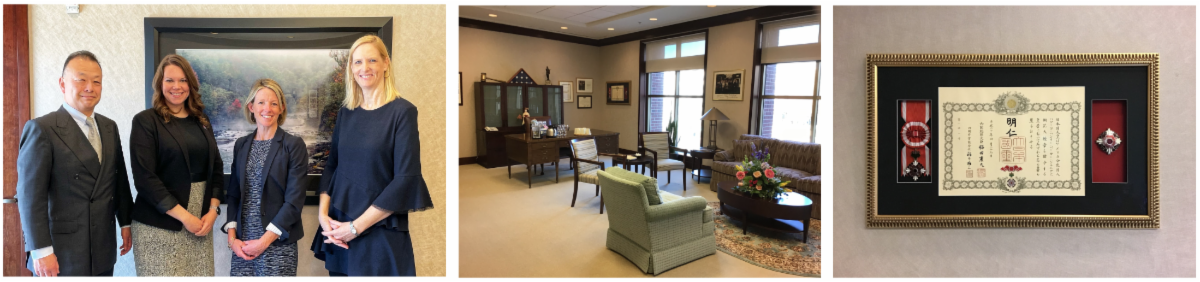
Left: Dr. Akimoto, Ms. Shoji, Dr. Wanamaker, and Dr. Wiegand
Middle: Amb. Baker’s Office in Howard H. Baker Jr. Center for Public Policy at Univ. of TN
Right: Grand Cordon of the Order of the Paulownia Flowers that Amb. Baker received in 2008 from the government of Japan
|
|
Ambassador Mike Mansfield, who served in Japan from 1977 to 1988, famously endorsed Ambassador Howard Baker’s appointment as Ambassador to Japan when he said, “Japan is getting two ambassadors for the price of one.” Ambassador Mansfield was referring to the powerful duo of Ambassador Baker and his wife, Senator Nancy Kassebaum, who at that time, was serving as a Senator representing the state of Kansas. She agreed to travel to Japan to be supportive of her husband. Together, they served in Tokyo from July 5, 2001 to February 17, 2005. Though Ambassador Baker was 75 when he began serving at the embassy in Tokyo, he proved to be energetic and a highly effective representative of the United States.
Senator Kassebaum liked to amuse Japanese people with some Japanese phrases, which she learned in Tokyo, and made many friends with her civility and charming personality. Ambassador Baker never really mastered Japanese language, except calling their dog Taishi (ambassador). He got to know Japanese of many walks of life through his professional-grade camera lens. The couple was very popular among Japanese, and Japan indeed got two ambassadors for the price of one. Ambassador Baker, who assumed important political positions, including Chief of Staff to President Ronald Reagan, played a major role in supporting the Bush-Koizumi friendship and strengthening the bilateral relationship following the 9-11 terrorist attacks. I was lucky enough to meet Ambassador Baker and Senator Kassebaum as a kabanmochi (bag holder) for Mr. Ben Makihara, Chairman of Mitsubishi Corporation, who was very friendly with the couple.
I visited Howard H. Baker Jr. Center for Public Policy at the University of Tennessee (UT) with Ms. Shanti Shoji, Director of Programs, on March 21. The Center’s mission is “to continue the legacy of Senator Baker by providing critical insights on domestic and international challenges through interdisciplinary research, experiential education, and policy engagement.” Dr. Marianne Wanamaker, Executive Director, and Dr. Krista Wiegand, Director of the Global Security Program at the Baker Center, made our visit very informative by making it possible for us to meet many professors who are in Japan-related fields, including Dr. Noriko J. Horiguchi, Associate Professor of Japanese Literature and Culture, and Chair of the Japanese Program. The meetings were made even more meaningful by being held in Ambassador Baker’s old office, which is housed in the Baker Center.
Ms. Shoji and I particularly enjoyed observing an intermediate Japanese language class taught by Ms. Mahagi LaCure, Senior Lecturer of Japanese and Director of Asian Studies Taped Language Program. For me, this reminded me of my fond memories teaching Japanese language classes at Harvard University as an instructor when I was a graduate student there from the late ‘80s to the early ‘90s. From what we observed in the class at UT, the general level of the class was high, with some students at an advanced level. Ms. Shoji, who speaks Japanese, had a conversation in Japanese with students in the class as well.
The state of Tennessee produced its second ambassador to Japan in Senator Bill Hagerty. He served as Ambassador in Japan from August 31, 2017 to July 22, 2019. There are over 190 Japanese companies which have their manufacturing and operating bases in Tennessee. The state of Tennessee seems to be ready to further develop its relationship with Japan, and Sasakawa Peace Foundation USA hopes to be part of the budding relationship. Finally, I would like to thank LtGen Lawrence “Larry” Nicholson, USMC (Ret.) for kindly facilitating initial contact with the Baker Center and for being a great host together with his lovely wife, Debbie-san, at their home.
|
|
Japan-U.S. Military Program (JUMP): JUMP Annual Dinner |
|
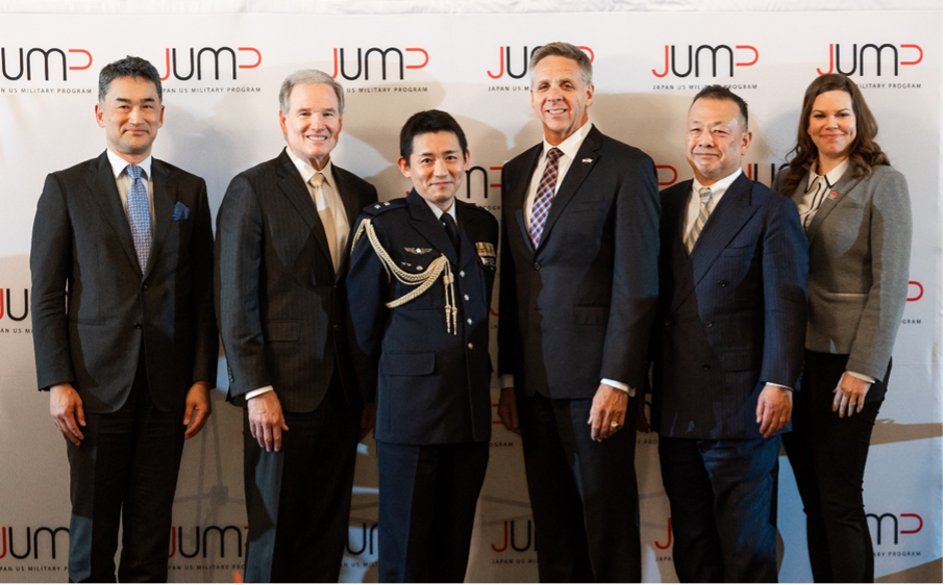
On March 10, Sasakawa USA hosted its 2022 JUMP Annual Dinner at the Army and Navy Club in Washington, D.C. The JUMP Annual Dinner focused on the future of the U.S.-Japan Alliance in facing new challenges in the Indo-Pacific. The evening featured a keynote address by Admiral Philip Davidson (USN, Ret.), 25th Commander of the U.S. Indo-Pacific Command. In addition, there were greetings from Ambassador Tamaki Tsukada, Deputy Chief of Mission of the Embassy of Japan; a toast and short remarks from Admiral Patrick Walsh (USN, Ret.), 59th Commander of the Pacific Fleet; and an introduction of the keynote speaker by Major General Hiroyuki Sugai (JASDF), Defense, Air, and Space Attaché of the Embassy of Japan. In attendance were senior active-duty and retired officers with an interest in the U.S.-Japan relationship. JUMP continues to serve as a national program to connect past and present service members, families, and government civilians who have served in Japan through social networks and grassroots events. JUMP is the only national program to do so, providing a powerful foundation for sustaining the alliance between the United States and Japan.
Photo: Amb. Tsukada, ADM Walsh, Maj Gen Sugai, ADM Davidson, Dr. Akimoto, and Ms. Shoji
|
|
US-Japan NEXT Alliance Initiative: Workshop on Strategies for Submarine Cable Networks in the Indo-Pacific |
|
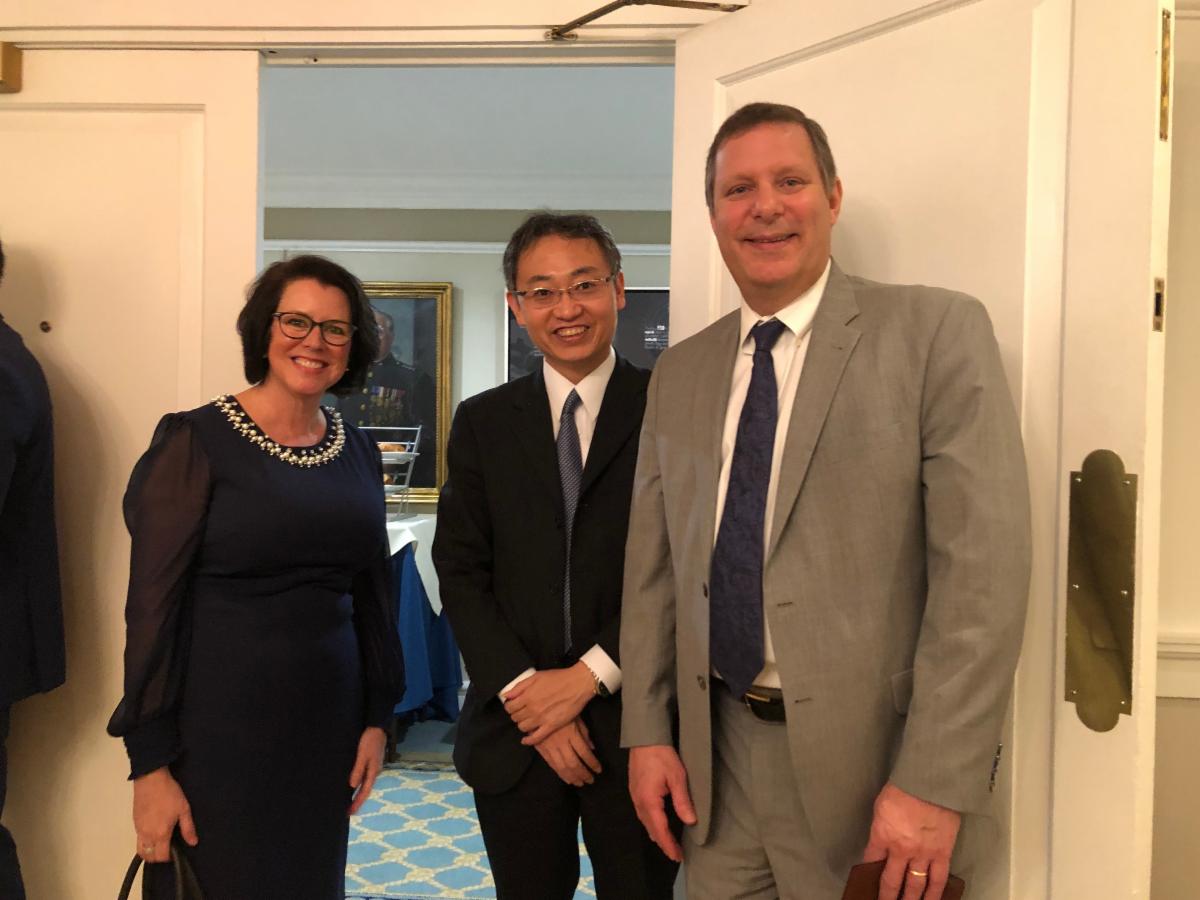
On March 11, the US-Japan NEXT Alliance Initiative convened a hybrid minilateral submarine cable strategy dialogue at the Army and Navy Club of Washington, D.C. Senior Director James Schoff hosted dozens of in-person and online participants from academia, the private sector, and officials from the Japanese, Australian, British, and American governments, including Mr. Yutaka Kitagami, Deputy Director-General for International Economic Affairs, Global Strategy Bureau, Ministry of Internal Affairs and Communications of Japan; and Ms. Laura Williams, Deputy Director, International Communications and Information Policy at the U.S. Department of State. The event addressed questions on risk mitigation for submarine cable networks, financing and development strategies for the Indo-Pacific region, and important emerging technologies. The dialogue was a collaborative effort organized by the Ministry of Internal Affairs and Communications of Japan, Keio University, and Sasakawa USA.
Photo: Ms. Williams, Mr. Kitagami, and Mr. Schoff
|
|
Sasakawa USA Emerging Experts Delegation (SEED): SEED Discussion with Professor Hitoshi Oshitani |
|
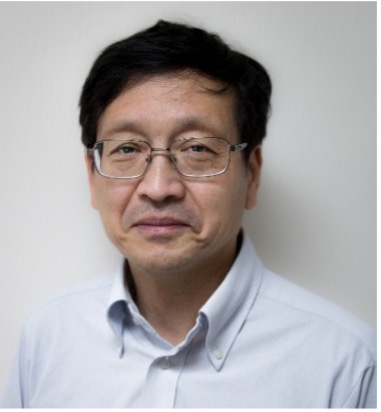
On March 15, Sasakawa USA hosted the fourth discussion for the current SEED cohort, featuring remarks by Professor Hitoshi Oshitani, Advisor to the Japanese Government and Professor of Virology at Tohoku University Graduate School of Medicine. In his off-the-record remarks, Prof. Oshitani discussed Japan’s overall COVID-19 response, approach to the situation with the Diamond Princess, and Japan’s ongoing decision-making process regarding COVID-19. The delegation will next meet with Mr. Yoshiyuki Sagara, Fellow at the Asia Pacific Initiative in April and will continue its monthly discussion sessions until traveling to Japan in the summer of 2022.
Photo: Prof. Oshitani
|
|
Congressional Program on U.S.-Japan and the Indo-Pacific (CPUSJ): Certificate Program in Partnership with the East-West Center for Washington |
|
The second annual CPUSJ completed its seventh and final session on March 3, 2022. Following this year’s CPUSJ program, eight congressional staffers received certificates of completion for their participation in the program. Sasakawa USA, in partnership with the East-West Center of Washington, hosted the virtual sessions to educate congressional staffers about the importance of the U.S.-Japan relationship and address opportunities for the two allies to work together in the Indo-Pacific. Sasakawa USA looks forward to continuing its relationship with this year’s impressive group of congressional staffers to maintain their interest in the U.S.-Japan alliance. Please visit the Sasakawa USA website for more details on this year’s program, including session topics and speakers. |
|
Networking Series: Promoting Women's Contributions to U.S.-Japan Relations |
|
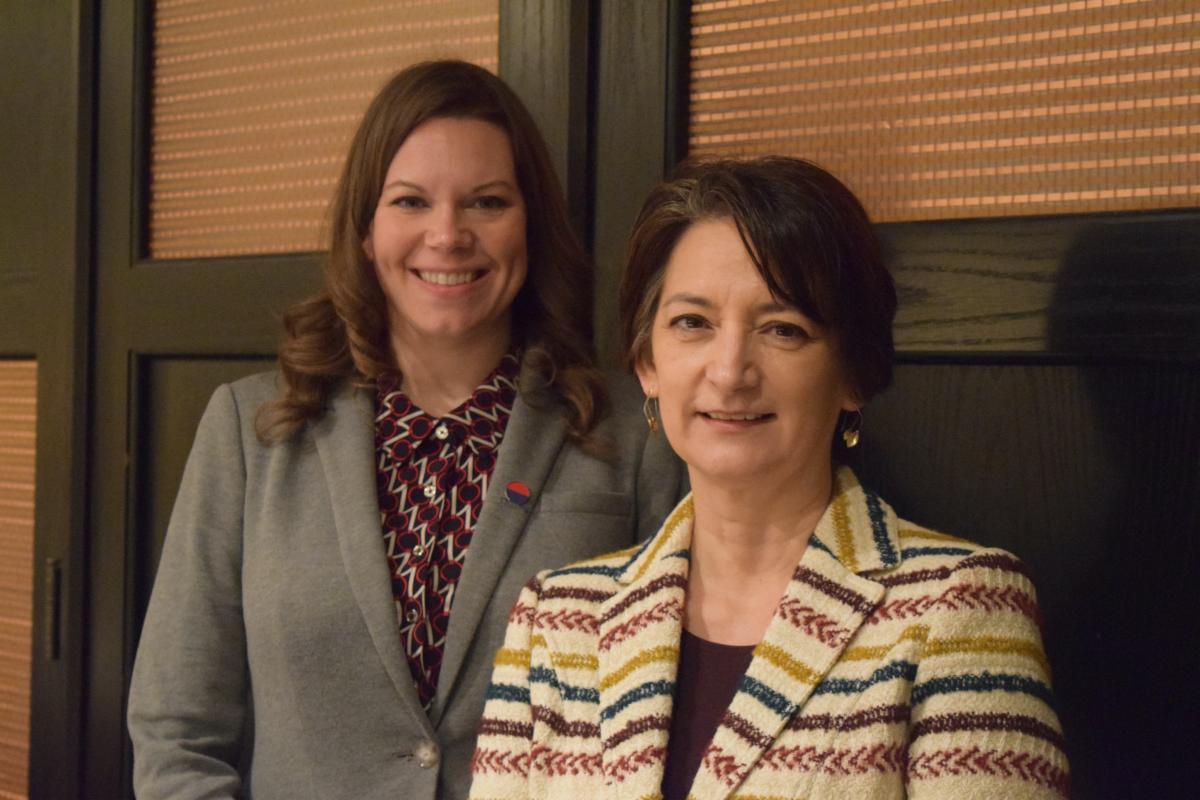
On March 23, Sasakawa USA hosted the in-person lunch dialogue “Promoting Women’s Contributions to U.S.-Japan Relations.” This event brought together women leaders from government, think tanks, media, the private sector, and grassroots diplomacy organizations for a discussion on promoting the work of women within the U.S.-Japan space, facilitating insights on how women leaders can better collaborate, connect, and support one another’s work. The event featured leading remarks by Dr. Mireya Solís, Philip Knight Chair in Japan Studies and Director of the Center for East Asia Policy Studies at Brookings Institution. The ensuing discussion amongst attendees was moderated by Ms. Shanti Shoji, Director of Programs of Sasakawa USA.
Photo: Ms. Shoji and Dr. Solís
|
|
Washington Kenkyu Group: A Discussion with Mr. Takao Shimokawa |
|
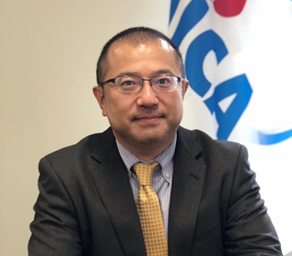
On March 1, Washington Kenkyu Group welcomed Mr. Takao Shimokawa, Chief Representative of the U.S. Office of the Japan International Cooperation Agency (JICA). JICA, as the centralized implementing agency for Japan's Official Development Assistance, plays a major role in building relationships between Japan and the international community through development cooperation with developing countries. Mr. Shimokawa shared JICA's liaison activities in Washington, D.C., and its wide-ranging efforts to address COVID-19 globally. His remarks were followed by an engaging Q&A discussion amongst the attendees, which included Japanese representatives from the private sector, think tanks, government, and media.
Photo: Mr. Shimokawa
|
|
Washington Kenkyu Group: A Discussion with Dr. Peter Watson |
|
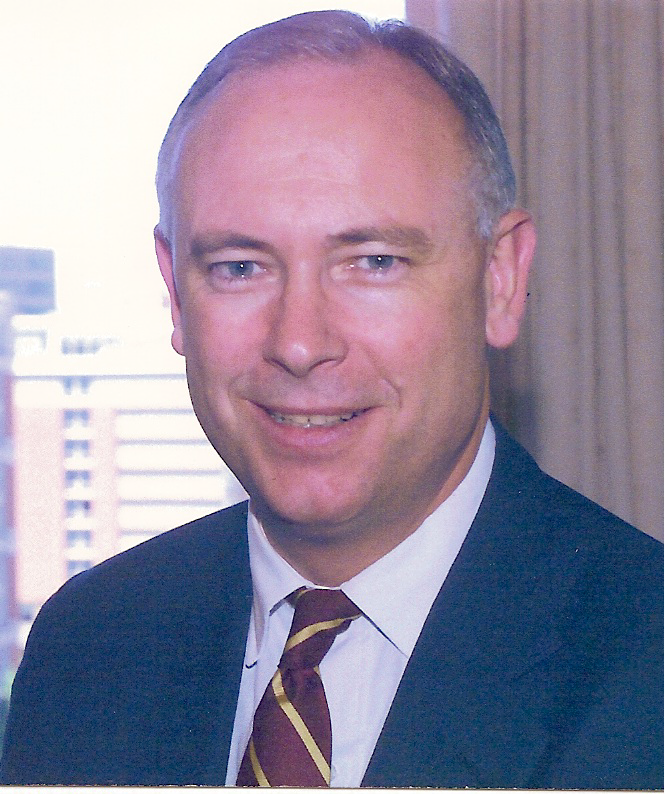
On March 17, Washington Kenkyu Group welcomed Dr. Peter Watson, former President and CEO of the U.S. Overseas Private Investment Corporation, now the Development Finance Corporation (DFC). For this virtual event, Dr. Watson provided his historical analysis of DFC, beginning with its origin from the 2018 BUILD Act up until the present. Dr. Watson closed his remarks with a review of likely future challenges to DFC. His remarks were followed by a lively Q&A discussion with attendees.
Photo: Dr. Watson
|
|
US-Japan NEXT Alliance Initiative: Mr. James Schoff Visit Tokyo |
|
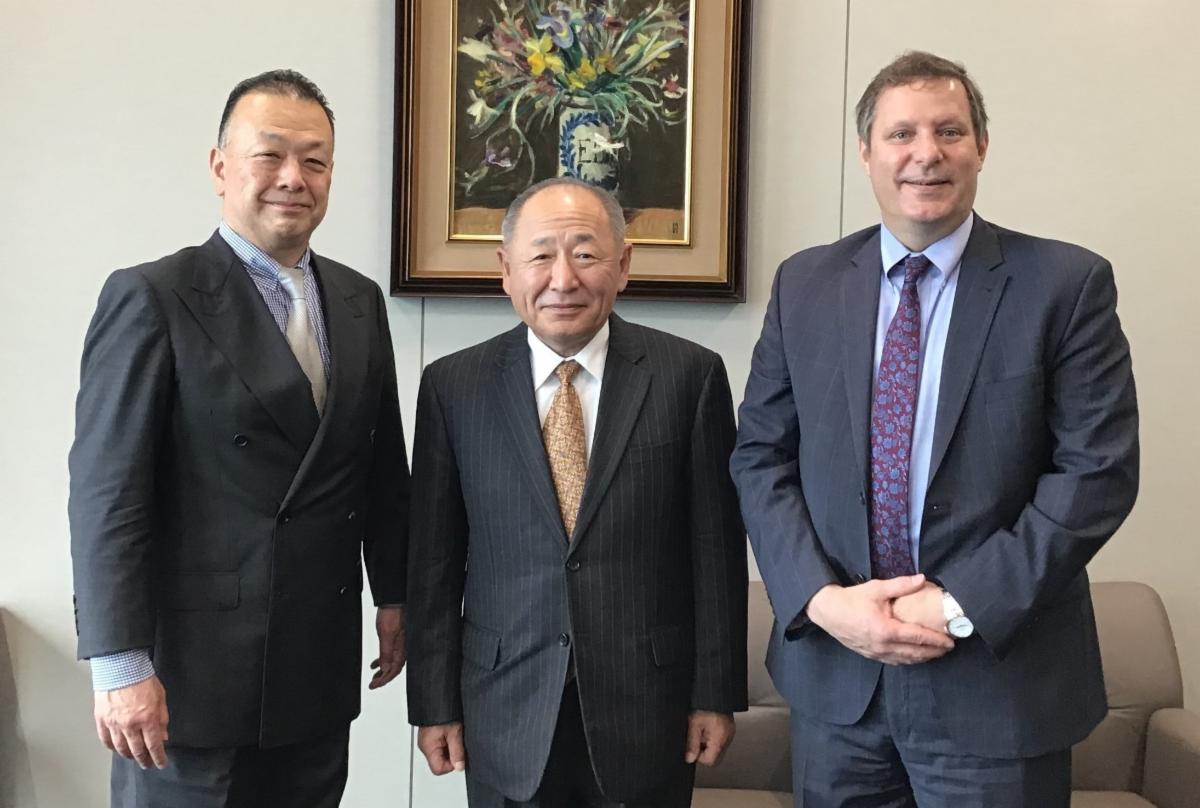
Sasakawa USA Senior Director Mr. James Schoff spent the last week of March in Tokyo introducing and discussing plans of the US-Japan NEXT Alliance Initiative to Japanese experts in national security and foreign policy. Mr. Schoff also had visits with leaders of Sasakawa Peace Foundation, Nippon Foundation, and Tokyo Foundation for Policy Research, including a meeting with Admiral Katsutoshi Kawano, Former 5th Chief of Staff, Joint Staff, who became a member of the board of Sasakawa USA last October. Mr. Schoff, together with Dr. Satohiro Akimoto, Chairman and President of Sasakawa USA, visited Admiral Kawano at his beautiful office at Mitsubishi Heavy Industries overlooking the Imperial Palace.
Photo: Dr. Akimoto, Adm. Kawano, and Mr. Schoff
|
|
Policy Briefing: The EU's Strategy for Indo-Pacific Engagement with Mr. George Cunningham |
|
On February 28, Sasakawa USA hosted the virtual Policy Briefing, “The EU’s Strategy for Indo-Pacific Engagement.” This briefing featured Mr. George Cunningham, Former Strategic Adviser at the Asia-Pacific Department of the European External Action Service, for a discussion on the EU’s strategy for cooperation in the Indo-Pacific which is outlined in his recent paper published on the Sasakawa USA website. He further touched upon the recent developments of the Ukrainian crisis and its potential impact on the EU’s strategy and the outcomes of the February 22, 2022 Ministerial Forum addressing specific challenges related to security and defense, digital connectivity, and global infrastructure development. The recap and video are available on the Sasakawa USA website. |
|
Commentary & Analysis: Germany's Strategic Vision for the Indo-Pacific (Dr. Stanzel) |
|
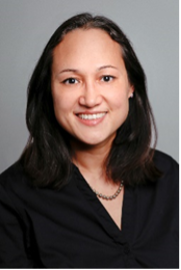
The third paper in the Commentary & Analysis series on Europe’s evolving strategic vision for the Indo-Pacific is “Germany’s Strategic Vision for the Indo-Pacific” by Dr. Angela Stanzel, an Associate in the Asia Research Division, at the German Institute for International and Security Affairs. Dr. Stanzel maintains that in order to move from vision to implementation of the German Indo-Pacific 2020 guidelines, Berlin needs to build upon its enhanced cooperation with Indo-Pacific countries and find a unified European approach to the region. Dr. Stanzel notes that Germany has strengthened relations with ASEAN, increased dialogue with Australia, and held 2+2 consultations with Japan. Dr. Stanzel also touches upon the next steps Germany could take to enhance coordination with the Indo-Pacific region through various fields including economy, security, climate change, and innovation. You can read Dr. Stanzel’s paper here.
Photo: Dr. Stanzel
|
|
Commentary & Analysis: "Where Does Europe Fit in India's Indo-Pacific Policy?" (Dr. Mohan) |
|
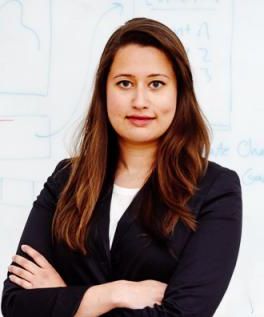
The fourth paper in the Commentary & Analysis series on Europe’s evolving strategic vision for the Indo-Pacific is “Where Does Europe Fit in India’s Indo-Pacific Policy?” by Dr. Garima Mohan, a Fellow in the Asia Program at the German Marshall Fund. Dr. Mohan examines the role European strategies envision for India, India’s reaction to the EU’s increased interest in the Indo-Pacific, and the reality of India-EU cooperation in the region. Dr. Mohan provides in-depth analysis of India’s important role in the EU’s Indo-Pacific strategy, and examines in what specific areas where India and the EU can strengthen ties including maritime security, infrastructure connectivity, and public health. You can read Dr. Mohan’s paper here.
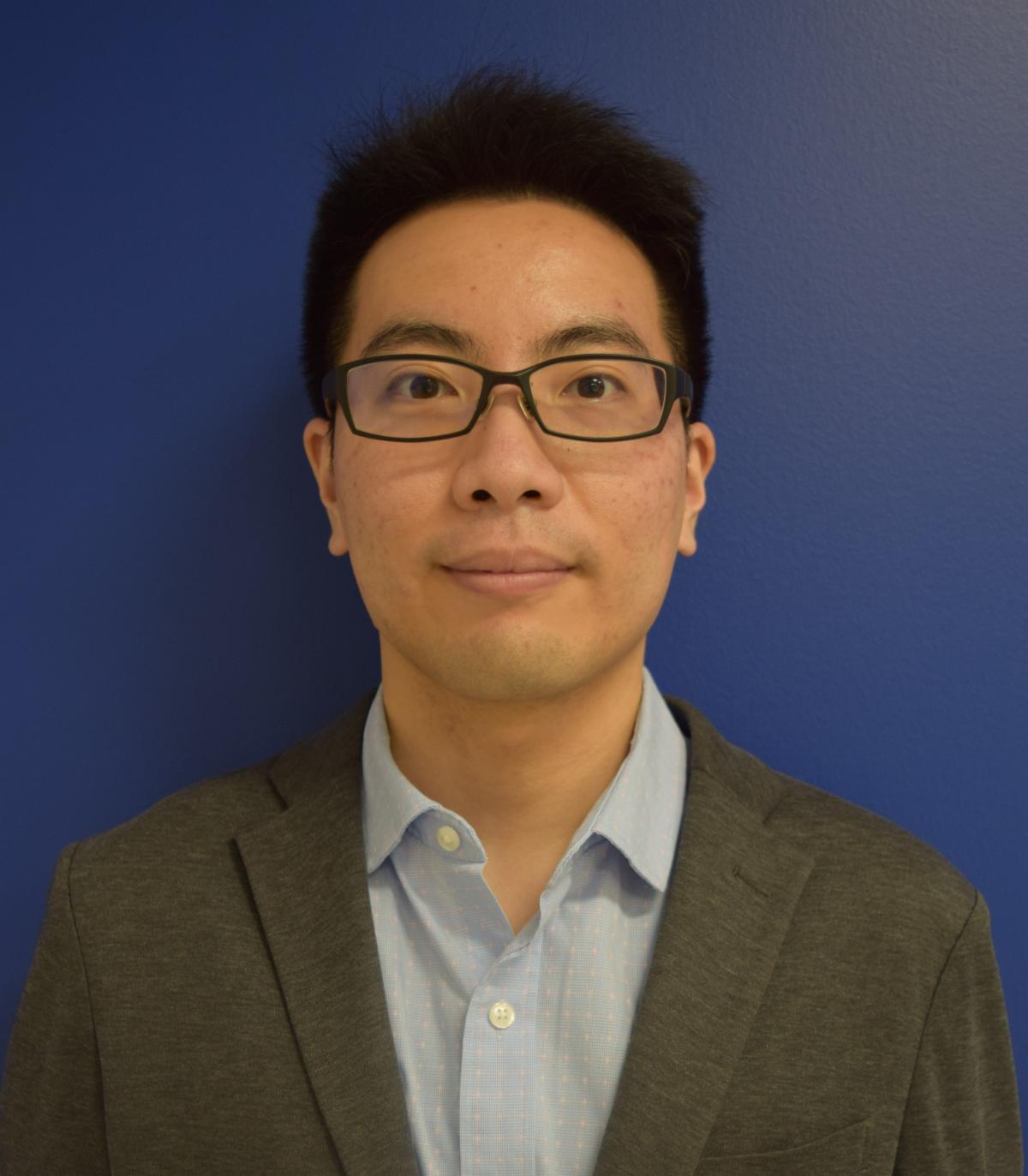
Photo: Dr. Mohan
|
|
US-Japan NEXT Alliance Initiative: U.S.-Japan Focus on Scaling Up Open RAN Technology Can Support Secure 5G Globally |
|
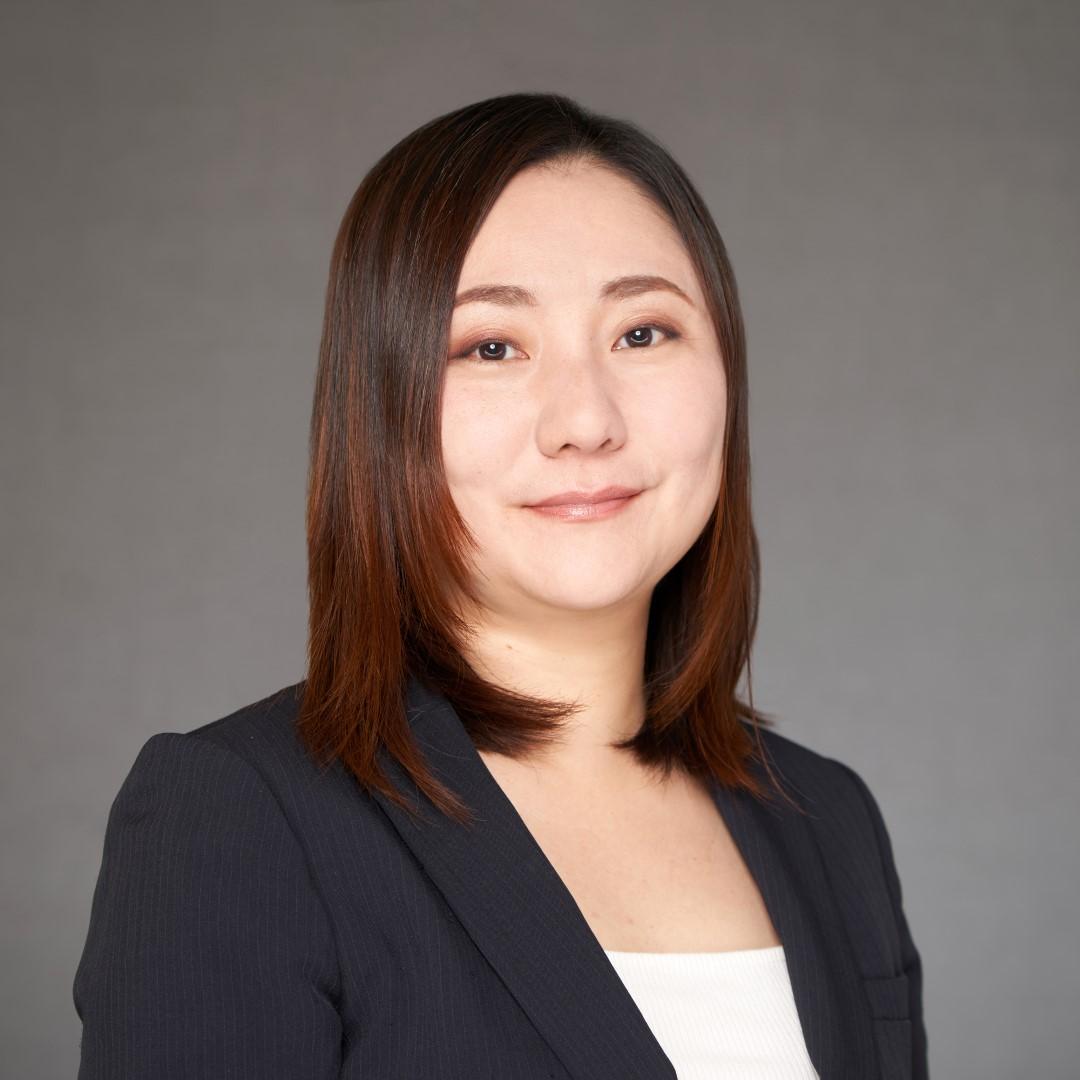
In her article, Ms. Tomoko Tanaka-Makino, a Visiting Research Fellow at the US-Japan Next Alliance Initiative, argues that the diplomatic efforts by the U.S. and Japanese governments to promote secure 5G networks through supporting Open Radio Access Network (RAN) technology should be combined with the activity to accelerate the maturity and scalability of the technology. Continued government funding and collaborative verification efforts are the keys to that end. Ms. Tanaka-Makino also points out the opportunity for the U.S. and Japanese governments to support the entire Open RAN ecosystem collectively where operators and vendors of both countries are closely interconnected. In addition, the efforts to collaborative finance by development finance institutions for digital infrastructure should be pursued through strengthening inter-agency coordination and identifying high-priority projects among stakeholders. You can read the article here.
Photo: Ms. Tanaka-Makino
|
|
Mr. James Schoff Joins "The Future of U.S.-Japan Defense Collaboration & World Affairs Table: Japan" by World Affairs Council of Philadelphia |
|
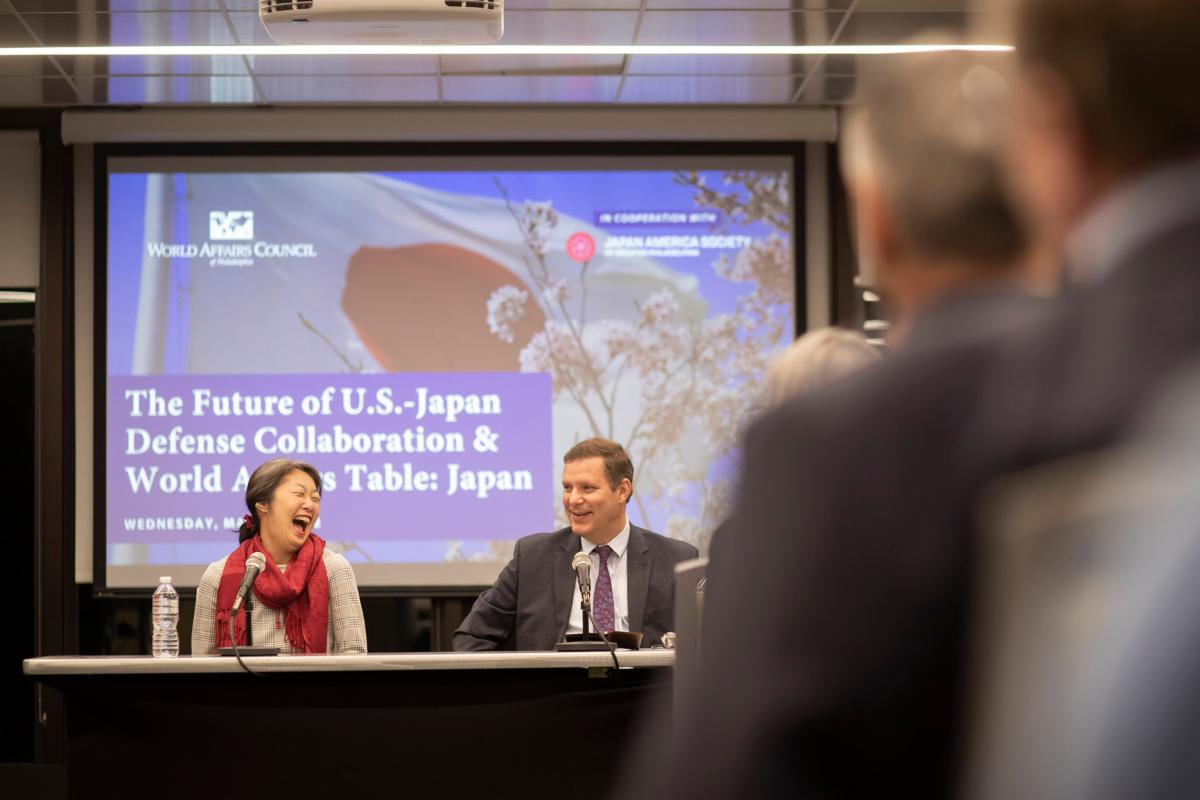
On March 2, Senior Director James Schoff spoke at “The Future of U.S.-Japan Defense Collaboration & World Affairs Table: Japan,” hosted by the World Affairs Council of Philadelphia. The event focused on the current state and future direction of the U.S.-Japan alliance. It was attended by about 70 guests and featured Ms. Yuki Tatsumi, Senior Fellow and Co-Director of the East Asia Program at the Stimson Center. Mr. Schoff described how the soon-to-be-released U.S. national defense strategy might fit well with Japan’s own planned defense strategy revisions this year, especially if a more integrated form of offense-defense security cooperation can be achieved. He also emphasized the need for frequent and open communication between Tokyo and Washington, D.C., so that any expansion of alliance cooperation is both operationally meaningful and politically sustainable. Consequently, he stated the point of strengthening allied deterrence after all, is to reduce chance of conflict or military coercion by China or North Korea.
|
|
Mr. Naritada Miura Joins "U.S.-Japan Alliance Cooperation in the Post-Pandemic World" by Stimson Center |
|
On March 7, Sasakawa USA Program Assistant Naritada Miura spoke at Stimson Center’s virtual event, “U.S.-Japan Alliance Cooperation in the Post-Pandemic World.” This publication launch event focused on strengthening the U.S.-Japan alliance and cooperation post pandemic. Mr. Miura discussed current challenges to technology cooperation between the two nations and provided policy recommendations for Japan in achieving greater cooperation, not only with the United States, but also with its partners in the Indo-Pacific region. You can view the webinar here.
Photo: Mr. Miura
|
|
The Alliance Working in America Series (TAWA): TAWA in Alabama |
|
The next installment of the TAWA series will be held in partnership with Global Ties Alabama on April 26 in Huntsville, AL. The TAWA-AL program will highlight the economic relationship between Japan and Alabama as well as the broader U.S.-Japan alliance and the importance of its economic impact throughout the U.S., but particularly in the Yellowhammer State. Panelists will include Ms. Emma Chanlett-Avery, Specialist in Asian Affairs at Congressional Research Service; The Hon. Paul Finley, Mayor of Madison, AL; Mr. Kenji Kunimoto, Treasurer of Toyota Motor Manufacturing of Alabama; and Mr. Mark Brazeal, Vice President of Administration of Mazda Toyota Manufacturing USA, Inc. Ms. Shanti Shoji, Director of Programs of Sasakawa USA, will moderate the discussion. |
|
Japan-U.S. Military Program (JUMP): JUMP at Sakura Matsuri |
|
On April 9 and 10, Sasakawa USA in collaboration with the Embassy of Japan, Defense Section will have a JUMP booth at the 60th Sakura Matsuri in Washington, D.C. The JUMP exhibit will provide festivalgoers an understanding of the footprint of the U.S. forces in Japan and the impact of U.S.-Japan military and security cooperation on regional security in the Indo-Pacific. Hands-on activities will for example showcase the number of U.S. bases in Japan, U.S. personnel, and their families. In addition, these activities will demonstrate the role of host nation support by Japan and the importance of the forward deployed presence to the United States and regional security partners. |
|
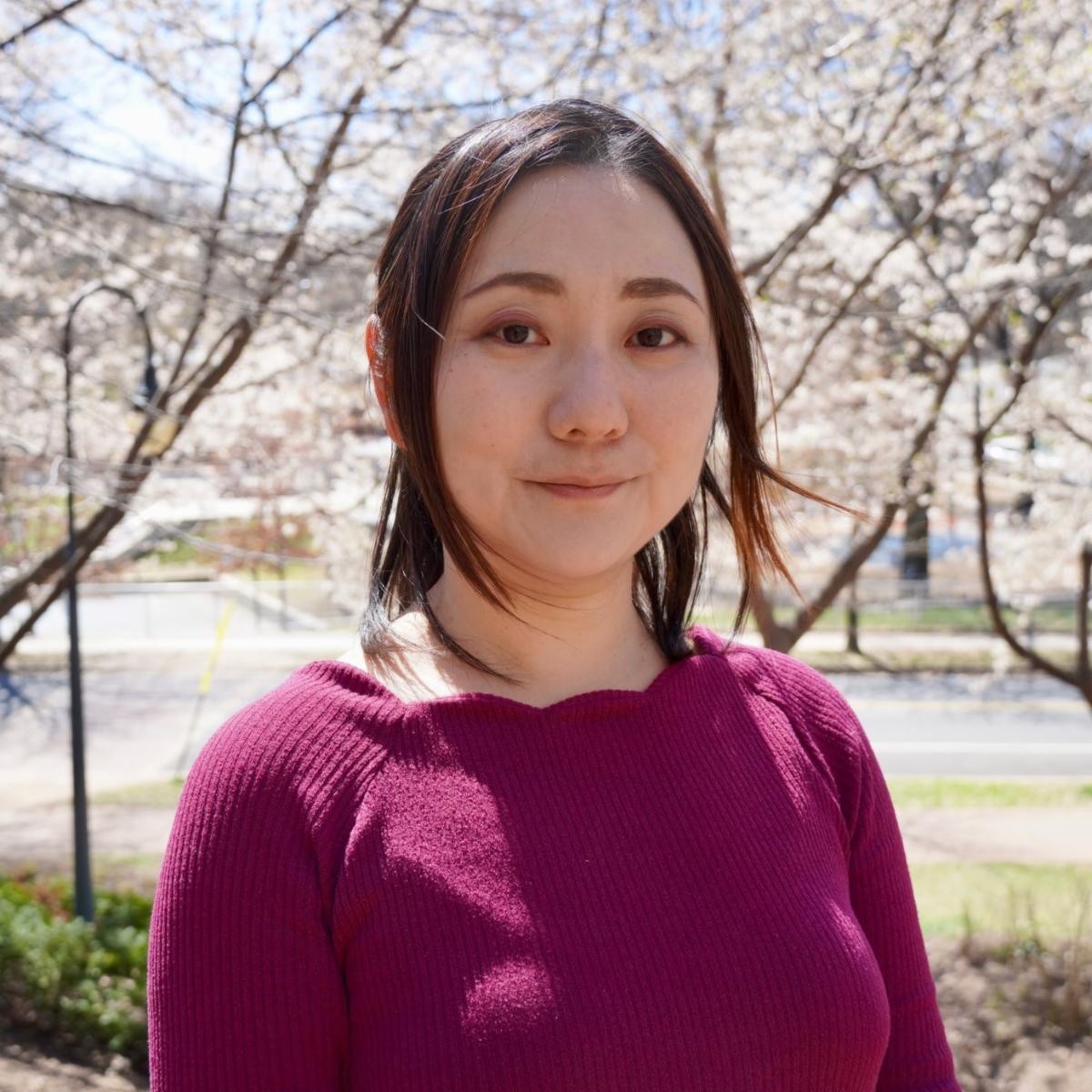
Hello everyone, I am Tomoko Tanaka-Makino, a Visiting Research Fellow for the US-Japan NEXT Alliance Initiative at Sasakawa USA, and cannot believe that I am about to complete my five-month fellowship.
I am originally a government official from Japan's Ministry of Internal Affairs and Communications, where I was involved in policymaking in the telecommunications sector, including consumer protection and cybersecurity. Last year, when I decided to come to Washington, D.C. with my family, I wanted to take advantage of this opportunity to study U.S.-Japan collaboration in the telecommunication field from a position outside of government. I was fortunately accepted at Sasakawa USA as a fellow.
In my time at Sasakawa USA, I have conducted personal research on U.S.-Japan collaboration on the global deployment of secure 5G networks and was given the opportunity to write a paper based on my research and stakeholder interviews. Also, as a member of the US-Japan NEXT Alliance Initiative team, I had the chance to conduct background research on central bank digital currencies and Japan’s DX policy, as well as participate in roundtables with top-level experts on high-tech alliances. These experiences greatly broadened my perspective on current important topics the United States and Japan are facing and deepened my understanding of the crucial role of U.S. think tanks in agilely aggregating the insights of experts from government, industry, and academia to make compelling policy recommendations.
In addition, I gained a great deal of inspiration from my talented and friendly colleagues. I will never forget the pleasant lunchtime conversations with them, where they shared their passion for U.S.-Japan relations, their dedicated work on various programs, and a taste of “real” American culture (how Americans enjoy seasonal events, etc.).
When I go back to work for the Japanese government, I hope to leverage my experience at Sasakawa USA for strategic policymaking, taking into account the importance of allied U.S.-Japan cooperation. I would like to express my sincere gratitude to all Sasakawa USA members, especially to Chairman and President Dr. Satohiro Akimoto and my supervisor Mr. James Schoff, for giving me this precious opportunity.
Photo: Ms. Tanaka-Makino
|
|
Sasakawa Peace Foundation USA
1819 L Street, NW
Suite 300
Washington DC 20036
202.296.6694
|
|
|
|
|
|
|