The RNA Transcript, November 29, 2021 |
|
We wish you a
Happy Hanukkah!
|
|
A new publication in PNAS:
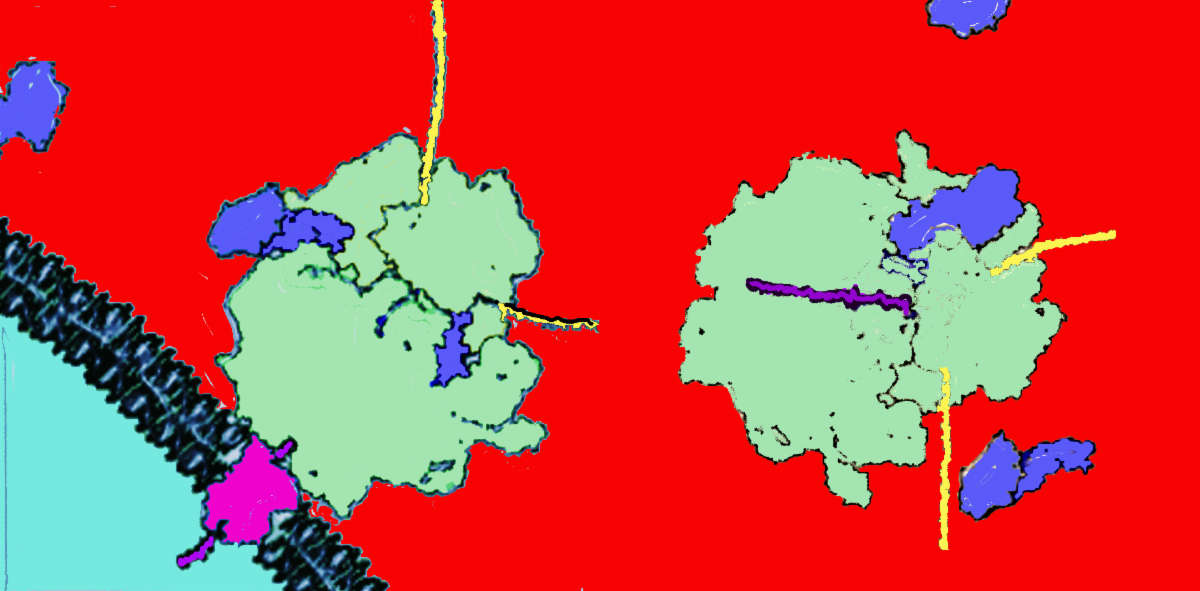
Exploring the mechanisms involved in sleep-dependent memory storage, a team of University of Michigan (U-M) cellular biologists found that RNAs associated with an understudied cell compartment in hippocampal neurons vary greatly between sleeping and sleep-deprived mice after learning.
Sara Aton, Ph.D., Associate Professor in the Department of Molecular, Cellular, and Developmental Biology, and Executive Committee member of the Center for RNA Biomedicine, and James Delorme, Ph.D., a recent U-M neuroscience graduate student, hypothesized that both a learning event and subsequent sleep (or sleep loss) would impact mRNA translation. Most prior work on the effects of sleep on mRNAs have focused on transcripts in the neuronal cytosol. However, Drs. Aton and Delorme found that after learning, major changes in RNAs are instead present —almost exclusively— on ribosomes associated with neuronal cell membranes. These results have been published in the Proceedings of the National Academy of Sciences, in November ? 2021.
Paper cited:
"Hippocampal neurons' cytosolic and membrane-bound ribosomal transcript profiles are differentially regulated by learning and subsequent sleep," James Delorme, Lijing Wang, Varna Kodoth, Yifan Wang, Jingqun Ma, Sha Jiang, Sara J. Aton, Proceedings of the National Academy of Sciences, November 30, 2021, https://doi.org/10.1073/pnas.2108534118
|
|
In this representation, the red background is the cytosol, and ribosomes are in light green. tRNAs are the purplish blue blobs. Some tRNAs are in the cytosol and others are bound to the green ribosomes. The mRNAs are represented in yellow. The thin purple strand coming out the other side of the ribosomes (and into the ER lumen) is the protein. The big thick black lines in the bottom left corner represents the lipid bilayer of the ER membrane. (Image credit: Sara Aton) |
|
Congratulations to Chase Weidmann, Ph.D., for receiving a K22 grant from NCI for “Unraveling the MALAT1 lncRNA-protein interaction networks that drive lung cancer metastasis”
This project’s goal is to integrate cutting-edge sequencing and quantitative proteomics technologies with cell-based functional approaches to understand how RNA-protein interaction networks of MALAT1 promote metastatic activity in human lung cancers.
Chase Weidmann is our second RNA Faculty Scholar hire and is an Assistant Professor in the department of Biological Chemistry at the Medical School.
Read about Weidmann’s journey into science: “Exploring unknown territories”
Read his scientific feature
Watch his introduction video
|
|
Congratulations to Amanda Garner, Ph.D., for receiving the ACS Division of Medicinal Chemistry 2022 David W. Robertson Award for Excellence in Medicinal Chemistry!
The David W. Robertson Award for Excellence in Medicinal Chemistry, awarded in even-numbered years, is intended to recognize seminal contributions by young scientists to medicinal chemistry. The nominee must have had a primary role in the discovery of a novel therapeutic agent(s), target(s), theoretical concept(s) in medicinal chemistry or drug discovery, and/or made a significant scientific discovery that enhances the field of medicinal chemistry.
|
|
18 U-M scientists and scholars present their research on three RNA therapeutics areas: mRNA vaccines, ASOs, and CRISPR. The second half of the magazine highlights the main activities of the Center for the July 2020–June 2021 period.
Special thanks to all our contributors!
|
|
Tuesday, November 30, 3:00 pm ET, Zoom | Harvard Medical School
“Nucleic Acid-based Virus-like Particles for Vaccine & Gene Therapeutic Applications”
Massachusetts Institute of Technology
|
|
Wednesday, December 1, 3:00 pm ET, Zoom information | University of Michigan, Molecular, Cellular and Developmental Biology, Dissertation Defense
"Post-transcriptional and Post-translational Mechanisms of Autophagy Regulation"
|
|
“Consequences of RNA-binding protein mutations in cancer”
"IMP-licating RNA binding proteins in intestinal tissue regeneration"
|
|
Wednesday, December 1, 4:00 pm ET, BSRB - Kahn Auditorium | University of Michigan, Pharmaceutical Sciences Seminar, 26th John G. Wagner Lecture
“Nucleoside-modified mRNA-LNP therapeutics”
|
|
Wednesday, December 1, 4:00–5:00 pm ET, Forum Hall, 4th Floor of Palmer Commons and Zoom | University of Michigan, DCMB / CCMB Hybrid Seminar
"Nonparametric Interrogation of Transcriptional Regulation in Single-Cell RNA and Chromatin Accessibility Multiomic Data"
Yuchao Jiang, Ph.D., Assistant Professor, Departments of Biostatistics and Genetics at University of North Carolina
|
|
Thursday, December 2, 1:00–2:00 pm ET | University of Michigan, Advanced Genomics Core
"Solving Genomic Needle-In-A-Haystack Challenges"
Jesse Salk, M.D., Ph.D., CEO, Founder @TwinStrand Biosciences
Join the University of Michigan BRCF Advanced Genomics Core and TwinStrand Biosciences for this webinar on how duplex sequencing technology provides a greater than 10,000 fold increase in accuracy over standard next-generation sequencing by virtually eliminating background noise and revealing true mutations. We will provide an overview of the technology and some of the applications where it is being used in medicine and life sciences to help improve human health and cure diseases such as:
- Early detection and residual disease monitoring in cancer
- Tumor evolution monitoring
- Immunotherapy monitoring
- Mutagenesis detection
|
|
Friday, December 3, 11:00 am ET, Taubman Library, Conference Room 6000 | University of Michigan Departments of Neurology and Human Genetics
“Tissue-specific alternative splicing separates the old from the new in a human tRNA synthetase”
Max Baymiller, Post-Doc candidate, University of Illinois
|
|
For press releases and blog articles about your upcoming top journal publications, please
|
|
Our members' publications are available through Altmetric. Sept queries are currently available: CRISPR, microRNA, molecule, RNA, RNA therapeutics, transcriptome, and translation. Please make sure to have at least one of these keywords in your title. Below is a recent highlight.
|
|
Extracellular Vesicles in Serum and Central Nervous System Tissues Contain microRNA Signatures in Sporadic Amyotrophic Lateral Sclerosis, Ting-wen Lo, Claudia Figueroa-Romero, Junguk Hur, Crystal Pacut, Evan Stoll, Calvin Spring, Rose Lewis, Athul Nair, Stephen A. Goutman, Stacey A. Sakowski, Sunitha Nagrath and Eva L. Feldman, Front. Mol. Neurosci., 29 October 2021, https://doi.org/10.3389/fnmol.2021.739016
Introduction
... Results from the current study provide a foundation for leveraging miRNA cargo from circulating EVs as a reflection of pathological EV signatures in ALS CNS tissue, generating new insight into possible pathogenic factors and untapped diagnostic opportunities.
|
|
To share your news
and comments, please
|
|
|
|
|
|
|
|