e-Newsletter | August 27, 2021 |
|
Insults Fly in the Newbury Meetinghouse
In the August 20, 2021, newsletter, the Museum of Old Newbury welcomed a new object to the collection, an important 18th century flagon given to commemorate the admission of Moses Gerrish, John Greenleaf, Makepeace Horton and Jeremiah Pierson into full communion at the fledgling Third Church of Newbury.
Though there are two Moses Gerrishes who were adults, or nearly so, at the time of the gift of the flagon, the most likely candidate is the grandson of English settler William Gerrish, born five years after his grandfather’s death, in 1692. He was in his mid-thirties when admitted to full communion, recently widowed and remarried, with five living children and a baby daughter, Lydia, who died in infancy just six months earlier. Three more children would be born in the next seven years.
|
|
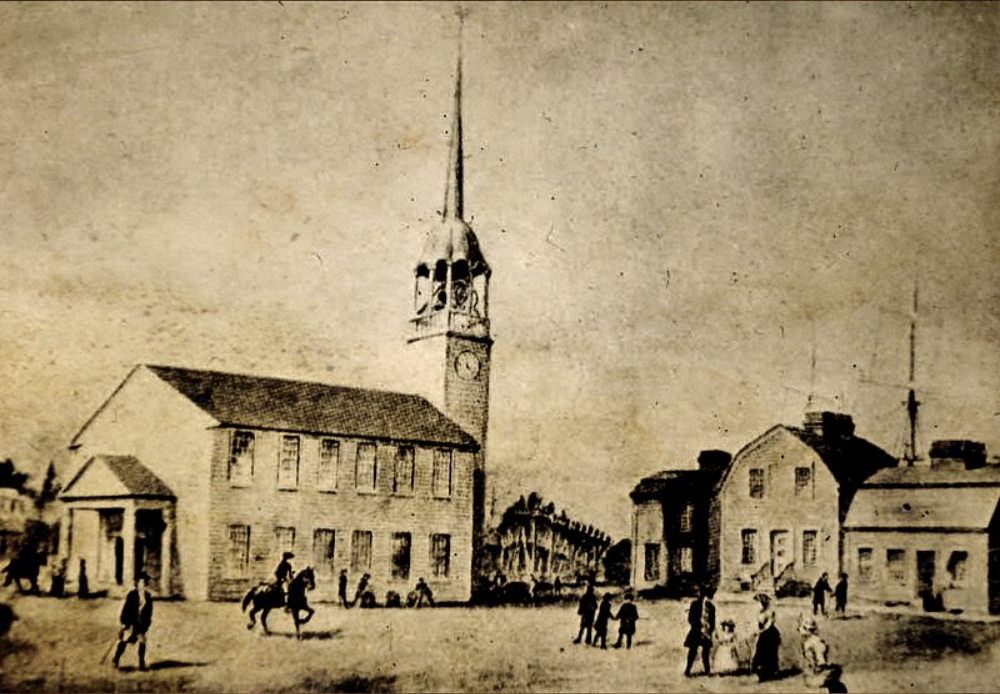
Third Parish Meeting House, Market Square. (Image from "The History of Newburyport, Mass., 1764-1905" by John J. Currier.) |
|
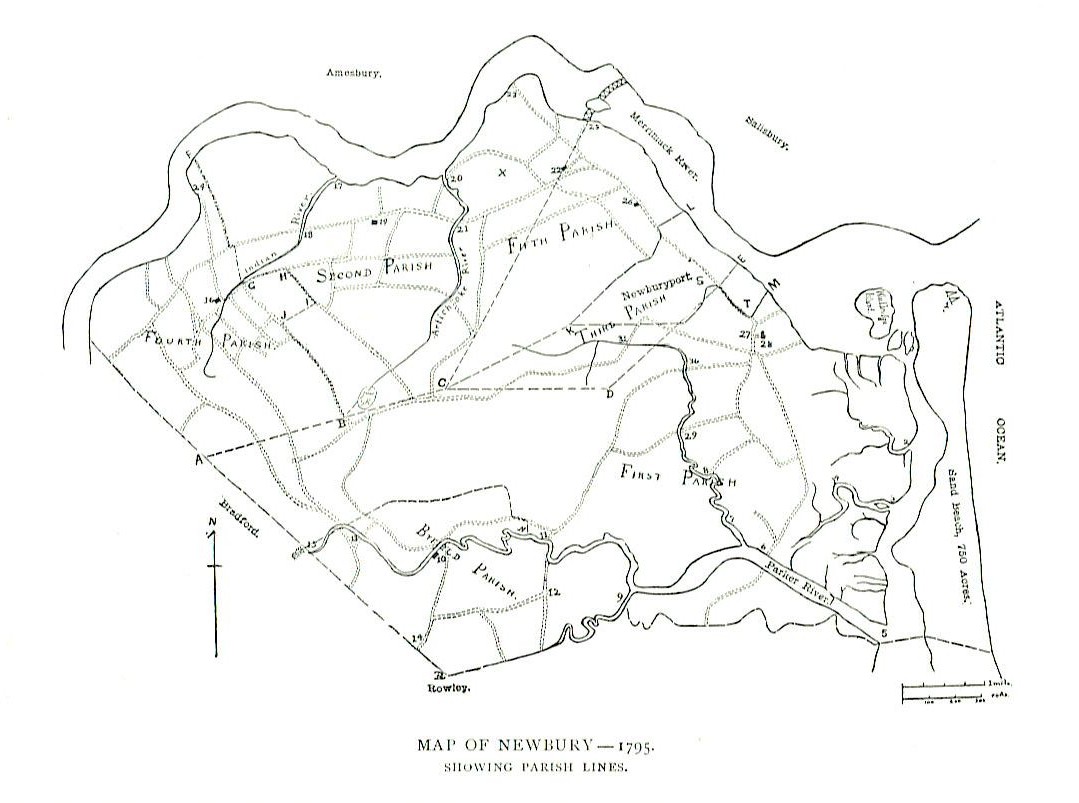
The parish church that received the Gerrish family began to separate from the original church in 1722. The population near the Newbury waterside had grown so large that they petitioned for, and were granted, permission to form a new parish, the third in Newbury. If there was a serious fracas about this separation, it is absent from the record, and the first parish gave their permission without argument, on September 17.
The new meeting house was built directly at the heart of the bustling waterfront, in the center of Market Square. By 1726, the church had signed their covenant, hired a minister and fixed the boundaries of their new parish. Considering the agony that had attended the birth of the second parish, near Sawyer Hill, the third went off without a hitch. It is likely that since so many of the wealthy and influential members of the first parish left to join the third, there was not much will to fight their departure. A decade after their split, the meeting house was enlarged and measured a massive eighty by sixty feet, with two galleries, and the first parish congregation voted to give them their old bell, which the third parish accepted and began immediately looking for a bigger one. The first, second and third parish churches also decided to come together in a new way.
|
|
Map detailing locations of all parishes, circa 1795. (Courtesy image.) |
|
In 1727, representatives from each parish formed the first council of churches “to meet once a month and consider what may be for the good of the town in general, especially the churches in it and more particularly their own church.”
The cooperative founding of the new church was a far cry from the scene in the meetinghouse in Newbury in 1669, in which Moses Gerrish’s grandfather William features prominently in what the kids these days would call, a “sick burn.”
John Woodbridge, who had moved from Newbury to Andover to England and back again, came to Newbury in 1663 to assist his uncle, Newbury minister Thomas Parker for half a year’s pay. The following year, when the time came to renew his contract, Woodbridge was offered sixty pounds, and his uncle’s salary was reduced from eighty to sixty pounds. This arrangement lasted for one year and was perceived by supporters of Rev. Parker as an insult. He had, after all, been the founder of the church in Newbury, and its faithful minister for thirty years, and Woodbridge had upset the delicate balance that existed between Parker and his parishioners.
In 1665, the town voted to raise Rev. Parker’s salary to eighty pounds once again and keep Woodbridge at sixty. Immediately, a motion was made to contest Woodbridge’s salary, and when it was again put to a vote, the town returned four votes in the affirmative, and thirty-one blank. Woodbridge got his money in 1665, despite protest, but every year thereafter there was a struggle over it, until he was finally let go in 1670.
Though there had been rumblings of dissatisfaction with Rev. Parker before Woodbridge returned, his arrival seems to have brought matters to a head. The core complaint against the ministers was that they were not true Congregationalists, that is, they did not submit to the authority of the congregation as a whole.
Most Puritan churches at that time believed strictly in the power of congregational self-government, and though Rev. Parker was a well-loved and well-respected member of the community, he was facing a new generation of church members, the sons of the men who had accompanied him on his journey to Newbury, and with the addition of John Woodbridge, whose salary they resented and whose personality seems to have been perceived as haughty and overbearing, the issue of church government became cause for full-on war within the Newbury church.
Edward Woodman was part of the group who had arrived with Parker, and he and John Woodbridge had served together as young men in the 1630’s as representatives to the General Court. It must have come as a bit of a shock, therefore, when he stood up in a public assembly on March 1, 1669, and denounced John Woodbridge as an intruder “brought in by craft and subtlety, and so kept in, notwithstanding he was voted out twice.”
Many members of the congregation were outraged, and a petition was immediately dispatched to the county court, claiming that Woodman had “said to Mr. Parker that he was an apostate and backslider from the truth, and that he would set up a prelacy and have more power than the pope… that he was the cause of all our contention and misery.”
While Woodman spoke, Captain Gerrish stood up and called him an old man, pointing out his gray hairs. Woodman replied “Captain Gerrish, my grey hairs will stand in any place where your bald head will stand.” Three weeks later, Rev. Parker put the question of Woodbridge’s employment to the church by asking those who wished him to go to speak up, and those who wished him to stay to be silent. Parker decided that more people were silent and therefore Woodbridge should stay.
Edward Woodman replied to the court that the source of his anger was the vote taken in 1665, where only four votes were cast in favor of Woodbridge, a vote that he considered illegal, though technically the majority of the voters had voted for him. The sticking point was the thirty-one blank votes. The court was not pleased with Edward Woodman’s outburst, and “we do judge some passages relating to Mr. Parker and Mr. Woodbridge to be false and scandalous, and that concerning Mr. Gerrish reproachful and provoking, and the whole greatly offensive.” Woodman was sentenced to be “seriously and solemnly admonished and enjoined to make a public confession…of his sinful expressions.”
Woodman did not apologize, and the fight raged on for another four years, but Edward Woodman got the last laugh, his “grey hairs” outliving “bald” Mr. Gerrish by seven years.
Some of the material used in this story is taken from Bethany Groff Dorau's A Brief History of Old Newbury (History Press) and The History of Newburyport, Mass., 1764-1905, John J. Currier.
Editor's note: Inconsistencies in spelling of names, grammar, etc., are from the historical record and not a typographical error.
|
|
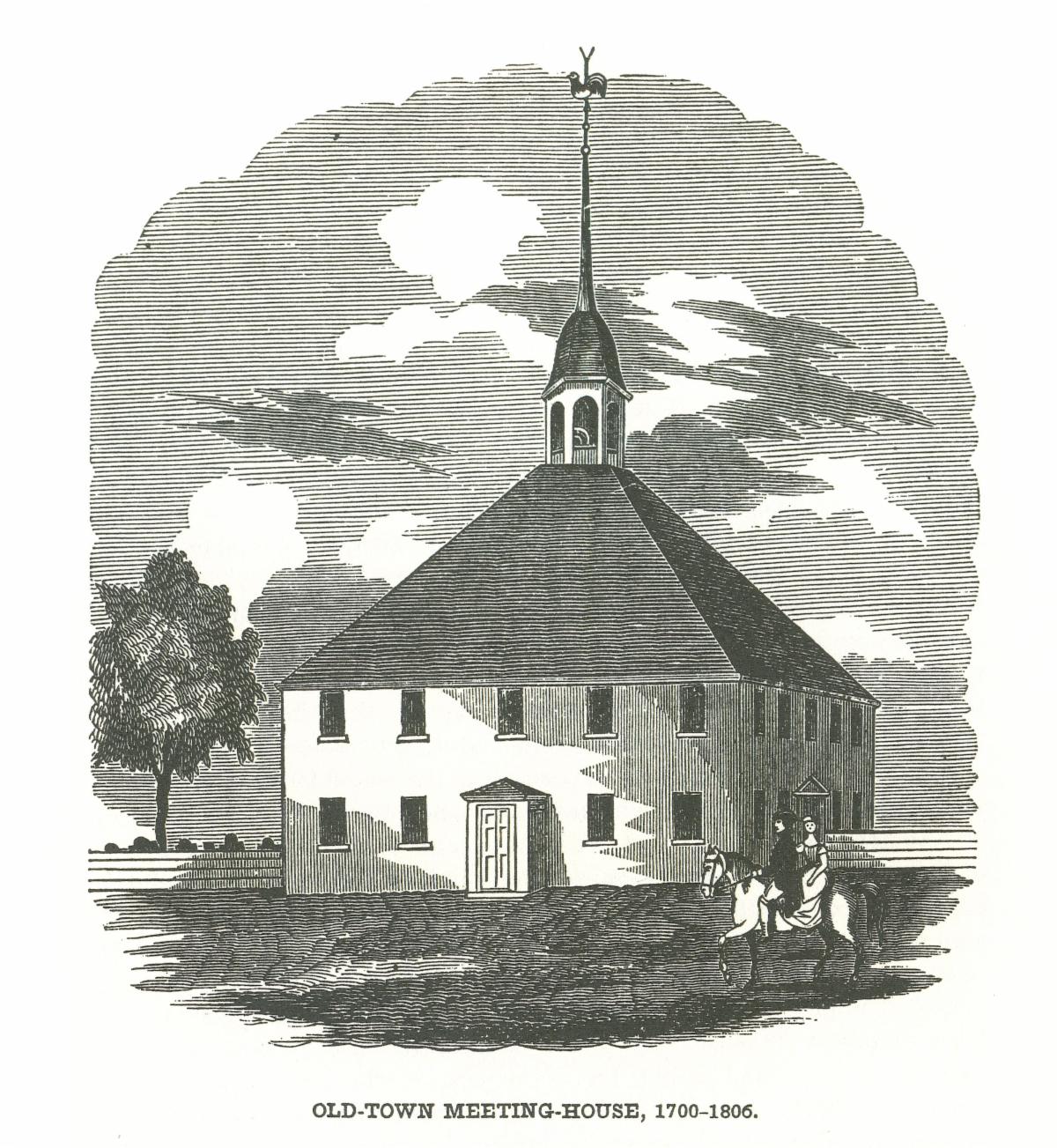
First Parish Meeting House, Newbury, Mass. (Image from "The History of Newburyport, Mass., 1764-1905" by John J. Currier.) |
|
Woman on the MOON
How to Sleep Like a Puritan...a blog by Bethany Groff Dorau
I have fond memories of the one time in my life when I slept exactly the way my body dictated, unfettered from the demands of the clock. It was *ahem* nearly thirty years ago and I was in college, living at UMass Amherst. One semester, all my first classes were at 1 p.m., and I slept from 1 a.m. to 10 a.m., unbroken, every single night. And when I woke up, I lay in bed for half an hour and had myself a think. There was no cell phone to beep and honk and chime at me.
There was no laptop. I had a Brother word processor on my desk and time to wake up slowly. I also had a king size bed all to myself, resulting from the gift of a second twin bed from the room down the hall, whose occupants, through a series of swaps and bribes, had managed to set up a forbidden co-ed living arrangement. They preferred the romantic entanglement of a shared twin bed. Ah, youth. That sounds like the third circle of hell to my middle-aged self.
I was a resident assistant. Don’t laugh. I was a darn good one, too, intervening in the lives of the proto-adults around me only in cases of danger or extreme slovenliness. My door read “Bethany Uhlig, General Secretary of the Butterfield Semi-Autonomous Collective.” I saved my money to buy a king-size featherbed, egg crate foam toppers, down comforters.
|
|
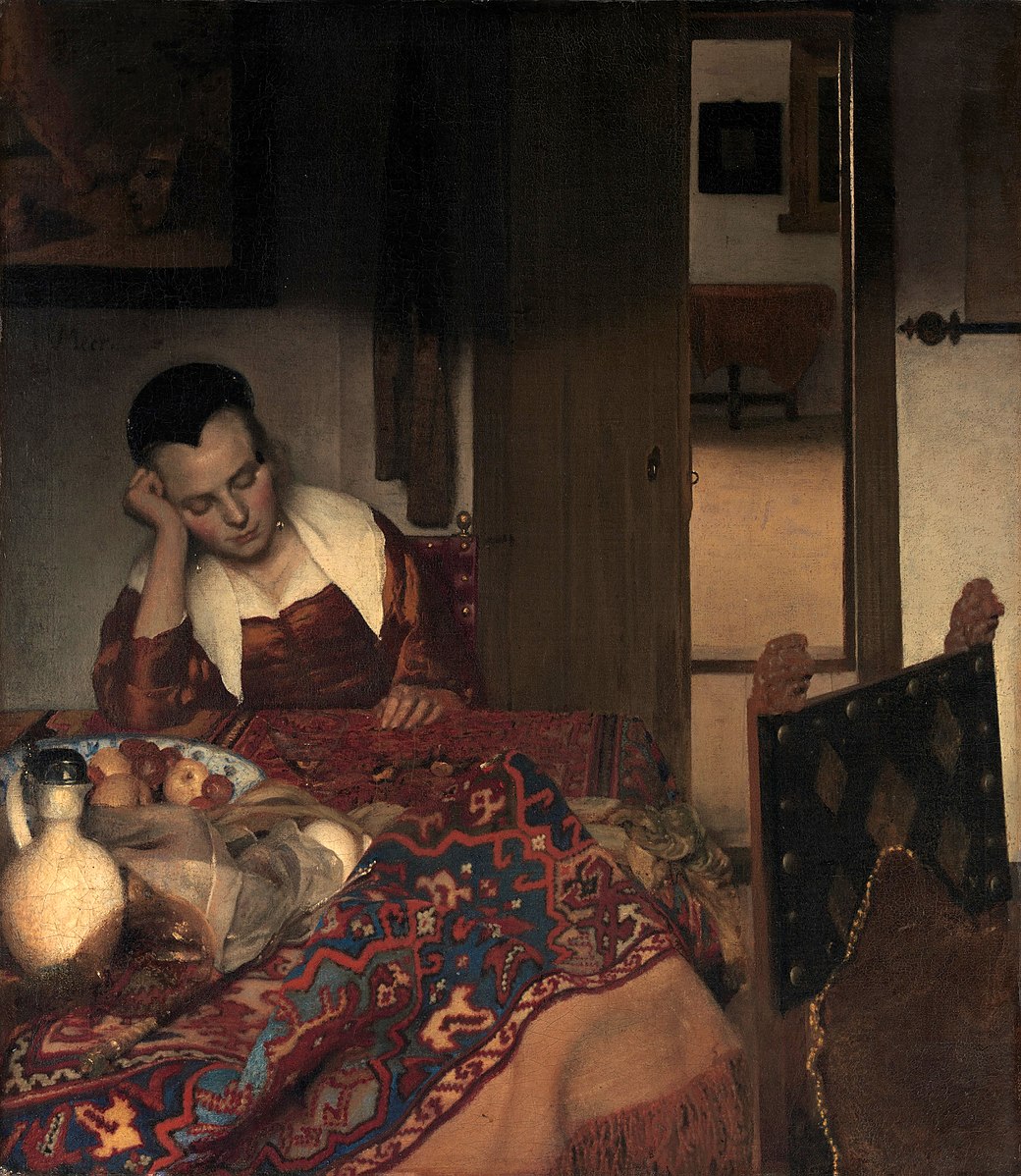
A Woman Asleep, Johannes Vermeer (1632-1675). Oil on canvas. (Courtesy photo.) |
|
And what, you may ask, has this to do with history? Well, first, as I lie awake at 3:00 a.m., making endless lists in my head, I ponder those halcyon days of nine unbroken hours of sleep, and I remember two things simultaneously. First, Colonial New Englanders did not sleep like we do today, and second, on Saturday nights in Butterfield, I slept like a Puritan.
This could spin out over hours, and indeed, if you corner me at a cocktail party and ask me about lighting, time and sleep, be prepared to stay for a while. The essence of it is this: here in Newbury in the 17th and 18th centuries, there was darkness, real, true, no-Haverhill-lights-on-the-horizon darkness, and silence. To fight this darkness there was a limited arsenal of weapons such as candles, rushlights (plant stems dipped in grease or tar) and oil lamps. Light was inefficient, labor intensive and expensive, so most people went to bed when it got dark and got up when it was light. In communities where houses clustered close together and portable flame could decimate a community in a matter of hours, curfews (from the French couvre-feu or cover fire) enforced the darkness. Light was everything. Cities were built around it, houses oriented to it.
In August in New England there are ten hours of darkness. It is dark for fifteen hours in December. Even the hardest-working Newbury residents did not need quite that much sleep. So what did they do? They got up halfway through the night, had a pee, stoked the fire, went for a walk to smoke a pipe with a neighbor. If there was a full moon, they might do some work, have a drink, run errands, even slaughter some hogs. From 1641, “…after the sow was killed..he killed another for (Goodwife) Goody Chaffy which had a spot in the skin; and another for himself. Mr. Kayne would have his killed at midnight.”
Ever wonder how so many babies were made in the crowded chambers of the 17th century? We have the hours between “first” and “full” bedtime to thank, in part, for the bit of privacy afforded couples while children slept.
Of course, the night was also the perfect time for illicit liaisons, theft and tomfoolery of all sorts. In 1662, in the records, a notorious seduction case involving two doctors and a plethora of potential partners, the following appears, “Dr. Cordwing, being at Hampton at …Goodman Tuck's and Mr. Greenland being also present, it being near midnight or full bedtime, said Cordwing desired deponent to go and get Mary Wedgwood, saying she was the prettiest maid in town, and if she would not come to get Sarah Tayler or Mary Wall, as he had a letter in his pocket for the latter.” It was a young Newbury wife, Mary Rolfe, who succumbed to the charms of Drs. Cordwing and Greenland in the end.
The scene of the seduction is interesting to me, not so much for the actual act, which involved Dr. Greenland whipping off his clothes and jumping into bed with Mary Rolfe, who then shrieked and pretended to faint, but because of how they were discovered. It was January 1663, and there must have been a full moon because Henry Lesenby, a servant of about eighteen, is out doing his master’s business at “eleven or twelve o'clock at night,” when he “heard a shriek so I went straight into the house. I asked Goody Rolfe what was the matter and she said nothing, but I went to the bedside because I thought there was somebody there.”
Dr. Greenland had been let into the house late at night to leap in bed with Mary Rolfe by requesting that he be let in to smoke a pipe with her and her friend, a perfectly routine nocturnal activity.
And what has this to do with a dorm room at UMass? On Saturday nights, my door was open from 3:00 to 4:00 a.m. I would wake up and put in a movie, and all the stragglers, the still-ups and the romantically disappointed, the inebriated, homesick and lonely would pile into my room, sprawled on the floor, on the bed, draped over chairs, and we would spend a delicious hour in peaceful company until one by one, they all trundled off to bed. I remember this hour as a beautiful part of my life, this half-asleep gathering of those in need of comfort and company.
As ruled by the clock as we are these days, I do not expect that this is a tradition I will revive, but as I write this in the wee hours, I like to think of you, the moonlight wanderers, the late-night ponderers, sipping your tea or reading your book as the stars shine over Old Newbury, as they have since time out of mind.
|
|
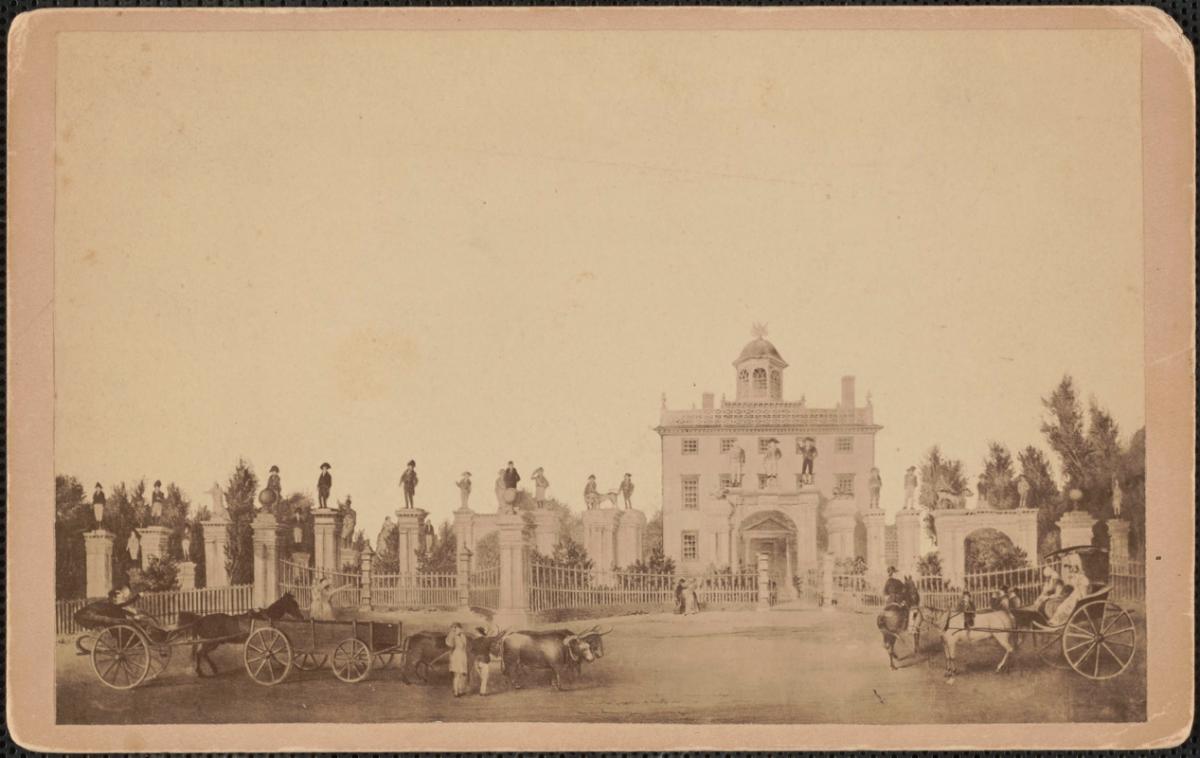
This cartes de visite, French for calling card and popular in the mid-19th century, of Lord Timothy Dexter's home, complete with all the carved wooden statues on their pedestals, is an albumen print from S.C. Reed, Photographer, 4 Pleasant Street, Newburyport, Mass. It is typical of the quality and remarkableness of the Snow Collection. From the collections of the Museum of Old Newbury. |
|
Public invited to Memorial Service of long-time supporter & board member Christopher Snow, tomorrow, Saturday, Aug. 28
For a man who spent decades assembling a collection of approximately 2,000 photographs, glass plate negatives and photo albums chronicling Newbury and Newburyport history for over a century, finding an image of him is a challenge. Chris was born in 1942 in Boston and at the age 13, began a mail-order business of World War II memorabilia. Even then it was his keen eye for finding vintage images in their original state that defined him.
He began volunteering at the Historical Society of Old Newbury (now the Museum of Old Newbury or MOON) at age 15. His father, Kenneth E. Snow, was an antique dealer and long-time board member of the museum, and friends remember that the Cushing House, to which the Historical Society moved in 1955, was a constant presence in his life. Snow was involved in the museum for most of his life, hosting fundraising auctions, meeting with other dealers and collectors to ensure that the best items with Newbury provenance would return to their hometown, and serving on the board of directors and executive board for decades.
In the summer of 2014, the museum acquired Snow's extensive collection of photographs, for which he is perhaps best known today. All aspects of Newbury-area history are represented including local landmarks, streetscapes, waterfront and maritime views, clubs and organizations, parades, fires, school portraits, churches, public buildings, military events and rural landscapes. Images from the Snow Collection can be found on social media in the Sepia Sunday feature (click on your favorite social media channel to follow: Facebook, Instagram, Twitter).
Museum volunteers worked for two years sorting and identifying the photographs and providing metadata. The museum retains the originals, but the Snow Collection is digitized for easy access and enjoyment through Digital Commonwealth (click here to view).
The Museum of Old Newbury sends their deepest respect and thanks to the Snow family. Please join the family for the Memorial Service for Christopher Snow, Saturday August 28, 2021 @ 3:00 p.m. at the Universalist Unitarian Church, 26 Pleasant Street, Newburyport.
|
|
Learn about upcoming programs, register, find Zoom links and catch up on previous presentations here. All of our virtual programs are free, however donations are gratefully accepted to help defray speaker fees.
|
|
You're Invited: Wednesday, September 8, 2021 |
|
Catch up with old friends while checking out the museum's newest acquisitions and executive director.
Museum of Old Newbury Annual Meeting
Wednesday, Sept. 8, 2021
6:30 p.m. | Refreshments
7:00 p.m. | Meeting
7:30 p.m. | What’s New @ the MOON
Space is limited, please reserve your spot now. Click here.
This is a free event for members only. Not a member? Become one here.
Donations are accepted and can be made here.
|
|
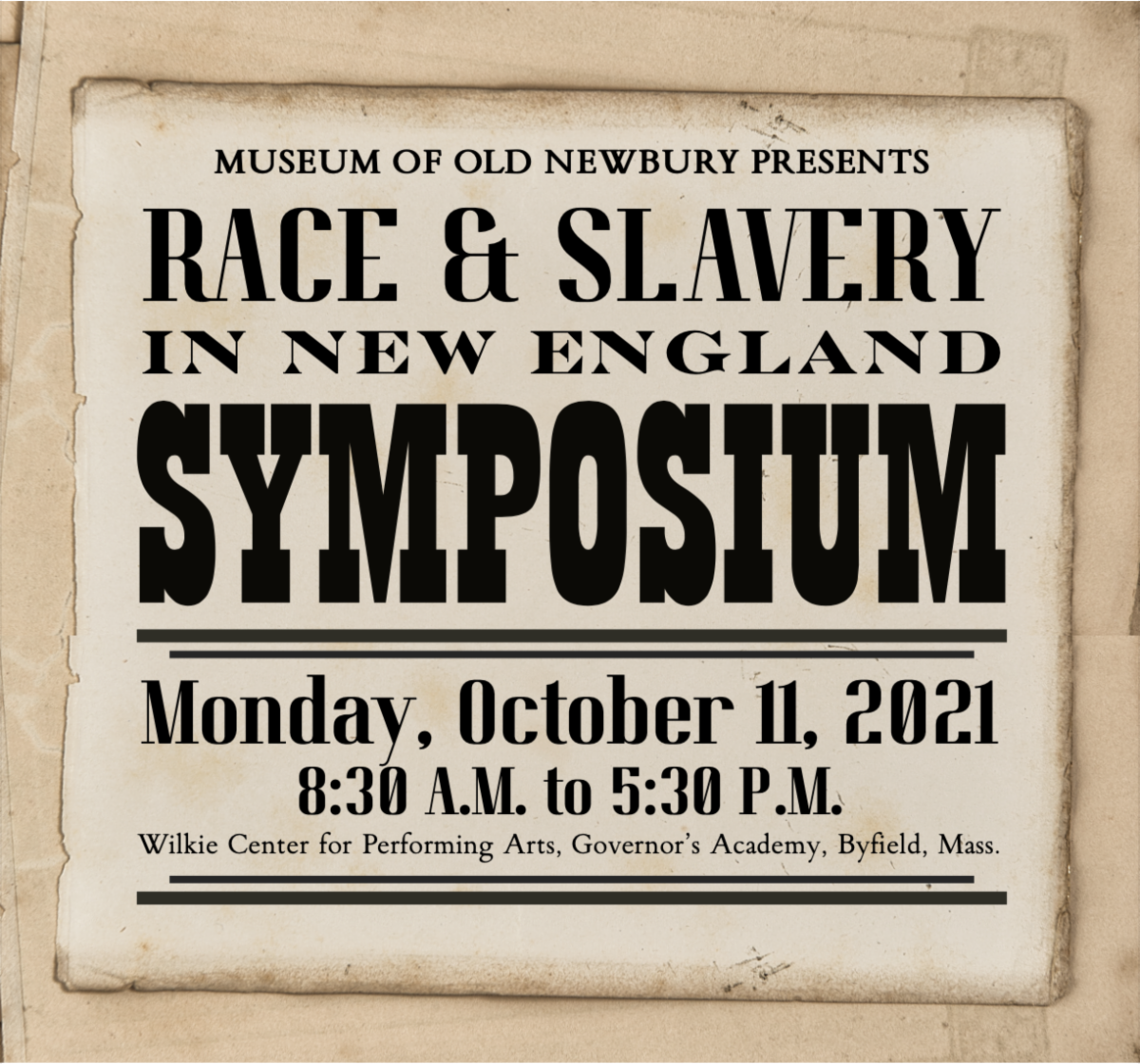
Save the Date: Monday, October 11, 2021 |
|
Scholars and historians scheduled to present include:
-
Manisha Sinha, Draper Chair in American History at the University of Connecticut;
-
John Stauffer, Sumner R. & Marshall S. Kates Professor of English and of African and African American Studies at Harvard;
-
Kabria Baumgartner, Dean's Associate Professor of History and Africana Studies at Northeastern University;
-
Allegra di Bonaventura, Associate Director of Graduate Programs at Yale Law School;
-
James DeWolf Perry, Principal Historical Consultant for Traces of the Trade: A Story from the Deep North, former Executive Director at Tracing Center on Histories and Legacies of Slavery; and
-
Keidrick Roy, PhD candidate in American Studies at Harvard University, to name a few.
Made possible by the generous support of The Governor's Academy, Historic New England, Eastern Bank, North of Boston Media Group and Newburyport Bank.
This in-person event requires proof of COVID-19 vaccination (with photo ID) and will follow all masking policies in place as per the Governor Baker's guidelines. Masks will be available at on-site registration.
Registration starting soon. Pricing levels to include Museum of Old Newbury & Historic New England member/non-member, student and optional donations for virtual attendance.
|
|
Puzzle Me This...
Box of Puzzles
Lacquered wood
China
Late 19th century
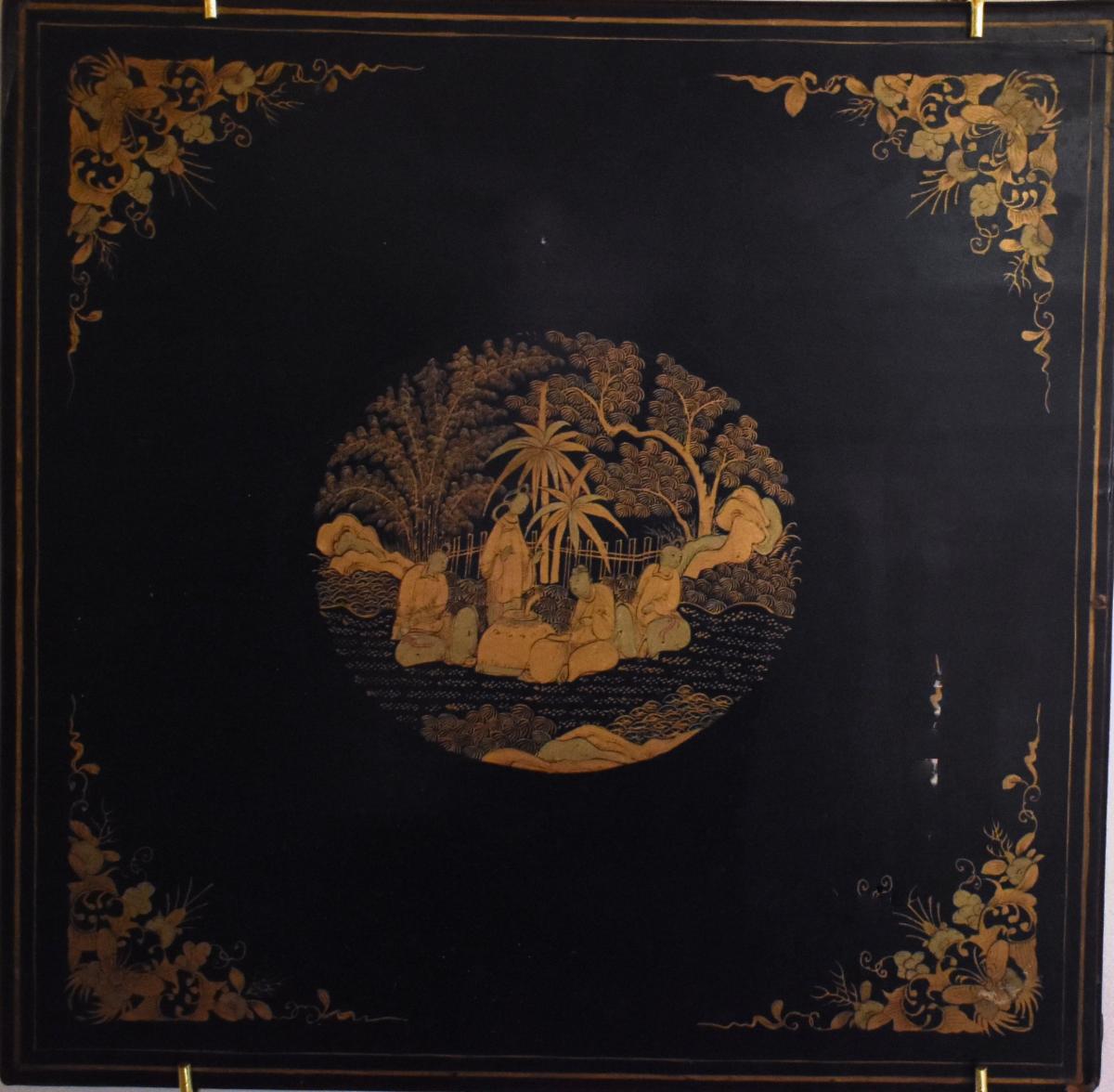
This puzzle box belonged to Sarah Elizabeth Stickney (1831-1916), Captain Frank W. Brown’s second cousin. According to a note inside, the box was given to Sarah by an unnamed ship captain. The captain, perhaps a member of the Brown family, took his wife on a voyage to China, and Sarah took care of their children while the couple was away.
The ivory game pieces inside are carved with intricate designs of dragons, flowers and people. The games include Tangrams, Nine Linked Rings and Interlocking Burr.
From the collections of the Museum of Old Newbury.
Click on image to begin.
|
|
Something is Always Cooking at the Museum
Six ingredients equal a world of flavor is this simple, Thai style dish from "a friend" of the Museum of Old Newbury.
Thai Curry Chicken
1 (14-ounce) can coconut milk
1 to 2 tablespoons green or red curry paste
1 tablespoon brown sugar
2 skinless, boneless chicken breasts, cut into bite-size chunks
1/4 cup bamboo shoots or snow peas
1/2 cup carrots, slivered
Simmer milk, curry paste and brown sugar for 5 minutes. Add chicken; simmer for 10 minutes. Blanch shoots and carrots and add to curry mixture. Simmer 5 minutes. Serve over rice. Serves 4 to 6.
|
|
During this difficult period of COVID-19, we rely on your support more than ever. We continue to develop new, online programs for you to enjoy and keep us connected and look forward to in-person events as protocols for safety loosen. We hope, if you are able, that you will consider a donation to the museum. Thank you for your continued support.
|
|
Museum e-Newsletter made possible through the
generosity of our sponsors:
|
|
|
Museum of Old Newbury
98 High Street
Newburyport, MA 01950
978-462-2681
|
|
|
|
|
|
|
|