Ocean Science to Service Workshop |
|
This month, PacIOOS and NOAA’s Global Ocean Monitoring and Observing (GOMO) were invited to join and co-facilitate an “Ocean Science to Service” workshop in the Federated States of Micronesia (FSM) as part of a growing partnership with the Pacific Community (SPC). The SPC Climate and Oceans Support Program in the Pacific (COSPPAC) led discussions on the fundamentals of early warning systems with FSM partners and colleagues from local weather service offices, Office of Fisheries and Aquaculture (OFA), state government, the Pohnpei Tourism Office, and more. Other workshop topics included local issues and science related to waves, coastal inundation and wave run-up, tides, El Niño, coral bleaching events, and more. The workshop included four days of interactive sessions in Pohnpei and a one-day session in Kosrae.
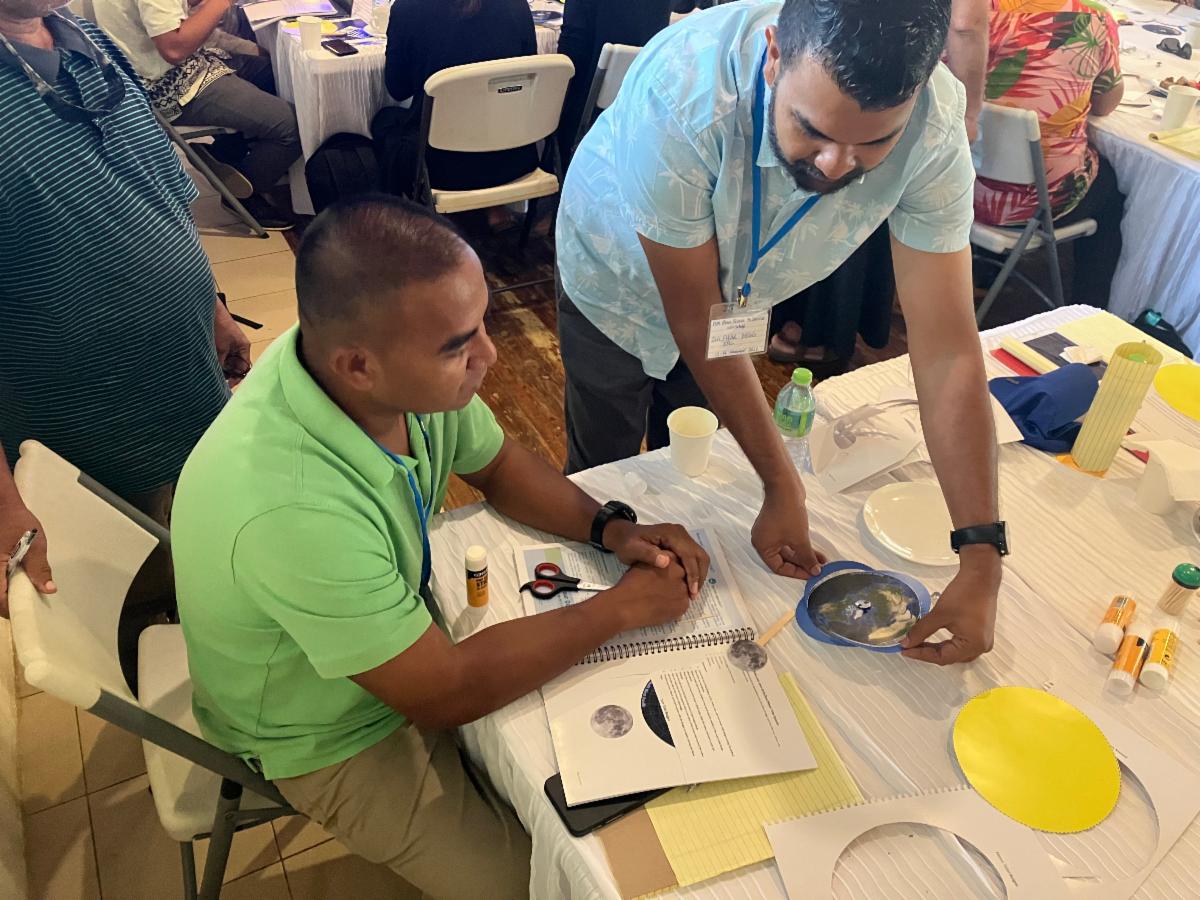
PacIOOS’ participation in the workshop was aimed at bolstering local capacity, strengthening on-the-ground partnerships in the region, and updating local entities about the forthcoming wave buoy deployments planned for Pohnpei, Kosrae, and Yap. The buoys are funded by the US State Department; the Pohnpei buoy will be deployed by PacIOOS and local partners, including OFA and SPC. [Photo: SPC’s Zulfikar Begg helps a workshop participant during an activity on tides]
|
|
Coral Reef Research Foundation Invasive Species Workshop |
|
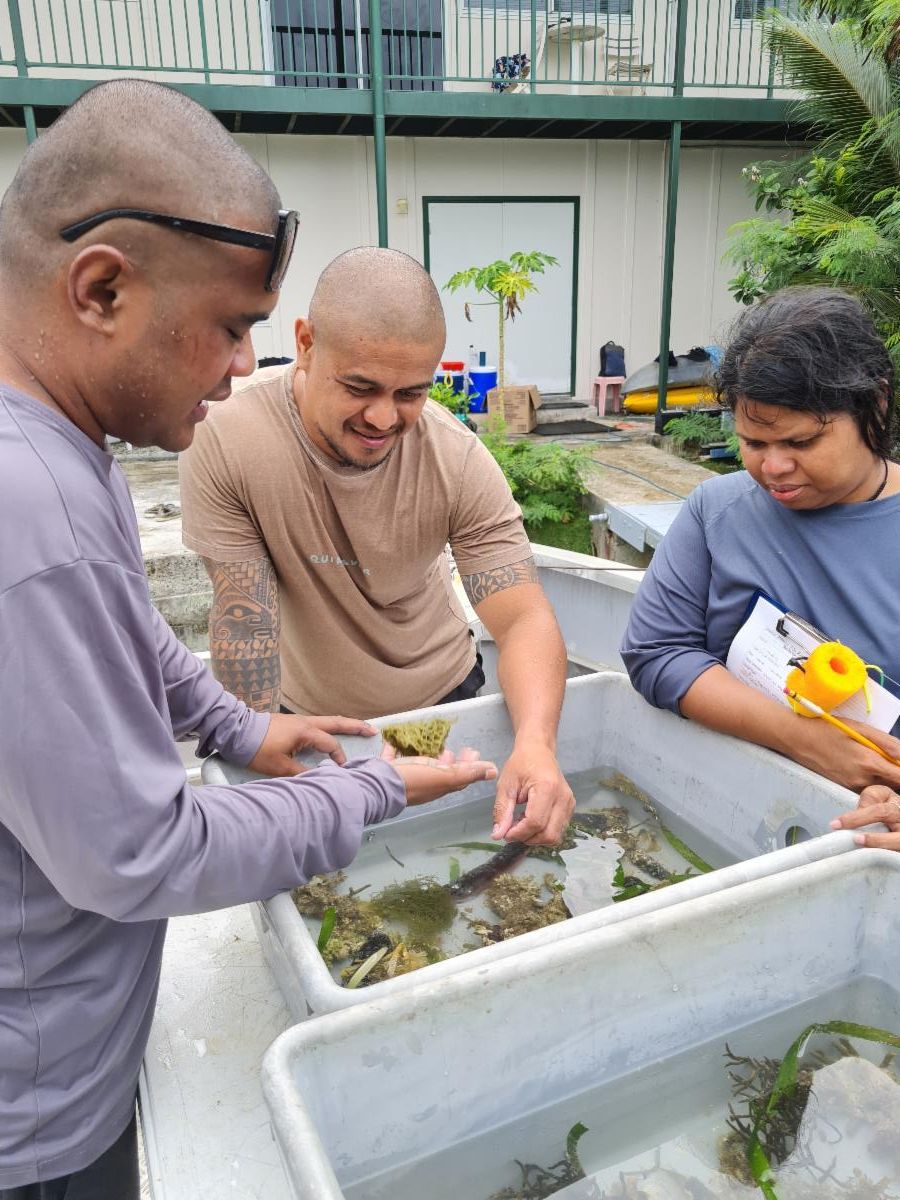
With support from GEF6 and Palau’s Ministry of Agriculture Fisheries and Environment (MAFE), Coral Reef Research Foundation (CRRF) conducted a workshop on marine invertebrates and non-native aquatic species from September 25–29, 2023. Participants from the Bureau of Biosecurity, Bureau of Environment and Island Conservation learned about marine invertebrate and plant classification and identification through a series of lectures, collections in the field and observations of wet and dry samples. After two days of learning about marine invertebrates and plants, the workshop then considered marine non-native species, covering topics such as non-native species recorded in Palau, vectors and pathways, risk assessments and case studies in other countries. To apply what they learned, participants collected samples from mooring lines and floating docks to identify organisms found on these common biofouling substrates. Using SPREP Marine Biosecurity Toolkit, participants learned how to assess incoming vessels for hull biofouling and the steps to take based on the assessments. They also learned about the Top 25 invasive species to be on the watch for in the Pacific. Overall, the workshop was a success as participants learned to identify major invasive groups, such as sponges, sea squirts, hydroids and many more. CRRF hopes to continue the partnerships and train more people from different agencies in Palau. Click here for the Instagram story. [Photo: Biosecurity officers studying collected samples]
|
|
Hawaiʻi Community Tagging Program |
|
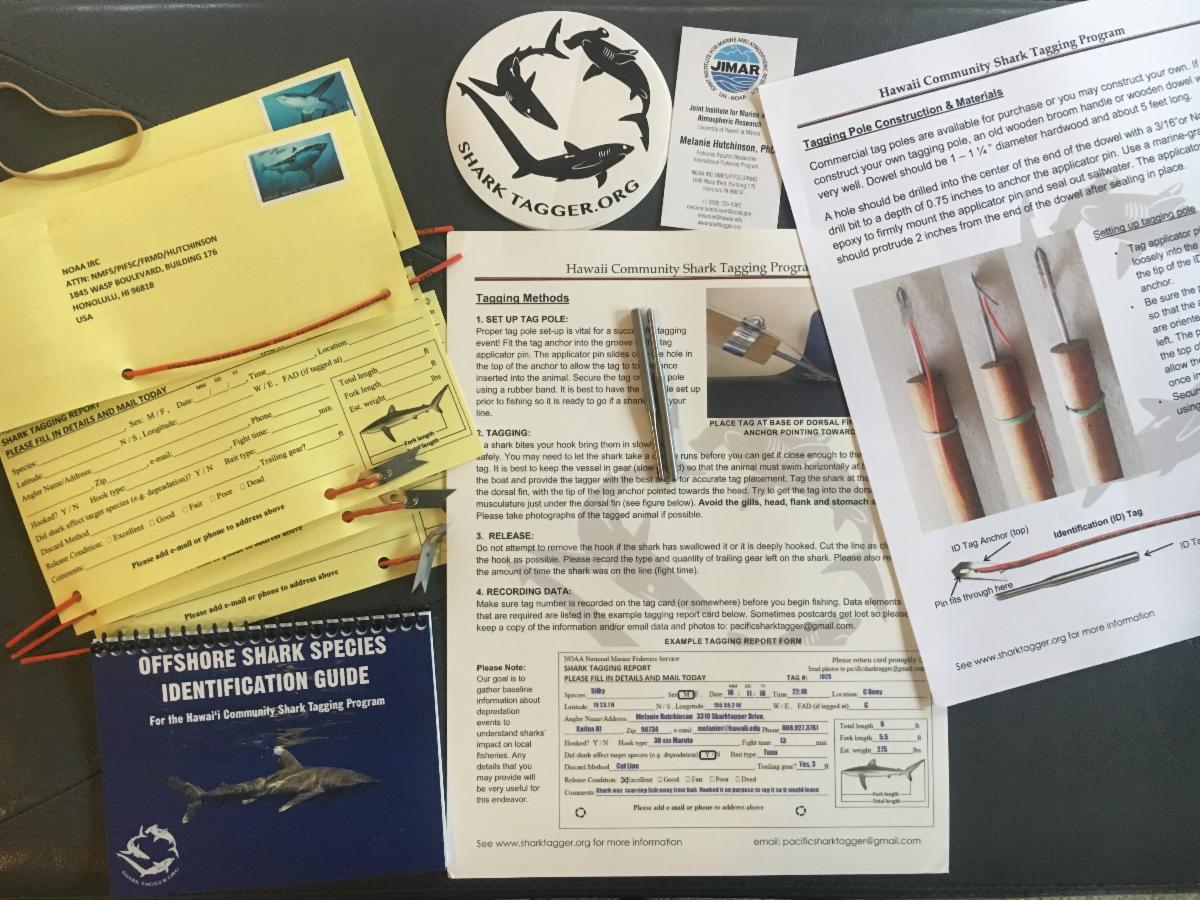
Shark depredation occurs when catches are damaged or removed from fishers' hooks by sharks. Such depredation has negative consequences for both fishers and shark populations across the Pacific Islands region. The Hawaiʻi Community Tagging Program is aimed at understanding and reducing shark depredation rates through an integrated approach to generate data on shark interactions using both electronic and conventional tags. If you are a local fisher and you have issues with shark depredation, the Tagging Program can send you a tagging packet. Each packet contains a shark identification guide, 10 identification (ID) or ‘conventional’ tags, instructions on how to set up a tagging pole, and how to safely tag incidentally caught sharks. These tags provide important information on interactions, re-sightings, growth rates, spatial activity, and whether or not interactions are species-specific or if there are problem individuals exerting influence on the fishery. Fishers also report that tagging is an effective deterrent method and sharks often leave the area after tagging! To request a tagging packet - click this link. [Photo: Contents of tagging packet]
|
|
Meet PacIOOS' New Communications Specialist Nicole Guiles |
|
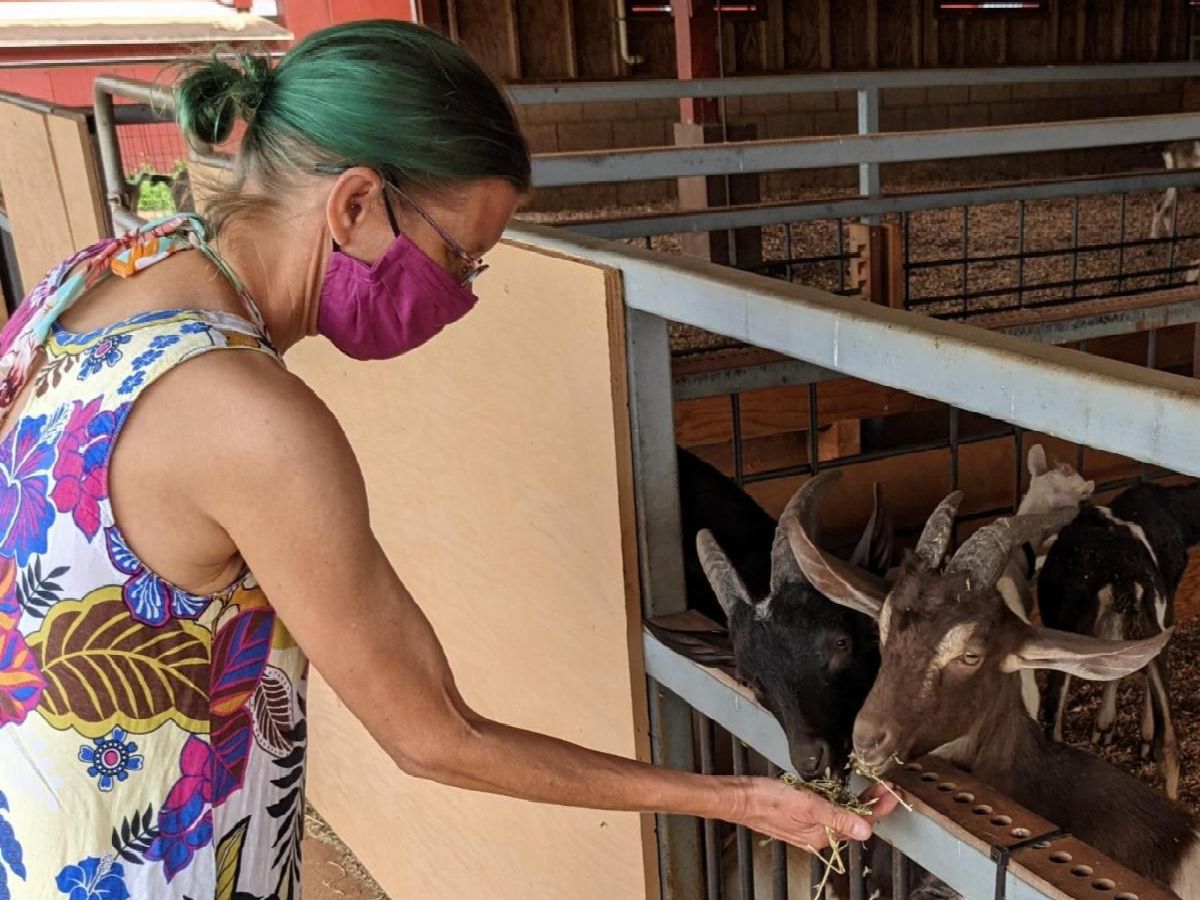
Nicole Guiles joined the PacIOOS team in April 2022 as the Data and Program Assistant, and transitioned into her current role as Communications Specialist in October. She will help improve PacIOOS' communication strategies with stakeholders, partners, and users in the U.S. and Pacific Islands. Nicole earned her Bachelor of Science degree in marine biology from The Evergreen State College in Washington, and moved to Hawaiʻi in 1999. For many years, her focus was on homeschooling her three daughters, and teaching science classes at local homeschool
co-ops. Now that all but one of her kids have graduated from high school, Nicole is excited to get back to her marine roots with PacIOOS! [Photo: At Sweet Land Farms, Oʻahu]
|
|
Meet PacIOOS' New Undergraduate Research Assistant Talofa Fe'a |
|
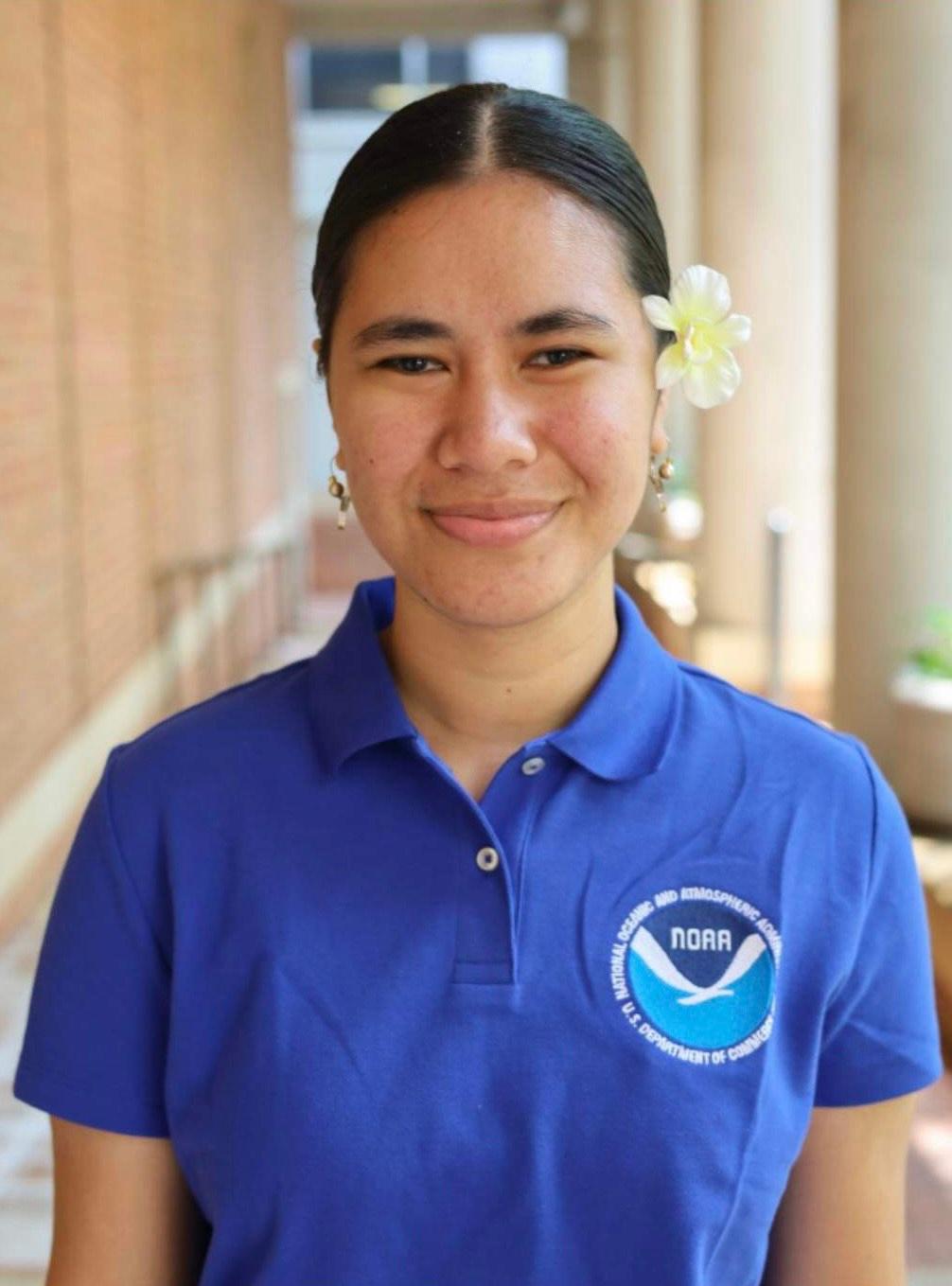
Talofa J. Fe’a recently joined the PacIOOS team as an Undergraduate Research Assistant. Born and raised in Tutuila, American Samoa, Talofa has a strong passion for conservation and environmental protection. As a tama’ita’i Sāmoa in STEM, she hopes to use her interests in resource management and research to amplify Indigenous knowledge and advance the needs of Oceania. She received an Associate of Science in Natural Resources from the American Samoa Community College in Fall 2022. Now, she is enrolled in the Natural Resources and Environmental Management Program at the University of Hawaiʻi at Mānoa for her bachelor studies. Talofa is excited to learn from PacIOOS scientists (like her supervisor, Dr. Eileen Nalley) who share the same hope as she does – to help leverage Pasefika voices and advance the needs of Pacific Island communities through research and education. She will be helping with the Pacific Ciguatera Network initiative. [Photo: NOAA EPP/MSI Program]
|
|
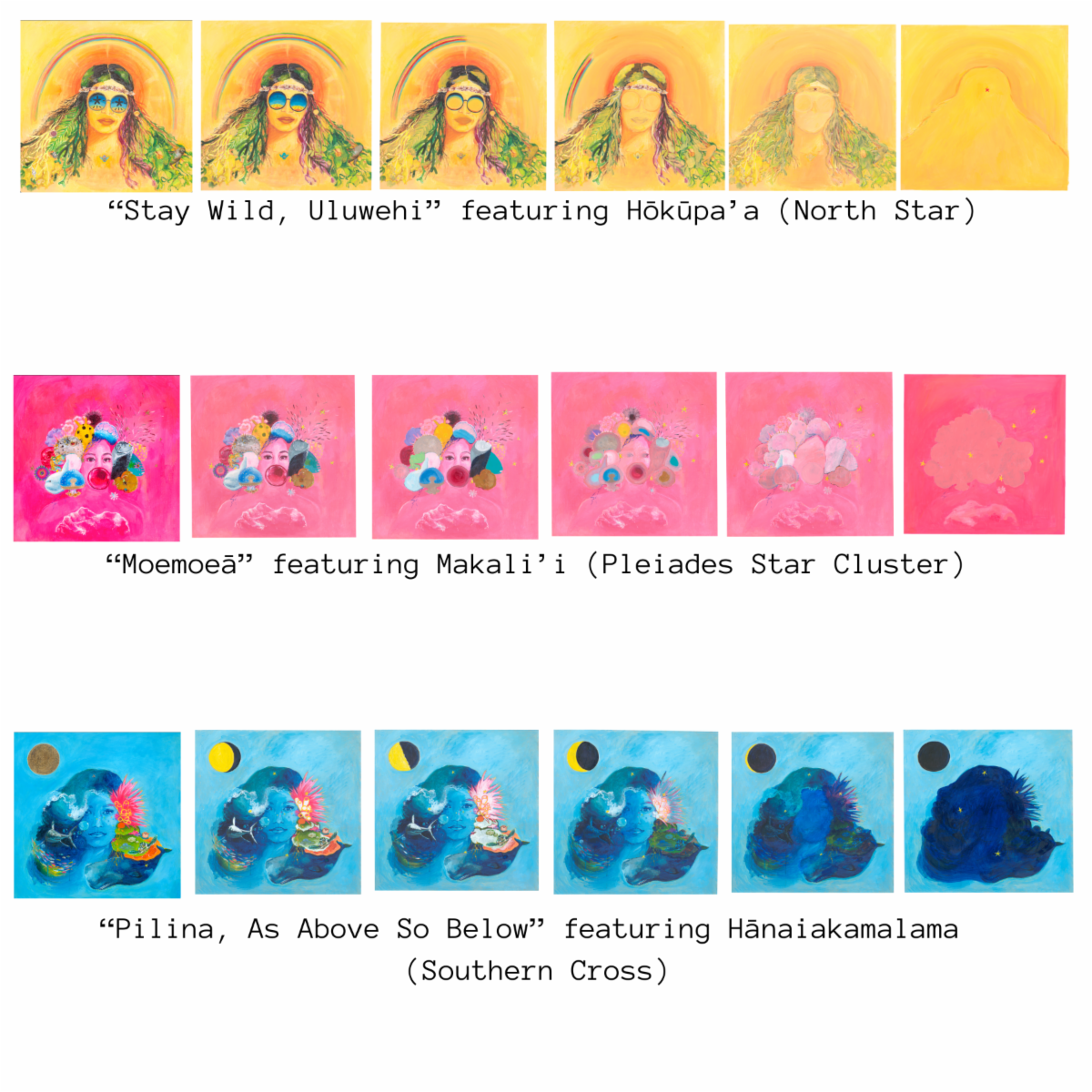
On October 25, 2023, artist Jana Ireijo launched her environmental-focused NFT collection: “Vanishing Murals: Hawaiʻi Ocean.” By intelligently converging art, technology, science, and environmental advocacy, this project illustrates a new frontier of interactive art and the implications of rising temperatures for our coral reefs. Jana started by hand painting six layers of each artwork. The layers “vanish” into constellations and the stars that guide us. Even as hope fades, we are reminded of the power of collaboration and the resiliency of nature if we give it a chance. Using cutting-edge blockchain technology, project developer Inoa.ai assigned each layer an ocean temperature range using data pulled every 12 hours from the PacIOOS website. When water temperatures start to rise, the NFT fades, and when the temperatures move back to optimal levels, the image reappears. Advising on the environmental data were University of Hawaiʻi at Manoa PhD Candidates in Marine Biology, Mollie Asbury and Erika Cabell. This collection supports the work of Fish Pono-Save Our Reefs. A donation of $4500 (20% of each NFT sold) was made to their public education campaign to help share the message that by living pono, in balance with nature, we will ensure healthy reefs, abundant with life for our future ʻohana. [Image: A set of Jana Ireijoʻs Vanishing Murals]
|
|
|
|
|
|
|