|
|
Systems Science August 2026 Newsletter
|
|
|
|
|
Dear Systems Science SIG members,
|
Welcome to the August 2026 newsletter! In this newsletter you will read more about:
|
| • | … a recap of the ISBNPA conference in Cádiz, written by James Nobles
|
|
| • | … updates related to Systems Science
|
|
|
Systems Science @ ISBNPA 2026
by James Noble
|
|
|
|
|
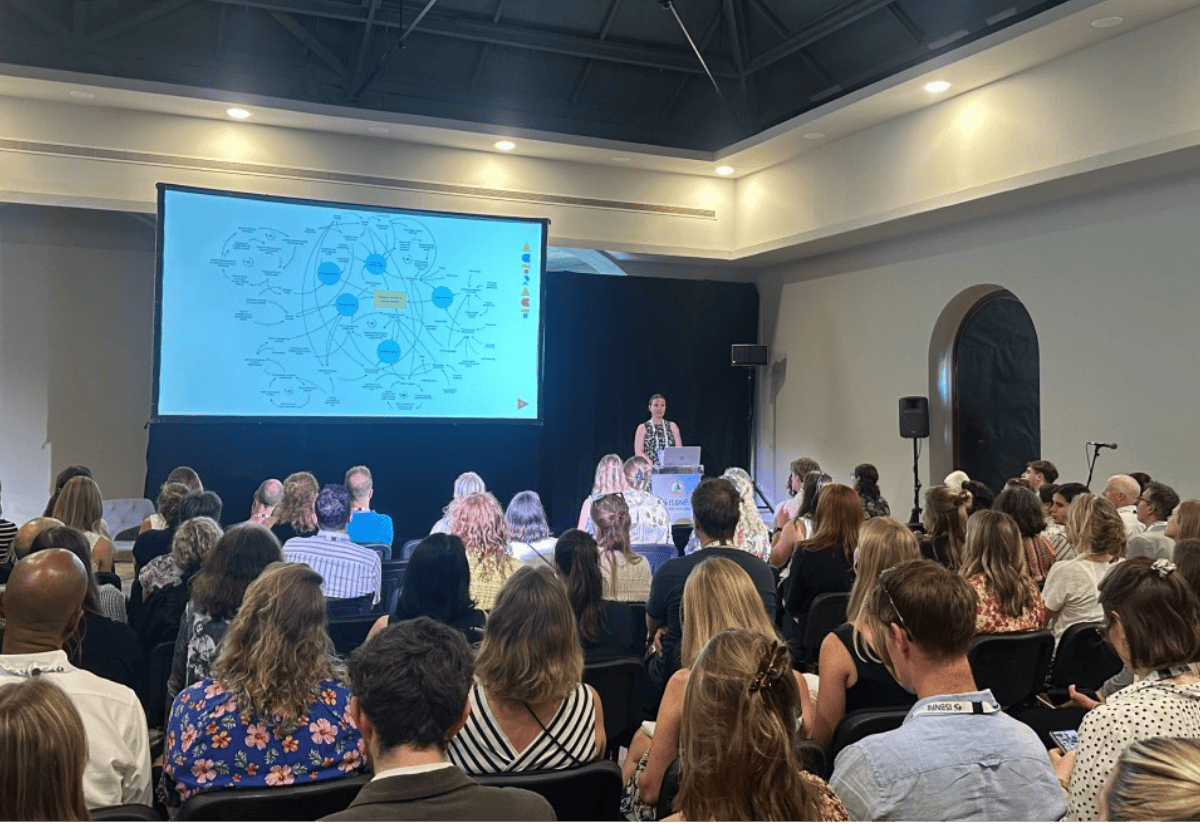
Systems science was in abundance at this year’s ISBNPA conference in Cadiz: more than 30 talks, several symposia, and countless posters. Every session with a packed room. Taking a step back though, what were the common messages? How can we keep progressing the field, and do so in a co-ordinated fashion?
|
|
| | |
|
|
These are some of my reflections from sitting in on most of the talks, having a lot of conversations, and spending time mulling things over post-conference. I inevitably will have missed things in this synthesis. Here’s what I’ll try to cover…
|
| 1. | Moving from insight to action
|
|
| 2. | Systems approaches in practice
|
|
| 3. | Innovations in systems science
|
|
| 4. | Opportunities for ISBNPA 2027 in Halifax, Nova Scotia
|
|
Moving from insight to action
|
Going back a few years, both at the conference and to the wider literature, we were seeing systems maps (like causal loop diagrams, fuzzy cognitive maps, and participatory systems maps) aplenty. Whilst these were still present at the ISBNPA conference, the conversation and thinking had shifted. Seldom were maps presented in isolation to illustrate the complexity of a problem, instead they were seen as the starting points for action.
|
This was where things got more interesting. Techniques for identifying potential places to intervene are both growing and becoming more advanced. Perhaps most often discussed was the use of “systems archetypes” – recurring patterns of behaviour we see across diverse settings. For those who haven’t heard or used these archetypes before, there are 8-10 of them frequently used (see Kim, 2000a and 2000b), each of which has suggested “solutions” for how to disrupt the pattern of behaviour.
|
Their appeal is obvious. If we can identify these patterns of behaviour in our own contexts, then we have a set of ready-made intervention ideas for how to act systemically. If we take a causal loop diagram to a room of policy makers and ask them to identify places to intervene, the chances are you’ll struggle. Take a system archetype to the same meeting, tell a story around the said archetype and remove the systems jargon, and we might have a more productive conversation.
|
What was less apparent to me from the talks was how we can either develop or identify archetypes. In our own work, we’ve used AI to support this process, but I’d be really keen to learn more from others on this. For more information on those presenting archetypes at ISBNPA, see Jillian O'Mara (paper published here), Loes Crielaard (paper in development), and Maxime van den Heuvel (paper in development), and Fleur Heuvelman (paper in development).
|
Our work on QSEM (the Qualitative Systems Exploration Model) also sits within this theme. QSEM asks stakeholders to assign three scores all relationships within a CLD; impact (how much impact does A have on B), control (to what extent can we, as stakeholders, control the impact of A on B), and time delay (how long till we see an impact of A on B). Based on these scores, the QSEM software (see here) will categorise factors based on their degree of influence in the system. The higher the influence, the more closely you might want to consider the factor for action.
|
And lastly, we saw a couple of examples this year of agent-based modelling being used to inform the design of interventions within complex adaptive systems. Shari Barkin walked through the ACTIVE ABM which was grounded in the data from the GROW (Growing Right onto Wellness) RCT. This was a really nice example of how ABM can help decision makers to appraise intervention options, and identify the potential cumulative effects of several simultaneous interventions. Further info here.
|
Systems approaches in practice
|
There’s systems methods like ABM, group-model building, and system dynamics modelling, and then there’s interventional “systems approaches”. Language was mixed on what to actually call them, from whole-of-systems approaches, to place-based systemic approaches, to systemic approaches. They all however shared common characteristics: systems science being used to bring diverse stakeholders together, to understand the complexity of a problem and its underlying root causes, and to identify systemic intervention options.
|
There were some great examples presented throughout the conference, including the Child Co-op (Denmark), the Mandala project (UK), Catalysing Communities (USA), YoPA (international), Minding the Gap (Netherlands), Thriving Teens (Netherlands), and the Sport England Place Partnership (UK).
|
Digging deeper, a few common patterns and questions emerged…
|
| • | Do we need to develop causal loop diagrams from scratch every time? There are potentially significant opportunity costs in bringing stakeholders into a group-model building session. Five years ago there were less pre-existing system maps available. Now, there are lots. We’ve also got AI. Could / should we develop base maps which we contextualise through group-model building, and use the surplus time to think about intervening in systems?
|
|
| • | How do we help stakeholders to work systemically? Whilst lots of the approaches used group-model building to help stakeholders to understand the complexity surrounding their problem of interest, many of the actions were short-term or surface level. Frameworks like the Intervention Level Framework, Action Scales Model, or Water of Systems Change were often applied as analytic lenses after the fact rather than to help stakeholders think systemically. Systems archetypes and QSEM could be helpful tools here.
|
|
| • | How do we create adaptive and facilitative governance processes for systems approaches? To truly work, a systems approach needs cross-sectoral and organisational investment of time and resource. Traditional governance structures -which favour siloed working, dedicated investment, and simple KPI monitoring – do not align with the ethos of a systems approach. More examples of effective systems governance would be very helpful.
|
|
| • | How do we maintain stakeholder engagement in a systems approach? There’s often a disconnect between traditional public health mindsets and those required for a systems approach. The “sales pitch” for a systems approach must state how this alternative way of working will be more beneficial than that came before it. That therefore requires proxy measures, or indicators of systems change, that offer stakeholders sufficient incentive to remain engaged. More examples for how to keep people engaged, especially within the context of evolving governance structures and cash poor environments, may help advance these conversations.
|
|
Innovations in systems science
|
There were a few nice new tools being shown for the first time this year too:
|
| • | The DISCOVER framework (Smith et al., 2024): A research planning and governance framework to systematically understand complex problems and identify places to intervene. It’s an eight-step process and draws on network analysis, systems mapping, and co-creation. The paper offers an example of its application to a blue space project.
|
|
| • | The System Maturity Matrix (Shearn et al., 2026) which asks stakeholders to appraise their systems approach against nine core conditions and across three areas of action. This tool has been used to gain deep insight to Sport England’s £500m investment in 100 local systems approaches in England.
|
|
| • | System-based theories of change (Wilkinson et al., 2021). This idea was presented by Alexia Sawyer in the context of the Mandala project. Rather than a nice, neat, linear theory of change, a systems-based theory of change pays attention to the complexity and context surrounding an intervention.
|
|
| • | The IMPAcT framework (Petersen et al., 2025) offers a pragmatic process for developing and evaluating a systems approach, incorporating group-model building, the action scales model, an action registry, and ripple effects mapping.
|
|
Thinking about the next ISBNPA
|
As co-chair for the Systems Science Special Interest Group, now is a good time to start thinking about what we could do in the lead up to the 2027 conference in Halifax. The conference has introduced new session formats in recent years, and so we could look to make the most of this. A “Dare2Share” session on the current limits of systems science in the ISBNPA remit? Pre-conference workshops on specific systems science methods? More oral presentations and symposia aiming to overcome / wrestle with the gritty issues facing systems approaches? Social opportunities to connect informally with others applying systems science? Please let us know ☺️
|
| |
Other updates related to Systems Science
|
|
|
|
|
SEN 16 Recap
|
On 22nd April we were delighted to have Jewlya Lynn, Pete Barbrook-Johnson, Jordan White, Melissa Carbrera, and Joshua Hayward present on how AI is being used, or considered, in the context of systems approaches and the associated evaluation. The links to the recording of their talks can be found below:
Talk 1: AI and the Future of Systems Change Practice. Jewlya Lynn, PolicySolve.
Talk 2: Using GenAI to Support Systems Mapping. Peter Barbrook-Johnson, University College London and Jordan White, University of Bristol.
Talk 3: Using Natural Language Processing to simplify and enhance CLD processes. Melissa Carbrera and Joshua Hayward, Deakin University.
|
Click here to access all previous session recordings.
|
RESOURCE
|
The UK Prevention Research Partnership (UKPRP) has developed some tools to support with Systems Thinking and Complex Systems. This work has been led on by Dr Leandro Garcia (Queens University Belfast, UK), Dr Philip Garnett (University of York, UK), and Dr Olumide Adisa (City St George’s, University of London, UK). The tools include two outputs, the first is targeted to funders and focuses on recommendations for the incorporation of systems approaches in prevention research. The second presents the UKPRP-funded consortia’s systems approaches to prevention research report. Both of these resources can be found on the following webpage: Systems thinking and complex systems - UKPRP
|
WHO COLLABORATING CENTRE
|
The WHO Collaborating Centre on Research and Training on Complex Systems and Network Science for NCD Prevention and Control also offers many tools and resources, including a variety on training videos: Capacity Building and Training | QUB
|
| |
|
Babaei Aghbolagh, M., Azizi, F., Asghari, A., Mohamadi, E., Mobinizadeh, M., Mostafavi, H., & Olyaeemanesh, A. (2026). Integrating Multi-Source Qualitative Data Using Causal Loop Diagrams: A Methodological Framework for Developing Systems Thinking. International Journal of Qualitative Methods, 25. https://doi-org/10.1177/16094069261449020
|
Kolosowska, A., Embling, R., Bird, S., Johnson, I., Bishop, J., & Long, S. (2026). Implementation evaluation of a whole systems approach (WSA) to childhood overweight and obesity in local communities: findings from the Children and Families Pilot in Wales, UK. BMC public health, 26(1), 1946. https://doi.org/10.1186/s12889-026-27489-9
|
O’Mara, J., Crielaard, L., Hagenaars, L., Stronks, K., & Waterlander, W. (2026). Using systems archetypes to understand system behaviour and identify leverage points for change in local obesity prevention in The Netherlands. Health promotion international, 41(3). https://doi.org/10.1093/heapro/daag056
|
Rossi, P., Husso, K., & Jalonen, H. (2026). Participatory systems mapping as relational (but not relational enough) method for evaluating complex social phenomena. Public Money & Management, 1-11. https://doi-org./10.1080/09540962.2026.2687779
|
| |
Stay connected!
|
Have you recently published a paper, developed a tool, started a new project, or are you looking for collaborators? Send us a short update for the next newsletter. Please contact Eline (e.m.meuleman@vu.nl) or Naomi (n.depooter@uu.nl).
|
| |
Stay in the loop by following ISBNPA on LinkedIn and Instagram
|
| |