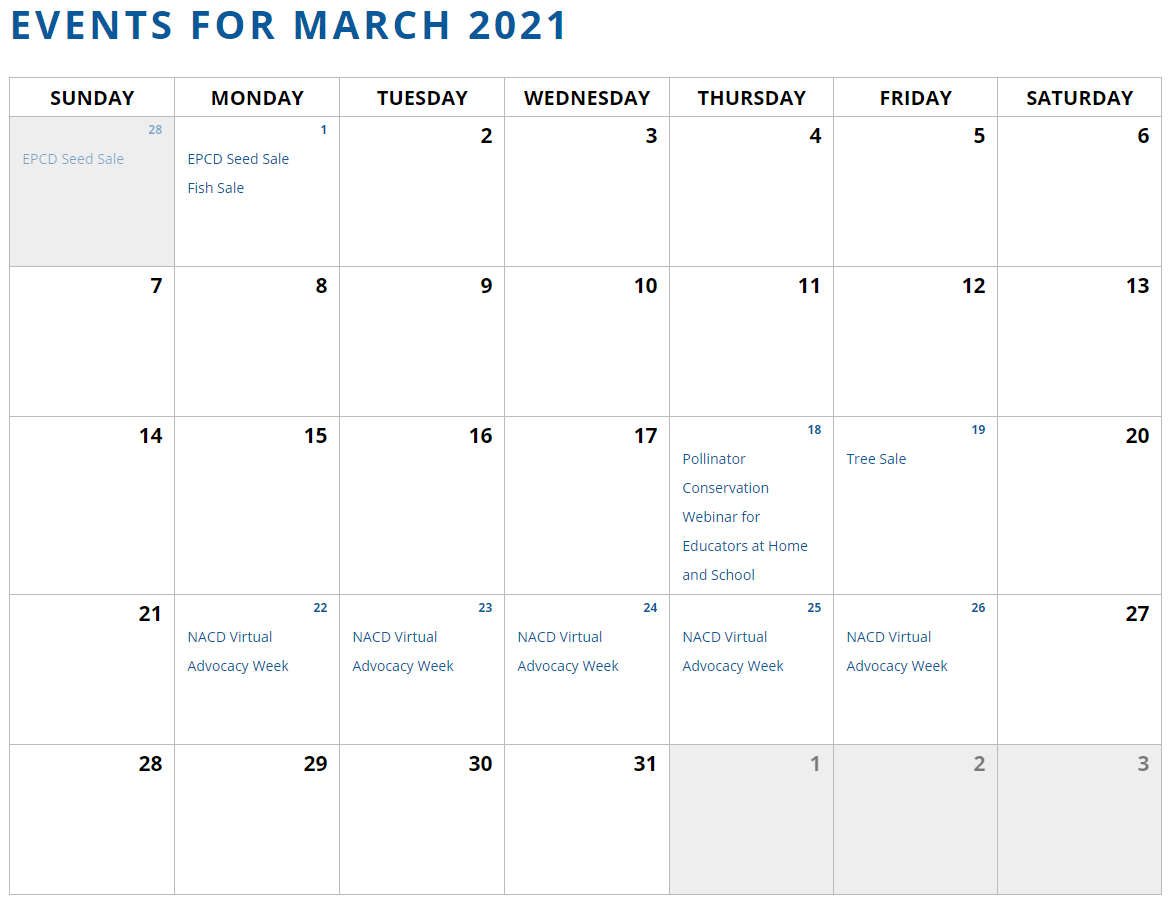
NACD’s Virtual Advocacy Week begins next week! From March 22-26, NACD encourages conservation districts to reach out to their members of Congress and share the needs of locally-led conservation and how they can provide adequate support to districts so that they can continue protecting our nation’s natural resources.
NACD’s Government Affairs team hosted a briefing for members and partners participating in the Virtual Advocacy Week which has been recorded and can be viewed here. This briefing is a substitute for the breakfast briefing we normally host in Washington, D.C., where we review the issue papers and answer any questions that people who are participating in the following week’s meetings may have.
As your state or territory works to schedule meetings, be sure to visit our “Tips and Tricks” document on NACD’s Advocacy Week webpage, where you can also find this year's issue papers .
Please contact NACD Director of Government Affairs Coleman Garrison at coleman-garrison@nacdnet.org if you have any questions about NACD’s Virtual Advocacy Week or if you or need additional information.
|
2021 NACD ANNUAL MEETING RECORDINGS NOW AVAILABLE |
Recordings from NACD's 75th Annual Meeting are now available on NACD's YouTube channel!
|
NACD PRESENTS IN
NEW YORK WATER QUALITY SYMPOSIUM
|
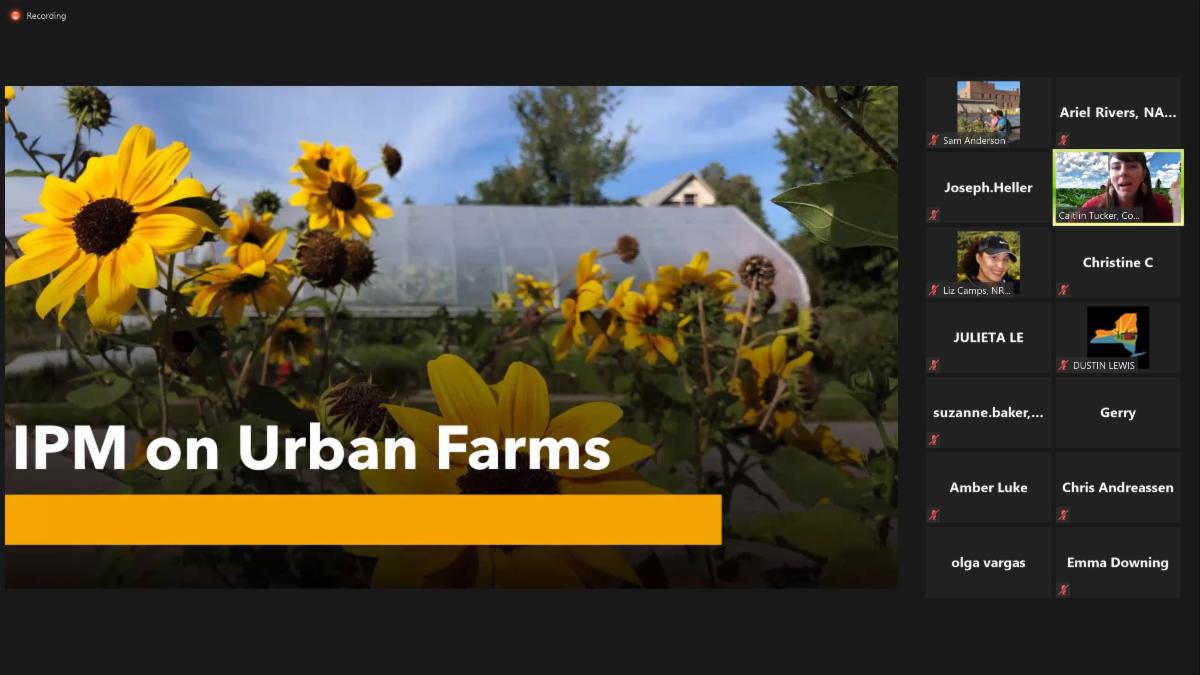
This year, a full day of presentations held on March 10 focused on working effectively with urban and suburban agriculture producers.
Joseph Heller, NRCS urban conservationist for New York, brought together presenters from NRCS Ohio, Cornell Cooperative Extension and Small Farms Program, Rise and Root Farm, and the U.S. Department of Agriculture (USDA) Agricultural Marketing Service. Each presentation detailed specific information helpful to NRCS and conservation district staff, including outreach to historically underserved farmers, accessing financial assistance through USDA programs for urban farms, technical information on soil health, pest management and irrigation for small-scale farmers, and the possibilities for successful operation of commercial urban farms.
Ariel Rivers, NACD’s Pacific Region Representative, shared information on the Urban Agriculture Conservation grants, and three previous grantees also presented on their programs: Prince George’s SCD in Maryland, Thurston CD of Washington and the Northern Rhode Island CD.
Many of the day’s presenters noted the challenges for urban agriculturalists to access capital (land and water), as well as ensuring farmers can use those resources wisely. This common theme indicates the need for conservation districts to provide technical assistance, which NACD’s Urban and Community (UAC) grants can help support.
“The day provided a great opportunity for NRCS and SWCD staff to share opportunities and challenges they have experienced while working with urban and community farmers,” said Heller. “NRCS’s commitment to NACD's UAC program highlights our unique partnership and capacity to better service all aspects of agriculture, especially this new and emerging industry robust with innovations in production.”
|
NACD’S DEI TASK FORCE ON OPEN MEETING LAWS |
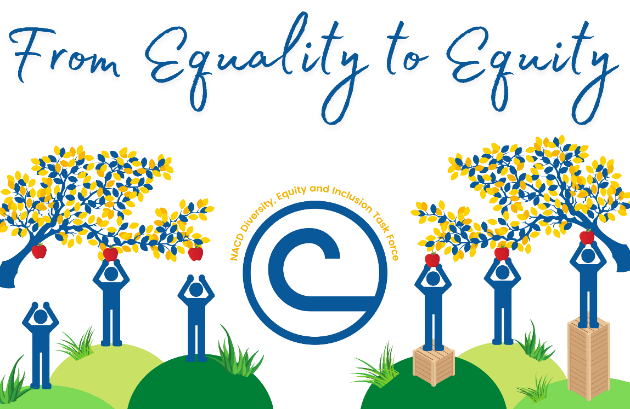
In July 2020, NACD’s Board of Directors produced a statement on diversity, equity and inclusion (DEI), which called for the formation of a DEI Task Force. The Task Force reviewed NACD’s internal governance and examined programs, policies and procedures. Conservation is important to all communities, and to be effective, we must improve our reach into diverse communities and actively engage people and communities that are not normally reached or those who face additional barriers to access services.
The following is an excerpt on Open Meeting Laws from the Task Force’s final report:
Generally speaking, Open Meeting Law is a set of rules to ensure transparency in the deliberations where public policy is discussed. Each state sets its own rules and regulations that public boards must adhere to. As local units of government, conservation district officials are required to follow the guidelines set forth in their state regulations. Open Meeting Law covers topics such as meeting notification, executive session, remote participation, public participation, minutes, etc.
There are a variety of factors to be considered when examining if strict adherence to Open Meeting Law could in fact be limiting meeting access to some members of the local community.
Some of these factors include:
Factors:
- Lack of outreach to underrepresented/underserved communities
- Lack of access to meetings (too far away, inability to access remotely, no phone conference/listening capabilities provided by conservation district)
- Required public notice represents a minimum bar for a conservation district to meet; it may not reach the broader, more diverse community present in a district
- Education/training
- Language – translation of announcements. Special accommodations – translation, interpretation, etc.
|
USDA RELEASES FEDERAL REGISTER NOTICE
ON CLIMATE CRISIS
|
On January 27, President Biden issued an Executive Order titled “Tackling the Climate Crisis at Home and Abroad,” which directed the Secretary of Agriculture to solicit input once again from stakeholders on “how to encourage the voluntary adoption of climate-smart agricultural and forestry practices that decrease wildfire risk fueled by climate change and result in additional, measurable and verifiable carbon reductions and sequestration.”
Yesterday, the U.S. Department of Agriculture (USDA) released a federal register notice to officially begin soliciting this feedback. The input requested is on “how to best use Department of Agriculture programs, funding and financing capacities, and other authorities, and how to encourage the voluntary adoption of climate-smart agricultural and forestry practices that decrease wildfire risk fueled by climate change and result in additional, measurable, and verifiable carbon reductions and sequestration and that source sustainable bioproducts and fuels."
With increased focus on the role agriculture can play in addressing climate change, it is vitally important that USDA receives input from the conservation district community on the ways that districts can help drive this effort. District staff are already involved in promoting climate-smart agriculture and forestry practices, and NACD strongly encourages your state association or individual district to provide comments by the April 15 deadline. Please contact NACD Director of Government Affairs Coleman Garrison at coleman-garrison@nacdnet.org if you have any questions. |
NACD’S GOVERNMENT AFFAIRS UPDATE ON
2021 CONGRESSIONAL CLIMATE HEARINGS
|
With a new administration in the White House and at the U.S. Department of Agriculture (USDA), the conversation on climate change has been moving quickly. President Biden promised to act on climate change and included the agriculture industry in his plans.
Against this backdrop, both the U.S. House and Senate Agriculture Committees have held hearings on the role of agriculture in climate change in the past month. While these hearings were both wide-ranging, they reaffirmed that this is an issue that will continue to get a lot of attention in the next few years.
House Hearing Overview
February’s House Agriculture Committee hearing on climate change featured a broad conversation about both the impact of and mitigation opportunities for climate change. Committee members asked questions about the impact of natural disasters on agriculture; the opportunities for various practice changes – like cover crops, organic production and regenerative agriculture – and the industry’s needs moving forward. Additional research, technical assistance and broadband were all identified as key requirements for success in addressing climate change.
Committee members and witnesses uniformly agreed on and did not debate the science of climate change and the role that agriculture can play in addressing it. The primary point of disagreement centered on the potential solutions for agriculture. Republican members of the Committee raised concerns specifically about proposals for private carbon markets and a USDA-run carbon bank. Carbon markets allow organizations and individuals to buy credits for carbon emissions reductions or carbon sequestration produced elsewhere, such as on a farm. A USDA-run carbon bank could be a central buyer for these credits from farmers, setting standardized protocols and prices.
|
|
NACD Welcomes New Region Representatives |
On Monday, March 15, Aubrey Evans joined NACD as the Northern Plains Region Representative.
Evans comes to NACD from the Riley County Conservation District (RCCD) in Manhattan, Kan., where she served eight years as the district manager. During this time, she held positions with the Kansas Association of Conservation Districts' Employee Organization and the Kansas Envirothon Committee. Before her position with the RCCD, Evans was the district technician for the Leavenworth County Conservation District, a botany technician in Missouri and Idaho, and a wolf researcher in Idaho.
Evans is from a small farm near Leavenworth, Kan., and has a bachelor's degree from Kansas State University in wildlife ecology and conservation biology.
|
Also on Monday, March 15, Rachel Theler joined NACD as the Southwest Region Representative.
Theler comes to NACD from the Colorado State Conservation Board (CSCB), which is part of the Colorado Department of Agriculture. For the past five and a half years, she supported conservation districts in the Southeast and San Luis Valley.
Theler was also the communications coordinator for the CSCB, assisting Colorado's conservation districts with their outreach and communications efforts. Through her service with the CSCB, Theler served as the National Association of State Conservation Agencies (NASCA) representative on the NACD Forestry Resource Policy Group (RPG).
Theler has also worked for the Purgatoire Watershed Partnership in Colorado and the Rocky Mountain Elk Foundation. She holds a bachelor's degree in communication studies from the University of Montana. Born and raised in northwest Montana, she now resides in Buena Vista, Colo., with her husband and three dogs. She can be reached at rachel-theler@nacdnet.org. |
NACD Requests Feedback on
NACD Summer Board Meeting
|
The 2021 Summer Conservation Forum and Tour is scheduled to be held July 24-27, 2021 in Chicago, Ill. With plans to meet in Chicago, NACD is looking to gauge interest in this summer's in-person meeting.
Please indicate your interest on whether you would attend NACD's Summer Meeting in Chicago by taking this quick survey.
|
NRCS Offers CSP Participants Renewal Options |
The Natural Resources Conservation Service (NRCS) is currently accepting applications for CSP contract renewals through March 31, 2021 for the approximately 11,000 CSP contracts that are currently set to expire December 31, 2021. The 2018 Farm Bill made several changes to the CSP program that could benefit producers in a new contract as long as the producer agrees to adopt additional conservation practices on their land above and beyond their current contract requirements. More information can be found here.
Additionally, as required in the 2018 Farm Bill, NRCS has been reviewing conservation practice standards and has published revised practice standards for 23 practices, including cover crops and stream crossings. It is important that conservation districts and state associations review these standards to ensure they continue to work for producers in your community. Comments are due by April 8 and can be found here.
|
2021 REPI Report
to Congress
Now Available
|
The U.S. Department of Defense (DoD)'s Readiness and Environmental Protection Integration (REPI) report is now available online.
The report summarizes and reviews the achievements of the program through fiscal year 2020. In its 18-year lifespan, the REPI program has protected over 757,000 acres at 115 locations in 35 states and territories.
|
NACD Marketplace Offers Special Spring Promotion |
Between March 1–May 1, take advantage of the NACD Marketplace's Spring Promotion for Bass Pro Shops' True Timber Caps.
For only $47.94, you can get six caps of different colors customized with the logo of your choice. The six-panel, low-profile poly design will bring a timeless fit and exceptional durability so you can wear your cap season after season.
Platinum, diamond and gold level NACD members making a single purchase of $100 or more from the Marketplace can benefit from 20 percent, 15 percent and 10 percent discounts, respectively. To learn more about NACD's membership incentives and levels of discounts, please visit NACD's Membership webpage or email us.
|
Promote your conservation district or state association's tree sale, annual meeting, webinar, field day or more on NACD's Calendar of Events!
|
|